April 14th 1865 – 161 yrs ago today the U.S. President Abraham Lincoln was shot by John Wilkes Booth at Ford’s Theatre in Washington, D.C. Did you know that the family of Great Gatsby author, F. Scott Fitzgerald, were implicated in the assassination? This article explores the Confederate ‘ghosts’ in the author’s Civil War closet — the heroes as well as the villains.
In the autumn of 1936, F. Scott Fitzgerald, 46 year-old author of The Great Gatsby, was left with collecting the things from his mother’s apartment at Meridian Mansion in Washington DC. Mollie had died in September that year. Failing health had left Scott with little option but to move her into a sanatorium in Rockville, Maryland, the hometown of his father with its surplus of aunts and cousins who could look in on her from time to time. Mollie and Scott’s father Edward had moved to the capital with Scott’s sister, Annabel in the early 1920s. Initially they had stayed at the Roosevelt Hotel before moving to an apartment at The Highlands Hotel. Sometime in the mid-1920s they took up a permanent place on Sixteenth Street, one of the oldest and most venerable streets in Washington. In their 2022 biography of Sixteenth Street, authors John DeFerrari and Peter Sefton, described it as an enclave of gilded age mansions whose evolution ran parallel to the evolution of American democracy. It did have its fair share of infamy too. On the corner of Sixteenth Street and K Street NW, where the St Regis Hotel stands today, lived the notorious Rose Greenhow. During the devious hurly-burly of the American Civil War, the 50 year-old hostess would tip-off the Confederate army of imminent attacks by Unionists. The house on Sixteenth Street which Greenhow kept plied with diplomats, congressmen, colonels and generals on an almost routine basis, had been operating as a secret listening post.
At the southern extremities of this broad and perfectly straight avenue was Lafayette Square and the White House. DeFerrari and Sefton had subtitled their book about Sixteenth Street ‘Avenue of Ambition’. No other street in America was said to reflect the excessive aspiration of political power quite so profoundly as this one. Known today as ‘The Envoy’ on account of the huge number of ambassadors, diplomats, senators and military personnel who have stayed here over the years, the apartment complex can be found in the Meridian Hill district of the city’s Northwest Quadrant. In the early to mid-19th Century, Sixteenth Street had been identified as part of the White House meridian and at one time there was even talk of using it to challenge its rival in Greenwich, London for control of global time.
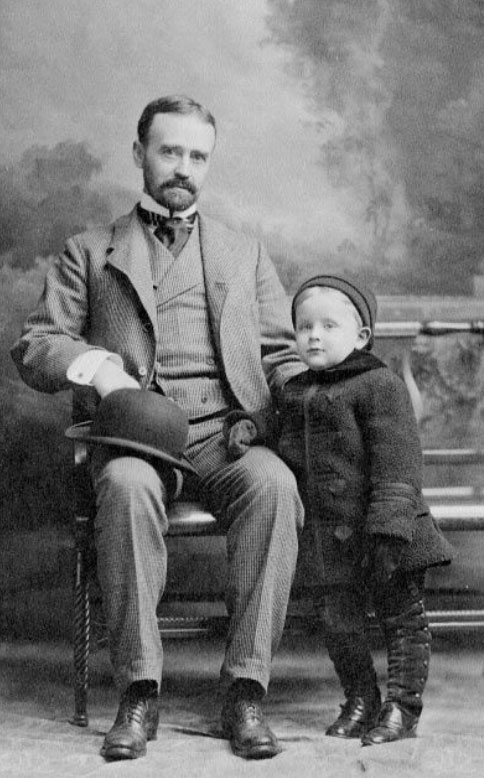
Edward and Mary’s decision to leave Minnesota may have been due in part to the health of Edward’s 97 year-old mother, Cecilia Ashton Scott Fitzgerald, who for several years had been living at P Street NW on the northern banks of the Potomac. After the death of Scott’s grandfather in the 1850s, Cecilia had moved the family from the farm in Rockville, Maryland to Washington D.C. It was through Cecilia’s illustrious and occasionally infamous line of descent that Scott was related to Francis Scott Key, the man who penned the country’s national anthem, The Star Spangled Banner. If an enigmatic reference in Scott’s ledger is anything to go by, there may have been a tradition in the family that like Nick Carraway in Gatsby, his grandmother had claimed descent from Francis Scott, the 2nd Duke of Buccleuch. [1] In a long rambling interview with the New York Evening Post in 1936, Scott would recall the romantic and nostalgic stories his father had told him of helping ferry Confederate spies from one side of the Potomac River to the other during the American Civil War. A slave state which at its farthest extremes straddled the North and South of the country, Maryland had been a place of bitterly divided sympathies. There were those who supported the Confederacy and those who supported the Union. Scott’s family supported the Confederacy. As a result of this, his family had “been mixed-up quite a bit in American history.” In his interview with Michael Mok a few weeks after his mother’s death, Scott spoke about the two extremes of patriotism in his family: Francis Key Scott, raised in triumph like a flag at the beginning of the century and Mary Surratt, hung monstrously in shame in the century’s warring middle years.
Scott wasn’t exactly forthcoming on the details of his genealogy but it’s been possible to put together a vague picture of his family’s links to Mrs Surrat and the Lincoln murder.
Mary Victorine Hunter, the first cousin of Scott’s father, had married John H. Surratt whose mother, Mary Surratt, had been hanged after being charged as an accessory in the assassination of Lincoln in 1865. [2] John, a known associate of Lincoln assassin, John Wilkes Booth, was likewise accused of complicity in Lincoln’s murder but fled to Europe to escape arrest. His own story was the stuff of legend. Two years into the war, Surratt had been recruited into the Confederate Secret Service where he would spend the middle years of the war conveying messages to the boats on the Potomac River using a well-established line of rebel sympathizers in Montgomery County, Maryland — the home of the Fitzgeralds. The last years of his life had seen him carve out a more conventional living as auditor and treasurer of the Bay Line Steam Company and he would eventually die of pneumonia at his home on West Lanvale Street in Baltimore in 1916. The man who provided his Requiem Mass was Reverend James E. Mackin of Saint Paul’s Church in Georgetown, Washington D.C. Mackin had known Surratt since the early days of the war when they had enrolled as young seminarians together at St Charles Seminary in Ellicott City. After entering the priesthood in 1864, Mackin would serve for a time as a priest at St Mary’s Church in Fitzgerald’s hometown of Rockville. [3]
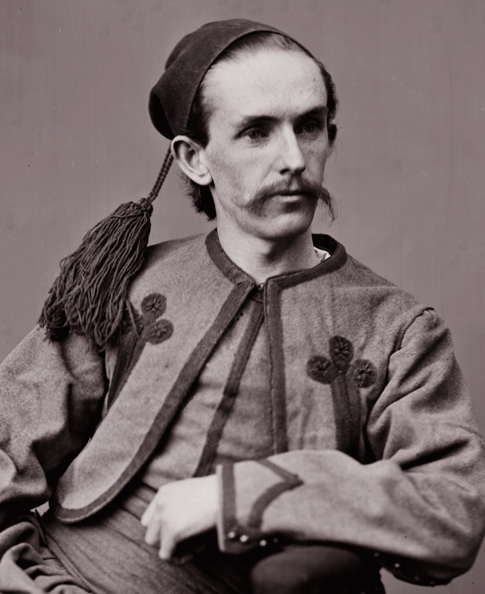
Despite living to a healthy old age, the majority of archive pictures show Surratt as a vain young man of 21, with a long angular face, a showy moustache and a fondness for natty clothes. Among his many adventures was his swashbuckling retreat to Rome to escape arrest, where as a devout Catholic he had enlisted in Pius IX’s Papal Zouave Regiment, the Pope’s foreign legion. That same decade would see the escalation of another civil war when the Pope’s Zouave put a valiant defence against Giuseppe Garibaldi’s Redshirts during his revolutionary bid for independence in Italy. In the eyes of the military leader, the Republican Red Shirt army were up against the same oppressive autocracy that George Washington had been up against with the British. If the anti-clerical rebel, Garibaldi, had his way, the Papal State would be abolished and its territories handed back to the people. [4] In June 1961, the American Consul, James W. Quiggle, is believed to have offered Italy’s Garibaldi leadership of his own platoon in the Union Army during the American Civil War. [5] After the death of Lincoln in April 1865, relations between the White House and the Vatican were thrown into chaos, and the Pope of Rome, anxious to appease America’s new President, Andrew Johnson, came under enormous diplomatic pressure to arrest Surratt, turn him over to Police and return him to the United States to face trial. However, a daring escape saw Surratt make his way to the port of Alexandria on the Mediterranean edge of the Nile River Delta where Egyptian authorities, obliged under an existing extradition treaty with America, gave orders for the 28 year-old suspect to be detained and deported. [6]
In June 1867, Surratt was tried in a civilian court in Washington D.C. The judge, George P. Fisher accepted that he may have played a part in an aborted plot to kidnap and murder Lincoln but found that there was insufficient evidence to prove beyond a reasonable doubt that Surratt had been part of any plans to kill him. The jury, composed of eight men from the Southern states, and four from the North, deliberated for over 72 hours. All eight jurists from the South favoured his acquittal and the four from the North pressed for his conviction. As the jury were unable to agree on his guilt, Surratt was acquitted in August that year. Three years later, Surratt stunned the world with his shock confessions about the plot. His series of lectures, delivered from a courthouse in Rockville, not far from where the Fitzgerald family were living, vividly recalled the evolution of the plot. He had stood in a courtroom before, he joked, just not in the capacity of lecturer. With all the flamboyance of a seasoned entertainer, Surratt regaled his audience with tales about his friend John Wilkes Booth, the Lincoln assassination and his perilous trek across Europe to escape arrest. Since being acquitted, Surratt had taken a job as teacher, first in Rockville and then in nearby North Bethesda. During the course of his lecture, it became evident to everyone that Surratt was proud of the role he’d played in history, making no attempt at all to play down his role in the plot. He cheerfully boasted to having conspired to kidnap the President, whilst maintaining, and not always persuasively, that he had no knowledge of Booth’s more murderous plans. The celebrity assassin was now on tour. Surratt had told an identical story at the Cooper Institute in New York the week before, and would tell the same story in Baltimore a week later. The line between hero and villain was becoming fantastically blurred. America had always had its fair share of feisty Romantic heroes with a spunky disregard for the rules: Jesse James, Billy the Kid, J. E. B. Stuart, Davy Crockett, Benedict Arnold, Alexander Hamilton, Stonewall Jackson. Perhaps thinking of Jay Gatsby, Scott had written in one of his notebooks, “Show me a hero and I’ll write you a tragedy.” [7] He might well have spun it the other way around: “Show me a tragedy and I’ll write you a hero.” In his typically romantic fashion he had stumbled upon the essential difference between reality and melodrama: the line between what made someone a hero and what made them a villain was not always clearly drawn. If the story about Surratt told the young author anything it was that a man could be both. The editor of the Baltimore County Union certainly didn’t think so, he was appalled by what he’d heard at his talk in Rockville; Surratt had been a traitor all along and the news had come from the villain’s own lips. The ‘scoundrel’ had freely admitted that he been led to play a part in the scheme by a sincere desire to assist the South in gaining her independence. For someone who didn’t crave notoriety, Surratt certainly had a wonderful knack of getting it. [8]
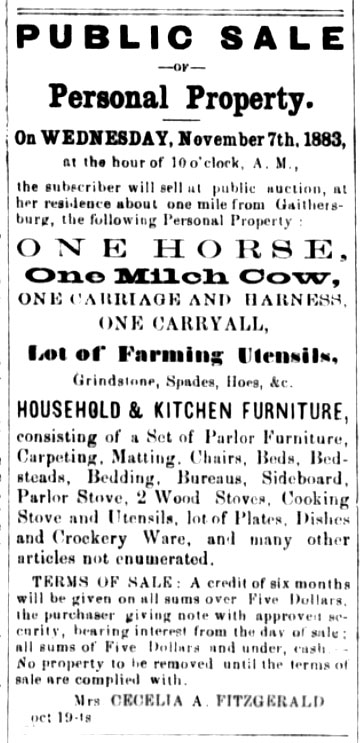
When Scott’s grandmother, Cecilia Fitzgerald, died at the ripe old age of 97 in February 1924, she was buried at Old St Mary’s Church in Rockville, the small town in Maryland where the family had owned their farm. The Washington press described her as the last living descendent of Maryland’s famous Key family and spoke of her tireless association with the Star Spangled Banner. Thankfully for Scott, they made no mention of her notorious nephew-in-law, John Surratt. In 1883, Cecilia had sold the last of the furniture at the family farm near Gaithersburg and relocated to the capital, spending her time between her daughter’s home in Randolph and the university district of Georgetown. Among her busy roster of friends and associates were George Herbert Wells, a Professor at the University and Colonel Charles W. Coombs, an organist at her church and the special messenger of the House of Representatives. [9] After being nominated for the position of Doorkeeper in the late 1870s, Coombs would go on to become one of the Capitol’s longest serving officials. Shortly after the inauguration of President Woodrow Wilson in March 1917, the Washington Times published an article celebrating his 41 years of service. This was, they said, the Colonel’s 13th consecutive inauguration, his first being President Grant’s. [10]
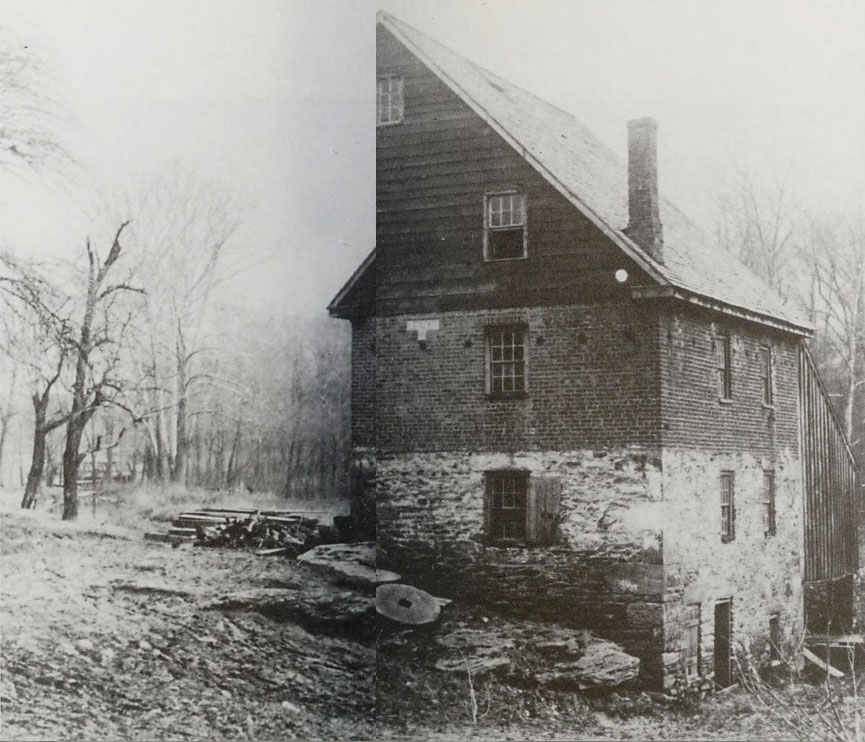
In June a 5,000 strong Confederate cavalry unit led by J. E. B Stuart arrived in Gaithersburg and Rockville, the home of Scott’s father Edward and his family not far from Clopper’s Mill. Once in Rockville, Stuart and his men quickly established a network of intelligence gatherers among townsfolk sympathetic to the Confederate cause. A write-up of the raid in the Unionist newspaper, the Harrisburg Patriot painted a clear picture of the support they had in the area: “Rockville has never been noted for its loyalty”, the paper snorted. Clopper’s Mill, owned by Michael and Cecilia Fitzgerald’s neighbour, Francis Clopper, would subsequently feature in the trial of George Atzerodt, an accomplice of John Wilkes Booth and John Surratt in the Lincoln kidnap and assassination plots. On April 15 1865, and already being pursued by Pinkerton detectives, Atzerodt had made his way by coach to Rockville where he proceeded on foot towards Gaithersburg. Upon reaching Clopper’s Mill he was put up for the night by its operator, Robert Kinder. A short time later he found a more permanent hiding place at his cousin’s house in nearby Germantown.
Despite her escape to Washington, Cecilia Fitzgerald wasn’t entirely free of the Surratt connection. The reason for this was that Georgetown, the district where she lived, had featured prominently in the Lincoln Assassination, with three of the eight people convicted in the conspiracy being members of the alumni of the university. Scott would later tell his daughter Scottie that his father Edward had attended the prestigious college in Georgetown in the early 1870s. Contrary to whatever Scott might have inferred from his father, the college he attended was most likely Georgetown Preparatory School in North Bethesda, some three miles south of the farm in Gaithersburg, although nobody really knows for sure. Scott would later say that the cousins and aunts of his father, who had neither the resolve nor the manpower to stay on the farms after their defeat in the civil war, sought sanctuary in the north west boarding houses of the capital. Located on the banks of the Potomac River, the historic Georgetown district would have been a constant reminder of the glory days of the rebellion and the part played by Scott’s father Edward in the subterfuge of its spies.
The Robertsons
In a letter to story-editor and film producer, Edwin Knopf, dated February 1940, Scott explained how a cousin of his father had been caught up in a surprise attack on Lt. Gen. ‘Stonewall’ Jackson on Chancellorsville in May 1863. [11] Scott, obviously excited by the tale, began the outline of his story by jogging the producer’s memory: “You may remember that the battles of Fredericksburg and Chancellorsville were fought respectively late in 1862 and early in 1863 and very nearly upon the same Virginia battlefield. I would begin my story with two girls who come South from Concord seeking the body of their brother who has been killed at Fredericksburg.” [12]Scott was looking for a sign that Knopf would be interested in seeing a script. A shorter version of his cousin’s capture was due to be published in Colliersmagazine that June. The story, The End of Hate, recalled a gruesome little episode in which one of Mosby’s raiders, Tib Dulany, is hung from the ceiling by his thumbs and ends with a conversation in which a disfigured Tib overhears the plot to assassinate Lincoln at a boarding house in Georgetown. [13] The editors had been so disturbed by the content of the story that Scott was forced to revise it several times. [14] According to a letter written to his cousin Cecilia in June 1940, the whole macabre adventure had been based on a deeply disturbing episode that had happened to William George Robertson II at the Fitzgerald family farm near Gaithersburg. William was the twenty year old son of Mary Victorine Key Scott Robertson, the sister of Scott’s paternal grandmother, Cecilia. The episode had clearly excited Scott: “Did you see a very poor story of mine that was in Collier’s a few weeks ago? It was interesting only in that it was founded on a family story—how William George Robertson was hung up by the thumbs at Glen Mary or was it Locust Grove? Aunt Elise [Eliza] would know.” [15]
Just six years earlier, Scott and Zelda had been living in Baltimore a few hundred yards from William George Robertson’s daughter Victorine on Park Avenue. Victorine and her brother Sothoron were at William’s old house at No. 1807 whilst Scott, Zelda and Scottie were just south of the property at No. 1307. [16] Just five minutes south of both of them was West Lanvale Street, the last known address of the rebel spymaster and Lincoln conspirator, John Surratt, whose swashbuckling adventures in the American Civil War had so energised Scott in his youth. Living with Surratt, his wife Mary and their daughter Eugenia on Lanvale Street was Robertson’s aunt, and Cecilia’s sister, Susanna Goodwin Key Scott Hunter. [17] Scott’s father Edward had been just ten years old when he was helping to ferry Confederate spies across the Potomac. It’s a very young age for spymasters, so it seems reasonable to assume that whatever role Edward had played in the war it was probably in helping older relatives like William achieve his aims. Many children, even those as young as ten, were actively engaged in supporting the war effort, usually in scouting or reconnaissance work and even sometimes on the battlefield. In Scott’s story, William is interrogated as one of Colonel Mosby’s guerillas — a spy.
In later years, Father Joseph Gallagher, a Baltimore priest, would shed a little more light on the story. Gallagher had encountered Robertson’s daughter Victorine and her brother Sothoron in the late 1950s. According to Gallagher, Sothoron had become housebound and his sister had begun to express concerns about his wellbeing. After several visits to their house on Park Avenue, Father Gallagher learned a little more about William, their father. According to Victorine, William — Tib in Scott’s story — had served with valour under Colonel Mosby’s infamous Berryville Raid and had moved to their present address in the early 1900s. Among his comrades was Lewis Powell, a resourceful Confederate spy and visitor to Baltimore, who would eventually be hanged for conspiring to murder Lincoln and the knife attack on the Secretary of State. The story told by Victorine was a good one and corresponded with much of what Scott’s father had told him about his cousin. Reports indicate that just after dawn on August 16, 1864, Mosby and 300 of his ‘ghosts’ attacked the rear section of a 600-vehicle convoy laden with supplies for the troops of General Sheridan, an officer in the Union Army. The guerilla tactics employed by Mosby and his men relied on speed, stealth and brutality. Removing their rebel grey uniforms, the group had set themselves up with canons on the side of a hill. Believing them to be friendlies, Sheridan’s men had paid them very little attention. Without warning Mosby and his ghosts, rumoured to be operating under the ‘black’ flag, unleashed the full fury of their canons on the convoy. By morning, the men had taken over 200 soldiers prisoner and claimed a hundred of their supply wagons. Boys like Scott’s father Edward were likely to have been drafted in to burn what was left of the convoy. Shortly after the raid, Sheridan had received an order from General Ulysses Grant: Mosby’s men and their families were to be hunted down and hung without trial. [18] One of the men involved in arranging the executions was General George Custer.
Records, unearthed by Michael Dwyer and Vivian Eicke of the Archaeological Society of Maryland, reveal that Edward’s cousin, William Robertson, had been brought up at Needwood Mansion, a substantial red-brick dwelling in the Derwood district of Montgomery County. This would be about seven miles east of Glenmary, the home of the Fitzgeralds. In their history of the 740 acre estate, Dwyer and Eicke describe this grand old house as “reminiscent of the fashionable townhouses of merchants in Georgetown. What it certainly didn’t remind them of, they wrote, was a farmhouse built in the country by a farmer. Like so many wealthy planters in the area, the Robertsons used slaves on the plantation. Somewhat inevitably, when the war came they sided with the Southern Rebels, and in March 1864 the family’s oldest son, William George Robertson Jr enlisted as a member of Mosby’s Rangers aka. ‘Mosby’s Ghosts’ (the 43rd Battalion Partisan Rangers). As a result of the family’s sympathies with the South, the district was regularly being raided for Confederate spies.
For years after the raids, William would attend the annual reunion celebrating Mosby’s ‘Greenback’ victory at Berryville with the men who had shown such unselfish devotion to their leader, recalling the whole astonishing story in a reading he prepared as a tribute. [19] Colonel Mosby, as on so many occasions, would make his excuses and not attend the meetings. It wasn’t a measure of Mosby’s pride in his struggle. In fact, it couldn’t have been further from the truth. After finally winning his pardon in 1866, Mosby became a key figure in reparations with the North, eventually backing former Union General, Ulysses S. Grant, in his second run for the Presidency and finding work under Theodore Roosevelt in the Department of the Interior. [20] After the war, there were those who wanted things to stay as they were and those who accepted that things had to move on.
In the early 1900s, William would move his family to a three-storey townhouse on Park Avenue in Baltimore. A report in the Baltimore Sun in October 1900 tells how William’s wife had composed a new version of ‘Ave Maria’ by Amos Harryman. The song, sung with ‘much dramatic vigor’ by Amos Harryman at the cathedral that month, was to be published by George Willig & Co. [21] In an entry made in his ledger in April 1905, Scott claims to have met William with other family members, including Clement Offutt, in the family’s hometown, Rockville.[22] The following year, Clement Offutt’s father Lee would become Mayor of Rockville and it is quite possible that he was kin to Mrs Emma Offutt whose testimony was heard at the trial of Mary Surratt. William’s daughter Victorine had shared a name with her cousin, Mary Victorine Surratt, the wife of John. [23]
Father Gallagher, the priest who befriended William’s children in Baltimore and who eventually inherited the Robertson’s house on Park Avenue, recalls finding a veritable treasure trove of paraphernalia from the Civil War and Revolution — seventeen rooms “crammed full of boxes and jars, closets and drawers” positively overflowing with items. There would be burned matches stored in their original matchboxes, partially smoked cigars, newspaper cuttings, a walnut Chippendale chair, two steel engravings of Stonewall Jackson and letters from as far back as 1770. Beneath the floor was “a bucketful of silverware” and an old bread knife with the words ‘Cutler to Her Majesty the Queen’ engraved on the handle. Sotheron, like Scott, had been an obsessive scrapbooker and collector. History was literally pouring from the house. Now in her 70s and having been mugged several times, Victorine was reluctant to go out of the house and would lock herself in her bedroom at night, a gun and a telephone by her side. On one of the few occasions she did venture out, Joesph recalls driving past Scott’s old house, boasting that he had just read a biography of the author. He was in the middle of telling her all about The Great Gatsby when suddenly the old lady sat bolt upright in her seat: “Oh you mean Scotty! He was my cousin — a lovely fellow, though he drank too much.” [24]
[1] The Great Gatsby, p.3. The entry in his ledger dated March 1913 reads, ‘Grandmother & the Duke of Buccleugh’.
[2]‘The Other Side of Paradise, Scott Fitzgerald, 40, Engulfed in Despair,’ Michel Mok, Conversations with F. Scott Fitzgerald, F. Scott Fitzgerald, 1896-1940, ed. Mattew J. Bruccoli and Judith S. Baughman, University Press of Mississippi, 2004, p.121-122. Surratt’s wife, Mary Victorine Hunter was the daughter of Thomas Hunter (1812-1854) and Susannah Key Hunter (1820-1885). Susannah was the sister of Cecilia Aston Fitzgerald (and Edward Key Scott) who was married to Michael Fitzgerald, Scott’s grandfather, father of Edward.
[3] ‘John Harrison Surratt’, The Baltimore Sun, 25 April 1916, p.10; ‘Reverend James F. Mackin’, Washington Herald , January 4, 1908, p.7; Montgomery Sentinel, October 2 1874, p.2
[4] ‘Garibaldi and the Papacy’, New York Times, October 15, 1860, p.4
[5] ‘Gen Garibaldi Coming’, New York Tribune, August 11, 1861, p.1
[6] ‘Arrest of John H. Surratt’, Washington Evening Star, December 4, 1866, p.2. Prior to joining The Pope’s Zouave, Surratt had escaped to both Liverpool and London. Lincoln assassin John Wilkes Booth had family in Clerkenwell, London.
[7] The Notebooks of F. Scott Fitzgerald, F. Scott Fitzgerald, Harcourt Brace Jovanovich, p. 322
[8] ‘A Lecture, John H. Surratt’, Port Tobacco Times, December 16, 1870, p.1
[9] Washington Evening Star, August 22, 1894, p.8; ‘Society’, Washington Herald, November 30, 1911, p.5. Like Scott’s mentor, Sigourney Fay, Wells would help out at the Church of St Stephen the Martyr during this period. The church was located on the eastern fringes of Georgetown.
[10] ‘Today’s Inaugural His Thirteenth’, Washington Times, March 17, 1917, p.5
[11] Stonewall Jackson was another distinguished Confederate General.
[12] ‘Dear Eddie, February 1, 1940’, Letters of F. Scott Fitzgerald, p.604.
[13] ‘The End of Hate’, F. Scott Fitzgerald, Colliers, June 22, 1940, pp. 9-10.
[14] ‘Of Empresses and Indians: A Compositional History of The End of Hate’, Justin Mellette, The F. Scott Fitzgerald Review, vol. 12 no. 1, 2014, p. 108-123. It is interesting that Scott takes the plot to assassinate Lincoln away from the boarding house of Mary Surratt on H Street to Georgetown where his Grandmother spent her last years alive.
[15] ‘Dearest Ceci, June 26, 1940’, Correspondence of F. Scott Fitzgerald, p.601
[16] William George Robertson, Local and Personal, Montgomery County Sentinel, April 11, 1924, p.3; Fooks Family, Herbert C. Fooks, J. W. Stowell Print. Co, 1953 p.452 (Fooks was a neighbour of Victorine Key Robertson);William G. Robertson, b. 1845 US Census 1920, Maryland, United States. William’s son would work for the Federal Government’s Interstate Commerce Commission in Washington D.C.
[17] ‘Mrs S.G. Key Hunter’, Baltimore Sun, August 15, 1906, p.9; US Census 1900, 1910, Baltimore Wards 16 and 18, Baltimore City, Maryland, United States, John H. Surratt, b.1845, William G. Robertson, b.1845
[18] Needwood Mansion, 18MO397, Michael Dwyer and Vivian Eicke, April 2009, https://www.asmmidpotomac.org/uploads/7/3/0/6/7306779/needwood_booklet_2009.pdf
[19] ibid
[20] ‘Reunion of Mosby’s Command’, Alexandria Gazette, October 15, 1897, p.2. William G. Robertson is misreported as William T Robertson, Montgomery County in the article. His wife Mrs William G. Robertson is reported accurately in a similar report in the Baltimore Sun. The 500 veterans were joined by members of The Daughters of the Confederacy.
[21] ‘Mrs N.B. Robertson as a Composter’, Baltimore Sun, October 30, 1900, p.12. The report mentions William and his association with Mosby’s Rangers.
[22] Clement was the eleven year old son of Lee Offutt, who would become Mayor of Rockville, Montgomery County the following year. Emma Offutt (of Surrattsville, Prince’s County) was questioned as a witness in the trial of the Lincoln conspirators. She was the sister in law of John M. Lloyd who was arrested but not charged. According to the 1880 census, Emma’s father was born in Montgomery County. They were all living at 709 E Street, across the road from the today’s International Spy Museum. Lloyd was a police officer before and after the assassination but not during.
[23] Mary Victorine Hunter Surratt (b.1846) was Surratt’s wife. Her mother, Susanna Goodwin Key Scott Hunter (b.1818) was the sister of Sothoron and Victorine Key Robertson’s mother, Mary Victorine Key Scott Robertson (b. 1822) and Scott’s grandmother, Cecilia Aston Scott Fitzgerald (b.1832).
[24] The Pain and the Privilege: Diary of a City Priest, Joseph Gallagher, Image Books, 1983, pp. 18-20