During their stays in London in 1921 and 1925, their London host, Shane Leslie, introduced Scott and Zelda Fitzgerald to an illustrious parade of British dignitaries that included his aunt, Lady Randolph (Jennie) Churchill — the New York-born mother of Britain’s Secretary of State for the Colonies, and Leslie’s cousin, Winston Churchill — and the Marchioness of Milford Haven, granddaughter of Queen Victoria [1]. It is often speculated that it was Zelda’s friend, Tallulah Bankhead, Britain’s favourite American stage-star, who had made the introductions, but if a diary entry made by Shane Leslie during Scott’s next trip to London in 1925 is anything to go by, the more likely explanation is that Scott had been introduced to Churchill and the Milford Havens by Leslie, the former British diplomat who had invited Scott to London that summer. What we do know is that by the end of their time together, Winston would be eating out of Zelda’s hand, such was his affection for her.
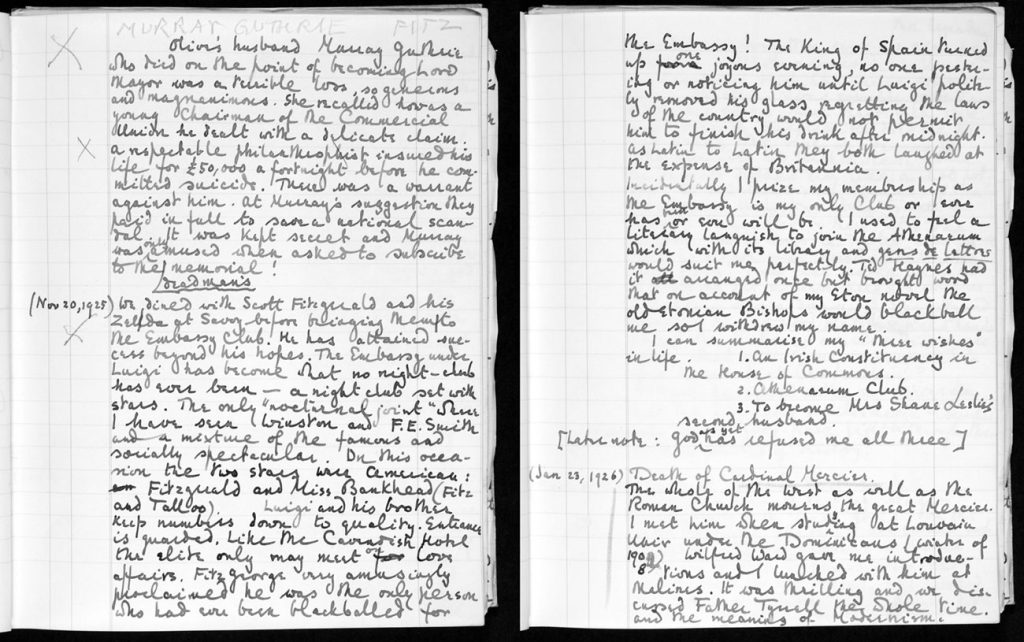
On November 20th 1925, Shane Leslie recorded in his diary that he had entertained Scott and Zelda at the Cavendish Hotel before taking them on to the Embassy Club on Old Bond Street. As creatures of custom, with long-ingrained social habits, it is likely that Scott was treated to much the same itinerary on their first trip too. Taking your guest to the Embassy Club or to The Cavendish Hotel was not only a mark of their respect, but an indication of how much they wanted to prove their worth socially. In the carbon typescript of his 1938 memoirs, Leslie claims that it had been the Embassy Club where Scott had been introduced to Winston during his first trip to London in the summer of 1921. [2] An entry from Scott’s ledger dated June 1921, likewise mentions a trip to the Cavendish Hotel. A later one dated November 1925 confirms a trip to the Embassy Club, although it makes no specific mention of Winston, nor anybody else for that matter. The entry in Scott’s ledger for May, June and July 1921 has led some biographers to conclude that Scott had been lodging at the Cavendish Hotel, but this is almost certainly not the case. If Zelda’s memories of meeting Bob Handley in the “gloom of the Cecil” are correct and the chronology of Scott’s ledger is accurate (‘June 30, London … Bob Handley’) then after a short stay at Claridge’s during which they had a “curious nocturnal bottle of champagne” with the British and American Polo teams, the couple resumed their place at the Hotel Cecil and not the Cavendish Hotel after returning from the continent at the end of June. [3] Zelda mentions the stay in a letter to Scott written in September 1930 in which the trip with Leslie to Wapping and the Randolph Churchill are also recalled. [4] Zelda’s memories of the trip are supported by Scott’s letter to Edmund Wilson written after his return from France and Italy which had been scrawled on Hotel Cecil stationery. [5]
The Cavendish Hotel, run by the celebrated ‘Queen of Cooks’, Rosa Lewis, was more popular for its food than for its rooms. Winston’s mother Jennie had employed Rosa in her service and the cook had retained a close relationship with the Churchill and Windsor families well into the 1920s. The Embassy Club was likewise frequented by Leslie, Winston and the Milford Havens. In his diary entry in 1925, Leslie recalls that it was during this second trip to the Embassy Club that he had shared his main aims in life with the couple. Among his hopes were an Irish constituency in the House of Commons, membership of the less glamourous but infinitely more prestigious, Athenaeum Club and “becoming Mrs Shane Leslie’s second husband”, a caustic aside on the fragile state of his marriage to his wife Marjorie at this time.
The Embassy Club, run by Italian restaurateur, Luigi Naintre, was known for its wild parties. Shane remarks in his letter that under Luigi, The Embassy Club had become what no London nightclub had ever been in the past: “a night club set with stars”. Edward VIII would famously describe it as the “Buckingham Palace of night clubs.” Slipping into the Bond Street building after dinner parties around midnight, one would glide through the large swing doors and down to the most luxurious of basements. In the basement would be a whirly-gigging dance floor, set on all side by mirrors. On a raised balcony on the far side of the room would be the band. For the next four hours the rules of the Old World would be wickedly suspended as thumping jungle patterns would be slapped out on upright basses and clarinets and oboes would pump out wave after thrilling wave of offbeat licks. Press-Lords would mix with princes and actors, writers and hangers on with ambassadors and politicians. Scott and Zelda would have melted into the place just perfectly, all boundaries, real or imagined, collapsing in a hypnotic cloud of smoke and a swirl of tassel dresses and dazzling sequins. For those who wanted something totally lawless, you could leave and head over to the 43 Club in Soho, but if you were prepared to be discreet, the same blistering quantities of cocaine and heroin could be consumed in the booths and in the rest rooms of the Embassy Club.[6] An entry in Shane’s diary reveals that it was “the only nocturnal joint” that he had seen his cousin Winston and his good friend Frederick Edwin Smith, the First Earl of Birkenhead, mix it up with “the famous and socially spectacular.” On this occasion, the stars were both American: Scott Fitzgerald and Miss Bankhead (“Fitz and Talloo”). If someone special was dining, Luigi and his brother would deliberately keep numbers down “to quality” and the entrance would be preciously guarded. Like the Cavendish Hotel, The Embassy Club was where the elite would meet “on love affairs”. Beneath its dangling chandeliers and lavish corniced ceilings, Scott and Zelda would have found themselves fox-trotting to tunes like Beneath the Burmese Moon, led by bandleader, Bert Ambrose and the Embassy Club Orchestra — a personal favourite with Edward, Prince of Wales. According to his diary, Shane found it impossible to conceal his joy at seeing the couple: Scott had “attained success beyond his hopes” and was obviously delighted he had come to London. [7]
In a letter to his friend, Ernest Hemingway, Scott refers to rumours of an ‘English orgy’ that the couple were alleged to have gone to in town. The author makes a half-hearted effort to persuade his friend that it wasn’t what everybody thought and jokes that it could possibly be traced to the ‘entertainment’ put on by Leslie. The next bit was more mischievous. Any gossip that Scott might have drunkenly shared about the club’s most illustrious patrons, the Windsors and Mountbattens, should by rights be treated as “fiction”. In 1925, New York’s Boni & Liveright published Rosa’s memoirs, The Queen of Cooks— and Some Kings. Their Embassy Club companion, F. E. Smith, would die of cirrhosis of the liver in 1930.
Shane Leslie’s place in the lofty firmament of Anglo-Irish and American relations had been firmly assured from birth. As we’ve seen already, Shane’s first cousin was Winston Churchill, son of New York’s Jennie Jerome — more commonly known as Lady Randolph Churchill. [8] Shane’s mother, Leonie, was Jennie’s sister and his brother-in-law was the legendary US Congressman, William Bourke Cockran. In his 1936 memoirs, American Wonderland, Leslie would describe Cockran as “the last of the Irish orators.” His life in America read like a romance. He had arrived in New York from Sligo in Southern Ireland without a penny to his name but by the end of his life would be walking down Broadway “like a King”. His 300-acre estate on Long Island, The Cedars, was one of the largest estates on the island and it was here that Scott would get his first real glimpse of how the other half lived when he visited his home with Leslie during his prep-school days at Newman. After training as a criminal lawyer, the young Cockran had never looked back and within years he had become the sounding board of Irish interests in America. His magnificent oratory compelled and entertained, instructed and commanded even the most stubborn of rivals, regularly turning his opponents onto causes that in other hands would have been already lost. Leslie recalls that he could play an audience “like a melodeon.” You had only to hear him the once, and you were completely and utterly under his spell — cousin Winston included.[9]
[1] Sometimes Madness is Wisdom: Zelda and Scott Fitzgerald, Kendall Taylor, Ballantine Books, 2001, pp. 107-109. The war with Germany forced the Marchioness’s husband, a German Prince, to resign his commission as Naval Admiral and change his name from Battenberg to Mountbatten. Two of Lord Milford Haven’s sisters-in-law (Empress Alexandra Fyodorovna and Grand Duchess Elizabeth Fyodorovna) were killed by the Bolsheviks in Russia.
[2] Shane Leslie: Sublime Failure, Otto Rauchbauer, Lilliput Press, 2014, p.109
[3] ‘To Carl Hovey, Claridge’s Hotel Letterhead’, Correspondence of F. Scott Fitzgerald, Random Houe, 1980, p.84; The Romantic Egoists: A Pictorial Autobiography from the Scrapbooks and Albums of F. Scott and Zelda Fitzgerald, ed. Joan Paterson Kerr, Matthew Joseph Bruccoli, Scottie Fitzgerald Smith, University of South Carolina Press, 2003, p.84
[4] ‘To Scott … September (?) 1930’, Dear Scott, Dearest Zelda, Bloomsbury, 2003, p.66.
[5] Life In Letters, p.46
[6] The sale of both had only been banned by the government in 1920 but habits and addictions took a long time to change.
[7] Shane Leslie, 20 November 1925, Shane Leslie Papers, Diary of Sir Shane Leslie, Jan1922-Dec. 1931, MS 22863, Call No. Ms. 23,382 , National Library of Ireland. Leslie’s remark about becoming Mrs Shane Leslie’s second husband’ was said in reference to the marital differences they were experiencing at the time.
[8] The Romantic Egoists: A Pictorial Autobiography from the Scrapbooks and Albums of F. Scott and Zelda Fitzgerald, Matthew Joseph Bruccoli, Scottie Fitzgerald Smith, South Carolina Press, 2003, p.84. An Anglo-Irish lecturer, writer and diplomat, Shane Leslie had met Fitzgerald while attending the Newman School in Hackensack, New Jersey, in 1912. In 1907 he had embarked on a walking tour of Russia and was later drafted in to serve the British Ambassador, Sir Cecil Spring Rice in Washington D.C as part of British plans to bring America into the war on the Irish ticket (‘Shane Leslie Appeals to America’, Boston Post, March 15, 1917, p.5).
[9] American Wonderland, Shane Leslie, Michael Joseph Ltd, 1936, pp. 40-43