On the 100th anniversary of the book being exposed as a forgery, a recent discovery I made in the archives in Dublin suggests that the 1920 British translation of The Protocols of the Elders of Zion (The Jewish Peril) was not the work of ‘lone wolf’ anti-Semite George Shanks, but part of a sophisticated propaganda offensive conceived and financed at the highest levels of the British Establishment
A recent find in the Department of Early Printed Books and Special Collections at Trinity College Dublin revealed that the man who published the first English translation of the notorious fake, The Protocols of the Elders of Zion in January 1920 was working first as a clerk in the Chief Whips Office at 12 Downing Street before being employed as personal assistant to Sir Philip Sassoon at No.10 Downing Street (the Private Secretary to Prime Minister David Lloyd George). The claim appeared in a copy of Lord Alfred Douglas’s Plain English journal dated January 22nd 1921 (‘The Blue Faced Ape of Horus’). Although renowned for its deeply offensive anti-Semitism and its excruciating conspiracy theories, the claims made in the journal are nevertheless backed-up by letters from readers printed in subsequent editions of the journal and in separate correspondence unearthed by Oxford historian Gisela Lebzelter in the late 1970s. However, this is the first time that the original source of the claims has been revealed and explored in detail.

A closer look at the background of George Shanks also reveals he was the nephew of Aylmer Maude, the famous friend and translator of the Russian author Leo Tolstoy. At the request of the British Government Maude joined Allied Forces in Archangel on the North Western where he became a leading voice in the pro-Interventionist movement of the Russian Affairs Committee during the Russian Civil War of 1917 to 1922. Maude’s colleagues at this time included former members of Britain’s wartime propaganda bureau in Petrograd, Harold Williams, Bernard Pares and Hugh Walpole, who were working closely with Winston Churchill on a no-holds barred campaign to destroy Lenin’s Bolsheviks who were at this time being equated with Internationalist ‘Jewish’ radicals. Just days after Shanks’s Jewish Peril pamphlet received its landmark review in The Times of London, the newspaper printed a letter by Maude passing judgement on the work. At no point did Maude acknowledge his nephew as its author or its publisher. The following PDF booklet also explores the impact of Churchill’s no less incendiary article for the Illustrated Sunday Herald, ‘Zionism versus Bolshevism’, which cynically combined the needs of making progress on the issue of British Mandate Palestine with attempts to undermine the trade negotiations between David Lloyd George’s government and Soviet Russia.
According to the British Art Historian, Robert Hobart Cust, Shanks co-translated the pamphlet with Cust’s friend, Major Edward G. G. Burdon, a talented linguist who since February 1917 had been acting as Secretary to the United Russia Societies Association under Speaker of the House of Commons, James Lowther (Lord Ullswater) and Arthur Nicolson MP (Lord Carnock).
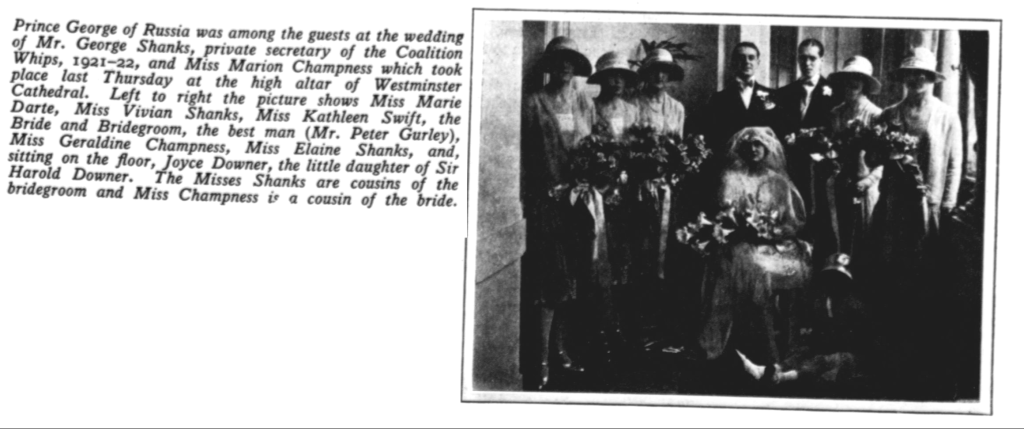
In 1928, George married his wife Diana Champness, the daughter of an accountant who’d made his fortune on the success of a lucrative welding patent. A report in the British court chronicle, The Queen, dated May 5th shows them being married at the High Altar of Westminster Cathedral. Among the guests were the Grand Duchess George of Russia and her nephew several times removed, Prince George, son of the Grand Duke Georgy Konstantinovich of Russia (1858-1915) and reputedly eigth in line to the Russian throne at the time of the 1917 revolution. A first cousin to Tsar Nicholas I, the Duchess’s husband, the Grand Duke George Mikhailovich of Russia, had been murdered by the Bolsheviks in 1919. [1] The report, in court chronicle The Queen, describes Shanks as having served as Private Secretary at the ‘Coalition Whips Office’ in the early 1920s. Other newspapers of the period list Prince George of Russia as an antique dealer and interior designer in Mayfair and a Claridges friend of Philip Sassoon. [2] The Prince’s Great Grandfather was Tsar Nicholas I and he was a cousin of Tsar Nicholas II. [3]
Issues, groups and personalities explored in the PDF guide include Major Edward Griffiths George Burdon (E.G.G Burdon), Robert Hobart Cust, Sergei Nilus, Pyotr Rachkovsky, Winston Churchill’s Zionism versus Bolshevism article, The Times of London, the Jewish Peril (May 1920), Harold Williams, Sir Bernard Pares, Vladimir Burtsev and the Committee on Russian Affairs, Princess Radziwill, Henry Wickham Steed, Philip Graves, Hermann Bernstein, Boris Brasol, the Russian Government Committee (Kingsway, London), Ivan Fedorovich Manasevich-Manuilov, Matvei (Mathieu) Golovinski, Eyre & Spottiswoode (The Jewish Peril 1920, First Edition) and Will Eisner’s The Plot. The PDF also features the service records of Sub-Lieutenant George Shanks detailing his dates with the Royal Navy Air Service and his time at the Russian Government Committee in Kingsway London.
Article by Alan Sargeant
Read PDF
To read or download the PDF: George Shanks, the Protocols of the Elders of Zion (Jewish Peril) and the Committee on Russian Affairs on Academia.edu see the screengrab below:
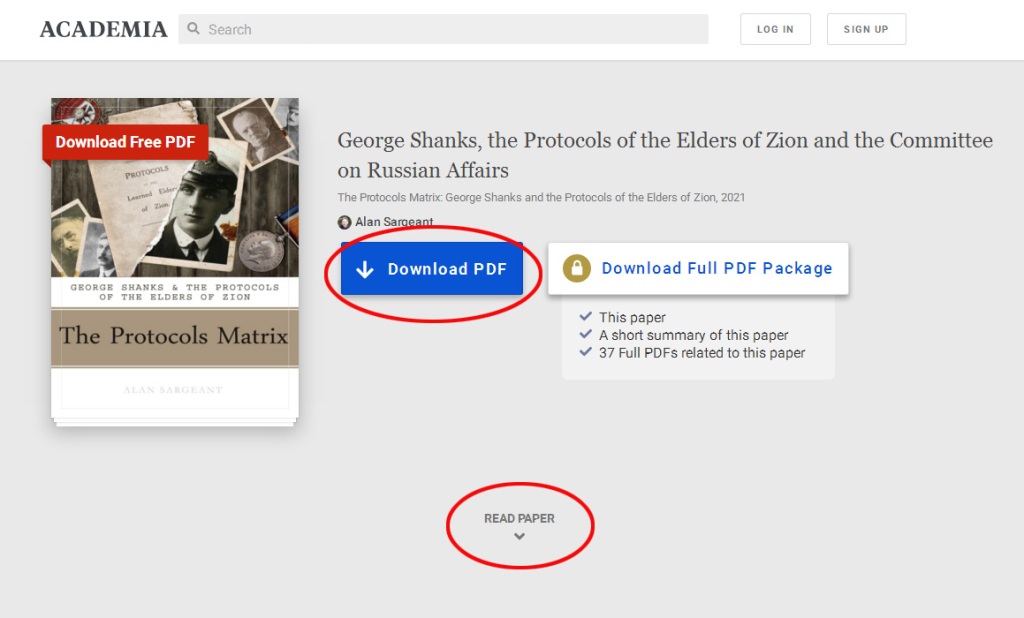
How to download or read the pdf
Links:
https://www.shanks-family.org/henry-and-george
[1] ‘Weddings of the Past Week’, The Queen, May 5, 1926, p.3; ‘Lynn Advertiser, December 14, 1923. Prince George Constantine born 1903 died as a Fifth Avenue fur salesman in New York in 1938.
[2] ‘Eligible Bachelors’, Daily Mirror, July 25, 1925, p.7
[3] ‘Exiled Russian Prince Now A Crack Fur Salesman’, Free Lance (US), January 2, 1937, p.11