Churchill’s ‘Zionism versus Bolshevism’ for the Illustrated Sunday Herald must rank as one of the most controversial press articles in the history of British Politics. In a generous two page spread published on February 8th 1920, Britain’s Secretary of State for War, Winston Churchill, drew-up a rambling, ham-fisted case for a establishing a Jewish National Home in Palestine, the only possible solution that he could see to the spreading Bolshevik menace whom he summarised rather grotesquely as “the International Jews”.
Just weeks earlier, the Downing Street clerk, George Shanks and Major Edward G. G. Burdon OBE had published their joint English translation of The Protocols of the Elders of Zion — one of the most heinous fakes in history, claiming as it did to show a Jewish plot for global domination. Elsewhere in the world, the White Russian armies under Generals Wrangel, Kolchak and Denikin were requesting the help of their former allies to crush Lenin’s Bolsheviks and take back control of government. Churchill’s patience was running out. Strikes and mutinies had been breaking out the width and length of Britain and Churchill, like many, was fearing outright revolution. But there was little appetite for war with Lenin’s Bolsheviks within the coalition cabinet. With the stakes so high, Churchill turned to the one thing that could be relied on to get Britons in a fighting spirit: the so-called ‘Jewish Peril’.
If there is one single piece of evidence to suggest that George Shanks and Major Burdon had been actively colluding with the pro-Interventionist lobby that was then gaining mass under Lowther and Aratoon’s United Russia Societies Association it is ‘Zionism versus Bolshevism’. Firstly, the article’s timing with The Protocols translation is nothing short of miraculous. Shanks and Burdon’s Jewish Peril had received its first review on page eight of the Westminster Gazette on February 9th 1920. The sabre-rattling article by Winston Churchill was published in the Illustrated Sunday Herald just 24-hours before.[1]
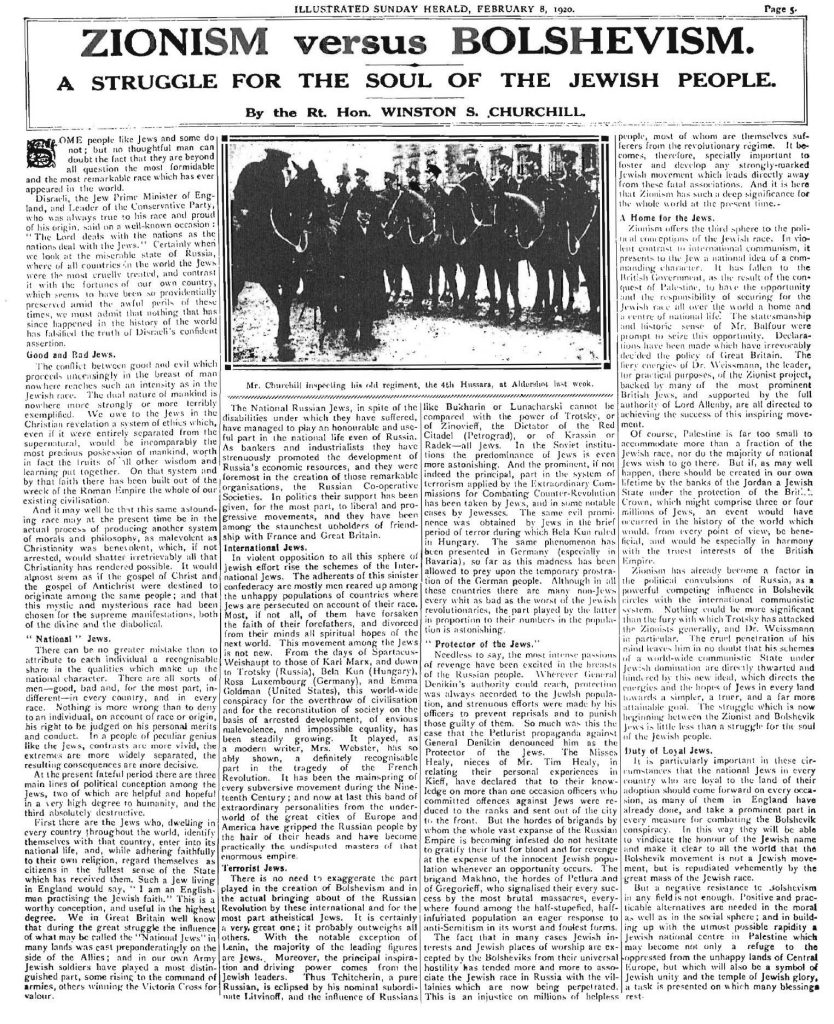
It isn’t a moderate affair by any standards, Churchill’s 2000 word article having been published as a blistering full page special on page five of the newspaper on February 8th 1920. Anyone who has managed to preserve an otherwise high regard for the cantankerous wartime Prime Minister may be disturbed to learn that this intensely provocative article draws substantially on the preposterous claims being made in The Protocols of the Elders of Zion; namely that the Jewish Internationalists under their leader, Vladimir Lenin were engaged in a diabolical plot to dominate the world and destroy the established order of things. Any attempt to square this off neatly with Winston’s stunning and very sincere triumph over Nazi Germany in World War II is an almost impossible task. In fact for most Brits, if not for most of our allies, past and present, the article won’t make a fat lot of sense. More often than not the problem will be dismissed fairly involuntarily as the ambiguous actions of a very complex man and a very inconvenient truth. In actual fact, it was neither that inconvenient nor that complex. Churchill had embraced Zionism as a colonial and economic necessity. The real problem, if there is one, is not that he was anti-Semitic. Like most in his class, he was. The problem for readers of the 21st Century is that Winston was embracing Zionism at the same time he was expressing sympathy for the conspiracy theory of Jewish Bolshevism. There was no subsequent epiphany that put a redeeming wedge of virtue between this and his later actions. The image we have of Winston wrestling Adolf to the floor and plunging the sword of righteousness into the heart of his evil empire, whilst not a myth entirely, is one that is rather crude and one dimensional. Winston was more like Cerberus, the multi-headed dog guarding the gates of the Empire from his twin Cerberus rival opening the gates of his. Whilst his perception of the “International Soviet of the Russian and Polish Jew” may have been similar to that of Hitler, their politics and their loyalties couldn’t have been further apart.
Perhaps the fairest way viewing the article was that it was a knee-jerk reaction, conceived in the midst of totally unparalleled events rattling along at a furious pace. It was a weak, opportunist effort from a complex and unpredictable character attempting to solve two problems with one instrument as fast as politically possible. No matter how much we may judge him by modern standards it would be unreasonable, if not downright incorrect, to present Churchill as a closet-fascist.
His article is not a pretty read on any level. Even by the standards of the day, this was a deeply offensive appeal, worded to pump as much venom as possible to the fangs of an anxious and exhausted post-war public, reluctant to do battle with a big new threat from the continent. In his rush to make his point, Churchill literally lumps together “malevolent” Jews like Karl Marx, Leon Trotsky, Bela Kun, Rosa Luxembourg and Emma Goldman for preaching the “gospel of the antichrist”. He also heaps no small amount of praise on fascist conspiracy theorist, Nesta Webster who had “so ably shown” that Jews had been the mainspring of “every subversive movement during the Nineteenth Century”. His worst fear was coming true: Jews were rising to prominence in these movements and seizing control. The exception to all this was Zionism which, as far as Churchill was concerned, presented a “more commanding” option for building Jewish national identity. Zionism was moreover, already becoming a factor “in the political convulsions in Russia, as a powerful competing influence to Bolshevism”. The struggle between the Zionist and Bolshevik Jews, Churchill enthused, was “little less than a struggle for the soul of the Jewish people”. Establishing a Jewish home in Palestine would “vindicate the honour of the Jewish name”. It was a simple proposition the War Secretary was putting forward to the Jews of Britain: you were either with us or against us. The Jew was being asked to either support Britain’s not terrifically well defined plans for the Jewish National Home in Palestine or Britain would have no other option but to treat them as a Bolshevik and public enemy number one. [2]
Building on the breathtaking wave of anti-Semitism currently steamrolling across Britain in the wake of Churchill’s article was new Director of Intelligence at the British Office, Sir Basil Thomson, who was likewise trying to convince the Cabinet of the Jewish Internationalist threat. Just 48 hours before a review of Shanks’ Jewish Peril appeared in The Times of London, Thomson would write in his weekly ‘scare bulletin’ for the British Home Office that “Jews of East End London” were fomenting rebellion over the brutal campaign in Poland. Thomson had quietly assured the government that a more aggressive policy against the “Jewish alien” would be a popular signal among the electorate. In the heading, ‘What the Working Man Thinks’, in his bulletin of May 6th 1920, Thomson was cheerfully reporting that a member of his Home Office team who had conversed with “workers selected at random” described how they all had a “hearty dislike for the alien” and would like to see “powder and shot used freely among the Labour leaders and the Jews”. Another wished all Jews to be given “free passage to Palestine” where he had served as a soldier during the war. [3] An entry dated July 3rd 1919 had provided the clearest indication yet of the global ‘Jewish Menace’. According to his fortnightly bulletin, “direct evidence had been received that the leaders in the Bolshevik movement in England, France and America are in touch with one another and with Moscow, and that the Bolshevik movement is an International Conspiracy of Jews”. [4]
By February 1921, Lord Curzon and Sir Ronald Graham, the British Minister at The Hague and a leading advocate at the Foreign Office of a British commitment to Zionism, were still discussing the influence of Jews in the Soviet administration in cables in February 1921. In one such cable, Graham says that he has the “honour” of presenting to Curzon one of two documents translated from its original native Dutch that showed “ the influence of the Jewish element in the Soviet Administration”. A second document communicated by Graham, dealt with “the instructions issued to Soviet agents abroad”. The document concluded with a statistical statement showing the alleged number of Jews that made up the senior Soviet ranks: Council of Peoples Commissars (18 out of 22 are Jews), Commission of War (34 out of 43 are Jews), Commission of Finance (13 out of 17 are Jews), Commission of Justice (20 out of 21 are Jews). And so it went on. [5]
Contrary to what many modern readers might think, Zionism wasn’t popular in America, Germany or Britain at this time. You’ll probably guess where it found its strongest support; in the battle weary warzones of Russia and Eastern Europe, where pogrom after pogrom had left Jews with the bleakest of ultimatums. Churchill and his team were effectively creating a problem that only Palestine could solve. They were turning up the Fahrenheit and applying the pressure. [6]
Although it would be grossly inaccurate to say that the Jews of Britain and America had responded positively to Churchill’s article in Britain, the Zionist Press of America were suggesting that the article had indeed been giving fresh “impetus” to the British Palestine Mandate and that donations to the recently formed Restoration/Foundation Fund, Keren Hayesod had increased. [7] It was certainly curiously timed. It seems that every attempt was being made to make Britain an increasingly hostile target for Jewish immigrants. Whether or not Churchill’s anti-Semitism was sincere, or whether it was a cool and totally dispassionate tactical manoeuvre, it was fair to say that the Jewish communities that had been fractured and scattered in exile were having a route-map for a whole new journey rather violently thrust upon them.
The following month (April 1920) saw the Jerusalem Riots, the first alleged pogrom in the region and a tough reminder for Britain of the challenges that lay ahead. But to what extent did Zionist leaders get behind the War Secretary’s divisive appeal and to what extent did they support the White Russians?
Unlikely support among Zionists
There’s no doubting that Zionist fighting units throughout Russia and Eastern Europe were supporting White Russian monarchists and Liberals in their conflict with Lenin’s Bolsheviks. In May 1920, just days after The Times of London threw the spotlight onto Shanks’ translation of The Protocols of the Elders of Zion (May 8th 1920) the New York Evening World ran a report that revealed details of how authorities in Soviet Russia had arrested seventy-five members of the All Russian Zionist Congress after discovering “compromising documents” that was said to reveal close contact between members of the Congress and representatives of the governments of Britain, France and America. It was alleged that the group had been operating a courier service between Russia and London. A further claim stated that over 30, 000 Jewish legionnaires had pledged their service to White Russian armies through an agreement with England. In a separate claim, it was alleged that former American Ambassador to Turkey, Henry Morgenthau had visited Poland on behalf of the Zionists and instructed them to get behind the Polish Imperialists. [8] Morgenthau had been dismissed from his role as Turkish Ambassador in February 1916 after it had been found that he had been engaged in ‘secret’ land purchases from the Ottomans in Palestine for the purpose of colonising the region after the war.[9] Zionism at this time divided the Jewish communities and was particularly unpopular among the Jewish ‘assimilationists’ and ‘Reformist Jews’ of Great Britain, Germany and America (see separate exhibit: ‘The Letter of the Ten/League of British Jews’). In the most extraordinary twist, the Jewish journalist and diplomat, Lucien Wolf, perfectly contented with his place in British culture, caused quite a stir in October 1904 when he explained his hostility to Zionism in a provocatively-titled article for the Jewish Fortnightly Review. The Zionist Peril, a 24-page indictment of the movement under Herzl and Zangwill, pulled little in the way of punches, sensationally revealing Zionism to be the “gravest peril to the Jewish people” which would ultimately present the most serious of set-backs to their history and their mission. Based on a letter he had circulated to the press in response to the Zionist Congress in Basel in September 1903, in which the Uganda Scheme had been discussed, Wolf rejected any notion that the Jewish religion and way of life was in ethical decay, pointing out, not unreasonably, that seeking racial and religious autonomy in Europe was leading to a whole scale rise in anti-Semitism.[10] It was Wolf’s belief that “Old-world prejudices” had been revived by “political factions for political purposes rather than because of any genuine belief in the Semitic peril”. [11] He had even been told by the Russian Minister von Plehve that he “counted on Zionism” as a means of re-directing the appetites among Jews for civil and religious emancipation away from the Socialist Revolutionary Party and Jewish Bund. [12] Bearing in mind that this piece was written a full fifteen years before Britain and White Russia harnessed the energy of anti-Semitism to justify a four year assault on the Bolsheviks, one has difficulty in regarding Wolf’s assessment as anything less than visionary.
It’s worth noting at this point that at least one article in The Cause of World Unrest, the book whose publication was so passionately endorsed by the editor of The Morning Post H.A Gwynne in October 1920, went to considerable lengths to dissociate the plans of the Zionists with the Jewish Internationalists plotting global domination from all the major capitals in Europe, even to the extent of rejecting the origins of the book put forward by Sergei Nilus, whose book on The Protocols they otherwise quote at length:
“As to the date on which the protocols were delivered we have the assertion that they were known to the Zionist Congress at Basle. That Congress brings us to the date 1897. But there is no evidence in the document that the authors have any concern with the Zionist Movement; indeed, their project of a universal domination might appear to render Zionism unnecessary.” [13]
Despite the fact that the first edition of The Protocols published by Nilus says quite categorically that secret extracts of The Protocols of the Elders of Zion were lifted directly from a speech made at a closed-meeting hosted by Herzl at the First Zionist Congress in August 1897, Chapter 7 of The Cause of the World Unrest bends and twists the facts to fit the sinister vision of the ‘New World Order’ being put forward by Churchill: The Jewish Internationalists (the Bolsheviks and the assimilated Liberal Jews of Europe) were the problem, not the Zionists. The version of The Protocols legend which appeared in Georgy Butmi de Katzman’s 1907 book, “The Enemy of the Human Race” was to make a similar departure; the plot as told by Butmi — dedicated to the ultra-Monarchist Black Hundreds — presented the diabolical bid for Jewish world supremacy as Masonic rather than Zionist in origin, the outcome of a secret convocation of Jews of the Masonic Lodge of Egyptian ritual that should not be confounded with leaders of the Zionist Movement in Russia or abroad. Butmi makes one thing very clear: the ‘Representatives of Zion’ should not be confused with the leaders of the Zionist Movement. [14]
In an ideal world this would probably prove beyond reasonable doubt that the publication of Shanks and Burdon’s Jewish Peril was an attempt to draw a clear distinct line between the aims of the ‘International Jews’ (the Bolsheviks and the Masons) and the emerging Zionist movement. But there are several problems with this. The first is that Shanks and Burdon’s Jewish Peril was sub-titled, The Protocols of the Elders of Zion. If it had been the authors’ intent to exclude the Zionists, then what logic was there in preserving the word itself? Secondly, nobody actually knows who authored the collection of articles included in H.A. Gwynne’s The Cause of World Unrest. Whoever wrote that the “universal domination” sought by Lenin’s Bolsheviks might “render Zionism unnecessary” in Chapter 7 of the book may well have been correct, but their identity is not known. As a result, it may be possible to surmise that some chapters of the book are written by those qualified to make the distinction (and whose feelings about Bolshevism may just about be possible to disentangle from sheer antipathy toward Jews) and those whose judgement was based on pure racial or religious prejudice. As Nesta Webster viewed both as “external manifestations of the general movement to establish Jewish Nationalism”, it’s unlikely to be her, unwilling as she was to make any such concession or distinction.[15] Jewish Bolshevik or Jewish Zionist, they were seen as separatists and extreme nationalists all the same.[16]
Whatever the exact truth is about the book’s authorship, such is synchrony that exists between The Cause of the World Unrest and the anti-Bolshevik campaign being led by Churchill that the book begins by quoting a speech that Winston made in the House of Commons on November 5th 1919, in which he breathed fresh life into the legend that Lenin had been sent into Russia by the Germans, “in the same way that you might send a phial containing a culture of typhoid or of cholera to be poured in to the water supply of a great city.” [17] Zionism wasn’t off the hook by any means, but the series of articles that make up The Cause of the World Unrest did their utmost to shift the greater burden of guilt at the doors of the Jewish Bolsheviks and the neutral Jews of Europe who failed to express disapproval of their revolutionary principles in the strongest terms required of them. As Gwynne writes in August 1920, “Is it not time to ask those our Jewish fellow citizens who do not share the views of their fellows to speak out openly and fearlessly?” In recent years, the Mosques of Europe and America have been accused of much the same failure: “the clerics are not doing enough to counter the narratives of extremism being circulated among its young”. [18]
There is absolutely no doubt that a powerful section of British and American Jews like Jacob H. Schiff — regarded as high priest of Capitalism by supporters of Lenin — were actively supporting the pro-Interventionist (anti-Bolshevik) movement.[19] Lucien Wolf had already written of the leverage that Zionism had given Tsarist Russia in its fight against ‘Jewish’ Socialism and it was only natural that those content with their own complex ethnic balance — not to mention their own wealth — would take objection to any political faction that sought to squeeze them into the corner of two artificial extremes. Wolf had been proved right. “Old-world prejudices” had been revived by “political factions for political purposes rather than because of any genuine belief in the Semitic peril.
Although the level of Anglo-Jewish commitment shown to the White Movement remains for the most part unclear, it’s certainly possible that Shanks’ translation of The Jewish Peril was being used to polarize debate and have the whole thing collapse into a passionate confrontation between pro-Zionist and anti-Zionist Jews. The battle lines were being drawn: those Jews who refused to get behind the pro-Interventionists (pro-Whites) and the plans for the Palestine Settlement were lumped unjustly with the Bolsheviks. [20] In many ways, Churchill’s ‘Zionism versus Bolshevism’ article for the Sunday Illustrated Herald in February 1920 sought to define the conflict order. This is afterall, the fundamental principle of all Culture Wars: polarizing groups and building increasingly dominant voting majorities. Sometimes the more outrageous and more emotive the issue, the more quickly and more securely the sides would split into their respective rivalries. It’s one way of re-directing the energy flow from the centre (and often neutral) ground to either one of the two extremes. The manufactured narratives of division create the necessary ‘bloc’ for political gains. If Sassoon had in any way sanctioned the publication of the Jewish Peril (which I doubt), or approved in any way Churchill’s rather disturbing ‘Bolshevism versus Zionism’ article of February 1920, then it was because it served the pro-Interventionist cause, and was not because of any emotional, religious or ideological commitment to a Jewish National Home in Palestine. [21] Men like Churchill and Gwynne were not demanding that we ask the question, “What is the true nature of Jewish identity?” they were demanding that the Jewish community choose one of two impossible options. ‘Good Jews’ were being asked to choose Zionism whilst ‘Bad Jews’ were being corralled into taking their place alongside Lenin’s Bolsheviks where they could be designated and detained as enemy combatants in a war being fought at a cultural level. [22] And this is exactly how both men put it:
“It is particularly important in these circumstances that the national Jews in every country who are loyal to the land of their adoption should come forward on every occasion … and take a prominent part in every measure for combating the Bolshevik conspiracy. In this they will be able to vindicate the honour of the Jewish name and make it clear to the world that the Bolshevik movement is not the Jewish movement, but is repudiated vehemently by the great mass of the Jewish race.”
— ‘Zionism versus Bolshevism’, Illustrated Sunday Herald, Winston Churchill, February 8th 1920
In the wake of the San Bernardino attack in the US and the Charlie Hebdo attack in Paris in 1915, the usual cry went up: it was the responsibility of Muslims the world over to condemn acts of terror. Much the same thing was taking place in 1920: Jews in Britain were being asked to disavow the acts of a regime some 4,000 miles away. As Asim Qureshi explains in his introduction to his 2020 book, I Refuse to Condemn, “meeting the expectation to condemn in order to be labelled safe carries with it an automatic excommunication from normality — for in the process of condemning we, we justify our coming into humanity, a humanity from which we had been excluded until that moment.” [23] Jews of the world were no longer being offered the option of practising Judaism as a religion. It was to be remodelled at the level of nation in which the demand for basic rights was to be routinely misrepresented as advocacy for political and cultural separation: “Are Jews working as a distinct race or merely as members of a distinct religion?” [24]
[1] Westminster Gazette, 09 February 1920, p.8. At this time, the Westminster Gazette was under the careful editorship of undiminished Liberal, J.A Spender.
[2] Zionism versus Bolshevism, Winston Churchill, Illustrated Sunday Herald, February 8th 1920, p.5
[3] Report on Revolutionary Organisations in the United Kingdom. No 53, May 6 1920, CAB 24/105/39, Report on Revolutionary Organisations in the United Kingdom. Report No. 37, February 5 1920, CAB 24/97/81
[4] Report on Revolutionary Organisations in the United Kingdom. Report No. 10, 03 July 1919, CAB 24/83/16, TNA
[5] The British National Archives, LG/F/203/2/8, Ronald Graham, The Hague, to Earl Curzon of Kedleston No.102, February 12 1921. Sir Ronald worked closely Vladimir Jabotinsky’s Zion Mule Corps when serving as Chief Staff Officer, G.O.C. Egypt. For more see: The Question of Palestine, 1914-1918; British-Jewish-Arab relations, Isaiah Friedman, pp.119-143. Graham was the British Ambassador in Italy during the rise of Italian Fascism under Mussolini in 1922.
[6] ‘Zionism versus Bolshevism’, Illustrated Sunday Herald, February 8th 1920, p.5
[7] B’nai B’rith Messenger, March 5 1920
[8] ‘Soviet Blames Morgenthau in Zionists’ Plot’, The Evening World (New York), May 18, 1920, p.13
[9] The Sentinel July 28 1916
[10] ‘The Zionist Peril, Letter to the Editor, Lucien Wolf’, The Evening Mail, September 9 1903, p.4
[11] ‘The Zionist Peril’, Lucien Wolf, Jewish Fortnightly Review, Vol. 17, October 1904, pp.11-12
[12] ‘The Zionist Peril’, Lucien Wolf, Jewish Fortnightly Review, Vol. 17, October 1904, pp.17-18.
[13] The Cause of World Unrest, G.P. Putnam’s Sons, September 1920, p.85
[14] The History of a Lie, The Protocols of the Wise Men of Zion: A Study, Herman Bernstein, J.S. Ogilivie Publishing Company, 1921, pp.60-61
[15] ‘Boche And Bolshevik’, Nesta H. Webster, The Beckwith Company, NY 1923, p.48. I would hazard a guess that the distinction being expressed in Chapter 7 of The Cause of World Unrest was made by a peer or diplomat with a legal background (Nb. the phrase “in any event it is plain from” on p.87 — common parlance among Justices of the Peace).
[16] The Cause of World Unrest, G.P. Putnam’s Sons, September 1920, Introduction, H.A. Gwynne, pp. XXIII-XXIX
[17] The Cause of World Unrest, G.P. Putnam’s Sons, September 1920, pp.1-2
[18] Mosques launch anti-radicalisation scheme as alternative to Prevent, Haroon Siddique, The Guardian, March 22 2018
[19] Joseph H. Schiff, leading fundraiser for the American Jewish Congress cut off all ties with the Bolsheviks. His various banks had made substantial Liberty Loans to Kerensky’s Provisional Government (in March 1917 he had also donated a Liberty Statue). Although he supported a sizeable settlement for Jews in Palestine prior the Bolshevik revolution, he was against the idea of a nation’. He revised this opinion in 1919, and backed the British Mandate before his death that same year. Although Lionel Rothschild allowed his business address to be used by the Free Russia Press, he was closer in terms of politics to Burtsev and the Liberal Cadets.
[20] The Cause of World Unrest, G.P. Putnam’s Sons, September 1920, Introduction, H.A. Gwynne, pp. XXIII-XXIX
[21] It’s worth noting that the Plain English article says attempts were made by prominent Jews to purchase practically all the first editions of Shanks and Burdon’s Jewish Peril. The same claim was made when The Protocols was published by Nilus in Russia in 1905 (see: The Cause of World Unrest, G.P. Putnam’s Sons, September 1920, p.85).
[22] The terms ‘Good Jews’ and ‘Bad Jews’ are Churchill’s (‘Zionism versus Bolshevism’, Illustrated Sunday Herald, February 8th 1920).
[23] ‘I Refuse to Condemn: Resisting Racism in Times of National Security’, Manchester University Press, 2020
[24] The Cause of World Unrest, G.P. Putnam’s Sons, September 1920, Introduction, H.A. Gwynne, p. XXVI