Less than 72 hours after the missing police chief’s daughter Barbara Lopukhin knocked at the door of Woburn Place and reassured everyone of her safety, Hastings compositor Alexis Sheftel boarded the RMS Lusitania in Liverpool and made the three thousand mile journey in steerage to start a new life in New York. The date was Saturday, November 2nd, 1907. This was the ship’s third voyage on the Liverpool-To-New York line and a good deal of interest had been aroused by its cargo: £2,000,000 of gold bullion — an emergency loan from the Bank of England to relieve the scarcity of gold in the US. [1] The loan had been coordinated by J.P. Morgan, an attempt to rescue a collapsing economy in the wake of ‘the great panic’.
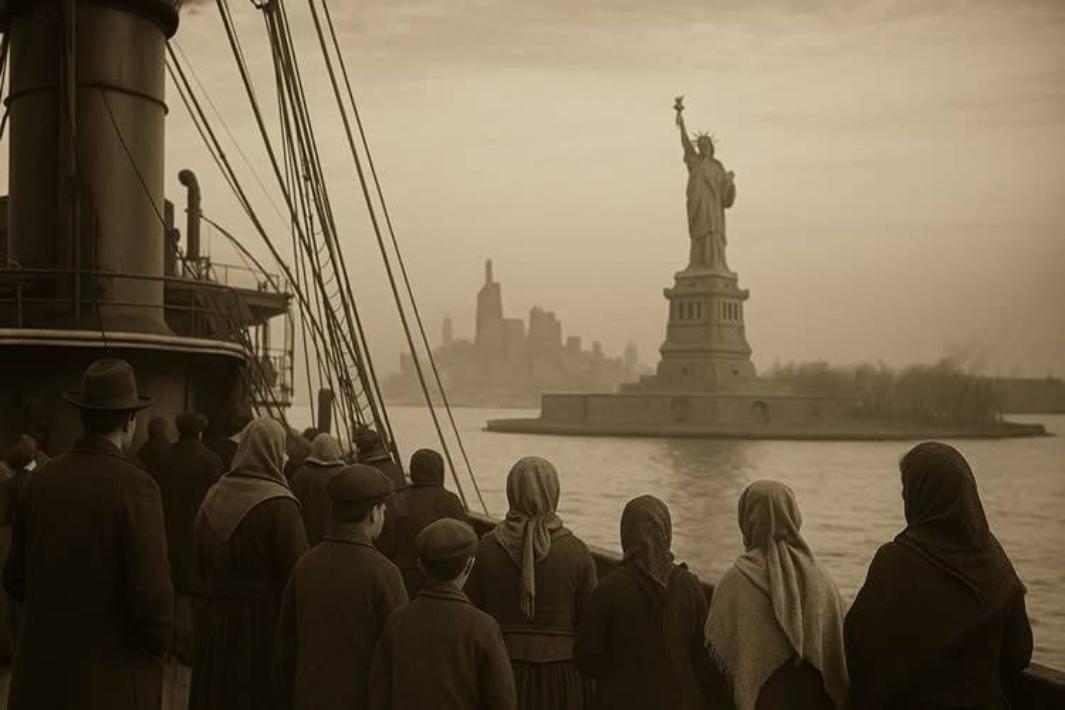
Sheftel was arriving in America at a difficult time. Back in February, President Theodore Roosevelt had introduced a new Immigration Act, tightening entry restrictions, doubling head tax to four dollars per person, and barring people with physical or mental disabilities. Despite this, 1907 would become the busiest year in Ellis Island history, with over million arriving immigrants being processed, almost 165,000 more than the previous year. Alongside Alexis that day were a jostling, hungry crowd of labourers, painters and tailors, many of them Russian. Meeting them at the end of the gang plank were the ‘Church at the Nation’s Gate’, a Christian missionary body who provided the dazed-looking strangers pouring through the station with a route-map to getting started: pointing out what work opportunities were available, dealing with potential crooks, and providing any spiritual needs.
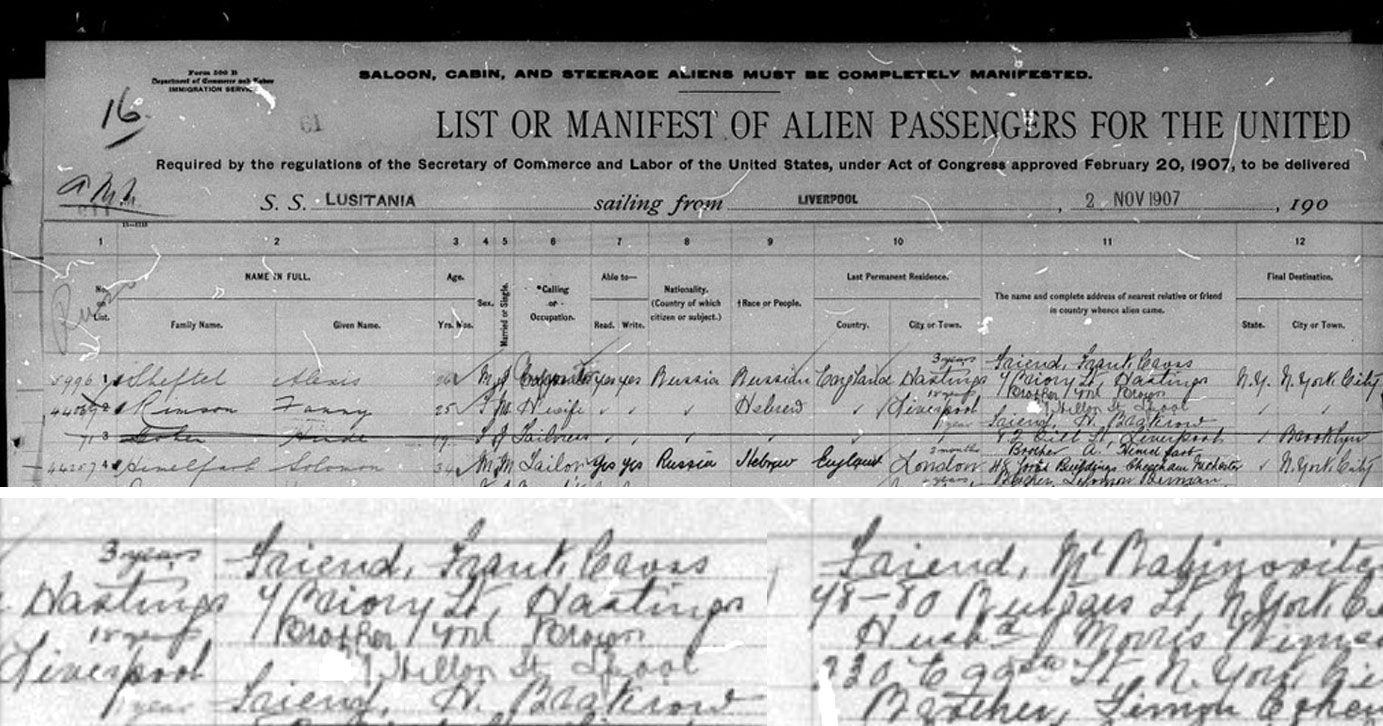
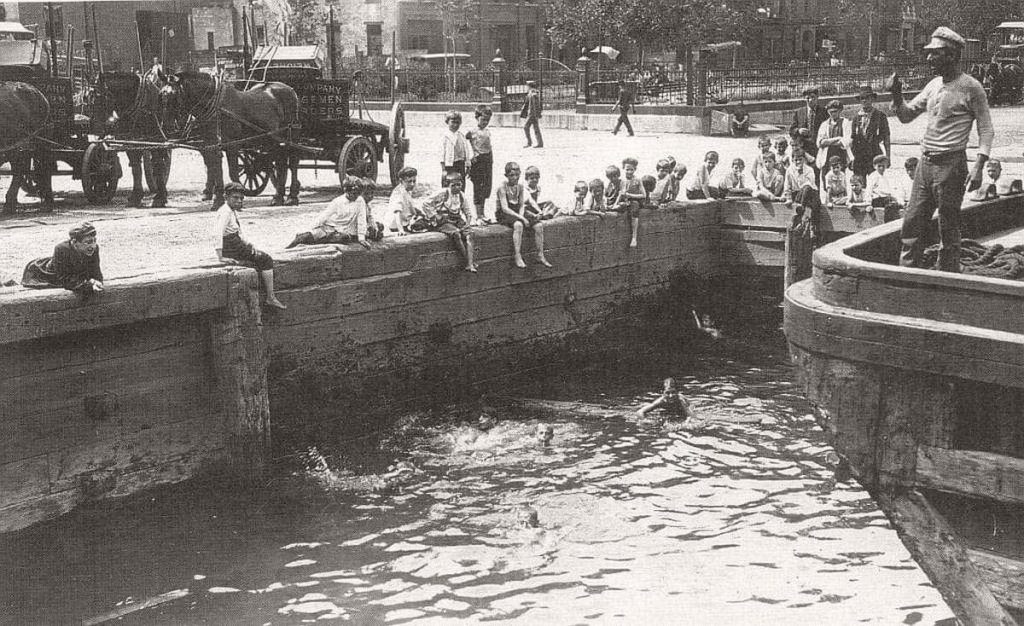
The Cunard liner arrived at Ellis Island in record time, setting a new transatlantic record of four days, 19 hours and 10 minutes, cutting 42 minutes from her former time. Its time would have been cut still further had it not been for a storm that had blown up the previous morning. [2] As it is, the wind had followed them, and Sheftel spent his first day in New York during a slightly colder, wetter spell with severe gales expected in the evening. The address of a friend that he gave on the ship manifest was 78–80 Rutgers Street on the Lower East Side of New York — the home of Mr Ben-Zion Rabinovitch and his wife, Chaye and daughter Bertha. [3] The six-story building close to the East River waterfront ran southeast toward the water, just yards from Brooklyn Bridge and Mussel Beach, the cruel, whipping winds from the water churning around the Rutgers boat slip. In the summer, children from the adjacent tenements would swim here, but in November this filthy street of water was ice cold.
Records show that Alexis and Bertha married in Manhattan. Alexis provides the names of his parents, Saul and Deborah Sheftel, and Bertha lists hers as Benzion and Chaye Robinovitz — a variant spelling. Both of them are 26. The date is the 5th of April, 1908. Sheftel’s application for naturalisation the following year reveals that he and Bertha were living for a time in Hartford, Connecticut (14 Avon Street). The house was, incidentally, the boyhood home of avant-garde painter Aaron Gelman, the grandson of Avraham Yaakov Gelman, one of the founding fathers of the Chovevei Zion settlements in Palestine. A short time later the couple settled at 529 Sutter Avenue in Brooklyn. [4] That same year Bertha gave birth to a son, Abraham (George). Alexis’s army registration card (1917) shows that he is in business as a printer in midtown Manhattan (138 West 36th Street). [5] Looking over the various cryptic and ultimately trailless entries in trade directories around this period, there is some evidence to suggest that Sheftel had found an additional source of income in high grade ‘Job Printing’ under the moniker ‘Elite Prints’ at his home address of 529 Sutter Avenue. So whatever he was doing in America, he was busy at least. What’s more, his address would find him just around the corner from the Communist League HQ at 1700 Pitkin Avenue, a street as varied in its pursuit of political and cultural freedom as any of its equivalents in New York’s Ukrainian Village or the Bowery in central New York (Alexis would join the Communist Party of America in the 1930s). In all fairness, there wasn’t a home or store front on Pitkin Avenue or Sutter Street that wasn’t at one time or another the site of revolutionary hokus pokus, Jewish outreach or ambiguous anarchist sentiment. Whatever it was that had brought Sheftel to New York, his permanent base on Sutter Avenue had found him in the nerve centre of radical politics and the city’s immigrant support fraternity.
Sheftel and Joseph Koven
After a few years in America, Sheftel’s trajectory becomes a little clearer, although we are still largely working from an unruly, disparate mish-mash of scraps and oddments from a fairly random collection of sources. And whilst the commercial side of Sheftel’s life is clearly taking shape, clues about any political or radical activities may only really be inferred from the publications he had a hand in printing. Many of the men whose signatures appeared on the petition sheet alongside Sheftel in March 1901 were writers or revolutionaries who had earned extraordinary reputations. Even the names that were genuinely obscure like V. Cheshchikhin-Vetrinskii (1866-1923) had already written many of the hundred or so works he was to publish in his life. Others like Vladimir Debogory-Mokrievich, who collaborated with fugitive spy-catcher Vladimir Burtsev on Svobodnaia Rossiia in Geneva, would eventually go on to feature in the sensational unmasking of Tsarist agent, Yeno Azef , so it’s peculiar to see someone so relatively young and so unknown among them. [6] Even if Sheftel’s rise to fame had been relatively swift and short-lived there was likely to be a damn good reason why he was asked to add his signature. As far as the historical record went, Sheftel was the ‘revolutionary without portfolio’. And if the clues were not available before he landed in England, then we would need to focus on any clues his journey offered after arriving in the United States, because it was here that Alexis would spend the rest of his life.
Let me start by saying that there are a small number of business interests that I have not as yet been able to shed a great deal of light on. These are the US Coal Briquetting Company Inc, which Sheftel appears to have been a junior stakeholder in. His co-directors in this particular venture appear to have been Chicago brewing legend Julius Kessler and his attorney John McGraw (Kesslerny Times 1924). On this, the only thing that I can resolve is that by the early 1920s, prohibition had plunged the former journalist’s liquor company into bankruptcy and Kessler was pouring his energies into his numerous other business interests. Like many entrepreneurs of this period, he was also in the habit of investing in any old commercial scheme launched by young, ambitious immigrants. The other company in which Sheftel had had stakes was the Carrm Convertible Car Corporation with Egypt-born inventor Bazel Eli Carrm and H. Levenson. [7] This was a short-lived firm affiliated to car exporters American Motors Inc at 100 Broad Street New York and active only for a relatively short period of time, from June 1917 to 1922. Described as a ‘revolutionary step forward in motor car coach work’, Carrm’s invention promised to transform a seven passenger touring car into a two-seater convertible in just a few minutes. [8] Carrm, an eccentric polyglot who the press described as a former soldier and world-traveller was later accused of using the company to sell fraudulent securities to the public. A court in Brooklyn had found no evidence of cars being produced, and ordered the company to cease trading. The company was wound down and declared bankrupt in 1924. Bazel’s daughter, Elena Karam, would later appear in films with Steve McQueen and Sylvester Stallone.
By the time that Sheftel had arrived in Manhattan, the district had experienced a sudden surge in expansion. Those living to the immediate east and west had to fight a daily battle with the various barriers being erected to build the city’s skyscrapers that increasingly towered over the city like some elevated kingdom, moated by clouds on all sides. Traffic snarled and bodies bundled their way through an ant-like nest of alleyways, subways and bridges. The Lower East Side of the city had become the émigré Jewish cosmopolis.
Just a few years earlier, the novelist, Abraham Cahan, would describe the Lower East Side as a “seething human sea, fed by streams, streamlets and rills of immigration flowing from all the Yiddish speaking centers of Europe”. It was an immense melting pot of dialects and sub-dialects thrown “pell mell into one social cauldron — a human hodgepodge with its component parts changed but not yet fused into one homogeneous whole”. [9] To the north were a suffocating mass of tenements that defined its commercial quarter, whilst to the south were houses and apartments, neatly offset by a scattering of trees, courtyards and the feeble jaundiced glow of naptha lightning. The Russian creatives tended to occupy the streets around East Broadway; a swanky looking boulevard that mimicked the majesty and pomp of St Petersburg’s Nevsky Prospect. Carnegie had built his copious free libraries here and there was also the ten-storey edifice of the Jewish Daily Forward, the Hebrew Sheltering House and the Jewish Maternity Hospital, all of which was miraculously linked to Brooklyn by the mighty Williamsburg drawbridge.
Whilst little can be ascertained about Sheftel’s life in America in the immediate months and years after his arrival in at Ellis Island in November 1907, it appears that sometime between 1912 and 1915, Sheftel started collaborating with the ‘small and nervous’ dramatist-poet, Joseph Koven, co-author of a series of plays with Gustav Davidson, a quirky esotericist with an unusual taste for John Milton who had arrived in New York during the very same year as Sheftel. At this time Koven had just moved out of his home on Cauldwell Avenue in the Bronx and was living with his Kavarskas-born father Julius and mother Esther in Brownsville, Brooklyn (37 Grafton Street), just a 15 minute walk from Alexis on Sutter Avenue. In 1919, Sheftel printed his play, Red Terror, a satire in one act. [10]
In 1921, a poem written by Koven — ‘Death by the Kremlin Wall, to John Reed’ — was published in the January 1st edition of ‘Soviet Russia’, the official organ of Gregory Weinstein and Ludwig Marten’s Russian Soviet Government Bureau in New York. A flurry of travel books followed, expanding on his time in Palestine, in which the intrepid young poet explained his bitter disillusionment with the existing Jewish settlements in Palestine and what were to his mind at least, the rather hopeless prospects of building a Jewish nation. By the 1930s Koven, still occasionally pumping out poems and plays for the ‘Masses’ and the International Ladies Garment Workers Union’s Justice newspaper, teamed-up with American Socialist activist (and early Communist Party of America member) Oakley C. Johnson on The Monthly Review — Koven performing the duties as editor, with Johnson as managing editor. Despite finding respect among some of his peers, some of Koven’s own contributions to the journal were received with no small amount of contempt by more scholastic members of the Marxist community, with Granville Hicks once describing them as “juvenile in conception, and inept and even offensive in expression”. [11] Hicks was a former associate of John Reed and Theodore Dreiser at the Monthly Review’s rival paper, ‘The New Masses’, a post-Depression reboot of Rufus Week’s The Masses, a journal Sheftel may very well have worked on some twenty years before. Hicks had been drawn into an awkward spat with the journal’s managing editor, Oakley Johnson over the editor’s decision to gear the content more towards sections of the middle class that were not sufficiently politicized and found themselves in need of “detailed and concrete data on the status of white collar and professional workers.” That Sheftel’s printing company were also involved in the printing of publications in the financial and insurance markets may suggest some analogous partnerships and affiliations. [12] The way Johnson and Koven saw it, the more middle class America understood about the economic threats and challenges faced by the working masses, the more likely they were to engage with and sympathize with them — insight that would be essential in their battle against the rising tide of Fascism in the thirties. Johnson provided a heroic and loyal defence, explaining how Koven had founded the journal at his own very “heavy expense”. [13] Joseph’s son with Kletsk-born Betty Spiegel — David Koven, born in Brownsville in 1918 — went on to become a leading member of the Libertarian-Communist Vanguard Group in San Francisco. In California Koven Jnr would edit the Berkeley-run Needle magazine after a stint managing the journals Why? and Resistance in New York with long-term partner Audrey Goodfriend and Sam Dolgoff.
Sheftel , Meyer Aronson, Herman Bernstein … and Leon Trotsky
Sharing Sheftel’s address at 529 Sutter Avenue in 1916 was local philanthropist and Petticoat manufacturer, Meyer Mordechai Aronson (b.1876), a wealthy Russian émigré who had upped-sticks and immigrated to New York from Žiežmariai in Lithuania in 1903. A cousin some five years his senior and also called Meyer had made a similar dramatic flight from neighbouring Raseiniai some 15 years earlier, steadily building up a small fortune in producing gas fittings in the passionately Yiddish Brownsville district of Brooklyn. Once here, both men quickly became immersed in a variety of charitable and educational endeavours. Fast-forward some ten years and Meyer Aronson can be found partnering social reformer and philanthropist David Shapiro in the Yiddish newspaper Der Tog and several other commercial ventures. The newspaper had been conceived as a liberal antidote to the ‘corrupt and demoralising’ Yiddish press then popular on New York’s Lower East Side. Aronson and Shapiro put their heads and money together and gave it some further thought. What was needed was a paper with sound ideals that could raise the tone and profile of the Yiddish press and the Jewish colonies in general.
The kind of editor they were looking for wouldn’t be an activist or revolutionary as such, it would be a scholar with a balanced outlook, a good diplomatic grasp of the complex range of issues dogging the Yiddish districts and a well-rooted network of contacts in the wider journalistic community. Their response was to bring in Herman Bernstein as co-director and editor, the man who just a few years earlier had bagged that blistering, explosive scoop on the assassination of General Korpov for the New York Times, based on information provided by Burtsev in Paris and London. [14] Given the rich flow of Burtsev-related content that ensued in the weeks that followed, it seems reasonable to assume that Bernstein had established something of an open channel with the ‘famous Russian detective’ who was about to take New York by storm. The killer article came just two weeks later. A soft-focus review of Burtsev’s mission in New York, told how the mild-eyed, kind and typical Russian bookworm and historian had transformed himself from editor and publicist into a passionate spy-hunter: “It was in the course of his work as a chronicler of the events of the emancipation movement in Russia that Bourtseff came upon the weeds in the revolutionary garden, the weeds that kept growing and spreading and absorbing all the sap that was to give strength to the roots of a new, better Russia”. [15] It was exactly the kind of introduction that SherlФck ИФlmes was looking for in America. Thankfully, no mention was made of the abortive dynamite plot he’d been involved in in Paris, and the article was generously supplemented by a rather handsome ‘sketch from life’ portrait from the hand of respected illustrator and artist, William G. Krieghoff by way of tribute.
Der Tog newspaper would eventually launch in November 1914 under the management of The Day Publishing Company and specifically targeted the local and foreign interests of the passionately Yiddish colony in Brownsville.Among the company’s handful of directors were Meyer Aronson, David Shapiro and Herman Bernstein. Given that Aronson’s cousin Meyer Mordechai Aronson was sharing his Sutter Avenue work address with Alexis Sheftel, it’s quite possible that the young typesetter was playing a role in the paper’s production. Each of the men lived in the radical yet profoundly proud colony of Yiddish families around Sutter Avenue and Pitkin Avenue, the street where the newspaper’s treasurer Meyer Aronson would live with wife Anna and their seven children. It was here that Aronson and his colleagues at the Brooklyn Unity Club would attempt to bring representatives of the Labour and Capital camps together and unite them in charitable endeavours. At the 10th Anniversary dinner of the Brooklyn Federation of Jewish Charities in November 1919, the Federation’s Honorary Secretary Nathan Jonas emphasised the need for its senior members to help steer the residents of Brooklyn away from the worst excesses of anarchism and show respect for the constitution: “Any part of the foreign-speaking people, the foreign language press, or the American Yellow Press which advocates or encourages treason in this country should be prosecuted fearlessly by the government. We all favour free speech but there is a great difference between free speech and license and the latter should be prohibited for the common welfare, whether practiced by individuals or newspapers.” [16]
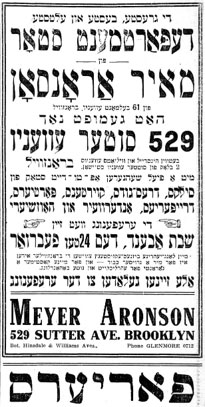
It wasn’t their only project by any means. In the Annual Report of the Brooklyn Federation of Jewish Charities published in 1916, Sheftel and Meyer Aronson’s names can be found in matters relating to the Glory of Israel Institute of East New York. The address given for both men is the same as it was on other documents: 529 Sutter Avenue. [17] There was nothing unusual about taking part in community projects. Between 1899 and 1904, the population in Brownsville had risen from ten thousand to sixty thousand, and contributions to the community’s welfare would have been expected among the vast numbers of skilled-tradesmen and business owners that made up these prosperous villages, but it suggests Sheftel was involved, superficially at least, in the furtherance of Yiddish issues. How passionate this interest was, and how much either of the Aronsons knew of his radical past, isn’t known. But then neither do we know the shape and texture of that radical past. We have a signature on a petition, nothing more.
Local charity records show that around the time that The Day Publishing Company was launched in 1914, Alexis Sheftel and Meyer Aronson were both sitting on the board of associates and directors at The Glory of Israel Hebrew Institute of East New York. Its headquarters, conveniently enough, could be found just around the corner from their mutual base at 529 Sutter Avenue in Brownsville. The school, which first opened its doors at 363 Pennsylvania Avenue in 1914, tasked itself with providing scholarly and spiritual outreach to local Jewish youths who were finding it hard to maintain their Jewish orthodoxy and their studies upon arrival in America. At the school’s opening in 1913, Secretary of the State of New York, Mitchell May was accompanied by its Secretary Abraham Kaplan, with both men eager to praise its ‘commodious and handsome structure’ and discuss its elaborate program of music and poetry. [18]
Aronson, the school’s director, would later be joined at the institute by Harry Godoff, another recent arrival from Zhytomyr in Ukraine. After becoming a successful dressmaker, Harry and his wife Anna would use their 24-room bedroom house at 340 Bradford Street to take in other refugee children from nearby villages back home. Harry’s granddaughter Ann Godoff would become a respected publishing executive with Penguin Press and Random House. The school itself was attached to the Glory of Israel Temple synagogue, also on Pennsylvania Avenue.
The Aronson family would subsequently become active in the development of the ‘Young Israel’ movement at its fund-raising base at 46 Moore Street in Williamsburg (Beth Hamidrash Hagodol) — a neighbouring Brooklyn district where Meyer Aronson and his wife Anna raised their young family of eight shortly after their arrival in the US. Jewish orthodoxy had been slipping among the young, and the group became the de facto organisation for introducing a more gruelling system of rules into the life of wayward young Jews.
In a bizarre and unlikely tease, there is another name appears on the list of the charity’s associates and directors below those of Aronson and Alexis Sheftel: L. Trotsky, 497 Pennsylvania Avenue (Brownsville) Brooklyn. Whilst it’s terrifically unlikely that it is THE Leon Trotsky, Trotsky is known to have visited the Brownsville district on his infamous trip to New York in January 1917 and retained strong ties with many of its leading radicals. The man is most likely insurance agent, Louis Trotsky (b.1860), another Russian national whose son Lester was enumerator in the district for the 1910 US census. Perhaps when looking for inspiration for names, Trotsky, whose real name was Lev Bronstein, drew upon friends and associates who may have made their way to Brooklyn ahead of him. Adding weight to the possibility is that less than five hundred metres away from The Glory of Israel’s ‘L. Trotsky’ at 479 Pennsylvania Avenue was Gregory Weinstein of 393 Hinsdale Street, Brownsville. The 37 year old Weinstein, born in Vilna in 1880, was the New York editor of Novy Mir (New World), the man whose newspaper Trotsky shared editing duties with during his short stay in New York in 1917. Sheftel and Meyer M. Aronson’s Sutter Avenue was just 500 yards in the other direction. During his three-month stay in New York, Trotsky would work side by side with Weinstein from the tiny brick cellar of 77 St Mark’s Place in New York’s Ukrainian Village on the Lower East Side, rubbing shoulders with the likes of Nikolai Bukharin and Alexandra Kollontai, the New York branch of Lenin’s Bolsheviks. The frenzied and electrifying circuitry of New York fascinated Trotsky. From Trotsky’s point of view, New York was “the fullest expression of the modern world” and when not writing reports, pressing leaflets or addressing meetings he would be foraging away in the city library or peering out from windows picking out clues on the spirit and character of its eclectic proletariat from the various passers-by.
That the Novy Mir’s Gregory Weinstein at 393 Hinsdale Street was little more than 500 yards from Alexis Sheftel at 529 Sutter Avenue begs the question: was Sheftel part of the welcoming committee that greeted Trotsky during his visit to Brooklyn shortly after his arrival in New York? To answer this, one really has to assess the options for previous encounters in London and to what extent Sheftel had ever been part of the revolutionary inner circle. If the pair had been introduced then the most likely period would have been when Trotsky, then Lev Bernstein, first arrived in London in 1902. At that time he was boarding at the so-called Iskra commune, a continental-style apartment house run by Vera Zasulich and Lenin’s London Lieutenant Nikolai Alexeev at 14 Sidmouth Street, a commune that would soon extend to properties on Regent Square and 23 Percy Street. The distance between these properties in St Pancras and Sheftel’s lodgings on Sulgrave Road would have been four or five miles but a regular schedule of lectures and meetings at the RSDLP’s Liberty Hall HQ would almost certainly have brought them together on a reasonably regular basis. Nikolai Alexseev, whose name featured prominently alongside Sheftel’s on the March 1901 petition was the man responsible for introducing Trotsky to London where he would assist Martov, Lenin and Axelrod in the day to day running of the Iskra journal. The doctor, who had mastered the English language before anyone in the group also assisted in acquainting all arriving exiles with the wonders of the Reading Room of the British Museum. The man responsible for arranging Lenin’s reading room permit, under the pseudonym Jacob Richter, was Konstantin Takhtarev, a good friend of Theodore Rothstein whose name similarly featured on the 1901 petition.
In January 1932 it was being reported that Sheftel and his son Abraham (George) had been arrested on charges of ‘booklegging’. According to the press, a complaint had been made by the American Society of Composers that Alexis and his son had unlawfully reproduced 10,000 sheets of sheet music. The pair were bailed on $1500 each. [19] By the mid-1940s, Alexis can be found living at 57 St Paul’s Place in Flatbush, Brooklyn and voting for the Communist Party of America. This continues until the mid-1940s when all trace of the man is lost. [20]
[1] ‘The Lusitania Bullion’, Lloyds’ List, November 2, 1907, p.10
[2] ‘The Lusitania Here’, New York Tribune, November 8, 1907, p.1
[3] Alexis Sheftel, Nov 2, 1907, Lusitania, Liverpool-New York (residence: 7 Priory Street, Hastings, relation (FRIEND): Mr Rabinovitch) New York City Passenger Lists, 1820-1957
[4] Alexis Sheftel, Hartford, Connecticut, 1909, Naturalization records (Hartford County, Connecticut), 1906-1945 NARA, RG21;
[5] World War I Draft Registration Cards, NARA series M1509, First World War.
[6] New York Times, August 29, 1909, p.1
[7] New York Times, 1924, p.25
[8] Muskogee Times Democrat, June 16, 1917, p.13
[9] Yekl: A Tale of the New York Ghetto, Abraham Cahan, D. Appleton & Company, 1896, pp.28-30
[10] The New York Times, September 5, 1920, p.30
[11] The Monthly Review, Volumes 1-5, 1934/ Catalogue of Copyright Entries, Part 1, Group 2, Volume 17, Issue 2, 1920
[12] Catalogue of Copyright Entries, Volume 24, 1927
[13] New Masses, January 8, 1935
[14] Philadelphia Jewish Exponent, May 22, 1914, p.6
[15] ‘Bourtseff Here to Hunt Down Spies’, New York Times, January 20, 1910, p.6
[16] The Brooklyn Daily Eagle, October 31, 1919, p.5
[17] Annual Report of the Brooklyn Federation of Jewish Charities, 1916, p.135-136
[18] Philadelphia Jewish Exponent, July 3, 1913, p.6
[19] The Republican, January 19, 1932, p.20
[20] The 1942 State-Wide Nominating Petitions and List of Signatures and Addresses which Appeared Thereon, Filed by the Communist Party with the Secretary of State in the State of New York, p.841