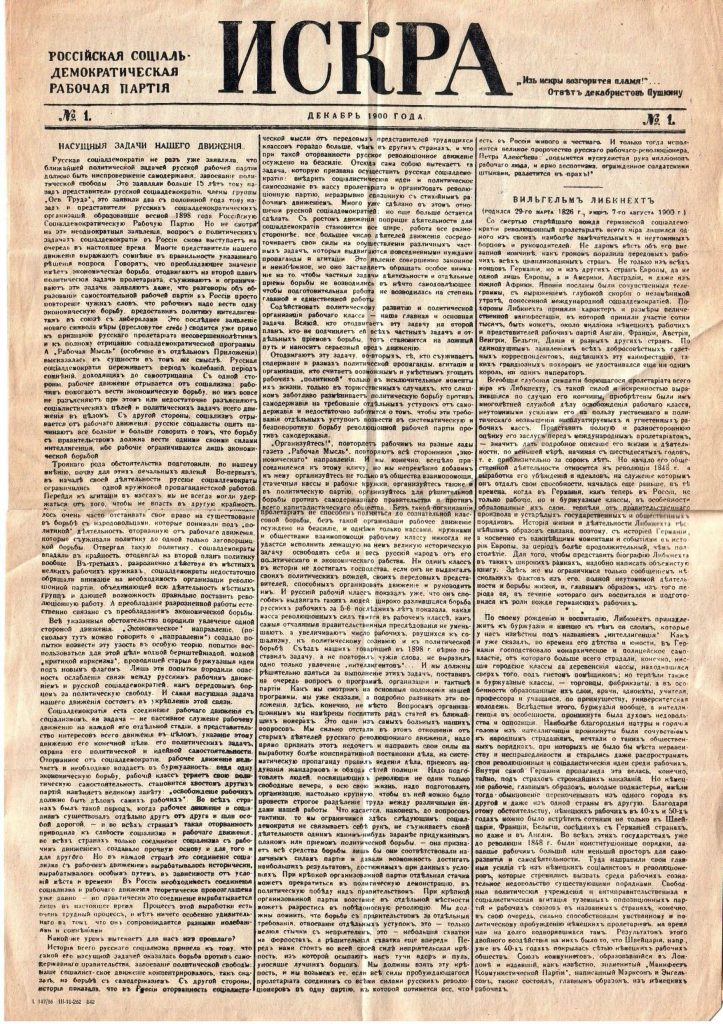
The socialist revolutionary, Leon Isaakovich Goldman, arrived in Kishinev (modern-day Chișinău) in May 1901, approximately two years before the infamous Kishinev Massacre, a murderous attack on Jews that was every bit as savage as the pogrom of October 7. Leon’s arrival in the town followed a secret trip to Munich, where he had met and fallen under the spell of future Soviet leader, Vladimir Lenin. The son of a Yiddish poet, he was known by his codenames, Akim and Leontev. Leon, or Lev as he was known to his friends, had arrived in Kishinev in spring that year, tasked with organising an illegal and very secret printing-press facility for Lenin’s Iskra journal. It was a hard ask all round. Lev had been used to a more lively, visceral atmosphere of students and intellectuals in Odessa. Here he felt he had little more than the dust and earth beneath his feet for entertainment. The only thing he had in common with many of the people here was his ‘Jewishness’. But whilst he’d been born into a prominent Jewish family in Vilnius, Leon had begun to dedicate himself more and more to the secular, godless drill of Revolutionary Marxism. That was in his bones now. That was his heritage. Kishinev was full of traders and full of farmers. It was where the fruits of its fertile lands were packed up and sold at market: the region’s capital of perishable goods. The 130,000 inhabitants were an eclectic but unremarkable mix of Bulgarians, Germans, Serbs, Moldovans and Greeks. Not even the wine made by the cart-load by the Moldovans was enough to provide a lift. Odessa had been like living in Rome or in Paris by comparison. He missed the sea there, he missed the ports and the constant tides of interesting people.
According to the memoirs of Nadezhda Krupskay, Lenin had gone to considerable lengths to establish a presence in Kishinev and had personally recruited Leon after being impressed with his management skills while serving at the Russian Socialist Democratic Party Headquarters in Paris. [1] Trouble, however, wasn’t too far away. In October that year, the press were reporting that a student at Kiev University, whose home was in Kishinev, had been arrested for a political offence and duly detained in the town awaiting his exile to Siberia. During his detention, a large contingent of students arrived from Kiev and Moscow and made a coordinated effort to free him. Before long, Kishinev was filled with over a thousand student activists massing in its small town centre, determined to prevent his transportation. Failing in their efforts to overwhelm the guards, the students are believed to have shifted the focus of their frustration on to the townsfolk and rioted, shouting ‘down with absolutism’. [2] According to one report, the editor of the Tsarist newspaper, Bessarabettz was beaten up in the street. The same editor would later draw attention to the more coordinated revolutionary element that had been raising the heat in the district. And as sensational as it sounds, it really wasn’t too far off the truth.
The Goldmans were something of a royal family in revolutionary circles. Lev’s brother was Bund leader, Mikhail Isaakovich Goldman (Mark Liber). His brother-in-law, Felix Dzerzhinky, would eventually become first head of the Cheka — the Soviet’s much feared Secret Police. Whether or not there was a connection between the arrest of the Kishinev student in October 1901 and the arrest of Goldman in 1902 isn’t clear but the timing is certainly curious. According to Solomon Chernomordik’s 1932 publication, The Bolsheviks on Trial, Goldman says the Tsarist Secret Police had seized the Kishinev printing plant sometime in 1901 and that the charges which Goldman and his comrades faced included ‘incitement to riot against the supreme powers’. [3] The documents seized during the raid seemed to relate to the student riots and every attempt was being made by the Police to tie it in with other local nuisances. During his trial, Goldman defended his mischief-making by arguing that these were not simple ‘riots’ but revolution “under the hegemony of the proletariat and led by Social Democracy”. The Social Democratic material that he had been printing he argued, had little in common with the criminal rioting experienced in the town and in Kiev. Goldman’s conduct at the trial was not uncommon among Lenin’s Maximalists. Not content to sit back into the relative sanctuary of a fragile, apologetic defence they would launch stinging attacks on the brutality of the system that had put them and their comrades on trial, and provided every justification for the actions they took. They were meting out instant justice to the Imperial regime and the capitalist system that maintained them. The spectacle at the trials was essential to the tactics and the programme of the Bolsheviks. This was no idle release of energy but a calculated piece of political theatre. The objective was to turn the tables and put the Imperial system on trial and give them an advance warning of the Social Democratic Party’s very precise and very capable long term ballistic programme. The Bolsheviks had to achieve at their trial, everything they sought to achieve whilst at liberty — “propagate the ideas and programme of his party and to call the masses to fight for the demands inscribed on its banner”. [4]
If the incarcerated student at the centre of the riots wasn’t Goldman himself, then it was almost certainly another student working at his plant. Goldman was kept in solitary confinement for two years and his case brought up behind the secrecy of a circuit court.
Whatever the exact truth of the matter, by January 1902, Goldman’s adopted hometown of Kishinev was one of sixteen additional cities and provinces placed under “extraordinary police supervision” by an anxious and underprepared Imperial Government. [5] The authorities were preparing for the grim realities of revolution. Under the terms of the new supervision order, local governors now had the right to close industrial establishments, award special penalties and expel anybody from any place without warning or any form of legal representation. The scope for preventative arrests would be increased, the length of time that suspects could be detained without charge would be increased. The inhabitants of Kishinev could be arrested and detained for even contemplating crimes of a political nature, and houses could be searched and documents seized at any time, the relentless, choking nature of which would destroy health and drive many others to suicide. [6]
Shortly before his arrest, a letter had arrived for Goldman from Lenin in Munich. Lenin was anxious to see Iskra develop from being a niche, underground publication to something that could ‘satiate the whole of Russia’. This would mean increasing its circulation: “Do you consider it essential that the existence of an Iskra print-shop in Russia be kept secret? That is to say: are you against our widely showing the Russian copy abroad?”. [7] Lenin’s message to Goldman in Kishinev coincided with the completion of his first major political work, What is to be Done? — an innovative project that sought to transform the crude reactionary nature of revolutionary discourse into a more organized political consciousness and shape the Russian Social Democrats into a highly disciplined and centralized party that would serve to sharpen the resolve of the proletariat. As Tariq Ali explains in his 2017 book, the Dilemmas of Lenin, anybody opening the pages of the book hoping to find “prescriptions for building an underground conspiratorial underground party” was going to be disappointed. The hit and run tactics employed by the anarchists were being rejected in favour of building a “clear-cut Marxist programme” that had far more in common with the German Social Democrat Party than the home-grown Socialist Revolutionaries. [8] Lenin’s model for success was to be based on a well developed press and an emotional, philosophical and theoretical framework that could take the energy forward. The ‘blunders of immature thought’ that characterized the hand-to-mouth activism of the factory workers would need shaping and perfecting, adding precise circuitry to spontaneous currents and bringing definition to dreams. It was about taking the various sparks and creating a common fire born from consciousness and not intuitiveness. [9]
As a result of Lenin’s suggestion Leon Goldman had increased production and raised their profile, a combustible affair at the best of times, but fraught with considerable danger given the state of “extraordinary police supervision” that the entire region had just been placed under. Was Lenin deliberately creating a spark that would see Kishinev erupt in flames? Was this the reasoning behind his request for Goldman’s Iskra to scale-up its operations and seek distribution of its copies abroad by smuggling them back across the border into Central Russia?
The future Bolshevik leader had worked long and hard at setting-up shop in Kishinev. It was never some random facility. [10] The brief had been simple: Goldman and the Russian members of the Iskra organisation should form a solid core and achieve a proper distribution of Iskra throughout Russia. The furore that followed his arrest ensured further traction among Kiev and Moscow students and further publicity throughout the region but it’s unlikely that this was Lenin’s primary motive. Goldman has his own suspicions too: “Lenin, perhaps without foundation, did not fully trust it [the Iskra organisation in Russia], he did not wish to be fully dependent on it. His own organization might suddenly emancipate itself from the editors and, exploiting the name of Iskra and its control of the equipment, might print some sort of heresy or its own flights of fancy” (XXX).” Goldman’s take on Lenin’s motives would certainly make a lot of sense. All Lenin’s efforts during this period had been put into centralising the power structures within the group and retaining tighter control of its membership and make it more impervious to penetration by the Secret Police. The disagreement at the Second Congress that saw the Russian Social Democrat Party split irrevocably into Mensheviks (the moderate majority) and Bolsheviks (the extremist minority) has often been dismissed as somewhat petty or ‘minor’. The truth was anything but; in fact it the basis for the rift was smack bang central to his centralising schemes. The issue related to membership. ‘Members’ of the party should be based around small elite executives who were actively engaged in organisational or distribution matters. For Lenin, it was not enough for members to simply subscribe to the basic principles of the party and lend their passive support. They must be actively pursuing the resolutions. The party was already too unevenly scattered and fragmented. Core membership of the party was to be centralised and closed. Its members should seek to engage an outer circle whose membership could only ever be ensured by “personal participation”. [11] Sadly, not all of the sixty or so people attending the congress shared Lenin’s view.
A Powerful rival
The arrest of Goldman in Kishinev by Kiev Police couldn’t have arrived at a better time. The young man’s increasing input into Iskra — the party’s vanguard publication — and its swelling popularity in Southern Russia was slowly transforming it into a creature of regional concerns and character. Reading between the lines of his letter, Goldman suspected Lenin of trying to impose corrective measures. But what lengths would Lenin go to, to ensure control of Iskra which had become something of a national pride in the south of Russia? Goldman had not been installed by Lenin in Kishinev. His arrival there had been down to negotiation. He was to a large extent autonomous. Like many of the exiles on Russia’s borders, he had provided support, funds and contacts. The issue had come to a head when an unusually broad and damaging series of arrests had prevented Goldman from printing Iskra for a time. Instead, he had focused his energies on printing the local political organ, Vpered. Writing to Inna Smidovich in December 1901, Lenin found it difficult to conceal his anger; people had been collecting huge amounts in funds to publish Iskra, and now one of its most trusted members had secretly deserted them for another publication. Readers and supporters were already complaining of the relative scarcity of copies in Russia. If the rumour was found to be true it was an “unbelievable perversity”. [12] Other regional and national related issues — whether it was Transnistrian or Ukrainian separatism or even ‘Jewry’ — were regarded as obstacles and challenges that would simply have to conform to central leadership or cede their gains and leave.
By the spring of 1902, the town of Kishinev was coming under a virtual lockdown. A pressure-cooker environment was developing, and frustration on all sides was being felt. With support from the Secret Police, local governors in the region would now have the legal presumption to act immediately on their own judgement without first seeking authorisation from officials in St Petersburg. [13] In May 1902 the already strengthened forces in the Kishinev area were further augmented by the addition of two more infantry divisions, with extensive manoeuvres being carried out in the south of the region under the supervision of General Sandetski. [14] In January 1903, a raft of economic restrictions were being heaped on Jewish businesses already crippled by commercial constraints. In Saint Petersburg, the Novoye Vremya was reporting that the Tsar was intending to prohibit Jews from purchasing agricultural products in the villages of Bessarabia and the sale of wines elsewhere.
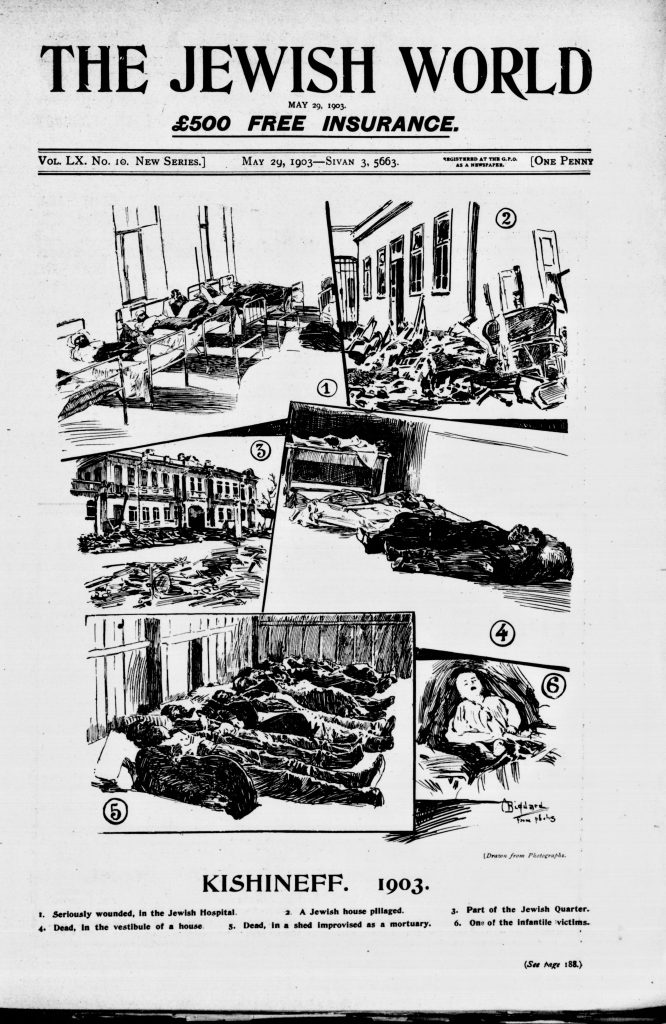
Goldman may have been moved on, but the impact of his work and the bolstering of a police and security presence in the region would probably lay the seeds of the one of the most dramatic events in Russian Jewish history: the Kishinev Massacre of 1903, an atrocity which would ironically enough, just happen to coincide with the outcome of Goldman’s trial. It may in fact be possible to trace the Revolution of 1917 and the birth of the Nation of Israel to the spectacular waves and frequencies emitted by this one extraordinary and savage event. The region had been a simmering cauldron of racial and political tension for years. All that it needed was a spark. As we shall see later, the famous ‘ten days that shook the world’ had their basis in a no less earth-shattering three-day killing spree during the Easter that followed the removal of Goldman. Was this some revolutionary big bang theory or just a case of history repeating itself?
Within months Lenin had shifted his operations from Munich to London where he would work on Iskra. It was whilst he was in London that he received news of the Kishinev massacre. As the young post-graduate, Philip Whitwell Wilson, hunkered down at Toynbee Hall and encountered the first shrill screams of Bolshevism, an ugly series of East End riots had erupted. A short time later, a rally was organised at the Great Assembly Hall in Whitechapel by the Russian Social Democratic Circle and members of the Jewish Bund and Social Democratic Federation. They had assembled with the expressed purpose of expressing their horror and anger at the massacres in Kishinev and at the framework of the Tsarist autocracy which had made it possible. The evening was co-chaired by Harry Quelch, the editor of Justice Newspaper whose printing press and offices at 37a Clerkenwell Green had been loaned over to Lenin’s Iskra. At the legendary 2nd Congress in August that year, the one that saw the Russian Social Democrat Party split acrimoniously into Lenin’s Bolshevik and Julius Martov’s Menshevik factions, the whole issue of Kishinev would take up centre-stage with the Bund requesting that their party be recognized as the sole representative of the Jewish working masses, a move that Lenin rejected, perhaps sensing the gradual dilution of a significant energy source and the creation of an obstacle to the ideological unity and “organisational rapprochement” that he now demanded within the party. With the Jewish Bund immediately severing ties with the RSDLP, the party’s response to the Kishinev pogrom was to adopt a resolution that would capitalize on the anger by framing it within the context of broader class division:
“In view of the fact that movements such as the all too sadly well-known pogrom in Kishinev, quite apart from the abominable atrocities they commit, serve in the hands of the police as a means by which the latter seek to hold back the growth of class consciousness among the proletariat, the Congress recommends comrades to use all means in their power to combat such movements and to explain to the proletariat the reactionary and class inspiration of anti-semitic and all other national-chauvinist incitements.”
— Russian Social-Democratic Labour Party Second Congress, Principal Resolutions
Trotsky, in one of the rare occasions in which he assumed his Jewish mantel with a certain amount of pride and high-mindedness, got right behind Lenin and provided just as robust a challenge to the Bund, whose series of unique requests regarding Yiddish-only schools threatened to introduce the kinds of inequitable schisms that would see their global mission fail. Russia was already too variegated a country pulling in too many directions. As far as Trotsky and Lenin were concerned, the route to lasting peace and freedom was having different nations to live together under “full democracy” and “full unity”. [15] Although quick to capitalise on the swell of media interest in Russian politics, the Kishinev massacres of Easter 1903 were being quantified rather differently. As deeply traumatic as they were, certainly to Trotsky, who was deeply affected by this and other massacres, the Kishinev atrocity was a) an attempt by the Tsarist regime to direct attention away from the failures of the Russo-Japanese war and b) an attempt to redefine and re-energise disharmonious cultural and religious distinctions that would inevitably shatter the mass political consciousness on which the Russian Social Democrats sought to launch a revolution. For Lenin, a trouble shared was a trouble doubled. Whilst the plight of the Jews themselves was not something he was likely to lose a great deal of sleep over, the sheer horror of Jewish persecution now registering around the world as it felt the “thunders of the ‘Kishinev massacres” was something he could use. By the time of the 2nd Congress in London in 1903, it was clear that the global upsurge in “mass meetings, manifestations and demonstrations” had provided “schools for solidarity and common action”. [16] When channelled into a single strike — and under one political consciousness — fury was an infinite resource that could inflict earth shattering damage on the instruments and centres of power. The smarter move, however, would be in refraining from a counter-campaign of violence that would weaken support globally and lead to an inevitable crackdown on Jews and Socialists alike.
Writing in Iskra in June that same year, Trotsky had explained his resistance to launching counter demonstrations on May Day. As he saw it, the authorities were preparing to use the provocation of mass unrest in Kiev to mount a region-wide crackdown. There was little wisdom in giving battle against the enemy under the very “conditions created by the enemy”. Resisting the urge to be drawn into a battle did not mean defeat; it meant leaving oneself intact for when a more favourable opportunity came knocking. A knee-jerk emotional response was, moreover, the obligation of ‘spasmodic revolutionism’. [17] How much this was based on strategy and how much on withholding support to and ultimately depleting the national and regional reserves of the Jewish Bund is difficult to fathom. Championing the injustices of a uniquely Jewish problem would give the Bund all the political expediency they needed at the forthcoming Congress. It’s certainly the case that the Russian Social Democrats in Kiev and Bessarabia had been queerly lacking in public outrage, with some appearing relatively indifferent to the event. Either way, the Russian Social Democratic Party withdrew from the May Day demonstration, whilst the Socialist Revolutionary Party went along with it.
[1] Reminiscences of Lenin, Nadezhda Krupskaya, Martin Lawrens, London, 1930. Translated by Eric Verney.
[2] ‘Disturbances in Russia’, Morning Post, October 22, 1901, p.7
[3] The Bolsheviks on Trial, Solomon Chernomordik, Modern Books, London, 1932, p.32
[4] The Bolsheviks on Trial, Solomon Chernomordik, Modern Books, London, 1932, p. 32-34
[5] Salt Lake City Herald, January 13, 1902
[6] The Tsarist Secret Police in Russian Society, 1880-1917, Frederic Scott Zuckerman, New York University Press, 1995
[7] Lenin Collected Works, Progress Publishers, 1974, Moscow, Volume 34, p.93
[8] Dilemmas of Lenin, Tariq Ali, Verso, 2017, pp. 84 – 85
[9] ‘What Is To Be Done?’, Vladimir Ilyich Lenin, The Spontaneity of the Masses, Lenin’s Selected Works, Volume 1, pp. 119 – 271
[10] Memories of Lenin, Nadezhda Krupskaya, 1931, p.42
[11] Lenin: Vol 1 Building the Party, Tony Cliff, Pluto Press, 1975, pp.105-118
[12] ‘Lenin’s Battle with Kustarnichestvo’, Slavic Review, Sep., 1964, Vol. 23, No. 3, Cambridge University Press, Allan K. Wildman
[13] Philadelphia Times, January 13, 1902, p.3
[14] The Times, May 20, 1902, p.3
[15] The Working Class & the National Question, Pravda No. 106, May 10, 1913
[16] Justice, December 19, 1903, p.3
[17] ‘More about the Tartuffes’, Iskra, No.41, June 1st 1903, L. Trotsky