In March 1901, a petition was published by a group of Russian exiles as part of a protest at the compulsory drafting of 183 students at Kiev University into the Tsar’s imperial army. According to a report that accompanied the petition, the same fate had befallen a further twenty-five students of St Petersburg University. According to the celebrated anarchist, Peter Kropotkin, the students had taken exception to the punishment meted out to a student who had been fined over some minor theft. A meeting was arranged, the rector was approached, demands were made and a skirmish broke out between the students and the Cossacks tasked with protecting the rector. According to Kropotkin, the students had done nothing more serious than take part in public meetings, but the Tsar’s government had clearly thought that a steady course of discipline at his majesty’s barracks was the kind of correction they needed. [1] The fear among Russia’s exiles in Europe however, was that a single unguarded word and instinctive rejection of command would bring the hot-headed youngsters under immediate court-martial and perhaps even death by firing squad.
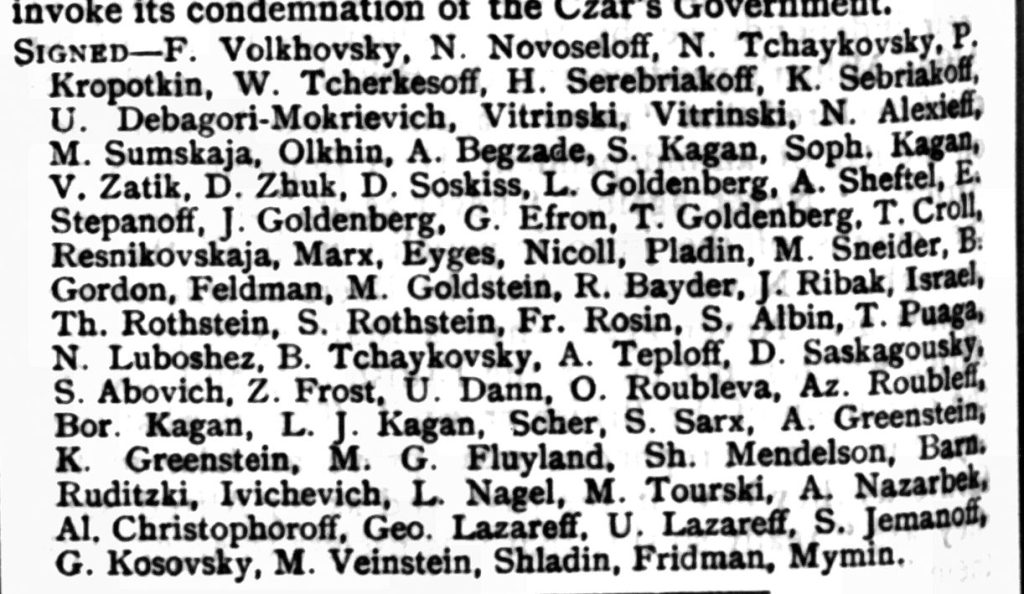
The names of those who had signed the petition comprised almost entirely of an executive commission of veteran Russian activists who had taken up exile in London and who were affiliated to varying degrees with the hugely influential Society of Friends of Russian Freedom. The names on the list included Feliks Volkhovsky (Socialist-Revolutionary Party and close friend of Sergey Stepniak), Nikolai Tchaikovsky (Socialist-Revolutionary Party), Warlaam Tcherkesoff (Socialist Revolutionary Party), Peter Kropotkin, Nikolai Alexieff (Alekseev), Theodore Rothstein, David Soskice (a colleague of Philip Whitwell Wilson at the London Daily News), Leon Goldberg (Secretary of the Society of Friends for Russian Freedom) and Alexei Teplov, founder of the Free Russian Library. [2]
Whilst many of these names are well known among Russianists and historians, there is one name towards the top of the list that until now has managed to dodge the attention of experts. His name is Alexis Sheftel, a compositor from Ovruch, a province in the north of the Ukraine. At the time the petition was published in March 1901, the passionate 20-year old émigré had found himself in London. The modest lodgings he had secured were at 67 Sulgrave Road, a handsome six-bedroom terrace in the Socialist utopia that was Hammersmith. His landlord at the house was paperhanger Joseph Alfred Barker and his family.
According to a 1903 Okhrana report compiled by Leonid Ratayev in Paris, Aleksei Feodorovich Aladin, the future Trudovik leader who would break away from the Socialist Revolutionary Party to take his place in Russia’s First Duma in 1906 could be found just a few yards across the road at 43 Sulgrave Road. Unlike Sheftel he had the good fortune of lodging with a likeminded host, as the property was the family home of Alfred B. Bradley, cycling and rambling organizer of the Hammersmith branch of the Independent Labour Party (Justice, 04 September 1897, p.5). In our efforts to understand the significance of Sheftel’s name appearing on the March 1901 petition, it’s probably worth noting that no fewer than four of the names would appear in Leonid Ratayev’s report for the Secret Police in 1903: Feliks Volkhovsky, Leon Goldenberg, Nikolai Tchaykovsky and Theodore Rothstein. [3]
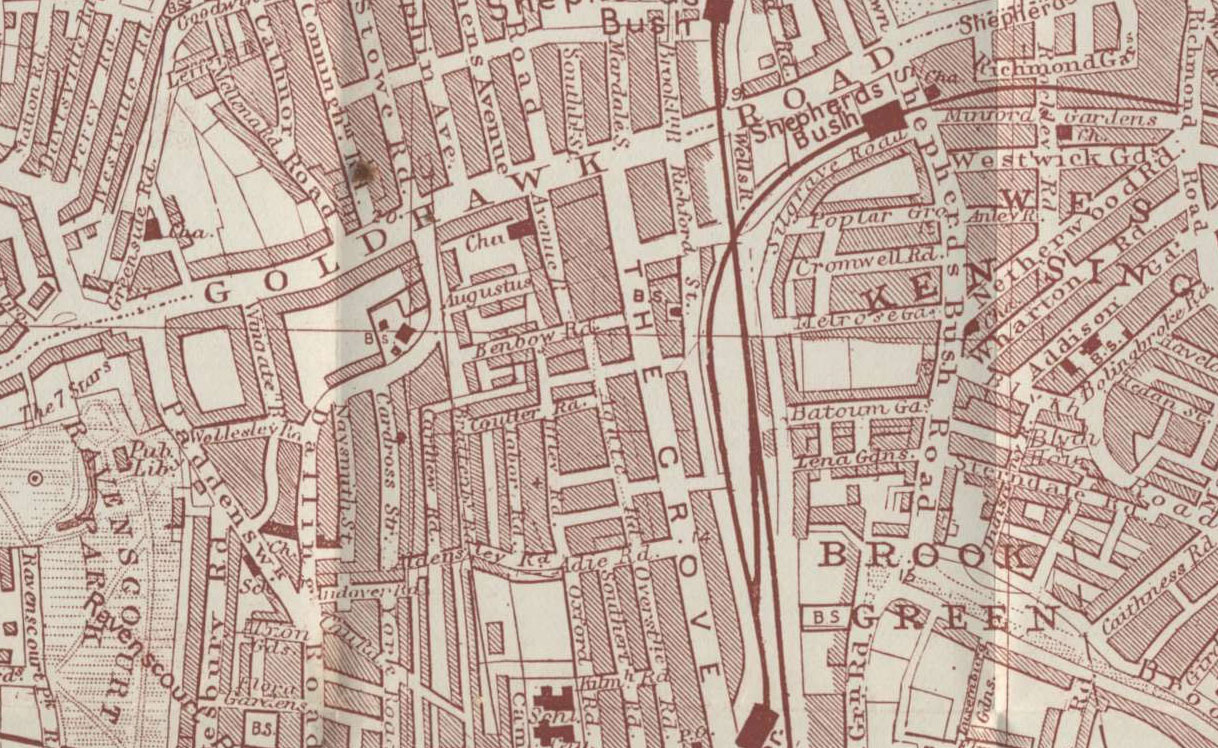
That Sheftel was living just a short walk away from Lazar Goldenberg at 15 Augustus Road in Hammersmith may be an indication that the 20 year-old compositor was working, for a short time at least, at the printing offices of the Russian Free Fund, whose periodical, Free Russia, Goldenberg was supervising. In the mid-1890s at the age of 42, the globe-trotting Jewish Socialist had relocated to London from New York and immersed himself rather quickly in the Fund’s publishing and distribution affairs at the Augustus Road address (now Brackenbury Gardens). Lara Green, writing on the blog site Peripheral Histories describes 15 Augustus Road as “the nexus of a vast and complex transnational network of revolutionary publishing and distribution”. From Goldenberg’s base, the Fund would distribute Russian revolutionary works right across Europe and America. Owing to its non-partisan arrangements and broad reformist outlook the Fund was able to appeal to a disparate range of groups and anti-Tsarist movements, making it something of a revolutionaries’ bureau of exchange. Among their scores of fervent customers were the British Museum’s Reading Room, small bookshops and lending libraries.
Robert Henderson, the former curator of the Russian Collections at the British Library, describes the Augustus Road address as one of the most important residences in Russian revolutionary circles [4]and that it was hardly surprising to find that the Okhrana’s man in London, Jean Edgar Farce was hunkered down and watching just a few minutes around the corner from his home at 11 Benbow Road. [5]
Whilst it’s the veteran Socialist Revolutionary, Felix Volkhovsky that tops the list of signatures, it’s two other names that I’d like to focus on now: Alexei Teplov and Nikolai Alexseev (shown in the image above as ‘A. Teploff’ and ‘N. Alexieff’). [6]
For readers who are not familiar with the rotating personnel who were active to varying degrees throughout these channels and outreach centres, Teplov was the founder of the Free Russian Library on Whitechapel Road, a floor-to-ceiling emporium of journals, books and newspapers selected to satisfy and inform the East End’s voracious radical masses. Although affiliated to the Fund this was Teplov’s labour of love. Needless to say he had an appropriate back-story, as most of the members did, having been jailed in 1890 over the notorious ‘Paris Bomb Plot’. The basics of the plot went a little like this. A group of thirteen students including Teplov and Evgeny Stepanov (also on the list of signatures) were arrested in the Gobelins quarter of the city after a bomb had exploded prematurely during testing. Goeblins, on the left bank of the River Seine, was at this time a Russian colony, a sanctuary for the thousands of Jewish immigrants who had been flooded from their homes after the murder of Tsar Alexander II the previous decade. In the year following the group’s arrest, a fire would sweep through the district, totally gutting the premises of its dazzling array of dye-makers, tapestry-makers and fancy-goods traders. Umberto Eco’s 2011 novel Prague Cemetery describes it as “a tangle of malodorous alleys, sliced in two by the course of the River Biévre” which emptied the bowels of the metropolis into the nearby Seine. [7] In reality it was a bit of everything, an imperfect jewel amongst the grime.
Teplov and Stepanov were taken in for questioning. A short time later a number of chemical substances were found by Police at a home-made laboratory the pair had constructed in the basement of their lodgings. It was subsequently ascertained that the compound they were attempting to prepare was panclastite, a Sprengel-type explosive. According to reports at the time of the incident, the revolutionaries had been seeking to build or else procure a small and stable device that could be easily transported but was guaranteed to detonate on impact. It was a largely experimental exercise and there’s little evidence to suggest that their plans to murder the Tsar was anything more than wishful thinking. To add insult to injury, it was subsequently learned that the whole thing had been conceived by Tsarist agent Abraham Landezen who had infiltrated the group in Paris. Introducing himself as Dr. Miller, to the well known revolutionaries Vladimir Burtsev and Iury Rappoport, Landezen assisted in preparations for an audacious attack on the Tsar. In demanding that they scale-up the operation through funding and support from other quarters, Landezen began to learn more and more about the groups operating between Moscow, Kiev and Paris. Through his sheer determination he was able to bag eight of the most resourceful revolutionaries.
Teplov had been under police surveillance ever since leaving Sebastapol a few months prior to the plot (The Latest News Of Nihilism, The Times, Dec 9 1890). The device was unsophisticated and its premature explosion had left him with a leg wound and his career as international terrorist was at an end. Nevertheless, Teplov was imprisoned and upon his release a few years later was promptly expelled from France. The names on the list of the March 1901 petition are not simply a random selection of advocates and supporters, or casually interested émigrés: they are a veritable ‘Who’s Who’ of Tsarist opposition in London at the beginning of the 20th Century. The names presented here are not just Russia’s most vociferous; they are also its ‘Most Wanted’.
Stepanov, one of those incarcerated alongside Teplov in the Maison de la Santé in Paris that year had likewise moved to England. At the time the petition was made he was residing at 103 Brooke Road in Hackney with Simon Kahan and his family. [8] Landing in London sometime in 1892, Stepanov could now be found assisting revolutionary ‘Sherlock Holmes’ Vladimir Burtsev — the alleged organizer of the Paris bomb plot — in his academic research, which was prolific, and his efforts to expose the vast seam of Tsarist agents operating within the Revolutionary movement. The fearless campaigning journalist would work tirelessly for years in exposing Tsarist oppression but the devotion of his aide-de-camp was no less unswerving. [9] That same year Stepanov’s closest partner in the fruitless scheme, Boris Reinstein would likewise slip to England before relocating permanently to New York. His skills in helping develop the explosive device in Paris appear to have come in handy as by 1900 Reinstein had set himself up as a chemist an established Russian colony, first in Cheektowaga and then in Buffalo, in Upstate New York. Upon his naturalisation as an American citizen in 1898 he would take a lead role in the American Socialist Party, before transferring his organisational skills to Lenin’s Soviet Government at the end of 1917, working directly under Trotsky in Military and Naval affairs.
The other man charged in the plot —Nikolai Alexseev — was one of the first people that Lenin visited upon his arrival at 16 Percy Circus at the end of April 1905. [10] At this time Alexseev was lodging just a few doors up the road at 23 Percy Circus, having found himself in charge of arranging accommodation for the thirty or so delegates of 1905’s Third Party Congress of the RSDLP. Lenin, representing the Odessa Committee was, as we’ve discovered already, enjoying the hospitality of Philip Whitwell Wilson and his family just a few doors along at No.16. [11]
On the second line of the list of signatures is Warlaam Tcherkesoff (Varlam Cherkesov) — lover of Pimlico suicide, Helene de Krebel who died within hours of Sergey Gapon (brother of the soon to be murdered 1905 Revolution leader, Father Georgy Gapon) being pulled from the sea in Hastings in March 1906. More intriguing perhaps, at least from the perspective of Scotland Yard and the Russian Secret Service, was a further coincidence. Alexis Sheftel, whose name appeared three lines down from Tcherkesoff, was living just a mile or so from the pier in Hastings when this rather chilling discovery was made. How Sheftel’s name came to be wedged so tantalisingly between Lazar Goldenberg of the Free Russia Fund and Paris bomber Evgeny Stepanov is a complete mystery. How Sheftel even arrived in Britain is a mystery. There was clearly value to be had in adding his name to the list of signatures but a good number of the other signatories were well established veterans, people of note. They had some gravitas, they had some form. Beyond a signature and a couple of press ads, Sheftel is totally missing from the historical record. If we were talking about those who featured on the cover of The Beatles’ Sgt. Pepper album, the 20 year old Alexis Sheftel would be somewhere between atrocious northern comic Tommy Handley and Hairdressers’ wax dummy No.2. We certainly wouldn’t be talking about the instantly recognisable faces of Karl Marx or Oscar Wilde. As far as history was concerned, Sheftel was a nobody. So why was his name there? And how did he end up in Hastings?
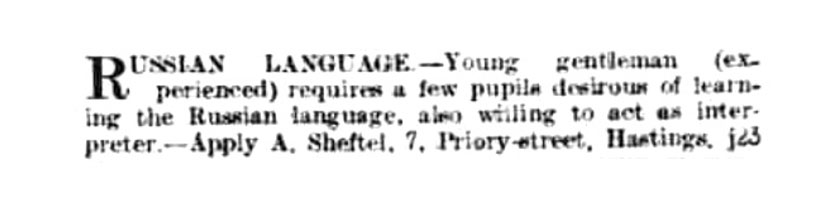
Something may be gleaned from a series of small ads published in a handful of local newspapers and journals between the years 1904 to 1907. The ads, amounting to little more than twenty to thirty words in total, appeared in everything from The Anglo-Russian and Free Russia to the Bexhill-on-Sea Observer and promoted Sheftel’s services as printer, translator and tutor in the Russian language. [12] Sometime in 1903 or 1904, Sheftel had moved from his lodgings on Sulgrave Road in Hammersmith to take up residence at 7 Priory Street where he resided until the autumn of 1907. This put him just a twenty minute walk from the groyne where police recovered the body of Sergey Gapon in March 1906. [13] Priory Street was also where Jaakoff Prelooker (an associate of Vladimir Burtsev and several of the people who signed the petition) printed copies of his popular émigré journal, The Anglo Russian Press.
The Kiev Student Riots
Practically nothing is known about Alexis Sheftel’s life prior to his move to America in 1907. We know from his naturalization and draft papers in the US that he was born in Ovruch, Ukraine on April 22, 1881 but any details about his life prior to 1901, or how he came into contact with the likes of Socialist Revolutionaries, Goldenberg, Teplov, Alekseev or even Prelooker are not forthcoming. [14] His young age precludes him from being among the circle of students and former-students rounded-up in Paris as part of the 1890 bomb plot so there was no chance of him being in England as the result of some mass expulsion order. There was a resurgence of anti-Semitism breaking out in Odessa during the summer of 1900 and a small number of Nihilist arrests had been made after a flurry of repercussions. A plot had been uncovered to murder the Tsar as he attended the Paris Exhibition in November that year and tensions were naturally high. As a result of investigations several arrests had taken place simultaneously at Warsaw, Odessa and Kiev, but the authorities had been unwilling to release further details. Trouble had been brewing ever since Police had taken an increasingly tough stance on censorship in the news. Small skirmishes were breaking out all over the Ukraine, with strikes breaking out among students. In Odessa a niggling quarrel between a soldier and a Jewish shopkeeper had escalated into a full blown riot when a mob had leapt noisily to the soldier’s defence. The mob subsequently invaded the nearby village, pillaging houses and shops, smashing windows and breaking doors. Those in Christian houses waved various holy images from the windows to safeguard their possessions from the furious rioters. In St Petersburg, Police had fired on another mob and over a thousand people had been arrested. [15]
Running parallel to the plot in Paris had been plans to stage to The Contrabandists, an anti-Jewish play, the performance of which had only been narrowly thwarted when a contingent of some 200 students stormed the offending playhouses in St Petersburg and Odessa. A series of violent riots followed at the universities in Moscow and Kiev in December. Over a thousand arrests were made after Police and Cossacks surrounded the campus. The Times of London reported that by January 4th 1901 over half of the students enrolled at Kiev University had been arrested and expelled. On each occasion the ringleaders were rounded-up and documents of a “highly inflammatory” nature were seized. It was determined that the various student riots had been coordinated. [16]
The March 1901 petition to which Alexis Sheftel, Goldenberg and Volkhovsky would add their names was over the forced conscription of 18 students responsible for unauthorized gatherings the previous December. In a fairly terse yet insightful interview with the London Daily News, anarchist veteran Prince Kropotkin provided a little more in the way of context. In the last few weeks of December a young student at Kiev was accused of theft. He’d attracted the interest of a “music hall girl” and was alleged to have taken some valuables. In an attempt to defend his honour, his friends arranged a protest but no practical resolution was arrived at. On hearing the news, the Tsar responded by banning all further public meetings and expatriating the ringleaders to Port Arthur where they were forcibly enrolled into military service. But this was only the start of his problems. He may have issued the orders but Ministers of State had told him the law could not be enforced, and whilst they may have stopped short of repealing his wishes, they refused to back the execution of it and asked for the students to be released. According to Kropotkin this was “the first time in the history of Russia” that the Tsar’s wishes had been overridden. [17]
None of the measures the Tsar and his people had taken to restore order went as smoothly as the authorities had planned. According to the Manchester Guardian back in England, the students had refused the oath of allegiance and were duly tried by court-martial and sentenced to death, only to be pardoned by the deeply frustrated and furiously adlibbing Imperial Government a few weeks later. The fate of the eighteen, the report went on, was “shrouded in darkness”, with the exception of one individual, the son of an official in a high-position, who had drawn the lot to murder the Jurist and University rector, Nikolay Bogolepov. Although it was the Kishinev-educated Count Sergei Witte who had conceived of the conscription regulations that sparked the actual riots, it was Bogolepov who had enforced them. The student was unable to follow through with the plot and committed suicide. [18] The decision was alleged to have been made by Grigory Gershuni of the Nihilist ‘Murder League’ (the combat arm of the Socialist Revolutionary Party maximalists) who had assumed part-control of the subsequent strikes and protests.
A few months later on February 10th 1901, the university rector, Nikolay Bogolepov, was shot in the neck by Socialist Revolutionary and former student, Pyotr Karpovich who had come to Kiev to present a petition. His weapon of choice? A .38 Smith and Wesson revolver: that deeply troubled symbol of the Free World of America. It wasn’t the first time the ‘Wild West’ gun makers had featured in such a plot. In March 1891 a young Ukrainian by the name of Skameikin had used the very same weapon in an attempt to murder Tsar Nicholas II. A special Smith and Wesson .44-Russian calibre No.3 revolver had been built to specification for the Russian Army by the company back in the 1870s. It was prefigured by a visit to their base in Springfield by the Grand Duke AlexeiAlexandrovich. As Russia prepared itself for war with Turkey, a more substantial order was made and some 5,000 barrels of rifle cartridges and 70,000 Smith and Wesson rifles for the Russian Government sailed on the A.J Pettingall in May 1877. [19] The original sale had been overseen by General Gorloff, Russia’s Military Attaché in Washington. A further shipment of 200,000 rifles followed. By 1900 virtually every officer in Russia possessed one of the guns as standard. A .32 calibre Smith & Wesson would later be used by anarchist, Leon Czolgosz to murder President McKinley in 1901.
Within weeks of the shooting incident, Bogolepov had died of his wounds. It was generally accepted that Karpovich had been tasked with the assassination by Gershuni and his anarchist hit squad. His trial was held in secret. A tip-off from their agents working abroad had informed Police that three high-officials had been marked for assassination. Karpovich was already under suspicion and being tagged, his watchers even having gone so far as to follow him into the building where Bogolepov was standing with the other officials.
In Britain’s press, the most substantial commentaries on the affair were provided by Sheftel’s co-signatory, Felix Volkhovsky and an anonymous ‘Russian Student’ who was clearly familiar with the tactics used by the Secret Police. The details provided by Volkhovsky’s special “informant” were clearly based on an eyewitness account. [20] Rumours abounded that a number of the students conscripted at Port Arthur had escaped military confinement. Several of the leaders of the follow-up demonstrations were also said to have evaded arrest, including Social Democrat Vlaimor Fridolin, who was believed to have helped coordinate the Kazan Square protest in St Petersburg with possible support from Lenin’s Iskra.
Had Sheftel, like Fridolin, been active as one of the leaders of the various Organisation Committees? Would that account for his fairly inconspicuous signature among the scores of hardcore veterans on the March 1901 petition demanding action? He would have been just twenty years of age at the time, the age of a typical undergraduate and there are few other convincing options that might plausibly account for his sudden arrival in the tight-knit revolutionary heartlands of London. If the censuses of the period are anything to go by he certainly wasn’t in the country with any of his family. In fact there was no one else with that same family name anywhere else in Britain at that time.
The petition the group signed wasn’t the end of it by any means. Back in London, Teplov was already making arrangements to hire the New Kings Hall on Commercial Road for a series of weekly lectures. Among those lining up for its inaugural addresses were Nikolai Tchaikovsky, Madame Kropotkin, David Soskice and Apollinariya Yakubova who was planning a special talk on the ‘Student Movement in Russia’. [21] A further explanation of the movement was provided at the Cliffords Inn Hall on Fleet Street in May, with Felix Volkhovsky’s taking the chair. Speaking as “one of the old Revolutionists exiled from Russia” he explained its evolution. The students were champions of progress and rapidly gaining traction among Russia’s working men; they offered hope. Recognising that he might not see it in his lifetime, he was like Moses in the land of Canaan, only able view it from afar, and “to contemplate its glories.” [22] The Student riots were, he argued, a ‘Russian Awakening’. A follow-up demonstration in Trafalgar Square was held in June with an extended message of support from Prince Kropotkin being read by Volkhovsky:
“From all the main cities of Russia the same news has been coming lately and is coming still. Peaceful unarmed crowds of students, men and women, are charged by the Cossacks. At St Petersburg — in one single day, the 17th of March — they have actually killed with their whips seven men, and wounded seventy-five men and thirty-two women.”
— Freedom, 01 July 1901, p.7
A few months later in October 1901, within weeks of a earthquake shattering the already fractured region, reports were emerging from Russia that another student riot had taken place, this time at Kishinev, where some of the severest of the shockwaves had registered. According to the press, a student at Kiev University whose home was in Kishinev was arrested for a political offence and duly detained in the town awaiting his exile to Siberia. During his detention, a large contingent of students arrived from Kiev and Moscow made a coordinated effort to free him. Before long, Kishinev was filled with over a thousand student activists massing in its small town centre, determined to prevent his transportation. Failing in their efforts to overwhelm the guards, the students are believed to have shifted the focus of their frustration on to the townsfolk and rioted, shouting ‘down with absolutism’. [23] According to one report, the editor of the Tsarist newspaper, Bessarabettz was beaten up in the street. The same editor would later draw attention to the more coordinated revolutionary element that had been raising the heat in the district. And as sensational as it sounds, it really wasn’t too far off the truth.
In the next two articles, I’ll take a look at Sheftel’s employer, Jaakoff Prelooker and the kidnap of the daughter of a prominent Russian police inspector that took place in Sheftel’s adopted home of Hastings and Bexhill shortly prior to his move to the United States — where we‘ll follow him next. There is also a Hastings spy caper that may provide additional context.
If you have any more information on Alexis Sheftel (b. April 22, 1881, parents Saul and Deborah, died New York) or his son, George Sheftel (February 20, 1909-1987) please get in touch. Alexis married Bertha Rabinowitz in 1908 in Manhattan, New York (b.1882 to Benzion and Chaye Rabinowitz (nee Buchel).
Recommended Reads
The Spark That Lit the Revolution, Robert Henderson, Bloomsbury/I.B Tauris, 2020
Vladimir Burtsev and the Struggle for a Free Russia: A Revolutionary in the Time of Tsarism and Bolshevism, Robert Henderson, Bloomsbury, 2017
Conspirator, Helen Rappaport, Hutchinson, 2009
[1] ‘The Passing Throng: Kropotkin Talks’, New York Tribune, April 2, 1901, p.7
[2] ‘A Protest, Condemnation of the Tzar’s Government’, Labour Leader, 30 March, 1901, p.6.
[3] Report by Ratayev, Okhrana, Paris to Department of Police, St Petersburg, 24 February 1903, Department of Police of the Ministry of Internal Affairs (МВД), Fond 102
[4] Vladimir Burtsev and the Struggle for a Free Russia, Dr Robert Henderson, Bloomsbury, 2017, p.26, p.24
[5] Jean E. Farce, 11, Benbow Road, Hammersmith, Fulham, London & Middlesex, England, 1901 England, Wales & Scotland Census
[6] Many of the names featured on the list are included in Dr Robert Henderson indispensable books, Vladimir Burtsev and the Struggle for A Free Russia (Bloomsbury, 2017) and The Spark That Lit the Revolution (Bloomsbury, I.B. Tauris, 2020).
[7] The Prague Cemetery, Umberto Eco, Vintage Books, 2012, p.1
[8] Simon Kahan, E. Stepanov, Hackney, London & Middlesex, England, 1901 England, Wales & Scotland Census , 1901 England, Wales & Scotland Census
[9] Stepanov, Evgenii, Revolutionaries, Hoover Institution, Okhrana Files Outgoing Dispatches, 1887
[10] The Spark That Lit the Revolution, Dr Robert Henderson, Bloomsbury/I.B. Tauris, 2020.
[11] 16 Percy Circus, St Pancras — 1905, Alan Sargeant, https://www.monocledmutineer.co.uk/16-percy-circus-st-pancras-1905/
[12] ‘Scholastic, Professional, Russian Language’, Hastings and St Leonards Advertiser, January 21, 1904, p.8
[13] ‘Defying the Sea’, Hastings and St Leonards’ Observer, March 17, 1906, p.10
[14] Alexis Sheftel, Hartford, Connecticut, 1909, Naturalization records (Hartford County, Connecticut), 1906-1945 NARA, RG21; Alexis Sheftel, Nov 2, 1907, Lusitania, Liverpool-New York (residence: 7 Priory Street, Hastings, relation (FRIEND): Mr Rabinovitch) New York City Passenger Lists, 1820-1957
[15] ‘Anti-Semitic Riots in Odessa Worse than Reported’, New York Times, 26 August, 1900, p.22.
[16] ‘The Russian Student Troubles’, The Times, March 15, 1901, p.3
[17] ‘The Russian Government and the Students’, London Daily News, March 4, 1901 p.6
[18] ‘Mysterious Fate of 18 Students’, Manchester Guardian, March 11, 1901, p.10
[19] ‘War Material from United States sent to Russia and Turkey’, London Daily News, June 15, 1877, p.5
[20] London Daily News, March 12, 1901, p.7
[21] The Spark That Lit the Revolution, Robert, Henderson, 2020, p.78-79
[22] ‘For a Free Russia’, London Daily News, May 2, 1901, p.10
[23] ‘Disturbances in Russia’, Morning Post, October 22, 1901, p.7