“I wouldn’t ask too much of her,” I ventured. “You can’t repeat the past.”
The Great Gatsby
“You can’t repeat the past?” he cried incredulously.
“Why of course you can!” He looked around him wildly, as if the past were lurking here in the shadow of his house, just out of reach of his hand.
With the possible exception of Benita A. Moore, Joan M. Allen, Tracy Fessenden and Thomas J. Ferraro, Scott’s biographers and critics have paid little attention to an examination of the author’s Catholic roots, and when they have, they have tended to look at how his novels and short-stories have repudiated those roots in some way. What I would like to do here is reassess that assumption. When F. Scott Fitzgerald announced that his third novel, The Great Gatsby, would have a “Catholic element”, many assumed it to have been lost when the writer discarded the novel’s prologue and published it separately as Absolution in June 1924. Scott’s biographer, Matthew J. Bruccoli, regarded by many as the ‘dean of Fitzgerald Studies’, believed it to be “entirely absent” in the novel. [1] And those who persevered with the idea continue to look for evidence in the finished novel for overtly Catholic symbolism, glib, parodic reprovals of his faith or perceive it as a “secularization” of those beliefs or, as Thomas J. Ferraro suggests, as evidence of the author’s Jansenism. [2]
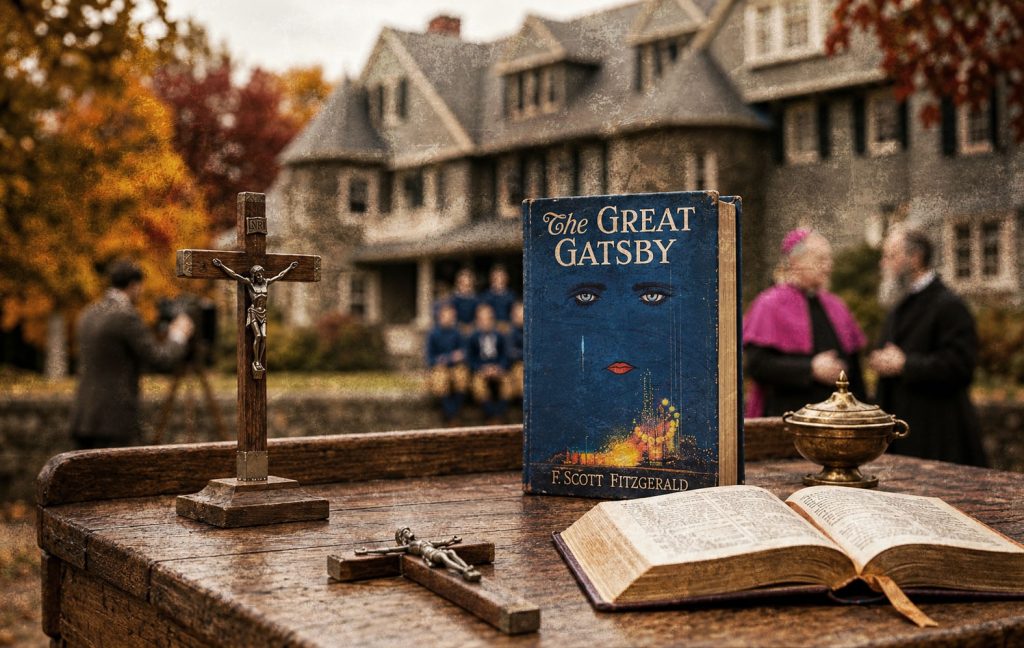
In taking a closer look at the depth and character of his Catholic upbringing, and the influence of ‘Americanist’ priest, Isaac T. Hecker, on the founding of Fitzgerald’s Catholic prep-school, the Newman School for Boys, I hope to show how the author’s work was less a repudiation of his Catholic faith and more of an attempt to extend, and perhaps update, the Modernist principles that Hecker and the Americanist movement had used to ‘humanize’ the Catholic faith in North America, and build on its notions of liberty and human ingenuity (‘genius’) that the group believed was vital to their dream of ‘perfecting’ the world. Nora Flynn, a friend of Scott, is reported to have once said that Scott “played hide and seek with the angels,” that he was, fundamentally, “a moralist and a very religious person. He kept his soul.” [3]
To the people around him, Scott’s attitude to Catholicism was mixed. Shortly before setting off on his Grand Tour of Europe in May 1921, Scott had contacted the Archbishop of Saint Paul, Austin Dowling, wondering if it might be possible to organize an audience with the Pope during his two-week stay in Rome. On June 3, Dowling had responded with a letter of introduction to Monsignor O’Hern at the North American College in Rome. In it, Dowling had described the Fitzgerald family as “staunch, devout and generous.” Fitzgerald was, moreover, “an author of talent and of wide celebrity.” Although he hadn’t had the pleasure of meeting Scott himself, the author, he told O’Hern, “desires greatly to see our Holy Father.”
What prompted Scott to make such a request isn’t clear.
Earlier that year, the Pope had published the ‘Enclyclical Sacra Propediem’. In it, Benedict had highlighted a crisis taking place among the allied nations and the dangerous, growing conflict between the social classes, noting that many of the Church’s fundamental Christian values had been “forgotten” after the war. Where morality was concerned, there was a growing sense of lawlessness, and the reality of the spiritual, the belief that there was something more precious in life, was being denied. The law had set law aside and the world was now dealing with the consequences. There were, he continued, only two dominant passions that now raised the spirit of man: the “unlimited desire of riches and an insatiable thirst for pleasures.” He even made special mention of the Shimmy and Charleston dances that were corrupting the world’s youth.
There were, Benedict maintained, ‘Five Enemies of the Human Race’ in the post-bellum period: ‘Challenge to Authority’, ‘Hatred Between Man and Man’, ‘Aversion to Work’, ‘Thirst for Pleasure’ and ‘Gross Materialism’. The thought of a lofty, groundbreaking discussion with Pope Benedict might have energised Scott’s spirits just as he was feeling that the peak of his domination was behind him. In his wildest daydreams he may have seen himself arriving in Rome as America’s best-selling author and offering the Church a rare opportunity to connect with American youth. As it is, we’ll never know.
On the surface of things, Fitzgerald was no longer a practising Catholic, but it is my belief that far from being a rejection of his faith, The Great Gatsby marked an eleventh hour attempt by the author to reconcile the firm beliefs of his youth with his more Modernist, post-Nietzschean energies and his admiration for Shelley and Keats to create a lasting American sacrament.
Feature length podcast (1 hr 5 mins)
Fitzgerald’s famous novel, which focuses as much on the continuities as on the discontinuities of post-war culture, functions not as a secular reading of Catholic ideology but as a more adaptive and effective carrier of what many Christians regarded as the church’s fundamental values — freedom, equality, tolerance and sacrifice — those “fundamental decencies” that the novel’s narrator identifies at the beginning of the novel. [4]
In an article written by Fitzgerald as he was deep into work on Gatsby, the author describes how “truth” itself was constantly changing. The ideals and conventions that made up the “milk” of one generation were very often the “poison” of the next.
We weren’t just handing down “discoveries” to our children, we were also passing on “delusions.”
The world that Scott had grown up in was in a terrible state of decay: “We have seen the war and its attendant ferocity, the hysteria both of the communists, and, over here, of the 100% Americans, the cheating of the wounded veterans, the administration corruption, the prohibition scandal.” Scott was now of the opinion that “the destiny of man” had reached its peak in the last decade of the 19th century when it had been “ideals” and “wisdom” that had occupied men’s minds, not the large quantities of “dust and rubbish” that amassed within them now. The “ideals of conduct” were, he lamented, in a state of “great decay”. Young Americans were on an ebbing tide. “It will be a strong heart that can fight its way upstream in these troubled waters”, he writes. [5]
In The Great Gatsby, the past holds on, and the future fades fast, with the author seeming to recognise that we have unconscious commitments to both, that our troubled little boats are obliged to sail on either current. The question I will be asking is not how much of the original ‘Catholic element’ is preserved in the novel, but to what extent the author broadens the scope of those Catholic dimensions.
In what I hope will be a more cellular look at the DNA of the Gatsby novel, I will bring in other materials such as books, news items, journals, lectures and public addresses that were concurrent with the composition of the novel and the author’s formative years at school. The first person I would like to introduce you to is Isaac T. Hecker, the outspoken Paulist priest and disciple of Immanuel Kant, who would provide spiritual inspiration to the founding of the Newman School For Boys, the post-Americanist prep school in New Jersey that F. Scott Fitzgerald would attend from the age of fifteen to seventeen (1911-1913).
THE GOSPEL OF SELF-RELIANCE
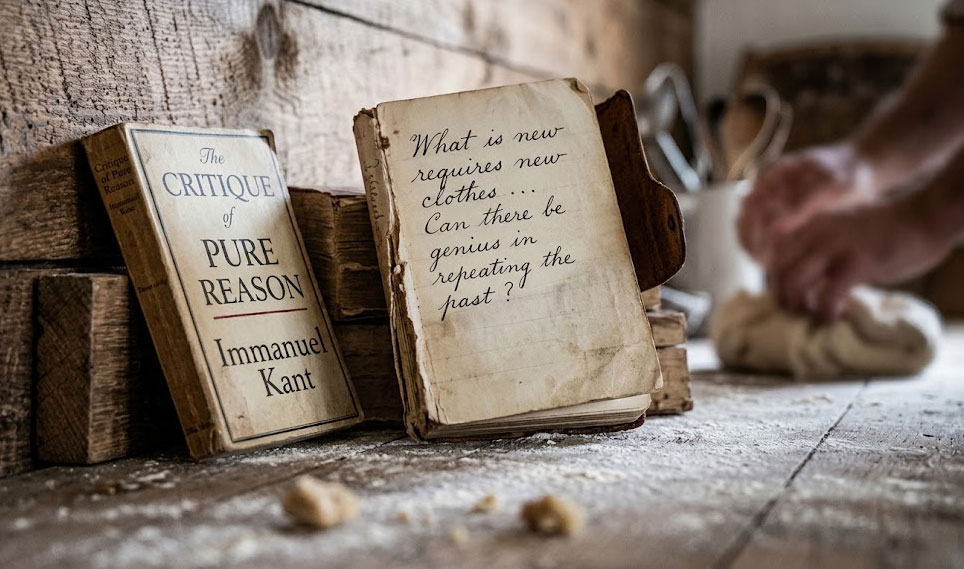
At the Transcendentalist commune, Brook Farm in July 1844, Isaac T. Hecker was wrestling with an inner voice that advised him that the only way for him to move forward on any intellectual or spiritual level, was by rejecting his past: “What is new requires new clothes … Can there be genius in repeating the past?” [6] Hecker reaffirmed this same belief after being ordained as a Catholic priest, this time extending it to the nation at large: “We cannot repeat the past … The new world promises a new civilization.” America was “young, fresh and in the vigor of its manhood.” The destiny of the nation was hanging in the balance and only a religion that could match its “true genius” could take it forward. Behind every real man was a belief that what is true for you in your private heart, is true for all men,—that is genius.” [7]
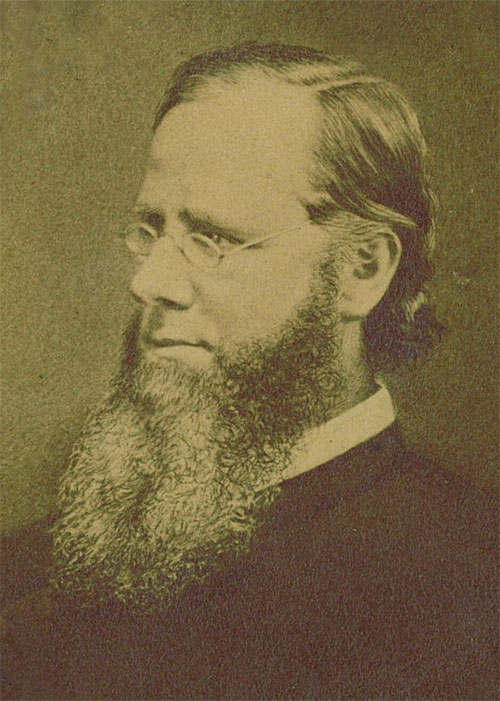
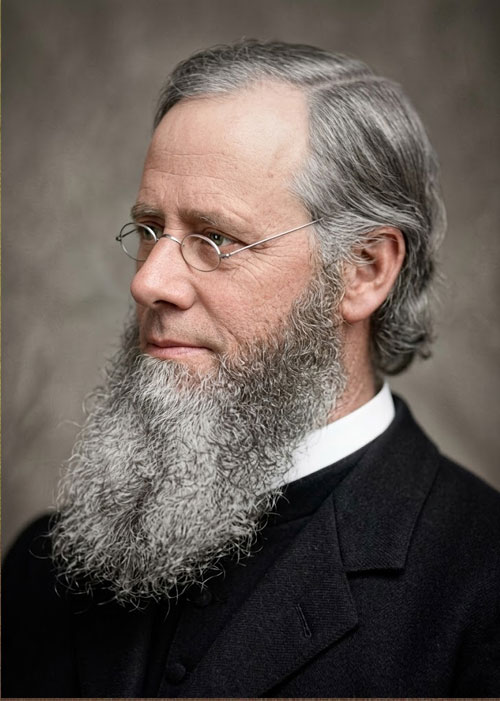
Like Emerson, Hecker believed that it was man’s duty to God to aspire to greatness, to reveal what was highest, divine and best in him. “Man hopes. Genius creates,” wrote Emerson. It looked forwards, not backwards. [8] Hecker had seen the same thing time and time again in the books that supported his studies. It was there in the pages of Shelley’s Prometheus Unbound and William Wordsworth’s Intimations of Immortality. Repeating the past without genius could only ever result in failure for civilisation.
The greatest moment in life was when the soul realised the untold capabilities it had in reaching beyond the earth’s boundaries. Once it recognised its goal, the soul would escape its chrysalis and fly like a butterfly. “America is the Future,” Hecker writes with a capital F. [9]
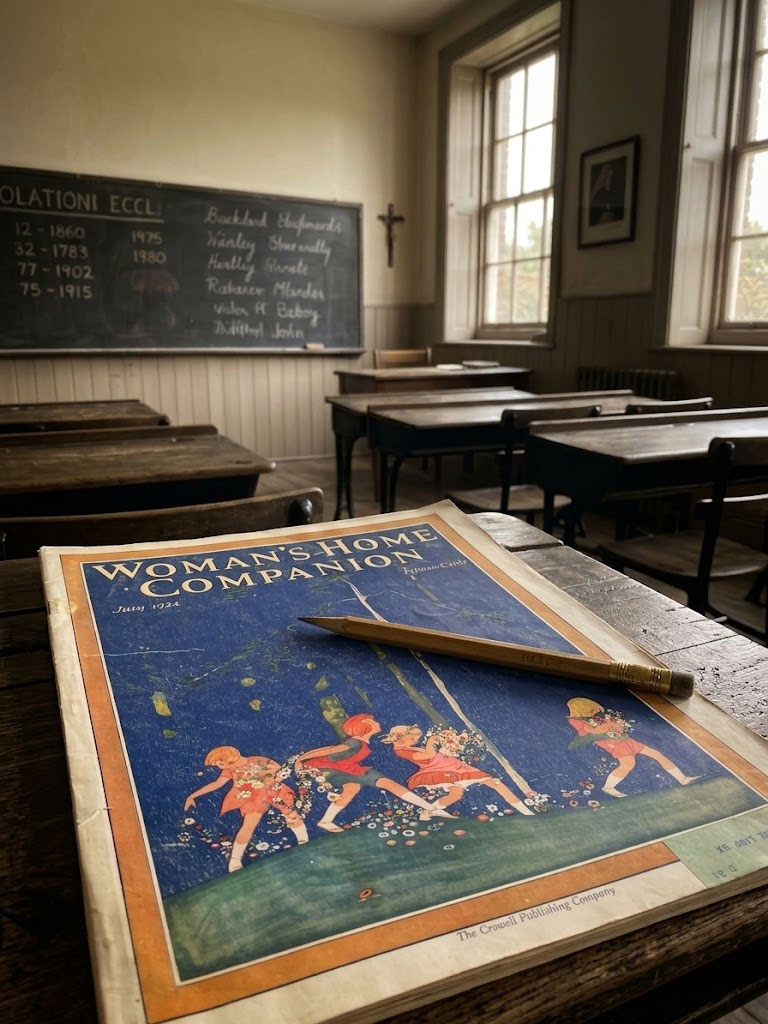
Compared to many of his contemporaries, Hecker remained remarkably upbeat about humanity’s prospects on earth. Man hadn’t been totally corrupted by the original sin. There was always that glimmer of hope. Scott would show his own support of Emerson and his principles of ‘greatness’ in an article he produced for the Woman’s Home Companion when he was in the process of completing Gatsby. Every great man that ever lived, the author moralises, had always “been alone in his heart.” The “story of great men” started with “self-reliance.” The world we created for ourselves should come from our “own convictions and standards.”
Scott would perceive this in the challenges faced by the “Russian Jewish newsboy on the streets of New York.” It was “being alone” that had given these boys their competitive, commercial edge. Unlike their soft, privileged counterparts, the difficult lives these boys had led had helped them understand how vast and merciless life could be. They were hungry for success. Among the few people he still thought worthy of inspiring us were radicals and free-thinkers like Emerson, John Henry Newman, Sigmund Freud, Friedrich Nietzsche and Anatole France. These “romantic men of great dreams” could still issue the “distinct call to something above and beyond life.” [10]
It was during his time at Brook Farm that Hecker had found himself torn between dedicating his life to the Catholic Church and staying with the community of enlightened romantics in this experimental, utopian commune. The 200-acre farm, located some eight miles south of Boston, was run by former Unitarian minister George Ripley and would acquire a sleazy reputation for indoctrinating the various drop-outs who made-up its rank and file with the most extreme forms of individualism and esotericism. Among its members was the author Nathaniel Hawthorne and the anarchist and abolitionist, Henry David Thoreau.
It was Ripley’s belief that the soul of religion lay not in doctrine or dogma of the conventional church but in the inner life of the spirit and the principles of democracy. In between periods of recreation at Coney Island, a magnet for all manner of religious dissenters, smugglers, pirates and pleasure seekers, the commune’s founder would encourage his followers to remake the world and religion in the true American spirit of self-culture, moving from the darkness of Catholic and Calvinistic pessimism, and the tyranny of the past, to the bright new world of tomorrow.
Time was important to Hecker. In a diary entry dated May 1843, the young student would write that the light of the past grew faint, whilst the light of the future filled his heart with a “glowing joy.” [11] This same sentiment would eventually find expression in Scott’s short story, Absolution, the intended prologue to Gatsby. As the clock ticks “insistently” in the “broken house “ of Father Schwartz, the priest can barely contain his excitement about the bright lights he has seen in the amusement parks: “When a lot of people get together in the best places, things go glimmering,” he stammers rhapsodically. [12]
In Gatsby, it is not the house that is broken but the old defunct clock on Nick’s mantelpiece that Jay accidentally tips over when he is finally reunited with Daisy. “Do you hear the hammer and the clock ticking and the bees?” the priest asks the boy. The sounds are intrusive and unwanted. They are the material world of the senses that distract from the priest’s transcendental memory of the big wheel in the park that glows with light (a Ferris wheel). [13]
When Jay is finally reunited with Daisy, it’s as if time stops still, but as the usual protocols of time resume, the huge creative investment that Gatsby had poured into this moment result in more losses than gains. His “count of enchanted objects” are diminished by one. [14] He has got the girl but lost the dream. He should have listened to the priest of Absolution: don’t get “too close” to the amusement park, he had warned the boy. If he did he was likely to feel only the “heat and the sweat and the life.” The boy was advised to stand a little way off “in a dark place, under dark trees.” [15]
The logic of what the priest is saying to the boy isn’t so difficult to work out; at the very moment that the experience came into contact with time, space and matter, everything that had given the scene such immense symbolic resonance — its joy — would be lost. The deep regard that Hecker had for the passing of time is repeated elsewhere in the novel. As a young James Gatz undergoes his metamorphoses into Jay Gatsby on Dan Cody’s boat on Lake Superior, he can hear the clock’s firm, enriching strokes: “A universe of ineffable gaudiness spun itself out in his brain while the clock ticked on the washstand.” [16]
It was during his time at Brook Farm that Ripley had introduced Hecker to John Anster’s translation of Goethe’s Faust. One passage in particular appears to have caught the group’s imagination: “Lose this day loitering … Seize this very minute, What you can do, or think you can, begin it; Boldness has genius, power, and magic in it.” [17] Of the three main states of time — past, present and future — it was the present that they valued the most. The only reality we had was now. The past, the Brook Farmers surmised, could only drag you back.
An entry in Hecker’s diary on May 16, 1844 reads: “The present is an eternal youth … hoping wistfully, intensely desiring … dimly seeing the bright star of hope in the future, beckoning him to move rapidly on, while his strong heart beats with enthusiasm and glowing joy. The past is dead.” [18] It was a torch that had been lit originally by Emerson: “A man should learn to detect and watch that gleam of light which flashes across his mind from within.” [19] For Hecker it was the big bright star of hope that beguiled him. In Absolution it is the light as big as a star that bewitches the priest. And in Gatsby, it is the green light at the end of the dock.
For each of these men, though, light is a manifestation of a supernatural presence, a twinkling spiritual world that would occasionally pierce the film of darkness that screened our mundane and earthly lives and drive us on; part-immanent, part-transcendent, part-within, part-without. “The spirit world is near and glimmering all around me,” writes Hecker. [20] There was gold in them thar stars.
Reading through the works of the American Transcendentalists, it soon becomes clear that the engine room of salvation was ‘genius’. It didn’t matter whether you were talking about saving America, like Emerson, or saving mankind, like Hecker. Genius was central to our survival as individuals and as a species. For the young Brook Farmers, America’s genius was its ‘can-do’ mindset, the pioneering and creative spirit that inspired every dreamer who had ever arrived on its shores.
This gospel of ‘Self Reliance’ is observable in the dog-eared schedule of daily resolves that Gatsby’s father presents to Nick at the end of the novel: “6.00 a.m., rise from bed, 6.15-6.30, Dumbbell exercise, 7.15-8.15, study electricity … read one improving book or magazine once per week.” [21] The logic that Hecker was applying was simple enough: if it was God that had given man his imagination and dreams of progress, then it was man’s moral imperative to keep moving forward.
Responding to this call, Hecker formed the Paulist Fathers in 1858, a breakaway Catholic movement that with the cautious approval of the Vatican would seek to bring millions of Northern Americans over to the Catholic faith in a way that preserved the core values of the US Constitution: the freedom to think, speak and act in any way that supported the basic mechanisms and ideals of Equality, Liberty and Progress.
Among the more orthodox Catholic pontiffs of France and Spain, Hecker’s group were viewed as a renegade group of ‘fake’ Catholics, peddling their own beliefs and values under the banner of the Church of Rome. The message these ‘dissemblers’ were pushing about finding one’s own path was viewed as nothing less than heretical: the church had its own path and that path was to be followed. Strict religious observance meant repeating the past on a daily basis. This would be achieved by maintaining the timeless traditions of liturgy: daily mass, confession, prayer, the sacraments and the observance of holy days and holidays. The cardinals and clergy of Rome held that laws and rules governing divine inheritance, the handing down of an absolute truth from one generation to another, was central to the preservation of the Church. Doing things in remembrance remained a powerful and vital means of communion with the past.
ABSOLUTION
When Scott sat down to write Absolution in June 1923, a tale he had composed to explain Jay Gatsby’s Midwest background, he seems to have been thinking along the same lines as Isaac Hecker: a new world required new clothes, or in this case, new armour. The 11-year-old Catholic boy in the story, Rudolph Miller, is attending his weekly confession. Hearing his confession is Father Schwartz, a priest with “cold watery eyes” whose grasp of reality is muddled by age, a fading memory and a palpable fear of his own earthly appetites.
The boy has a range of sins to confess, all of which are minor, from missing confession on one occasion, to swearing and smoking and having “immodest” thoughts of girls. The one sin that he has most trouble confessing, however, is his almost habitual reliance on lying. As a way of overcoming the shame that he feels in his lies, the boy creates an alter-ego: Blatchford Sarnemington. When he was ‘Blatchford Sarnemington’ he feels beyond all reproach. It was a “corner of his mind where he was safe from God.” Sitting there half-terrified and half-enthralled by the Priest’s ecstatic recollection of the lights at the amusement park, the boy fantasises of leading a troop of “German cuirassiers” during a cavalry charge at Sedan. [22]
Writing in 1973, William A. Fahey would dismiss the allusion to Sedan as “cheap and pretentious”, wrongly assuming that Scott’s only intention was to convey the glamour and romance of a teenage dream. Despite it being perfectly consistent with the way in which Scott presents Blatchford Sarnemington as the boy’s armour-plated inner retreat — his “garnished front” — Fahey suggests it fails in its “desired effect.” [23] I think Fahey couldn’t be more wrong on this point. Pretentious or not, the image provides a key to unlocking the inner conflict at the heart of the story.
Although it is not stated explicitly, the boy is not only a Catholic, he is also the child of German settlers. This colourfully imagined scene plays out at a figurative level the conflict the boy experiences between his moral fidelity to Rome and his loyalty to his German heritage. And the battle that Scott has chosen to represent this personal battle couldn’t have been more apt.
The Battle of Sedan, which was fought during the Franco-Prussian War in the late 1800s, was a decisive moment in the collapse of the Papal States. At the end of the Battle of Sedan, Rome was taken by rebel troops and declared the capital of a unified Italy. As a result, the Papal State was annexed and absorbed into the Kingdom of Italy. The global influence of the Catholic Church had been dealt a crippling blow. As a symbol of self-determination at both a personal and secular level, Scott’s allusion to the battle was a subtle, inspired choice.
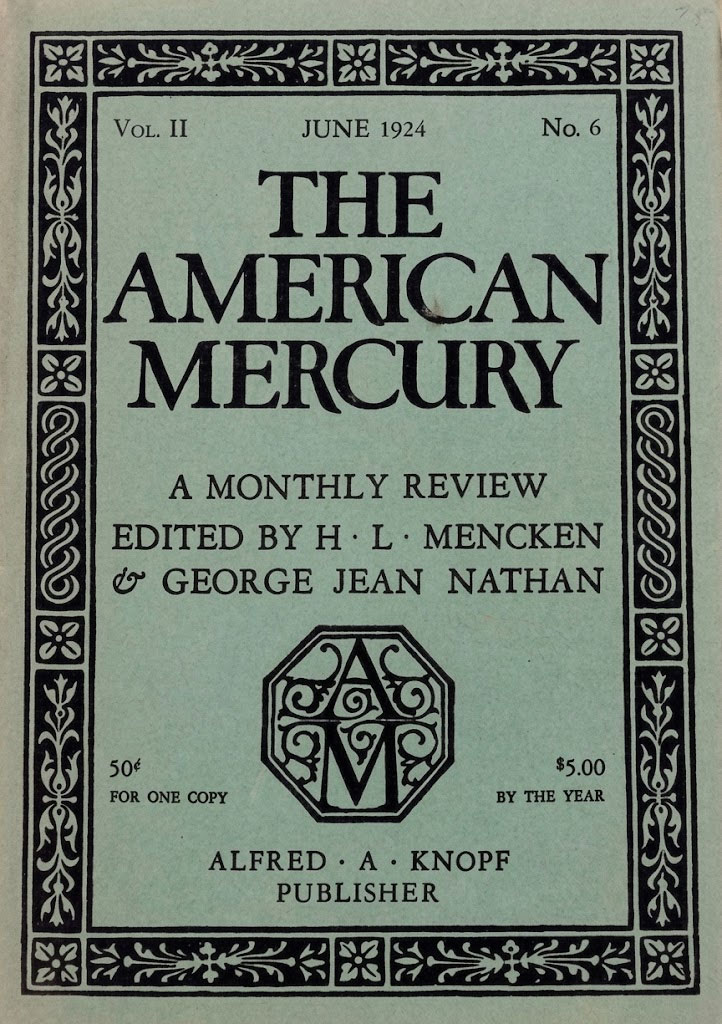
After the publication of Absolution in The American Mercury in June 1924, Scott was delighted to see that he had received two letters of protest from Catholic readers. Scott’s story had concluded with the priest, crippled by a lifetime of clerical oppression, collapse in a confused, babbling heap upon the floor. The reference to the Battle of Sedan, which marked the most far-reaching of Papal defeats, would only have compounded the insult. So why did Scott do this?
The explanation might be traced to the principles of American ‘genius’ celebrated by Isaac Hecker and his ‘Americanist’ Paulist movement back in New York: it was mankind’s duty to God to aspire to greatness, to reveal what was highest, divine and best in him. To be true to God, one had to be true to oneself. The boy is imagining that God has forgiven his original sin of lying for the high level of creativity that Miller has shown in the confessional box. Something rather profound has dawned on the boy: the route to redemption isn’t through some dull and automatous admission of guilt but through applying creativity to the challenges that God presents him with in life.
Beyond his moral obligation to God, the boy begins to feel an increasing sense of duty to his dreams and imagination. Suddenly, “there was something ineffably gorgeous somewhere that had nothing to do with God.” [24] Miller no longer feels guilty for having lied in the confessional box, but thrilled at having lifted its oppressive influence. If Scott had allowed the novel to progress as he had planned originally, this would probably have been the moment that the eleven-year old Rudolph Miller runs out of the church, travels north to Lake Superior and becomes Jay Gatsby — the white-suited ‘cuirassier’ of Long Island.
Scott’s eventual novel, The Great Gatsby repeats several ideas from Absolution — the ticking clock, the madness of four o’clock, the Swastika symbol, the ‘confessional’ role adopted by Nick and also the reference to the Canadian American rail magnate, James J. Hill. The narrator says of the boy’s father: “For twenty years he had lived alone with Hill’s name and God.” [25] Hill makes a memorable return in the final chapters of The Great Gatsby when he is mentioned by Mr Gatz: “If he’d of lived, he’d of been a great man. A man like James J. Hill.” [26]
What many people won’t know is that Hill wasn’t some remote figure of America’s industrial past that the author had only known by name, but a long-time friend of Scott’s mother’s family, the McQuillans back in his hometown of Saint Paul. Scott’s mother Mary was the daughter of a respected and successful merchant grocer, Philip F. McQuillan whose prosperity had been allowed to blossom away from the toxic racial prejudices that generally typified the Midwestern region. It was to Philip McQuillan that Scott and his family owed their highly regarded middle-class status, his grandfather having worked his way up from the very bottom in what was then one of the country’s more affluent Irish-American colonies.
By the time of his death in 1877, Philip’s hard work and talent for business had amassed him a very respectable $200,000 fortune. The success that he enjoyed would be nothing short of infectious. By 1880, the whirring cogs of ambition were almost audible in a town put together, by and large, by Scott’s grandfather, Philip F. McQuillan, Dillon O’ Brien, and the super-charged Catholic Bishop, John Ireland, whose efforts to re-locate and rehabilitate the thousands of refugees escaping to New York under the auspices of the Catholic Colonization Bureau had created a buzzing, dynamic atmosphere. [27] The man providing financial assistance to Ireland’s group was railway pioneer, James J. Hill.
THE MCQUILLANS OF SAINT PAUL
Whilst Scott’s father Edward gave the occasional indulgence to Scott’s literary aspirations by reading his son the restless, romantic poetry of Byron and the macabre mysteries of Poe, his mother Mary dedicated herself to redeeming the damage caused by his imagination with a schedule of moral instruction under the aegis of the Catholic Church. Mary and her sisters were continuing a tradition of lay ministry and support in the parish that had begun with her father and mother. The engine room of religious devotion in the McQuillan and Fitzgerald household was in the charitable activity of its elders, Louisa and Annabel McQuillan, then living at Laurel Avenue.
The success of their father, Philip F. McQuillan had made them pillars of the community.
Continuing the work that Philip had started with John Ireland and Dillon O’Brien, the women donated generously to the building and decoration of several major churches, including St Mary’s Church in Lowertown, Saint Paul. An appreciative report in the Daily Globe in May 1889 described the church as one of the most beautiful in the city, pure Norman in style with arched-windows, heavy flanking buttresses and frescoed ceilings and walls. Flanking the chancel on its gospel-side was an altar of St Joseph and opposite, a large white marble font that had been kindly donated by Scott’s aunt, Annabel McQuillan, the first person ever to have been baptised in the church. A large crucifix had been donated separately by Scott’s grandmother, Louisa. [28]
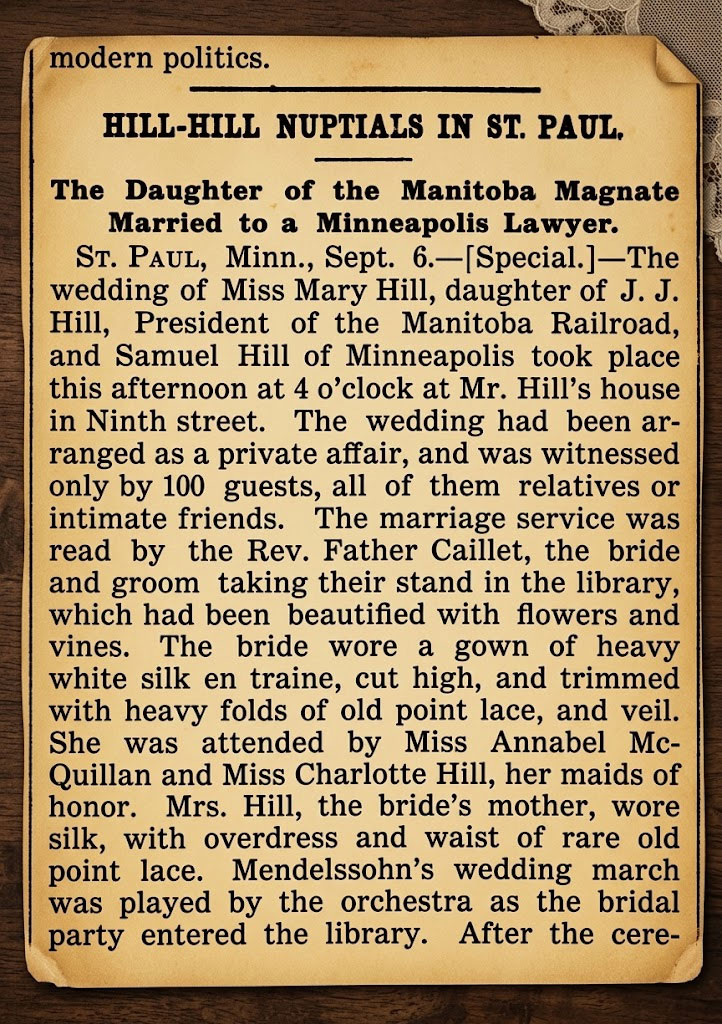
A report in the Saint Paul Daily Globe from September the previous year also reveals that Annabel had been maid of honour at the marriage of Samuel Hill and Miss Mary Hill, daughter of ‘the great James J. Hill’. [29]
The construction of St Mary’s Church had been an attempt to unite the more aristocratic Catholic immigrants from France with their socially ‘inferior’ Irish neighbours. Much to the frustration of the McQuillans, equality couldn’t even be relied upon among the Catholics of Saint Paul. The Protestants had only been half of the problem. The pandemic of heresy that had broken out among liberal Americanist priests like Bishop Ireland had caused a schism in the church.
The drama that Catholicism now faced at an existential and global level was being played-out in miniature in Scott’s hometown: the American-heritage Catholics were anxious to move forward whilst their European counterparts were determined to preserve the past. Both camps had their own idea of Newton’s third law of motion: if a boatman wants to move the boat ahead in water, he has to push the water backwards. The Americanists were pushing the water backwards against the current and the traditionalists were letting the boats drift idly on the Romanist tide. The gothic affectations of St Mary’s Church and Father Cailett’s close proximity to the Hill and McQuillan families was an attempt at gluing the various ethnic factions together. [30]
A novel that Hill and Philip McQuillan’s friend Dillon O’Brien published in 1866, The Dalys of Dalystown, told the classic New World ‘famine-to-riches’ story with a reflection on the past not totally out-of-step with Gatsby, the narrator of the book confessing that America cannot be a true home to him whilst his roots remain deep in his native land. There’s a scene right at the end of O’Brien’s novel in which its hero, having made his fortune in America, returns to Ireland to reclaim his family mansion. In the calm light of the evening he sees the old place “stretched out before him … the gray turrets and gables peeping through the trees.” Its rusty gate is broken off its hinges and the entrance to the house is worn and neglected.
The Great Gatsby’s narrator, Nick Carraway is confronted with an equally haunting image when he pays a visit to his dead friend’s house in the final chapter of Fitzgerald’s novel. In Dillon’s book, the no less reflective narrator goes on to describe “the sudden, unaccountable sadness that frequently accompanies the realisation of our hopes.” [31]
As we see in The Great Gatsby, the toxic combination of impossible dreams and the stifling grip of the past, prove fatal to its hero. Writing in the Church and Modern Society in 1896, Dillon and McQuillan’s friend, the Bishop John Ireland, delivered a no less cautionary message: “I bid you turn to the future … the past our father’s wrought; the future will be wrought by us.” [32] The spirit of America wasn’t about repeating the past exactly, but adding something to it.
LIKE KANT AT HIS CHURCH STEEPLE
Walter Elliott once painted a memorable picture of Isaac Hecker kneading at the dough trough at Brook Farm with a copy of Kant’s Critique of Pure Reason propped up on a wall in front of him. [33] In it, Hecker would have found that the philosopher had laid out his belief that genius was the very opposite of imitation. The goal of a genius wasn’t to obey existing rules but to create new rules. But herein lay a paradox: the creative imagination relied on existing rules and paradigms (and even language) to communicate; it simply couldn’t escape the past. Nevertheless, it was this observation by Kant that would inspire Hecker to write in his diary: “We cannot repeat the past.”
When a nervous Jay Gatsby finally reunites with Daisy in Chapter Five of the novel, Nick waits on the grass outside staring up at the huge, “incoherent failure of a house.” Any creativity shown by Gatsby is purely imitative and his ludicrous palatial home reflects this; it is a “factual imitation” of a large gothic château in France (the ‘Hotel de Ville in Normandy’). This highly conspicuous property appears to have had its real-life equivalent in Alva Vanderbilt Belmont’s Beacon Towers, a scaled-down replica of the Abbey of Saint-Étienne in Caen, Normandy. Like Gatsby’s mansion, Beacon Towers enjoyed a beach-side location and could be seen at the northernmost tip of Sands Point, just across the bay from the author’s house in Great Neck. [34]
Scott writes that Nick stares at Gatsby’s house “like Kant at his church steeple.” The author had made a very similar reference in his second novel, The Beautiful and Damned. On that occasion, Maury Noble is dismissing the efforts of a friend to “pierce the darkness of political idealism with some wild despairing urge toward the truth.” To make his point, Maury makes a thinly veiled allusion to Kant’s habit of looking up at the steeple of Löbenicht Church in his hometown of Königsberg in an attempt to focus his thoughts. [35] Scott’s character dismisses his friend’s efforts as futile. He was wasting his time, sitting in his chair, “infinitely removed from life”, staring at the tip of a steeple through the trees, “trying to separate the knowable from the unknowable.”
Catholic historians like Bob Scribner have sometimes described this process as a ‘sacramental’ way of seeing. The religious observer will look upon the divine image in a lingering, contemplative way, hoping that some eternal truth will make itself manifest in phenomena. Scribner writes that it “combined in a single action Luther’s idea of ‘looking through’ the physical image and the mystics’ notion of ascending from the sensual to the divine.”
The “sacramental gaze”, as Scribner called it, represented an intense and emotional “passion to see”, that went beyond traditional Augustinian notions of “mystical seeing” to something that was closer in spirit to the epistemology of Kant, in which religion is brought back to the realm of experience. [36] For the sacramental observer, things that were present in the Eucharist were not symbolic or metaphorical but real and substantial. They restored a ‘real’ divine presence (Kant’s ‘ens realissimum’).
The Kantian idea that Maury is referencing was central to the controversy that surrounded Modernism in the Catholic Church — the notion that whatever truth there was in the world could only ever be received subjectively. [37] In the last thirty years of the 19th Century, Catholicism in France, America and Britain was receiving a critical update that had drawn its inspiration from the pantheistic notions of immanence and transcendence explored by the Romantic Poets and philosophers like Immanuel Kant.
The point that Maury Noble is making in the novel is that even if humankind were to make every effort to have an unmediated, objective experience of God, it is only ever possible to receive it subjectively. The material world we lived in and everything that lay beyond it was being constantly reduced and filtered by our sensory organs, our own biology. As Johannes Artz explains in his study of Kant and Newman, “The noumena themselves are given to us in a shape which corresponds to our subjective structure.” [38] Much like the “romantic speculation” that Gatsby inspires amongst his guests [39], the truth was being shaped to the patterns of our own individual consciousnesses.
n Critique of Pure Reason, Kant had put forward the idea that experience was comprised of two distinct phenomena: the mode or channel of experience and our sensation of them. It was Kant’s belief that the human mind came pre-installed with a spatial temporal lens that allowed us to apprehend the material world. There was the projector (the eyes) and there was the screen (the mind’s eye or the brain). Stimuli was received and the ego duly shaped it, the former having properties in space and time that could not be degraded to mere ‘illusory experiences’. [40]
The top and bottom of it (in Kant’s estimation at least) was that the books in Gatsby’s ‘Merton College’ library wouldn’t disappear as soon as Nick and Jordan left the party. The rich, enchanted world that Gatsby has fashioned from his own “fantastic conceits” has been rendered ‘real’. [41] They existed as real substances, having moved from the world of appearance to the world of ‘phenomena’. It’s an idea that Scott develops as Nick and Jay race across Queensboro Bridge into the bewitching emerald city. Time and space have become more relative: “Anything can happen now”, thinks Nick as they enter New York, “Even Gatsby could happen, without any particular wonder.” [42]
Inevitably, the novel’s efforts to explore the metaphysics around the philosophy of perception are filtered through the not always fastidiously academic brain of Fitzgerald. As the philosophy adapts to the chaos of the drama that unfolds, few if any of these complex theories are left intact: they are confabulatory, at best. They are Scott’s idea of somebody else’s idea of what Kant means, what Nietzsche means or what Einstein means. Whenever the author doesn’t understand something, or doesn’t agree with something, he modifies it or combines them with more contemporary patterns of thought. The principles of stack influence weren’t lost on Scott: “Spengler stands on the shoulders of Nietzsche and Nietzsche on those of Goethe,” he would tell The New York World. [43] Scott wasn’t alone in any of this. The degree of competence in interpretations of such philosophies varied considerably across the board.
Whatever faith the author had in Kant’s Transcendental Idealism completely collapses at the end of the novel. Or does it? As Gatsby slips blithely into his pool, the pale, shadowy figure of Wilson glides towards him. Suddenly the sky looks “unfamiliar”, the leaves look “frightening”, the sunlight looks so “raw” and the roses that had once looked so beautiful, now look so ‘grotesque’. Wilson has torn open the veil of perception and the noumenal world comes flooding in. In the end, the spatial and temporal processes of cause and effect destroy Gatsby’s world. Reality has broken through. It is a “new world” that Gatsby dies in, one that is “material without being real” — suggesting that the dreamworld that Gatsby has been inhabiting for the best part of five years is somehow more real — and certainly more satisfying — than anything experienced by Wilson, Buchannan or any of his friends and neighbours.
It’s a fairytale world that Gatsby inhabits. This is clear at the very beginning of the novel when Nick’s arrival in West Egg is conveyed with all the creepy enchantment of a Brothers Grimm folktale. Nick is like Hansel and Gretel. He’s lost his way and finds himself in some “weather-beaten cardboard bungalow” nestled among the trees whose leaves burst miraculously into life upon arrival. [44] He never planned to come here. He has drifted here.
Nick Carraway is a man with no manifest destiny at all, a casual traveller with a casual lifestyle drifting aimlessly through his life, his loose-grip on the past marked by some doubtful claim of kinship to some long lost Scottish clan and a sentimental reluctance to let go of the romance of the war. If he’s not being physically manhandled by Tom, he’s being bundled onto the sofa with Jordan by Daisy. “I am slow-thinking and full of interior rules that act as brakes on my desires,” he confesses. [45]
Nick spends much of the book in some debilitating semi-hypnotic state, unable to make the simplest of decisions. He feels like he’s entangled in ropes, and these ropes keep pulling him back. There’s enchantment on the one hand and repulsion on the other. [46] It’s part-Midsummer Night’s Dream, part-Hansel and Gretel and part-Life in the Woods by Henry David Thoreau (1854). It’s a haunted and magical place — a place full of ghosts. There’s old owl-eyes breaking into “ghostly laughter” in Gatsby’s library (110), Gatsby’s “ghostly heart” (116), the keys of a “ghostly piano” (176), “ghostly birds” singing among the leaves (182), “poor ghosts” drifting “fortuitously” about Gatsby’s pool in his final moments (194), the Old Metropole “filled with faces dead and gone” (184), the “fantastic conceits” that “haunt” the young James Gatz (119).
But more interestingly, there’s the “haunting loneliness” felt by Nick in the “enchanted” twilight of New York (69). Like Gatsby, the thing that really haunts Nick is himself. In fact, it may be possible to argue that Nick’s quest in the novel isn’t to learn the truth about Gatsby, but to learn the truth about his own inner self. Even the “most intimate revelations” are “usually plagiaristic and marred by obvious suppressions”, surmises Nick, right at the start of the novel. Tracy Fessenden identified much the same idea in her 2005 essay, F. Scott Fitzgerald’s Catholic Closet. What we find in Gatsby is “identity as performance.” The “unspoken desires” of people are “layered in unspoken losses.”
Gatsby’s closet of gaudy shirts is where our “shadow selves go.” It is where we store our artifice. [47] “If personality is an unbroken series of successful gestures, then there was something gorgeous about him,” writes Nick. [48] His friend is quite literally a motion picture, a sequence of potent frames projected rapidly and rather beautifully upon a silken white screen.
‘Personality’ was an idea that Scott had addressed very memorably in his first novel, This Side of Paradise. Recalling a conversation the author had had with Father Fay whilst at Newman (Monsignor Darcy in the book), a rather sharp distinction is made between a ‘personality’ and a ‘personage’. A ‘personality’ is the person you thought you were, an echo of other men’s thoughts. It was a “physical matter almost entirely.” [49] A “personage”, on the other hand, was able to express one’s constant inner core, one’s inner resolve, something that went beyond the narrow, defining limits of ego and be of lasting value to all mankind. And it was this inner core that glowed
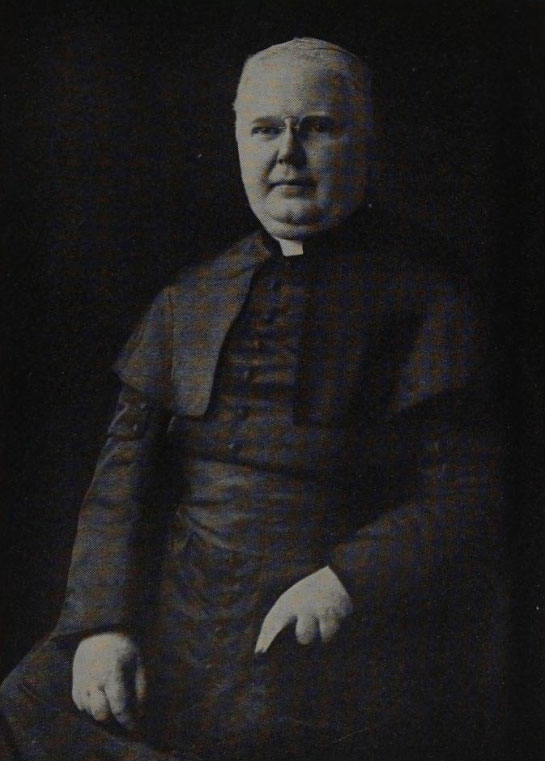
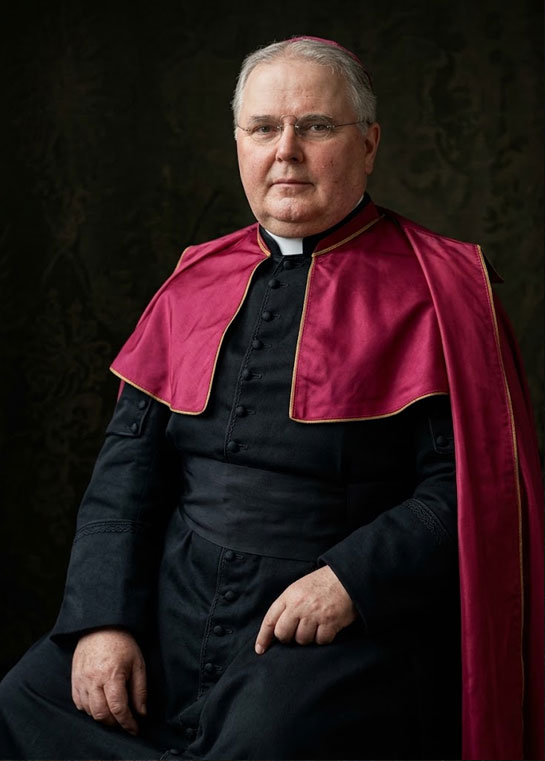
Scott would repeat the same exchange in a letter to his friend, Sally Pope Taylor: “A personage and a personality are quite different … Your mother, Peter the Hermit, Joan of Arc, Cousin Tom, Mark Antony and Bonnie Prince Charlie were personalities. You and Cardinal Newman and Julius Caesar and Elizabeth Barrett Browning and myself and Mme. de Staél were personages. Does the distinction begin to glimmer on you?” [50] Whilst Scott may not have fully grasped the meaning of what Fay had been saying, the use of the word ‘glimmer’ may at least provide a clue about the real-life identity of the priest in Absolution. When Scott is talking about things that ‘go glimmering’ he is using the language of divine revelation. Things that ‘glimmer’ are a sensory-based expression of the noumenal — the world of God, the unknowable ‘thing in itself’.
Closet or confessional box? There’s very little difference in many respects. As Nick embarks on his opening monologue, it soon becomes clear that life’s greatest mystery is ourselves. We roll away the stone only to find another stone, remove the mask only to find another mask. As the boy in Absolution discovered, confession isn’t always about sharing the full scale of one’s moral ‘shipwreck’, but hiding it. [51]
[1] Some Sort of Epic Grandeur: The Life of F. Scott Fitzgerald, Matthew J. Brucolli, Harcourt Brace Jovanovich, 1981, p.192
[2] ‘Butter-and-Egg Men: Response to Breitwieser’, Thomas J. Ferraro, American Literary History 12, no. 3 (2000); pp.384-85
[3] Scott Fitzgerald, Andrew Turnbull, Charles Scribner’s Sons, 1962, p.270. The phrase appears to have been borrowed from J.M Barrie, the author of Peter Pan.
[4] The Great Gatsby, p.2
[5] ‘Wait Till You Have Children of Your Own’, F. Scott Fitzgerald), Woman’s Home Companion, July, 1924, Vol. LI, No. 7, p.13, p.105
[6] Le Père Hecker: Fondateur des ‘Paulistes’ Américains, 1819-1888, Walter Elliott, Preface by Abbe Félix Klein, translated by Countess de Raviliax, Victor Lecoffre, 1898, Paris, p. XXXIV
[7] ‘Self-Reliance’, Essays, Ralph Waldo Emerson, First Series, James Munroe & Company, 1847, p.39
[8] Nature, Charles Waldo Emerson, Henry G. Bohn, London, 1852, p.55
[9] Aspirations of Nature (1857), pp.45-48
[10] ‘Wait Till You Have Children of Your Own’, F. Scott Fitzgerald, p.13, p.105
[11] The Life of Father Hecker, Walter Elliott, The Columbus Press, New York, 1891, p.69
[12] ‘Absolution’, F. Scott Fitzgerald, The American Mercury, June 1926, Vol 2, No.6, p.148
[13] Absolution, p.148-149
[14] The Great Gatsby, F. Scott Fitzgerald, Charles Scribner’s Sons, 1925, p.113
[15] Absolution, p.149.
[16] The Great Gatsby, p.119
[17] Faustus, A Dramatic Mystery, Hohann Wolfgang von Goethe, trans. John Anster, Longman, Rees, Orme, Brown & Longman, 1835, p.15
[18] The Life of Father Hecker, Elliott; p.69
[19] ‘Self-Reliance’, Emerson, p.39
[20] The Life of Father Hecker, Elliott; p.190
[21] The Great Gatsby, p.209
[22] ‘Absolution’; p.149. The boy’s name appears to be a blend of Blatch (meaning ‘black’) and ‘Sarnem’ which features in a Latin version of the eucharist as a reference to the flesh. Scott’s tutor Shane Leslie would later recall that Scott was particularly in the Black Mass (Mass of the Dead or ‘Requiem Mass’).
[23] F. Scott Fitzgerald and the American Dream, William A. Fahey, Crowell, 1973, p.11
[24] ‘Absolution’; p.149
[25] Absolution; p. 144
[26] The Great Gatsby, p.202. The Fitzgerald and Hill families both lived on Summit Avenue in Saint Paul.
[27] ‘St Paul Leads as Usual’, The Saint Paul Daily Globe, March 22, 1880, p. 4; ‘Catholic Colonization in Minnesota: Letter from Bishop Ireland’, Pilot, Volume 46, Number 9, 3 March 1883, p.8.
[28] ‘St Mary’s Church One of the Most Beautiful in the City’, Saint Paul Daily Globe, March 11, 1899, p.5
[29] ‘Cupid’s Connections’, Saint Paul Daily Globe, September 9, 1888, p. 18.
[30] Some Letters of Monsignor Louis E. Caillet and August N. Chemidlin, 1868-1899, ed. Clara Hill Lindley, St Paul 1922, p.10. The Hills and the McQuillans also sat on directors of the board of directors of St Mary’s Friendless Girls Society.
[31] The Days of Dalystown, Dillon O’Brien, Pioneer Print Company, Saint Paul, 1866, pp.505-506
[32] ‘The Mission of Catholics in America’, John Ireland, The Church and Modern Society: Lectures and Addresses, Vol. I, Saint Paul Pioneer Press, 1905, p.71
[33] The Life of Father Hecker, Elliott; p.29
[34] Hearst the Collector, Mary L. Levkoff, Museum Associates, Los Angeles, 2008; p.107. The Abbey was dedicated to Saint Stephen, the first martyr of the Catholic Church. The saint is referred to a number of times by Scott in his stories and novels. He also made up the ‘Stephen’ part of James Joyce’s famous character, Stephen Dedalus.
[35] The Beautiful and Damned, F. Scott Fitzgerald, Charles Scribner’s Sons, 1922, p.256
[36] Popular Piety and Modes of Visual Perception in Late-Medieval and Reformation Germany, Bob Scribner, The Journal of Religious History, Vol. 15, No. 4, December 1989, pp.459-461
[37] Pius X, The Encyclical of His Holiness Pius X on the Doctrines on the Modernists (Pascendi Dominici Gregi), September 8, 1907, trans. Thomas E. Judge. Augustinian notions of “mystical seeing” in their purest form do not rely on visual imagery.
[38] ‘Newman in Contact with Kants Thought’, Johnannes Artz, The Journal of Theological Studies , October 1980, New Series, Vol. 31, No. 2, pp. 517-535
[39] The Great Gatsby, p.53
[40] Critique of Pure Reason (1781), Immanuel Kant, G. Bell and Sons, London, 1878, pp. 41-43
[41] The Great Gatsby, p.119
[42] The Great Gatsby, p.83
[43] ‘Fitzgerald, Spenglarian’, interview with Harry Salpeter, New York World, April 2 1927.
[44] The Great Gatsby, pp.1-6
[45] The Great Gatsby, 72
[46] The Great Gatsby, 43
[47] ‘Scott Fitzgerald’s Catholic Closet’, Tracy Fessenden, U.S. Catholic Historian , Summer, 2005, Vol. 23, No. 3, American Fiction and Catholic Culture, pp. 19-40
[48] The Great Gatsby, p.2
[49] This Side of Paradise, 1920, pp. 112-116
[50] To Sally Pope Taylor, June 19, 1918, The Letters of Scott Fitzgerald, p.459
[51] The Catechism of the Catholic Church refers to the act of confession (the sacrament of penance and reconciliation) as the “first plank of salvation after the shipwreck of mortal sin”.