I would have accepted without question the information that Gatsby sprang from the swamps of Louisiana or from the lower East Side of New York. That was comprehensible. But young men didn’t—at least in my provincial inexperience I believed they didn’t—drift coolly out of nowhere and buy a palace on Long Island Sound — The Great Gatsby [1]
Few novels capture the anxieties of 1920s America quite as sharply as F. Scott Fitzgerald’s The Great Gatsby. Beneath its parties, automobiles and champagne lies a darker preoccupation: who gets to be American? The question is there in its opening pages, and its impossible to miss. Tom Buchanan, the embodiment of Old Money privilege, parroting the racial theories then fashionable among America’s nativists. “Civilisation is going to pieces,” he declares, before demanding to know whether Nick Carraway has read The Rise of the Colored Empires “by that man Goddard.” [2]
Barely concealed behind all the glitter and all the dancing are deep-seated anxieties about immigration, assimilation, and shifting concepts of American identity. Tom’s prejudice returns with no less venom later in the text: “next they’ll throw everything overboard and have intermarriage between black and white.” Underneath his bluster lies a desperate defence of Old Money nativism — a pledge that he is not “going to let Mr. Nobody from Nowhere make love to his wife.” [3]
Tom’s fear is not simply about race, it’s about losing control. America itself seems to be slipping from his grip, and so is his wife Daisy, who he regards as part of that inheritance. “Mr. Nobody from Nowhere” has crossed into a world that rightfully belongs to Tom. Gatsby is, in this sense, the immigrant at the gates. His origins are obscure, his name is partially invented (derived from his immigrant name, ‘Gatz’), and the source of his wealth is just as mysterious. The exchange captures the central anxiety of nativism: the fear that an outsider might enter America, reinvent himself, acquire its wealth and privileges, and become impossible to distinguish from those who inherited them.
When Fitzgerald set sail for Europe to complete the novel in May 1924, the United States was passing the last of its emergency immigration restriction acts. Signed into law by President Calvin Coolidge on May 26, 1924—just as Fitzgerald arrived in Paris—the Immigration Act of 1924 (the Johnson-Reed Act) radically curtailed U.S. immigration through a strict national-origins quota system. In Tom’s eyes, at least, Jay Gatsby represents precisely the kind of rootless, unvetted outsider this legislation was designed to exclude: a ‘Mr. Nobody from Nowhere’ whose Nordic credentials remain unproven and whose very existence presents a threat.
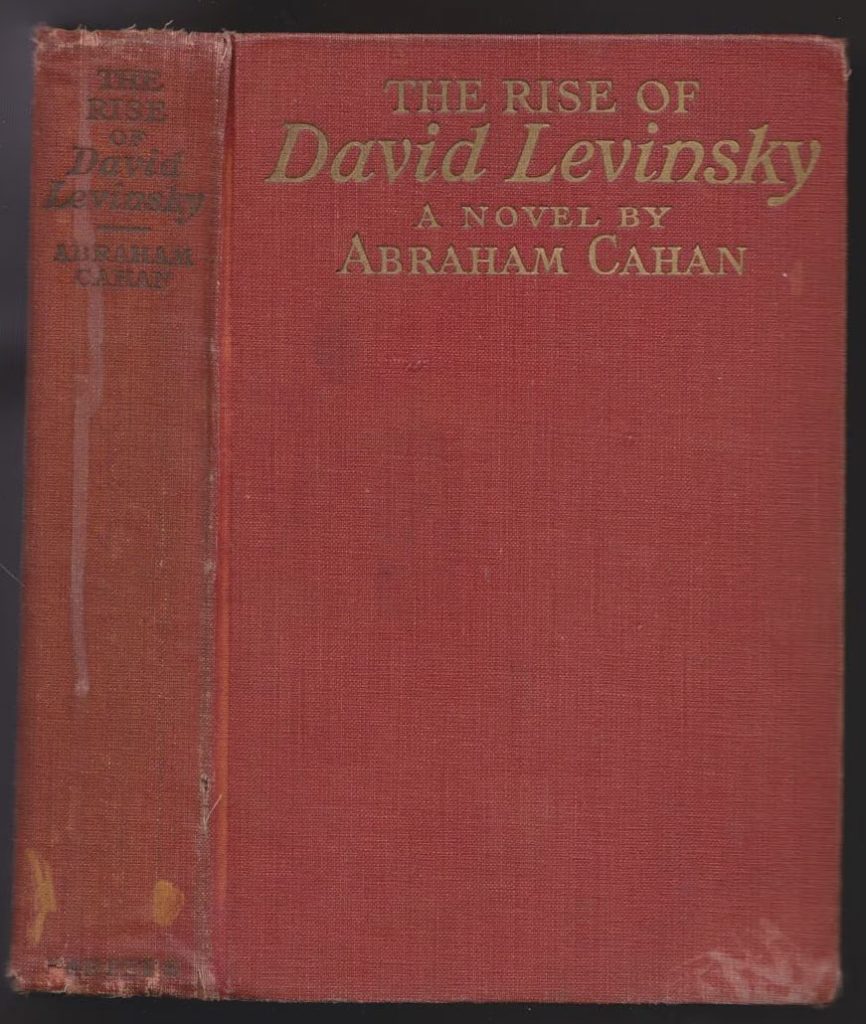
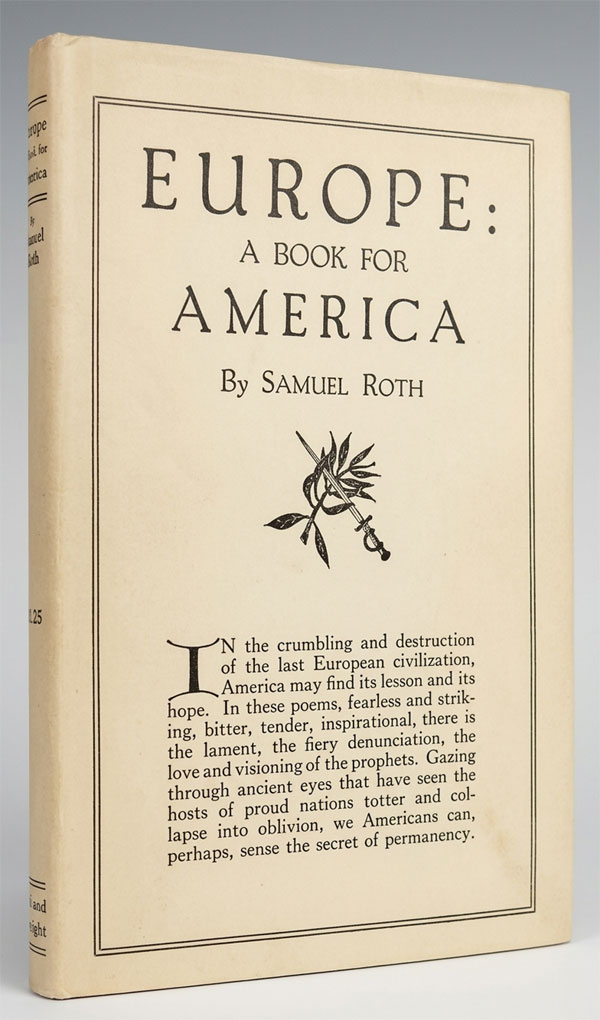
Yet, while Fitzgerald captures the nativist anxieties of the Gilded Age elite attempting to guard its literal borders, the broader literary landscape of the period tells a far richer story of the immigrant experience. Works such as Abraham Cahan’s The Rise of David Levinsky (1917) and Samuel Roth’s blank-verse epic Europe: A Book for America (1919) offer crucial counterpoints to Tom Buchanan’s nativist fearmongering.
The Promised Land
The first, and arguably the most respected of these, The Rise of David Levinsky by Abraham Cahan, is the fictional autobiography of a Russian Jew who emigrates to the Lower East Side of New York and becomes a huge commercial success in the textiles industry. The rags-to-riches story covers the gradual erosion of his Jewish identity as he is forced to confront the many moral and cultural challenges of his new life in America. His pursuit of the American Dream has come at enormous spiritual and personal sacrifice. The Promised Land becomes a land of lost souls.
One of the most poignant moments in the book is when the author describes Levinsky’s response to a small Yiddish band fighting a losing battle to win over a noisy and inattentive audience. In a last ditch attempt to get the audience’s attention’s the band strikes up The Star Spangled Banner. [4] “The effect was overwhelming”, writes Cahan, “the few hundred diners rose like one man, applauding … many of those paying tribute to the Stars and Stripes were listening to the tune with grave, solemn mien. It was if they were saying: We are not prosecuted under this flag. At last we have found a home.” Beneath the lavish sentimentality and the decorative romanticism of the dream, however, Levinsky finds that the America he had discovered is as “brutally selfish as the jungle” and “worm-eaten with hypocrisy”:
“From time to time the newspapers published sensational revelations concerning some pillar of society who had turned out to be a common thief on an uncommon scale. I saw that political speeches, sermons, and editorials had, with very few exceptions, no more sincerity in them than the rhetoric of an advertisement. I saw that Americans who boasted descent from the heroes of the Revolution boasted, in the same breath, of having spent an evening with Lord So-and-so; that it was their avowed ambition to acquire for their daughters the very titles which their ancestors had fought to banish from the life of their country. I saw that civilization was honeycombed with what Max Nordau called conventional lies, with sham ecstasy, sham sympathy, sham smiles, sham laughter.” [5]
Beneath its sugary, fondant icing, Cahan writes, was a hollow and quite toxic Styrofoam shell. For all his success, Levinsky has found neither happiness nor contentment. Another novel published the same year as Gatsby updated the Cinderella story. Again it was set among the schizophrenic tenements on the Lower East Side of Manhattan. Bread Givers (1925) by Anzia Yezierska tells the story of Sara Smolinsky — the ‘Cinderella of the Sweatshop’ — and her own unique pursuit for independence and self-fulfilment and the struggle she undertakes against the forces of survival and Americanisation. [6]
East vs West
If we were looking for specific echoes of Gatsby’s pessimism, there is one publication above all others that stands out in this genre: Samuel Roth’s 1919 blank verse epic, Europe: A Book for America — a prophetic look at the moral and economic decline of Europe. Europe is presented as the dying old world and America as the vibrant, uncorrupted future. Written in 1919 amidst the fiery national debate over Woodrow Wilson’s League of Nations, Roth’s poem depicts Europe as an exhausted, morally bankrupt ‘dungheap’ consumed by endless conflict, and America as a land of promise. In order to fulfil this promise, Roth writes, America would need to resist its prevailing tendency to repeat the sins of Europe. To continue to shine proud as a beacon of hope in the world, America would need to preserve its ideals of cultural heterogeneity. Put more simply, the grip of the ‘Old World’ would need to be loosened if America was to realise its potential as a model for world peace.
In many ways, the book builds upon the ideas first popularised by one of Roth’s early admirers, Israel Zangwill, ten years earlier. [7] His play, The Melting Pot (1909) tells the story of David Quixano who survives the Kishinev pogrom of 1903, moves to New York and composes a great American Symphony called The Crucible, a composition that expresses his hope for a world in which all religious, social and ethnic divisions have melted away. [8] When the play opened in Washington D.C, President Theodore Roosevelt is said to have leaned over the edge of his private box and shouted, “That’s a great play, Mr. Zangwill, that’s a great play.”
Parallels between Roth’s Europe: A Book for America and Fitzgerald’s The Great Gatsby can be drawn on several levels, but it’s the very first page of the book’s For America chapter that features its most compelling similarity:
Once the world was divided into East and West.
East debauched and fainted away;
West debauched and fainted away;
Now there is only America.
Between the ancient ruins of the East
And the new ruins of the West
You stand America,
You are neither East nor West—
Remember that.
Remember above all else,
America,
That you have nothing to do with East or with
West,
That you are America,
That you are alone,
That just as the world was separately Babylon,
Nineveh, Jerusalem, Athens and Rome,
The world is to-day America
At the beginning of The Great Gatsby, the author divides his “slender riotous Island” into a similarly polarised East and West: East Egg and West Egg — the Old World and the New World. In one the sun rises and in the other the sun sets. It’s a cycle of evolution that resets itself every day. The basic gist of Roth’s poem, which takes the form of an Old Testament prophecy, is that America should be neither. It should remain a neutral figure, capable of uniting the world but remaining non-judgemental — separate and distinct. In contrast to Europe it should thrive on diversity, embrace the unconventional and help administer a remedy for the world’s evils. Rome was its father and Greece its mother. Europe is sick and in a terminal state of decay and now it demands of the world, a cure — a Treaty of Peace that will help restore “the profound undisturbed peace of the dead”. The Europe that Roth describes is born of antiquity and in antiquity it promises to die.
As the former East Side newsboy worked on the composition in the last few months of the war, America, under President Wilson was contemplating greater engagement with Europe, and as it did so, Roth began to fear that it was looking into the abyss, a “desolate valley of rotten bones and wandering winds”. The moment had come when America would see the ashes of that star, and realised that the vision they had before them wasn’t a vision at all but “a memory and a dead one”. Roth pleads with America to celebrate its “terrible wisdom” of baseball games, football and boxing that the Old World pretensions of Europe find hard to digest, but which make it a “worthy habitation for mankind”. It was indeed a land of variety and contradictions: “The more conservative you are, the profounder is your Americanism. The more radical you are the profounder is your Americanism.” The quote, from Friedrich Nietzsche, that Roth had used at the beginning of his ‘For America’ section provided some much needed clarity: “One must have chaos within to give birth to a dancing star; I tell you, you still have chaos in yourselves.” America had been birthed in chaos and its dazzling, dynamite future would be built on it. But an oldness had crept into its blood. “Old words, old words”, it murmured:
“Then came a day
When you left the fields and hills of your valley to
lock yourself up in an old study-house that
gleamed with old dust and the webs of spiders.
Four long years, you stood in your place at the
Eastern-window where a thousand pleasures
beckoned to you but never reached you over
the wild growth of the neglected garden, and
only a young fresh moon looked kindly on you.
Four long years you stood at the Eastern Window
bowed over the great yellow book, murmuring,
“Thus Saith the Lord” ..
… Once the world was Babylon. Today it is America. [9]
The image that Roth composes of someone from the fields and hills of the Midwest standing at an east-facing window in some reclusive, gothic mansion certainly bears some resemblance to Jay Gatsby, but it’s not an exact match by any means. Nevertheless, the America that Roth describes, once an indivisible, universal identity split into its lesser entities — East and West — is a metaphor that Fitzgerald narrowed in on in Gatsby.
In certain respects (but not in all) Roth’s dramatic soothsaying anticipates the ‘Return to Normalcy’ narrative that Warren G. Harding used as the basis of his presidential campaign in May 1920. Harding is applying it slightly differently, of course. Roth seems determined that America should keep the chaos and diversity that makes-up every one of the fifty ‘dancing stars’ on its flag, and Harding seems anxious to return to something a little more harmonised — and white.
Let’s Make America Great Again
The future President had launched his bid at a meeting of the Home Market Club in Boston on May 14. He had been joined on the stage by his running mate, Calvin Coolidge and Senator Irvine Lenroot of Winsconsin. Like every successful advertising slogan, the phrase was based on a ‘statement’ slash ‘assumption’: America needed to return to normal. Every politician needs to be seen to be solving a problem, so Harding spent the better of his speech telling Americans they had a problem — the country was in chaos. Occupying a talismanic place at the phrase’s centre was ‘the past’. As America approached its point of no return it was something to get back to. It was a factory reset of sorts for America. The country’s future lay in its past. It’s malware could be removed and America could be great again. [10]
The scene of chaos that Harding described wasn’t unlike the lavish and inebriated “doings” of Gatsby’s maritime mentor, Dan Cody at Lake Superior: “We are living like drunken sailors, without a thought of America, and without any consideration of our problems.” The senator was preaching the gospel of thrift. He said he prayed for “sober thinking” on behalf of America, greater and careful control of its economics. Raising his eyes, he appealed to God: “if I could offer a prayer tonight for this Republic of ours, I would ask God almighty to make us a simple-living people”. President Woodrow Wilson’s commitment to the League of Nations, the Peace Plan currently brokered in Europe, was, Harding believed, the stuff of extravagant and conceited dreams. If anything, it was a case of “too much Wilson”. America was currently drunk on Wilson’s plans for global domination and securing his place in history: “I do not think one man is big enough to run the United States of America, much less the world.” He supported cooperation and participation in the affairs of Europe. America, he went on, should not be aloof but should focus on its own affairs.
Fitzgerald would reveal the full, true extent of his loathing for Harding in his 1923 play, The Vegetable, a less than subtle satire in which an ordinary and incompetent postman fulfils his dream of becoming US President, only for his term in office to collapse in a dishonourable spectacle of cronyism, bootlegging and corruption. [11] He would rain further blows on the President in his 1931 essay, Echoes of the Jazz Age in which he attributes the rise of Jazz Age anarchy and political nihilism to the unspent “nervous energy” that had built up as a result of an unfinished war, and the poison that had been stirred into the cup of the American consciousness by the corrupt activities of squirming, “stuffed shirts” that sat upon the throne of the United States. Harding’s friendship with the young Prince of Wales (the future George V) would only demean this once “powerful nation” further, as Americans started “ordering suits by the gross from London”. A whole race was becoming hedonistic, hell-bent on experiencing pleasure — with or without the stimulants. [12] The tyranny of prohibition, and the fear of impending collapse, just made people crave excitement all the more. The poison had become the antidote. The outrage stirred by books like Ulysses and The Satyricon wasn’t because they introduced obscenity into the world, but because they mapped it. As Scott tells us in his essay, all of it was already familiar in contemporary life.
The way Harding saw it, America was now in chaos. Any plans for further intervention in foreign affairs were to be dropped immediately. In the aftermath of the war, America had experienced huge upheaval. The Spanish Flu had claimed some 550,000 American lives, and the various restrictions put in place had only added to the general feeling of protest. Attendance was limited or prohibited at funerals. Americans were encouraged to wear masks. There’d been labour unrest, a series of race riots, and by September 1920 there had even been the first terrorist attack on US soil: the bombing on Wall Street. Then of course, there were the Bolsheviks. The so-called ‘Red Scare’, whose swirling cyclone energies had stirred-up the May Day Riots and Palmer Raids of 1919, had breathed fresh life into national paranoia about Marxism. There had been a rapid increase in organised crime and mounting unemployment as companies who had ramped-up production during the war began to scale things down.
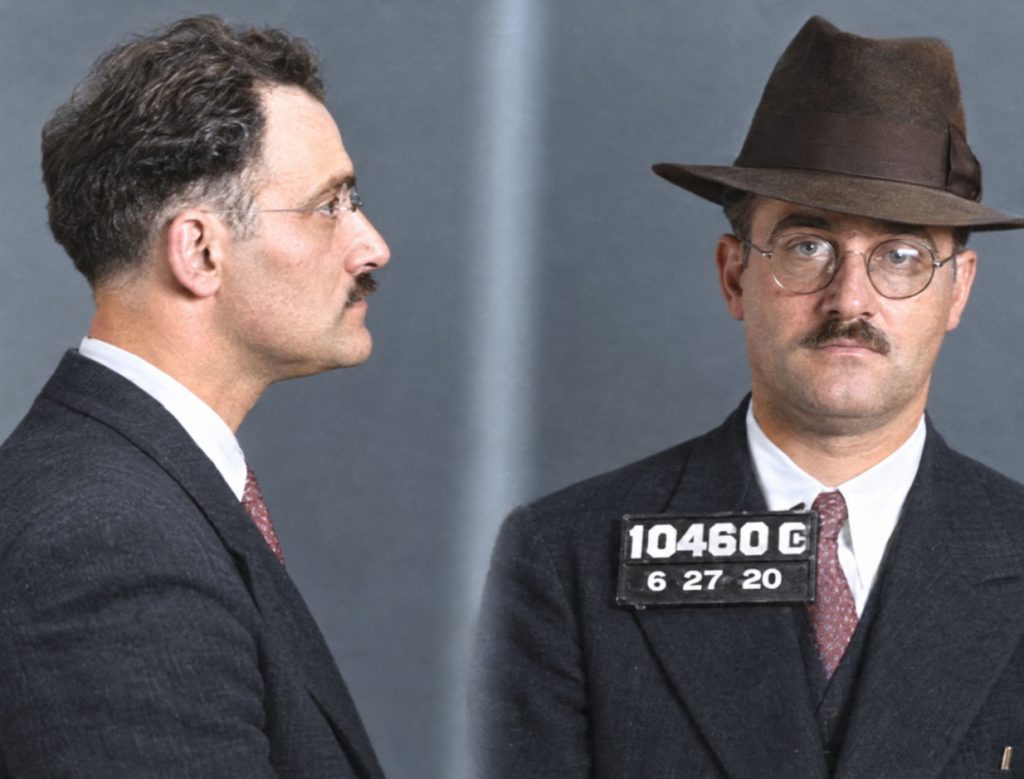
(AI restored)
By 1920, the country was entering a recession. Adding to the tension were the thousands of black workers who had flocked to the northern cities to fill the vacancies left by conscription, remained in the towns and cities in the roles they’d been perceived as ‘usurping’. In the South a revival of violence by the Ku Klux Klan resulted in 64 lynchings in 1918 and 83 the following year. Harding’s response was much like Donald Trump a century later. The Senator wanted to make America “Great Again”. His proposal was rather simple: what they needed was “the good old American protection like that of 1896” when the Republican Party under William McKinley fought a campaign to renew and reaffirm the country’s allegiance to the policy of protection “as the bulwark of American industrial independence, and the foundation of development and prosperity.” Like McKinley before him and Trump a century later, Harding wanted to increase production in American and minimise its dependency on foreign imports: “America’s present need is not heroics, but healing; not nostrums [13] but normality; not revolution, but restoration; not agitation but adjustment; not surgery, but serenity; not the dramatic but the dispassionate; not experiment, but equipoise [14], not submergence in Internationality, but sustainment of triumphant nationality.” [15]
Whilst the two men phrased the crisis very differently, Samuel Roth ultimately arrived at the same isolationist and protectionist stance as Warren G. Harding. Their objectives may have differed, but they shared a common enemy—and that enemy was Europe.
Roth did not fit neatly into a standard Left–Right political box. Instead, his politics were an idiosyncratic, often contradictory mix of anti-establishment populism, isolationism, free-speech radicalism, and Jewish nationalism. When all is said and done, Roth operated as a political outsider, challenging the tyranny of state censorship and government overreach, his stubborn, vexatious defiance culminating in the landmark 1957 U.S. Supreme Court decision Roth v. United States, which redefined the legal standard for obscenity under the First Amendment.
Was Fitzgerald aware of Roth’s work?
It’s hard to say. Roth’s book was published by Boni & Liveright the same year that Scott was putting the finishing touches to his debut novel, This Side of Paradise, and it was a publisher he would cite as a trailblazer in his letters to his editor. [16] What we do know is that Roth’s activity in censorship issues had put him on Scott’s radar. In 1927, an ‘International Protest’ was organised by Sylvia Beach and Ludwig Lewisohn to condemn Roth’s pirating of Joyce’s work. It was signed by 167 prominent writers and intellectuals, including Fitzgerald, T.S. Eliot, Ernest Hemingway, and D.H. Lawrence.
They got into automobiles which bore them out to Long Island, and somehow they ended up at Gatsby’s door. Once there they were introduced by somebody who knew Gatsby, and after that they conducted themselves according to the rules of behavior associated with an amusement park. Sometimes they came and went without having met Gatsby at all, came for the party with a simplicity of heart that was its own ticket of admission — The Great Gatsby
Roth was a peculiar man and a raft of contradictions. Described by his detractors as the ‘bad boy of Greenwich Village’ Roth had been born some twenty-five years before in Zboriv in Western Ukraine. After the Kishinev pogroms of 1903, Roth and his family had fled to America where they occupied the same modest tenement apartment in the Lower East Side of Manhattan as Cahan’s David Levinsky and Yezierska’s Sara Smolinsky. Although a talented poet who had earned no small amount of praise from Ezra Pound and Louis Untermyer, the little poetry book store he opened at 49 West 8th Street was constantly being raided by the Police, anxious to keep his stock of erotic facetiae — his forbidden fruit of ‘dirty words’ and ‘dirty pictures’ — within the letter of the law.
In 1926, Roth would find himself at the centre of a fierce censorship battle with the Suppression of Vice Society’s John S. Sumner when he took up where Margaret Anderson and the Little Review left off and ploughed ahead with publishing expurgated (but no less smutty) extracts of James Joyce’s Ulysses in his Two Worlds Monthly journal. [17] Described as an “unscrupulous literary pirate” by scholar Paul S. Boyer and Joyce’s publisher Sylvia Beach, Roth faced a lengthy obscenity case brought by Sumner and the improbably named, Clean Book Association of the Hungarian Jews. Roth was jailed the following year. [18]
Interestingly, The Poetry Bookstore where Roth sold his erotica was practically next door to the headquarters of Anderson’s Little Review. Roth was at 49 West 8th Street, whilst Anderson was just a few doors down at 27 West 8th Street. Controversial poet and High Priest of Thelema, Aleister Crowley was just around the corner at West 9th Street. Crowley’s American patron was millionaire lawyer and book collector, John Quinn, the attorney who represented Anderson and the Little Review in the 1921 case brought by Sumner and the New York Society of Vice. The author and historian Richard Spence claims that both Quinn and Crowley had worked as spies for British Intelligence in New York during the war.
[1] The Great Gatsby, F. Scott Fitzgerald, Charles Scribner’s Son, 1925, p.60. The lower East Side of New York was known for its large immigrant population.
[2] The Great Gatsby, p.16
[3] The Great Gatsby, p.156
[4] In a curious case of serendipity, the man who wrote the words for The Star Spangled Banner was Francis Scott Key — a distant relative of Gatsby author and namesake, Francis Scott Key Fitzgerald.
[5] The Rise of David Levinsky, Abraham Cahan, Harper & Brothers, 1917, p.380
[6] ‘Turbulent Folkways of the Ghetto in a New Novel; Bread Givers by Anzia Yezterska,’, New York Times, September 13, 1925, p.8
[7] Zangwill writes in his book, The Voice of Jerusalem that Roth’s poem had “excoriated Europe” with antique phrases but “ultra-modern” message: The Voice of Jerusalem, Israel Zangwill, The Macmillan Company, 1921, p.236
[8] It recalls the story of New York’s Joseph Bovshover (Basil Dahl), the immigrant poet who provided the words for ‘America, My Glorious Land’ composed by Ukrainian, Platon Brounoff. This was discussed in an earlier chapter.
[9] Europe: A Book for America, Samuel Roth, Boni and Liveright, 1919. There’s more than a touch of Aleister Crowley’s Book of Law in Roth’s ruminations on unity in diversity and godliness in chaos. It’s intriguing that both men lived in Greenwich Village around this time. Roth would become the first to publish Crowley’s racy poem, Jezebel in his fortnightly journal American Aphrodite. (Volume 4, No. 14). Joseph G. Robin named his rail project The Babylon Railroad which serviced the Long Village of Babylon.
[10] Trump’s ‘New Right’ philosophy is uncannily like that of Harding. The irony of course being that the emergence of the New Right movement in America is America’s ‘Old Right’ under Coolidge and Harding. The mantra of ‘Let’s Make America Great Again’ is based on a similar presupposition: America needs fixing. The politics of the ‘system restore point.’ What’s old is new. Like reclaimed furniture.
[11] Shortly before his death in 1923, Harding had been accused of consuming and serving bootleg liquor in the Oval Office during prohibition.
[12] The Crack-Up: With Other Pieces and Stories, F. Scott Fitzgerald, Penguin, 1965, pp. 9-11. In the novel, Jay Gatsby remarks that he has his shirts made in London.
[13] Quack remedies.
[14] Balance of forces or interests.
[15] ‘Trouble with America is too much Wilson, says Harding’, Boston Sunday Globe, June 20, 1920, p.4
[16] Boni & Liveright
[17] ‘The Bookshelf’, Scarsdale Enquirer, December 25, 1920, p. 6.
[18] Purity in Print, Paul S. Boyer, Scribner, 1968, pp.234-235