During the war, the essayist and critic H. L. Mencken was quizzed on several occasions about his German heritage and the contact he had with ‘enemy’ oculist Dr Wilhelm Sohler and Victor Hugo Erpf, a Baltimore businessman who had been arrested and imprisoned as a spy in April 1917. By this point in time, Mencken had moved across from The Baltimore Sun to edit the unashamedly intellectual, Smart Set magazine in an office he shared with its co-editor George Nathan on Fourth Avenue in New York. As a series of entries on Mencken were added to an increasing number of files gaining attention at the Justice Department and US Military Intelligence, his case was duly assigned to the American Protection League. A short time later, a warrant was issued to open and read his mail — a decision that had been triggered by some fairly rough literary treatment he had given to George Washington in his 1918 book, Damn! A Book of Calumny. The picture he painted of Washington was of a drunk and arrogant autocrat every bit as tyrannical as the recently deposed Romanovs:
“He was the Rockefeller of his time, the richest man in the United States, a promoter of stock companies, a land-grabber, an exploiter of mines and timber. He was a bitter opponent of foreign alliances … He had no belief in infallible wisdom of the common people, but regarded them as inflammatory dolts.” [1]
During the war and post-war period, journalists and authors were considered every bit as dangerous as agents and revolutionaries themselves. The subtle messages about Federalist America that Mencken was trying to convey were disregarded by his investigators: he was being treated as a subversive and possible spy. In dissing Washington he was dissing democracy. That’s what it really boiled down to. There wasn’t a space on the form for irony, so Mencken was duly investigated, his German ancestry doing little to win him clemency.
In Britain, the Bolshevik sympathies of writers like Arthur Ransome would come under the scrutiny of the spooks at Watergate House. As with Mencken, a home office warrant had been issued, allowing agents to intercept his mail, the so-called ‘Red Scare’ having made the author’s passionate yet unformed politics a matter of national urgency. Other writers who had their own files included journalist and sculptor Clare Consuelo Sheridan, Henry Brailsford, Ezra Pound, G. D. H. Col, American journalist Ernestine Evans who had accompanied author Sherwood Anderson to Paris in May 1921 and The London Herald’s George Slocombe. [2] Evans was an associate of Edmund Wilson at The New Republic and their trip to France coincided with that of Wilson’s friend, F. Scott Fitzgerald and his wife, Zelda. Each of these individuals had files opened on them as early as 1918, and all had their mail routinely sifted for clues. [3]
The fact that Wilson found himself in Paris in June 1921 with Slocombe may have sparked some interest from the spooks. Wilson had turned up in France hoping to reignite his romance with activist, poet and playwright, Edna St. Vincent Millay, an old flame from Greenwich Village who was now shacked up with Slocombe, a “big red-haired British journalist’ at a hotel in Paris. [4] A security file had been opened on Slocombe in Britain in 1916 and reopened in 1918 after an intercepted letter revealed that Slocombe had been interested in receiving copies of the then illegal Anarchist-Communist journal, Freedom. Slocombe’s editor at the Daily Herald, George Lansbury had his own file, having been directly involved in sponsoring the Fifth Congress of the Russian Social Democratic Labour Party in London in May 1907, and had been agitating on behalf of the Socialists ever since. [5]
The personal file on Slocombe reveals that he was aware of his mail being intercepted and had started to seal the envelopes by folding the stamp around its edges. If the recipient of the letter found that the seal had been broken, then they would have known that its contents had been read. A letter to GHQ in August 1918 instructed that any such letter in the future should be forwarded unopened to the Special Section, who would take particular care in opening them and forwarding them on. A follow-up report dated November 30, 1921 reports that Slocombe, now Paris correspondent of the Daily Herald and in touch with “local Communist extremists” was, according to most reliable information, “being used as a channel for Bolshevik literature coming to Britain.” He was also said to be in regular contact with members of the Red Trade Union International movement. [6] A few weeks after Wilson’s arrival in Paris, the American Socialist leader, Morris Hillquit arrived in La Havre on the same boat, the La Lorraine. Whilst his scheduled trip to Russia had been put on ice, the New York Herald was reporting that he would be keeping his appointments with the Socialist leaders in Germany. [7] According to the files, Millay and Slocombe’s address in the months that followed was 19 Rue d’Antin, the Caves Mura, the address that Ernest Hemingway would use when visiting Ulysses publisher, Sylvia Beach in Paris. If Scott Fitzgerald had met with Edna whilst in Paris in June 1921, it’s entirely possible that he’d also been introduced to her new lover, George Slocombe, who may well have warned the author of undue interest in his mail.
The inclusion of Clare Sheridan in the Mi5 files is perhaps more intriguing still. Clare was the daughter of Clarita Jerome, the sister of Winston Churchill’s mother Jennie and Shane Leslie’s mother Leonie. After being introduced to Lev Kamenev and Krassin during the Anglo-Soviet trade negotiations in London in the summer of 1920, Clare had been invited to Russia to sculpt the busts of Lenin and Trotsky. On her return, the various channels of communication she had opened with the new regime in Russia had been preserved in a rather buoyant, and from Britain’s perspective at least, a rather unhealthy, overly sympathetic fashion. A report in her security file dated March 1922 indicates that Sheridan had been in regular contact with Slocombe whilst in London. The report, typed-up for the attention of Mi5 director, Vernon Kell, suggests she had also connected with Slocombe under the alias, Nathan Gunberg, whilst visiting Lausanne in France. Described in the files as ‘eclectic’ and ‘most indiscreet’, agents had been particularly interested in a trip that Clare had made to the Grand Hotel in Rome at the end of November 1922, shortly after completing an interview with Lenin for the New York World. [8] Italian Police had kept her under tight surveillance and told their counterparts in Britain that she seemed intent on making contact with Mussolini who had also booked rooms at the Grand. A British minister who was dining at a nearby table reported hearing Sheridan remark in a loud voice that Mussolini had managed to convert her “from Bolshevism to Fascismo” and that she had already got to work on sculpting his bust. Britain’s Secret Intelligence Service didn’t believe a word of it, suspecting that the spectacle produced by Sheridan had been made up on the spot as a cocky, deliberate tease for any ‘watchers’ watching. In fairness though, if Clare’s appetite for adventure and controversy was anything to go by, the words probably tumbled from her mouth just for the tingling, giddy sensation she got when she said it aloud.
Two Literary Protégés
Clare would cross paths with Scott and Zelda Fitzgerald several times both at home and abroad. During a trip to Biskra in 1930, the Fitzgeralds had turned up at her door on camels, before sinking down for an hour or so in some collapsible chairs she had in the garden. Sheridan would later recall their reluctance to dismount the beasts and the surreal nature of the vision: “It was intensely strange to come upon Americans who vibrations were still adjusted to the Western world. They made waves on our desert ether.” The man who had triggered the trek across the desert on the camel was Clare’s cousin, and Scott’s friend and former mentor, Shane Leslie, an Anglo-Irish baronet whose propaganda and diplomatic work for the British in America during the war had been of particular use to the Peace Conference that followed. The Fitzgeralds had been on a whistle-stop tour of Arabia and Shane had told them to look her up. Leslie had been telling Clare how Scott had dedicated his second novel The Beautiful and Damned to him and that Scott sure knew how to write. Clare could never quite believe how the great High Priest and High Priestess of the Jazz Age had managed to swap the good vibrations of New York for the “slow motion of a camel.” [9] Shane had been fond of them both. In a letter to Scott in 1922, Leslie would write: “I read what you and my cousin Clare Sheridan write in the Metropolitan Magazine. Curiously enough you are my two literary protégés and I have no doubt command higher prices than your quondam adviser.” However, not everyone in Clare’s family were as impressed with her or her cousin Shane. Clare’s uncle, the former New York City Attorney, William Travers Jerome, spoke frankly of Leslie in February 1921: “I don’t see the Jerome in him”, he snorted, “we were always practical and forceful — never dreamers.” Jerome then proceeded to tell Clare about the time he had wandered around the East Side of Manhattan with the author Henry James. Jerome had asked Meyer Shonfield, a Jewish sweatshop owner to join them. “Study this man Henry James, he is a de-nationalised American and I want your opinion of him.” Meyer is said to have turned to Jerome, and with a glow of enthusiasm had said, “he’s a real man, ain’t he!”[10]
At the time the Fitzgeralds had been planning their first trip to Europe in the summer of 1921, Leslie had been advising Sheridan on the publication of her diary, Mayfair to Moscow, published by Boni & Liveright just a few weeks before the couple set sail for Europe in May. By the time that they were thinking about heading back Sheridan was on her way to Mexico. So in case you’re wondering, they didn’t meet up with the Fitzgeralds in London that year. However, despite being thousands of miles apart in terms of geography, Clare’s experience of her new surroundings wasn’t unlike Scott’s own. The pull of antiquity was leaving her with a melancholy sense of déjà vu: “I think I would prefer almost any fat on earth except that of the President of Mexico. Like the Roman Rulers, one after another, doomed to destruction.” The tottering old, ruinous wreck of a civilisation that Scott had encountered in France and Italy was breaking through the soils of the southern-most point of North America and was in all probability, creeping just as stealthily forward. [11] Like Scott, Clare had been trying to process, or balance rather, the two frustrating, polarised sides of her brain: the one side that sought to dig its thin, shallow roots into the barren grey lands of the past and the one that sought plunge its fresh green shoots deep into the plentiful soils of the future. Sheridan’s feelings as she left New York had been conflicting. On the one hand she was leaving home, the part of herself that was “so proper and business-like, so well regulated, so absolutely just what it should be”, and on the other she was being pulled into the “blue unknown” which was exciting and stimulating. The two countries that she belonged to, England and America, were so prosaic and disappointing. They now had little left of the colour and romanticism that she loved. One shouldn’t have to choose between them but one did, she confided: “The Old World and tradition have become museum preserves. They are no longer working concerns, and the world Imperialism gives me a pain in the head. So much for my father’s land. In my mother’s country I find a heap of things that irritate me; but it’s a ‘live-world’, efficient, and infinitely large. There is space without Imperialism, a new world, without decadence and without tradition. Although it is reactionary and conservative on the surface, it is at heart young and progressive and opens wide areas to new ideas.” [12] The battle was very much on; not between the old and the new or between one civilisation and another civilisation, but right down at the very bottom, at the very ontology of what was meant by ‘past’ and the ‘future’, between two conflicting claims on what was civilised and un-civilised, what was stagnation and what was progress — what was freedom and what held that freedom back.
Attempt on the life of Ambassador Herrick
Yes, it could have been a coincidence that Edmund Wilson had turned up in Paris just ahead of the Bastille Day celebrations, but it’s unlikely to be how British and American security were regarding the issue. The formal launch of a dedicated surveillance team by the Police Prefecture in May that year certainly suggests they were being cautious, but the celebrations weren’t just attracting literary Bolsheviks like Wilson, Joyce and Beach, they were also acting as a beacon for violent revolutionaries. It is probably fair to say that the deep, probing mechanisms of surveillance tends to kick-in when the safe old hands of tradition are forced to get a grip of the more radical mechanics of change, and Scott and his friends like Wilson were out to change the world, starting from the wild, roaring floors of the speakeasies and the Jazz clubs to the dangerous dreams and follies of the printed page. An insight into the threat that Modernist writers were thought to pose can be glimpsed in the files maintained by Mi5 on Ezra Pound. In one extract from 1918, they underline the name of another of Wilson’s associates: John Quinn and The Little Review. The Little Review was the journal of the Paris-based ‘booklegger’ Sylvia Beach, and Ezra Pound served as its foreign editor. Quinn had arrived back in Paris in April that year, pledging to get the Little Review back on the news-stands in France after the suspension of the journal’s production during the infamous Ulysses affair. [13] British interest in Pound and Quinn had been triggered by their name in the papers of Indian Nationalist (and Americanist) Benoy Kumar Sarkar, who, like Pound, would later express support for Hitler’s Nazi Party and Mussolini. [14] Even if writers like Scott, Wilson or Pound didn’t pose a clear and imminent threat to National Security, their friends and associates might. In the eyes of the spooks, they were all fair game.
In October that year, their very worst fears were realised when an assassination attempt was made on America’s newly arrived Ambassador, Myron T. Herrick. In the Paris edition of the New York Herald on October 20th, reporters described how Paris-based Communists had been pressuring the new Ambassador to use his influence to prevent the execution of Wall Street Bombers, Sacco and Vanzetti. After returning from a reception in honour of General John J. Pershing at the Hotel de Ville, Herrick’s valet had untied a package in his bedroom. After removing the paper from around the package he had found a box tied with string. No sooner had the valet loosened the string than the lid flew open and tendrils of smoke began to emerge. The fizzing of a fuse left him in no doubt what was happening and he flung the package into an adjoining bathroom, protecting Herrick from the worst of the blast. The Prefecture of Paris concluded that it was the work of anarchists. [15] It is interesting to note that in the May 1921 edition of New York’s Marxist The Toiler newspaper, the last three books it features in its advertisements for ‘books on Russia’ are books by Ransome, Brailsford and Sheridan — authors who all had fresh new files recently opened on them by Mi5. In what was a genuinely sincere case of ‘trust no one’, practically everybody was under the microscope. [16]
In later years, Scott’s biographers Henry Dan Piper and Andrew Turnbull would claim that as the 1930s approached, even Scott and Zelda Fitzgerald were becoming increasingly curious about Communism, Scott reading Das Kapital and offering his home to local Communist meetings, and Zelda exposing their eleven year old daughter, Scottie to N. Ilns’s New Russian Primer, which had been specifically aimed at children. The couple treated their flirtation with Marxism with their usual laconic impudence, with Zelda joking that Scott’s mother, Mollie Fitzgerald, had become convinced that both of them were working for the Russian Secret Service, passing up “June strawberries” for “bombs”. [17]
Having your mail routinely sifted by the spooks was becoming a badge of honour. The Russian Revolutionaries in London and America were especially gifted when it came to leaving misleading statements or just quietly ‘giving the finger’ to anybody they suspected of ‘watching’. Edmund Wilson’s former girlfriend, Edna St Vincent Millay was so bemused by FBI surveillance that she was in the habit of leaving calling cards at places she visited, simply to taunt its agents. During the period in question, Mi5 and their counterparts in America had convinced themselves that the Soviets were cooperating with Sinn Féin, making Wilson’s proximity to Shane Leslie through Scott a potentially vulnerable area, despite the lack of trust that existed between Leslie and its leaders. In an article written for The New Yorker in 1987, Herbert Mitgang expressed his astonishment that a file had ever been opened on Wilson, noting that he seemed to be “one of the writers least likely to have a file and, having one, to have it subject to censorship or to denial under the Freedom of Information Act.” Mitgang had received just fifteen pages of the file and those that were returned were heavily redacted, with “interest of the national defense or foreign policy” being cited as the reason (‘Policing America’s Writers’, Herbert Mitgang, The New Yorker. September 28, 1987).
The Intellectual Proletariat
For his part, Edmund Wilson had never shied away from his own radical streak, explaining that he had grown up in a “modern prosperous America with an outside point of view.” His decision to enter journalism rather than law had been based on a desire to find himself in a more varied world where his “keel would strike on basic realities” and he would “go ashore” at last — immersing himself in the Liberal Arts in pursuit of the “truth”. The revolution that came in 1917 had dazzled him. Whilst an FBI file was officially opened on Wilson in the 1940s, it is certainly possible that interest had been aroused in his activities as early as the 1920s when the so-called ‘Red Scare’ in America had been at its most intense. [18] Writing to his and Scott’s mutual friend at Princeton, Stanley Dell in February 1919, Wilson had expressed his sympathy with the Bolsheviks and described the course of action he had decided upon taking once he had been demobilised from France: “In order to escape the worst consequences of the imminent Social Revolution, I shall declare myself a member of the ‘Intellectual Proletariat’, invest some of my savings in stocks, and try to persuade the bourgeois by reason so that they will not be too rudely swept away.” Like so many of the views the friends exchanged in their letters, the comment was a little tongue-in-cheek, but there’s little doubting the side he was going to take on returning home: “A friend of mine here and I have sworn a solemn vow to return to the States and know no rest till we have made merciless war on everything represented by Sir Henry van Dyke.” The man that Wilson was talking about was the son of the outspoken Presbyterian minister and anti-abolitionist campaigner, Henry van Dyke, the visiting Professor of English at Princeton whose jingoistic series of articles for Scribner’s Magazine in 1917 provided the kind of ‘informed commentary’ that both America and Scribner’s could use to embolden opinion about the war. [19] In April 1919, van Dyke had been given total editorial control of The Princeton Book of Verse. The book featured three contributions from Scott and seven from Wilson. Van Dyke’s remarks in its Preface tells us everything we need to know: “It is surprising, and I must confess refreshing, to find in this collection so few pieces written in what is called vers libre — the Bolshevism of poetry, — which promises liberty by the destruction of all form and order.” Perhaps tellingly, there was no sign of Stanley Dell, whose work had featured in several earlier editions. [20]
In other letters to Dell, Wilson would explain how he had made a number of Bolshevik friends during his time with the Military Transport Division in France. Of their old crowd he thought Dell was “the only real Bolshevik in the bunch.” He admitted to using the term in the loosest sense of the word. Wilson actually regarded Trotsky’s idea of class-war as grim. Nevertheless he did regard the present situation in America as potentially explosive. If the Allies decided to send more troops into Russia they were likely to have revolutions of their own. In Wilson’s opinion, the Allies were “forgetting how the enemies of the French Revolution harassed France into welding a great army.” [21]
Wilson and Dell had both graduated from Princeton in 1916. By 1919, Dell was editor at the New York Sun and married to Marion Cleveland, the youngest daughter of President Grover Cleveland, the only President to have served two non-consecutive terms in office. On Wilson’s return to New York the friends were planning a series of personal war stories and had been looking for a contribution from Scott, who was busy putting the final touches to his first novel, This Side of Paradise. The idea that Scott put forward was about a soldier falling in love with a French girl. As it is, it was never completed.
Wilson had been in England when he learned of the Bolshevik Revolution in November 1917. He had learned about it from a newspaper stand in Southampton. On hearing the news he immediately located a bookshop and picked up a copy of Henry James’ posthumous time-travel novel, A Sense of the Past. The plot of James’ novel revolved around American, Ralph Pendrel, who discovers the portrait of an old English ancestor on a visit to a mysterious house on the old family estate in London. Much to his surprise his English ancestor springs magically to life and they trade places. The book, which was unfinished, had been published by Scribner’s just two weeks earlier. In a bizarre parallel, Russia, Britain and America stood at a very similar time threshold. Sadly the novel ended just as abruptly as British, Russian and American relations. James died before the book was finished.
In some ways, if you were to blend James’ two posthumous efforts, The Sense of the Past (restoring the past) and The Ivory Tower (the corrupting influence of money) you probably have the bare bones of Fitzgerald’s third novel, The Great Gatsby. Gatsby is also a time-traveller of sorts — a Connecticut Yankee in the Court of King Arthur. Perhaps the story reflected the sometimes intense isolation and crippling self-doubt that Fitzgerald had experienced in the shameful, classless wasteland of his time at Princeton, an opportunity that had come his way in a surprising and fluky fashion. For much of his life, Fitzgerald’s parents had been living close to the breadline until his mother Mollie came into a large inheritance. Suddenly life changed, all measure of opportunities began to present themselves. At 13, Fitzgerald must have felt like a cuckoo in the nest, a confused precocious fledgling without any natural right to the world he had inherited. For many years, Fitzgerald would regard himself as a bit of charlatan — a fraud. Even a cursory glance at the families of his Princeton pals and classmates will tell you how very far removed the novelist was socially from his more privileged peers. Wilson’s father had served as US Attorney General for New Jersey and remained an influential Republican until his death in 1923. It was the same with other friends at Princeton. Dell was engaged to the daughter of former President Grover Cleveland. John Peale Bishop was from a well-to-do family from Charles Town, West Virginia. Ginevra King, his first love at Princeton was the daughter of the fabulously wealthy Charles Garfield King who famously ended their burgeoning romance on account of Fitzgerald’s inferior status. In one letter, Edmund Wilson had sarcastically remarked that Fitzgerald had never really gone to Princeton at all as he had spent the better part of his time there drunk – and by October 1917 he had dropped out of it altogether, escaping into the relative anonymity of the officer’s uniform. The only thing holding Fitzgerald together, Wilson went on, were the elegant stripes and bars skilfully covering up the cracks, and the handsome Sam Brown belt. Fitzgerald’s sense of dislocation and alienation from the usual cliques and causes that engaged his Princeton friends and their families socially is likely to have been immense. Everywhere he looked he would have found substance and authenticity engaged in a ferocious battle with artifice and superficiality. Manners were there to be mimicked. Accents were there to be feigned. Thoughts, ideals, philosophies and aspirations were all available to have on loan, and progress in the world could be clinched through a well-plotted romance. There were probably few people enrolled at Princeton who felt more like Odysseus. ‘Coming home’ must have seemed like an epic task: cobbling together rafts from the various wrecks of his own making, strapping it together with words and poetry, practically drowning in perilous seas, being revived by beautifully addictive women, crossing-boundaries, defeating the Cyclops ‘muscleheads’ and Jocks on campus, fending off suitors with a witty put-down, pulling on rags and tossing them off in a heroic fit of revelation. It must have seemed an impossible journey, from the moment he left Saint Paul to the moment he pulled on his uniform and pulled-off his miraculous transformation from cuckoo, cuckold and commoner into America’s most gifted new author. It wasn’t a journey to the centre of the earth as much as an all-in-one demolition-excavation project to reveal his true, authentic centre. His third novel, Gatsby, would in many ways be the culmination of a thirteen year mission to find a home for the cultural migrant that creaked and moaned like the stern of the boat within him.
Literary Bolshevism
The extent to which Fitzgerald had begun to move away from the mentor of his youth, Shane Leslie, is perhaps nowhere better illustrated than by the ‘Ulysses’ affair. Although his trip to Paris in 1921 had resulted in only the briefest, peripheral encounters with the book’s eventual publishers and its lawyer (and Leslie’s friend) John Quinn, Fitzgerald had taken an active interest in the ongoing legal tussle to have it banned in America. [22] A number of extracts from the novel had been appearing for several years in Margaret C. Anderson’s Greenwich Village-based journal, The Little Review, a magazine that had been affiliated briefly with anarchist Emma Goldman and her husband, Alexander Berkman, whose attempt on the life of industrialist, Henry Clay Frick, some thirty years before had stunned the entire nation. [23] Things had really only come to a head in July 1920 when Anderson published an extract describing the idle, erotic daydreams of its Irish-Jewish character, Leopold Bloom. [24] With the encouragement of New York District Attorney, Joab H. Banton, John S. Sumner, leader of New York Society of the Suppression of Vice, had immediately filed a complaint. Just a few weeks later, Anderson and the magazines co-editor, Jane Heap were arrested. A formal trial was held in February 1921 with a solitary John S. Sumner looking smugly triumphant among a crowd of jostling Greenwich Villagers shouting their support for the women. One of the judges commented that the extract that Sumner had brought before the court had struck him as “the ravings of a disordered mind” and possessed “too many frank expressions” to be read in full in court. Ezra Pound, who had persuaded Anderson to serialise the novel in the first place, had had few doubts about the fury that the extracts would ignite, famously describing Joyce’s book as “obscure” and “obscene” as life itself. [25] Upon hearing the judge dismiss the author’s efforts in such a painfully inadequate way, Anderson had to be physically restrained by her colleague and co-defendant, Jean Heap. The women’s counsel, John Quinn, did his best to defend the extracts from Joyce’s novel on their artistic merits. Joyce, he explained, was a graduate of Dublin University whose work had been “highly praised by critics”. Quinn conceded that the book was cast in a very curious style, and that its lack of punctuation had contributed to a false sense of unscholarliness and vulgarity. [26] It was met with a simple riposte from the judge: what it was, he said, was “unintelligible”.
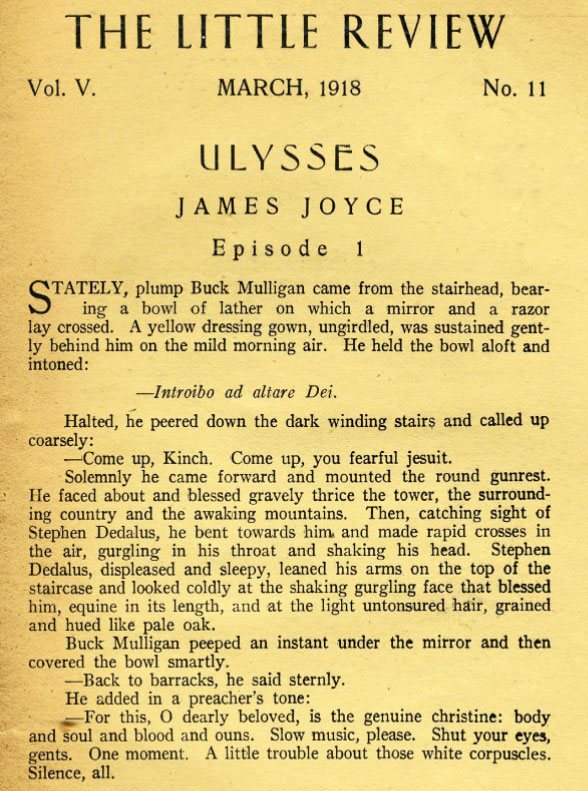
Some ten days later on February 24th, Anderson was handed a $50 fine and advised to suspend all further publication of its extracts. Anderson declined, saying that she fully intended to publish a further series of instalments in The Little Review. The “literary masterpiece of its generation” was at this time viewed with little more than contempt by the literary elites. Anderson had not just been let down by New York’s justice system but by the peers she had considered to be her friends. “A nude statue cannot be obscene and art at the same time,” she explained to the court, Ulysses was “the experience of things that have affected James Joyce the most in his life. The book is not an experiment but an achievement.” The judges, she admitted, had done their best to comprehend it as a work of literary art, but the language that the author had used had been “too obscure for them to understand.” In the end it wasn’t the $50 fine she said that hurt her, but the attitude of former friends who did not understand her motives.” [27]
By February 1922, Joyce’s 730 page classic had finally been published in Paris by Sylvia Beach. Fitzgerald had fallen truly in love with it — or in love with the idea of it at least. In a letter to his friend Edmund Wilson written in May 1922, Fitzgerald had found himself bubbling over with excitement. He was literally ‘wild’ to read Joyce’s book, having already drawn upon Joyce’s Portrait of the Artist for inspiration in This Side of Paradise. For Fitzgerald, Joyce, like T. S. Elliot, offered a measure of instant kudos whenever you said their name. Like many young creatives, Fitzgerald was one of those people who liked to sprinkle conversation with the kind of gold dust that dazzled those he was either trying to please, win over or impress. When Fitzgerald had told Leslie that the death of their mutual friend, Father Sigourney Fay, had left him feeling more like dying than at any other time in his life, it was probably because he thought it was what Leslie wanted to hear. When he told Wilson that he was ‘wild’ to read Ulysses it was likewise because he now wanted to show his old friend just how eager he was to engage in more radical forms of literature. Life was one big colour-splash of post-impressionism. Fitzgerald didn’t deal in the kind of brushstrokes and palettes of a Manet or a Millett, he applied to life the thick, expressive emotions of a van Gogh. At this time in his life, he desired life to be one big spectacle, one big statement. Success in life came down to dramatic leaps forward rather than small, nervous advances. Anything that didn’t shock, oppose or inspire was dead in his opinion — or at least in those opinions he expressed in his letters to other authors. The thought of not getting a reaction was like spending a lifetime fishing and never being bothered about getting a bite. Words were hooks and namedrops were the live bait. What he seemed to like about Ulysses more than anything else, was that in art-terms it was the classic ‘shocker’. Fitzgerald wanted something that either lifted or relieved his feelings of Catholic guilt and not something that sharpened its teeth. The young author was finding that all too often in art, just as all too often in life, the soul and spirit of an individual was weighted down by civil tastes, the demands of servitude under one’s religious faith or from having to resign oneself to a lifetime in the slow-lane by a ludicrous class system. Censorship was killing freedom.
According to historian Noël Riley Fitch, the novel’s Paris-based publisher Sylvia Beach had been involved in a plot to smuggle copies of Ulysses into the United States with the English-born publisher and gallery owner, Mitchell Kennerley, whose trip to France and London in the summer of 1921 coincided with that of Wilson and Fitzgerald. The man who would assist them was censorship bustin’ lawyer, John Quinn, also in Paris that month. Letters exchanged during this period show that Kennerley, a personal friend of the captain of a steam liner operating regularly between Britain and America, devised a plan to “smuggle twenty or thirty copies in bulk a month from London.” Kennerly arrived in Paris within weeks of the opening of Beach’s bookstore. A news item in the European edition of the Chicago Tribune on August 1st 1921 describes how the President of Anderson Galleries in New York had arrived at the Ritz Hotel in Paris after spending some time in London. [28] The following year Kennerley’s Anderson Galleries would provide the venue for the debut of Francis Cugat — the Spanish-Cuban painter who would provide the legendary gauche painting used for the dust-jacket of Fitzgerald’s The Great Gatsby. [29] The booklet that accompanied the young painter’s exhibition was written by Zoe Beckley, whose Christopher Street apartment in Greenwich Village was just a 20 minutes’ walk from the studio on West 8th Street that Margaret Anderson and Jane Heap had used to syndicate extracts from Joyce’s novel. The Modernist streak was creeping northward to defile the Conservative race.
[1] Damn!: A Book of Calumny, H.L. Mencken, Philip Goodman Co, 1918. Mencken and the Feds, Menckeniana, No. 123, Enoch Pratt Free Library, 1992, pp. 6-10
[2] Ernestine Evans was an associate of Wilson at The New Republic. She was suspected of having been the director of the Soviet press agency TASS in the US. In 1930 she would appear on a list of those associated with the John Reed Club protesting against anti-Communist propaganda. Other names on the list included H. L. Mencken and Edmund Wilson. see: Investigation of Un-American Propaganda Activities, part 9, volume 1, p.104
[3] The National Archives, Kew, Security Service, KV2 files, KV 2/1904, KV 2/485, KV 2/1033, KV 2/875, KV 2/686, KV 2/1985
[4] Letters on Literature and Politics, 1912-1972, Edmund Wilson, Farrar, Starus and Giroux, 1977, Letter to John Peale Bishop, Paris, July 3, 1921, p. 67
[5] The Last Dissenter: H.N. Brailsford and His World, F. M. Leventhal, Clarendon Press, 1985, p. 62. The Mi5 files on Slocombe during the 1918-1921 generally consist of Slocombe’s articles and reports for the Daily Herald which would be considered pro-Soviet in nature.
[6] The National Archives, Kew, George Edward Slocombe, alias Nathan Grunberg KV 2/485, Secret, Dr G.E Slocombe, 27 August, 1918. Slocombe had spent two years in France as driver (and clerk) with the Mechanical Transport section of the R.A.F.
[7] ‘Morris Hillquit Sails to Study Foreign Field’, New York Herald, July 7, 1921, p.24
[8] Scott and Zelda Fitzgerald stayed at this same hotel in June 1921. It was also popular with the staff of the British and American Embassies.
[9] Arab Interlude, Clare Sheridan, Ivor Nicholson & Watson, 1936, p. 337; Clare Sheridan, Anita Leslie, Double Day, 1977, pp. 251-252
[10] My American Diary, Boni & Liveright, 1922, pp. 54-55.
[11] My American Diary, Clare Sheridan, Boni & Liveright, 1922, p.148. At the time that Sheridan made her way to Mexico, its new President, Álvaro Obregón was talking trade with President Harding in a bid to renew the country.
[12] My American Diary, Clare Sheridan, Boni & Liveright, 1922, pp. 140-141
[13] ‘Little Review Again to Appear’, New York Herald (Paris ed), April 27, 1921, p.2
[14] Ezra Pound, KV 2/875, The National Archives, Kew, London
[15] ‘Myron T. Herrick Narrowly Escapes as Bomb Blasts in American Embassy’, New York Herald (Paris Ed), October 20, 1921, p.1
[16] ‘Books about Russia’, The Toiler, May 14, 1921, p.4
[17] ‘To Scott, December 1931’, Dearest Scott/Dearest Zelda, p.132, p.156
[18] The Intransigence of Edmund Wilson, Granville Hicks, The Antioch Review , Winter, 1946, Vol. 6, No. 4, pp. 550-562
[19] ‘Charles Scribner’s Sons and the Great War’, James E. Sait, The Princeton University Library Chronicle , Winter 1987, Vol. 48, No. 2, pp. 152-18. In 1913 van Dyke was asked to serve as American Ambassador to Luxembourg and the Netherlands by President Woodrow Wilson (he had Dutch ancestry). He returned to his full time post at Princeton in January 1917. He would return to Princeton throughout that period to give key lectures (see The Daily Princeton, 1913-1917)
[20] ‘A Book of Princeton Verse II: 1919, ed. Henry van Dyke, Prince University Press, 1919.
[21] Letters on Literature and Politics, 1912-1972, Edmund Wilson, ed. Elena Wilson, pp. 42-44
[22] The Ulysses ‘obscenity trial’ was held in New York in February 1921 after an extract from the book had appeared in the Little Review.
[23] If you recall it was Alexander Berkman who had attempted to murder Andrew Carnegie’s partner, Henry Clay Frick in June 1892. Anderson had published the Ulysses instalments on the recommendation of Ezra Pound.
[24] The extract was from the concluding part of Nausicaa in which Lepold Bloom pleasures himself whilst spying on one of the novel’s ‘temptresses’, Gerty MacDowell. It is the Thirteenth Chapter of the novel. Unlucky for some.
[25] Modernism and the Theater of Censorship, Obscenity and the Nonreproductive Sexuality: Ulysses and the Little Review Trial, Adam Parkes, Oxford University Press, 1996, p.65. Well worth a reading the whole thing.
[26] ‘Improper Novel Costs Women $100: Greenwich Village Publisher & her Editor Fined for producing Ulysses’, New York Times, February 22, 1921, p.12
[27] Author Defends Little review, Elyria Chronicle Telegram, February 24, 1921, p.1; Purity in Print; the Vice-Society Movement and Book Censorship in America, Paul S Boyer, Scribner, 1968, pp.83-86
[28] ‘Mr Mitchell Kennerley’, Chicago Tribune (Paris ed), August 1, 1921, p.4
[29] ‘A Statement by the Anderson Galleries’, New York Tribune, June 13, 1922, p.9; ‘Exhibitions, Time, Vol. II, No.12, November 19, 1923, p.13., November 19, 1923, p.13.