He waved his hand toward the book-shelves. They’re real … absolutely real … have pages and everything. I thought they’d be a nice durable cardboard. Matter of fact, they’re absolutely real … It’s a bona-fide piece of printed matter. It fooled me. This fella’s a regular Belasco. It’s a triumph. What thoroughness!
What realism! — The Great Gatsby
Had it been Immanuel Kant and not old ‘Owl Eyes’ studying the books in Jay Gatsby’s imitation Merton Library, it’s very likely he would have concluded that they were both ‘absolutely real’ and ‘absolutely unreal’ all at the same time. Living to see the novel published in 1925, Kant would have recognised that behind Gatsby’s gorgeous world of appearances was some noumenal secret place that existed beyond experience, beyond cognition, and beyond the radar of even his most imaginative guests. For Kant, the things we saw with our eyes may not have been real, but the eyes themselves were real. The mind’s lens did not merely interpret the world; it brought it into existence. I’m taking some liberties here, of course, but it serves as a reminder that few things in the novel are what they seem, and this includes the novel’s meaning. It’s a multi-layered read; there is as much philosophy here as flappers.
So what makes something ‘real’, and what makes something ‘unreal’? In Critique of Pure Reason, Kant put forward the idea that experience was comprised of two distinct phenomena: the mode or channel of experience and our sensation of them. There was the projector (the eyes) and there was the screen (the mind’s eye or the brain). Stimuli was received and the ego duly shaped it, the former having properties in space and time that could not be degraded to mere ‘illusory experiences’. [1] The top and bottom of it (in Kant’s estimation at least) was that Gatsby’s books wouldn’t disappear as soon as he, Nick and Jordan left the party. Kant would probably have concluded one of two things: either there was something real and authentic behind Gatsby’s lies, or he had made those lies real. [2] I’ll explore Kant’s influence in another article, as I think the entire philosophical weight of The Great Gatsby has been down-sized over the years. For now, I want to focus on someone who would have considered himself Kant’s fiercest opponent — Friedrich Nietzsche.
Jay Gatsby, Fitzgerald writes, had sprung, quite literally, from “his own Platonic conception of himself”. He had invented “just the sort of Jay Gatsby that a seventeen year-old boy would be likely to invent, and to this conception he was faithful to the end”. But Gatsby hasn’t just invented a persona for himself, he has invented an entire world — an extraordinary alternative reality. As Fitzgerald tells us in the final pages of the novel, it was a world that is “material without being real”, where the grass is “scarcely created” and its people “breathe dreams like air”. [3] It’s a theme that’s been extended and repeated in a thousand different forms over the years, from The Magus to The Truman Show to the X-Files and Wandavision. A man wakes up in a world that is an almost exact replica of the one he left behind, usually put together by some villainous corporate network or some unscrupulous polytropoi with psychokinetic abilities. But somewhere down the line, the hero eventually comes to their senses after discovering some flaw in the otherwise perfect illusion. Perhaps the pages in the books are blank or the buildings they see in the distance are found to be nothing more than plywood shells with no interiors.
“Anything can happen now that we’ve slid over this bridge,” I thought; “anything at all… .” Even Gatsby could happen, without any particular wonder — The Great Gatsby [4]
Whilst Fitzgerald’s The Great Gatsby may not be an example of ‘simulated reality’ fiction in the strictest sense of the word, it pays a clear debt to the earliest forms of the genre, works like Plato’s Allegory of the Cave, Shakespeare’s The Tempest, and Pedro Calderón de la Barca’s Life is a Dream. Fitzgerald is presenting us with a challenge: what is real and what is unreal — what’s the intrinsic difference between the authentic and the fake? Or, to put it more firmly in the context of the novel, between the lie that Gatsby tells himself about his fairy tale ending with Daisy, and the reality of her marriage to Tom?
The whole ‘appearance vs reality’ thing is a notoriously elusive and confusing idea, so I‘ll try and anchor it in the text. Take the “factual imitation of some Hôtel de Ville in Normandy” that Gatsby erects in West Egg. [5] Nick describes it in the very first pages of the novel. It is a “colossal affair” that has been built in the style of a medieval castle in France. It is, he tells us later, a “incoherent failure of a house”. It is a copy of something grander — a shadow. In Plato’s Allegory of the Cave, prisoners mistake shadows projected on a wall for ultimate reality, unaware that those shadows are merely two-dimensional imitations of physical objects, which are themselves only reflections of ideal Forms. Gatsby’s mansion operates on this exact hierarchy of illusion. The ideal Form is the centuries-old, organic Old Money grandeur Gatsby longs to embody; the physical object is an ahistorical blend of the genuine Old Money heritage of East Egg and the original château in Normandy; and Gatsby’s mansion is the shadow on the wall—a theatrical, imitation-medieval facsimile constructed to project an illusion of legitimacy. For Gatsby’s partygoers, who willingly inhabit this manufactured cave, the shadow is enough; they accept the fake castle as real prestige. But Gatsby himself is caught between worlds—a man trying to construct a ultimate Form out of cheap imitation materials and raw will, forever trapped in a shadow of his own making. In Plato’s story, freedom for the men would mean shattering the illusion. It would destroy everything that they had previously held sacred. Freedom and ambition were fraught with danger. [6] Escape wasn’t always the safer option. Reality wasn’t always the better option.
Sometimes a shadow moved against a dressing-room blind above, gave way to another shadow, an indefinite procession of shadows, who rouged and powdered in an invisible glass. “Who is this Gatsby anyhow?” demanded Tom — The Great Gatsby [7]
The passage above is taken from a scene at one of Gatsby’s parties, but there are shadows pooling in every corner of the novel, whether it’s the “shadow of a garage” that is run by George Wilson, the room “shadowed with awnings” where Nick meets Daisy and Jordan for the first time, the shadows of the trees falling across Gatsby’s lawn, the ripples that are ‘hardly shadows of waves” on Gatsby’s pool, the shadows of holly wreaths on the houses as Nick travels home at Christmas, or even the “shadowy moving glow of the ferryboats” moving across the Long Island Sound. For many people, shadows have no substance of their own; they are mere derivatives, hints, or reflections of the real, cast by solid objects. Nietzsche, however, saw them a little differently. For Nietzsche, the shadows we cast were a reflection of our unexamined impulses and hidden psychological truths. They represented the parts of our mind that observe life without filters or social pretences. The idea finds its parallel in the notion of ‘masks’. In Western culture, the mask conceals something, but in other cultures it makes things manifest. For these people, the mask does not hide the wearer; it activates or liberates something dormant inside them or in the community. This naturally begs the question: does the mask that Gatsby wears and the house that he occupies conceal the real James Gatz or does it liberate his inner ‘Gatsby’?
Careless People
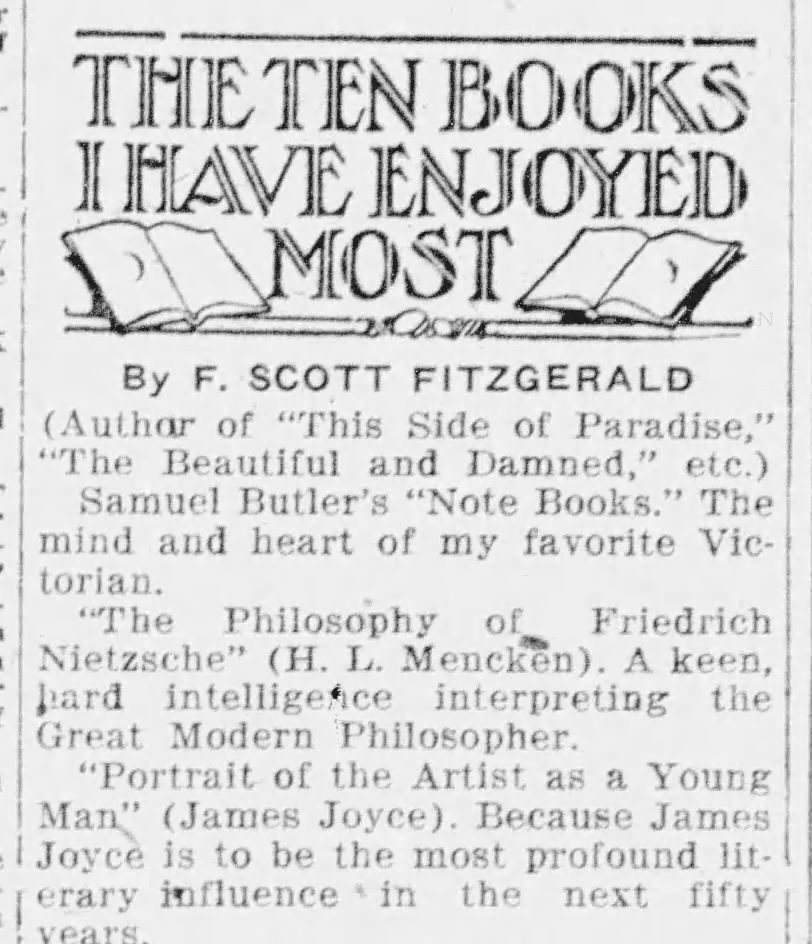
By the time that The Great Gatsby was being conceived, Fitzgerald had been reading Thus Spoke Zarathustra and the Genealogy of Morality by Friedrich Nietzsche, whose own take on God, the world and reality was significantly more uncompromising and pessimistic than that of Kant. [8] In his essay, We Fearless Ones, Nietzsche casts a less than critical eye over the skills and qualities necessary for thriving in a world where God is dead and where both tradition and modernity can be transcended or discarded. For those who have read The Great Gatsby and been thoroughly appalled by the unscrupulous behaviour of these Bright Young Things, We Fearless Ones might be regarded, superficially at least, as a manifesto of sorts for all the ‘careless people’ that came to define the author’s Jazz Age. [9] Whilst vehemently opposed to laxity, excessive indulgence, and chaotic recklessness, Nietzsche believed that true freedom required one to pursue fulfilment and growth aggressively — giving the green light, as it were, to breaking the rules and lying.
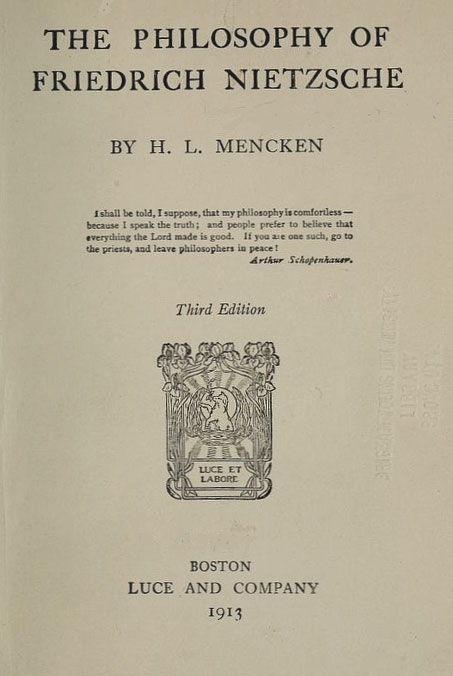
by H. L. Mencken
In We Fearless Ones, the Fifth Book added to his larger philosophical work, The Gay Science, Nietzsche takes issue with man’s “unconditional will to truth”, his overwhelming determination not to be deceived, on the assumption that being deceived is harmful and dangerous. He decided that we should really be asking ourselves why this was so: why was it that people didn’t want to deceive or be deceived? Why was it that “life aimed at semblance … deception, simulation, delusion, self-delusion” was so very, very wrong, when the “great sweep of life has actually always shown itself to be on the side of the most unscrupulous polytropoi”? [10] A passionate belief or love is what made man happy, not the truth. Love was a local anaesthetic — a ‘novocaine for the soul’ [11] — but it didn’t release man, writes Nietzsche, it enslaved him. If Nietzsche had been writing for DC Comics in the 1950s, it wouldn’t be kryptonite that kills Superman, it would be Lois Lane. Nietzsche wondered if humankind would be happier if it embraced life’s darker side. Not a world without love exactly, but a world in which love wasn’t determined by social norms or moral principles.
As a race, Nietzsche thought we were celebrating all the wrong virtues. The way Nietzsche saw it, there was the ‘conscientious man’ who demands absolute truth, and who is miserable as hell as a result of being denied it, and then there was the more versatile, life-affirming individual who was able to adapt and rise above real life. He called this new kind of human being the ‘polytropoi’ — someone capable of responding positively to immense deception and illusion. Nietzsche had taken the name from the very first lines of Homer’s Odyssey. Homer had been telling us about Odysseus, or Ulysses as he was known by some, a wanderer of many dimensions, someone difficult to pin down or predict — a man full of contradictions, deceitful and unscrupulous even. It was also being said that Nietzsche’s ‘polytropoi’ had been influenced by Quasi-Christian-Platonic cults who held that there was a superior race of humans called the pneumatikoi — a people that were pure and enlightened — light-workers — star-seeds like the Lemurians. No matter how gross or reprehensible their behaviour, it was felt that those who had achieved this state of perfection were free to exist beyond the usual laws of nature and morality. As the Christians believed there could be no redemption without sin, the story went around that the pneumatikoi were sinning themselves to perfection. [12] Fitzgerald would have seen a similar approach to life from the Old Money elites like the Chanlers, the Astors and the Rumseys back on Long Island, and to a lesser degree in men like Arnold Rothstein in Manhattan. As Nietzsche saw it, these people didn’t care for the truth and had no need to. It was just one reason why the very rich were so different from the rest of us.
Simulacra and Simulation
In the theatre of the 1920s, the ground-breaking work of producer and playwright David Belasco was adding a profound sense of realism and naturalism to the experience of drama. The birth and success of the motion picture blurred the boundary between reality and illusion still further. Sets and costumes were getting more elaborate, dialogue was getting more realistic and the imaginary situations being played out on the screen were beginning to influence rather than just reflect behaviour. The intellectuals and artists of the world were obsessed with conveying a sense of reality. But the reality we saw on the screen wasn’t reality in the strictest sense of the word, it was verisimilitude. Movie theatres were bursting with people who begged them to suspend belief. The people of the Free World had found a new Church. The tolerance of ‘deception’, ‘simulation’ and ‘delusion’ that Nietzsche had embraced in We Fearless Ones was being preached on a national scale. Even Chaplin was more popular than Jesus now.
The French philosopher, Jean Baudrillard, was probably channelling Nietzsche when he wrote that “The simulacrum is never that which conceals the truth—it is the truth which conceals that there is none. The simulacrum is true.” [13] In his book, Baudrillard had very playfully attributed the statement to Ecclesiastes — a book of Old Testament wisdom — with the effect that it buried it behind another layer of illusion. Nietzsche had said something similar: reality was an illusion that we had forgotten was an illusion. It was a copy with no original, a shadow with no source. Baudrillard had, however, recalibrated the idea with the world of hyper consumerism in mind; society constructs an elaborate web of signs, media, and consumer goods to simulate a functioning ‘reality’. In turn, this structure desperately tries to prevent us from realising that the foundation is completely empty. Inevitably, Fitzgerald would have been adapting these basic Nietzschean principles to popular issues of the day, like ‘conspicuous consumption’ (the practice of buying luxury goods and services to publicly display wealth and social status rather than to meet practical needs) and ‘pecuniary emulation’ (the social practice of competing for status by imitating the consumption habits and lifestyles of wealthier individuals).
Philosophers like Nietzsche were at war with absolutes and moral laws. What he was saying was that until now, people had had no other option but to rely on Christianity and morality. But now, in what remained of the 19th century, there were other options. The horizon was ‘free’ to them again, a ‘new dawn’ was upon them. Their ships were ‘free to sail’ into open waters to face any danger. Nietzsche was hard-pressed to contain his excitement: “perhaps there had never yet been such an open sea”. [14] Open sea or not though, the oars, the philosopher recognised, were still often stuck in reverse. Nietzsche surmises that few things faded as quickly as the future, just as few things clung like the past. What often held us back was our own consciousness and mediocrity. What set Gatsby apart from the others was his almost Dionysian outlook. Until he was tragically brought down by the petty and careless indulgences of people like Tom and Daisy Buchanan, Gatsby had possessed a super abundance of life. Love was what made Gatsby ‘great’ but it was also what killed him in the end. For the many folk who have misrepresented, or misunderstood Nietzsche over the years, romantic love wasn’t a strength, it was a weakness. It was friendship that really mattered.
Enchanted Objects
In his 18th century novel, Julie ou La Nouvelle Héloïse, Rousseau wrote that ‘the charm of illusion’ gave you the happiness you craved. The heroine of the piece, Julie, had arrived at the conclusion that as long as people desire, they are happy. As long as we had something to reach for, something to hope for, people could live without happiness. Love and desire was what focused us on the future. ‘Malheur à qui n’a plus rien â desirer!’ —Woe to him who has nothing left to desire. The greatest happiness we felt was in those long, persistent moments of longing. The fuel we sought was in the ‘charm of illusion’ that wanting brings. ‘On jouit moins de ce qu’on obtient, que de ce qu’on efpere , et l’on n’eft heureux qu’avant d’être heureux — what we obtain, we enjoy less than what we hope for.’ [15] It is a maxim that is repeated in Gatsby. Jay and Daisy have just been reunited and he asks her about the green light that burns all night at the end of her dock across the bay. Fitzgerald writes that the “colossal significance of that light” may now have been lost forever, that the magic and influence the light had once held over his life had vanished the very moment Daisy had put her arm through his. Gatsby’s “count of enchanted objects”, he continues, had reduced in number by one.
For Nietzsche, reality was raw, often harsh, and inherently meaningless. It was the reason we had art — so that we wouldn’t die of reality. Illusion was essential for human existence, acting as a necessary, life-affirming shield against the often unbearable, chaotic truth of reality. Even the misery that love inflicted was preferable to the reality of life without it. That’s where happiness was — in desiring the thing. The joy was in romance. The race to truth was a race to death. Fitzgerald had probably looked at all those colossal mansions owned by the millionaires back on Long Island and arrived at much the same conclusion: you didn’t build a big beautiful house to embrace the world around you, you did it to keep it out. In the final pages of the novel, Gatsby’s dreamworld has been breached. The figure of Wilson is gliding toward him through the trees. This is what Fitzgerald writes: “He must have looked up at an unfamiliar sky through frightening leaves and shivered as he found what a grotesque thing a rose is and how raw the sunlight was upon the scarcely created grass. A new world, material without being real, where poor ghosts, breathing dreams like air, drifted fortuitously about.” [16] The world he had created may have been one of ‘unreality’, but somehow it had seemed more real.
The Novel’s discarded, and very Nietzschean, prologue.
Before we leave Nietzsche, I’d like to return to the prologue to The Great Gatsby that was removed from the final drafts of the novel and published separately as the short story ‘Absolution’ in The American Mercury. It tells the story of an eleven year old boy, Rudolph Miller. The boy is attending confession. He has missed the last confession and is feeling guilty about it. When the priest asks why he missed confession, the boy lies. We come to learn that Miller is a natural liar. Before long he is telling other lies, and to avoid feeling guilty about them, he invents another persona: Blatchford Sarnemington, a strutting aristocrat who lives in a world of “great sweeping triumphs.” But it’s a description of a Ferris Wheel and the lights of a fairground provided by the priest that I want to focus on here and the strange, otherworldly phrase he uses. The priest is trying to put across the vision of a turning Ferris wheel. In the story, the wheel represents the dazzling, romantic escape dreamt of by the boy. As the priest speaks, the weight of the boy’s guilt lifts, replaced not by conventional pious humility, but by a surge of defiant arrogance. Caught between fear and fascination, Rudolph imagines himself leading a cavalry charge at the Battle of Sedan—a heroic daydream that transforms him from a penitent boy into a radiant, self-fashioned titan. Rather than submitting to divine grace, he adopts the invincible alter-ego of “Blatchford Sarnemington,” shielding himself behind an armour of unassailable confidence.
When the priest talks of the lights at the amusement park, he says that “things go glimmering.’ Indeed, the visual correlations between the glimmering brilliance of the amusement park (which featured on the original cover art of the novel), the bright lights of Gatsby’s parties, and the pulsing green light at the end of the dock are too striking to ignore. Both are stories about lies, escape, and maintaining illusions. In his poem about the “wreckage of the stars,” Nietzsche had written that ‘The poet, who can willingly and knowingly lie, can alone tell the truth.’ In Plato’s view of the world, poets moved away from the truth. Poetry was the lies of fools. For Nietzsche, however, the colourful screens that poets drew around them and the elaborate masques these ‘liars’ performed — their “broken words and false rainbows” — freed others from the burden and the obligation of the truth. The poet’s ‘conscious lie’ was a way of viewing the truth from a safe dark place, somewhere from which he might view the better part of the spectacle. Writing of the metaphysical needs of the thinker in 1878 book, Human, all Too Human, Nietzsche had written that in man’s determination to be liberated from the earthly world of his senses he may feel like he is floating above the earth in a starry dome” where “all the stars seem to glimmer around him”.
When Rudolph leaves the church, Fitzgerald invests the landscape with subtle Nietzschean symbolism. The “blue sirocco” drifting over the local grain fields echoes a specific motif from Nietzsche’s The Antichrist (translated by H.L. Mencken and published in Knopf’s Borzoi series in 1923). For Nietzsche, the warm, stifling Mediterranean sirocco symbolised the weakening influence of Christian morality — a soft, oppressive breeze that sap the vital energy of the strong. In contrast, the sensual, “blond Northern girls” in the town embody a vitality that far surpasses this languid wind. By contrasting these forces, Fitzgerald highlights Rudolph’s rejection of his town’s passive, servile faith in favour of an instinctual, heroic self-assertion that places him beyond conventional ideas of good and evil, a place where he is “safe from God.” (see Nietzsche’s Beyond Good and Evil, 1886).
Nietzsche’s reference to the ‘polytropoi’ had been taken from the very first line of Homer’s Odyssey, in which the narrator asks to be reminded of that most complicated ‘polytropos’ (πολuτροπον) of Troy, Odysseus — a man skilled in the art of deception and manipulation but also a man much lied to and manipulated by others. In Homer’s story, the hero’s creativity and resourcefulness allows him to triumph over nature, the brute force of the Cyclops, be repatriated with the land of his birth and then finally, to be reunited with his lover. Odysseus is a living metaphor, an inconstant symbol, saying one thing and meaning another — a symbol of the triumph of the figurative over the literal, of the temporal over the corporeal, of the spirit over the world. The impact that Gatsby has on West Egg is like the constantly turning tide that strokes the rocks at Manhasset Bay and quietly shapes the Long Island coastline. Gatsby is the projection of the image onto the reality that is to be enjoyed on its own terms — the glass of fashion and a master magician.
Whilst we may never know what side of the Nietzsche-Kant debate Scott eventually came down on, what we do know is this: Gatsby races toward the future but is pulled back by the past. In the words of Isaac Hecker, the past would be his grave. The handsome, blue-eyed bootlegger is presented by Nick as the angel of the material world, a Jazz Age Demiurge holding a mirror up to nature for all those who attend his parties. But of all those people he lies to or manipulates, there is no one he is more willing to deceive than himself. The pink-shirted polytropoi sees nothing when he looks in the mirror, just an “indefinite procession of shadows”. [17] He is Prospero on Prospero’s island.
Hot Nietzschean?
So which side does Fitzgerald ultimately come down on? Is Jay Gatsby a hot Nietzschean or hot Kantian? Well, in all fairness, its not clear. In the end, it all seems rather confused. Fitzgerald seems equally committed to embracing the Romantic idealism of Kant and Shelley as he is the ‘Übermensch’ ideas of Nietzsche — or more accurately perhaps — what he believes to be the ideas of Nietzsche. Gatsby talked a lot about the past, explains Nick, it was like he wanted to recover “some idea of himself” that had been lost in loving Daisy. Since meeting her, his life had been “confused and disordered.” [21] Scott, or at least Nick, doesn’t quite seem to know whether its the death of God, or the birth of God, whether Gatsby is a Nietzschean failure or a Nietzschean triumph, whether it was better to have never loved at all than to have loved, lost and gone through the whole messy rigmarole of gaining that love again. For Nietzsche, love generally conformed to existing moral laws. It was an idea, not a thing. Gatsby admits as much himself in the original manuscript of the novel: “she had been an ideal of his”. [22] If man was to thrive in the material world there were two things he needed to reject: the idea of God, and the idea of love, or at the very least, to recognise both of them for what they were: systems that gave our life meaning.
Scott’s fascination with Nietzsche had followed him all the way from prep-school to university. His dependency had been such that his Newman School mentor, Father Sigourney Fay, had told him that his “high handed scheme of blind dominance” had been preventing his inner growth. In refusing to throw away all that “old luggage about success and the Superman and all,” he had done little more than make a boorish, neurotic “ass” of himself. [23] Fay’s loathing of Nietzsche would culminate in the sensational The Genesis of the Super-German, a 1000-word attack on the “insidious propaganda” being carried out by Germany during the war: “There is at once no height of egoism and no depth of wickedness to which such a mind cannot come. If I know only myself, egoism and megalomania are the inevitable results. Nietzsche follows Kant as logically as Kant follows Nietzsche … Christendom must no longer be a mere idea, but a vital reality, if the world is to be saved.” [24] If there is a ‘superman’ in the novel, then it’s probably the boorish white supremacist, Tom Buchanan. Tom embodies the popular, degraded misreadings of Nietzsche—his quasi-intellectual rants about the ‘Overman’ and ‘Underman’ drawn directly from the racialized theories of Lothrop Stoddard. [25] Fitzgerald would later turn Stoddard’s Nordic elitism on its head, asserting in 1927 that the true saviour of ‘a race yet unborn’ would spring not from patrician blood, but from the immigrant class—perhaps “in the guise of an eastside newsboy.” [26]
So what can we take from all of this? Well, it’s Nietzsche, Jim. Just not as we know it. Inevitably, the novel’s efforts to explore the metaphysics around the philosophy of perception are filtered through the not always fastidiously academic brain of Fitzgerald. His engagement with Nietzschean philosophy is filtered through an artist’s intuition. As the philosophy adapts to the chaos of the drama that unfolds, few if any of these complex theories are left intact: they are patchy, at best. They are Scott’s idea of somebody else’s idea of what Kant means, what Nietzsche means or what Goethe means. Whenever the author doesn’t understand something, or doesn’t agree with something, he modifies it or combines them with more contemporary, and sometimes more intensely personal patterns of thought. The principles of stack influence weren’t lost on Scott: “Spengler stands on the shoulders of Nietzsche and Nietzsche on those of Goethe,” he would tell The New York World. Scott wasn’t alone in any of this. The degree of competence in interpretations of such philosophies varied considerably across the board.
Scott wasn’t wrong when he told a friend about ditching some of the more gritty, urban material to preserve the “haunted-ness” of the novel, as there’s another novel, a much deeper one, ghosting the main one. [27] Discerning it beneath the more obvious sentimental melodrama demands a reading that’s not unlike waving an ultraviolet light over the night sky to reveal all that invisible radiation and energy, that ‘background glow,’ as it were. Gatsby is no ‘Übermensch’, that’s for sure, or if he is, he’s a failed one. His entire project is chained to a poetic, romantic devotion, an almost worshipful idealism. He has too much capacity for wonder, too much tragic humanity, to remain a cold titan. And maybe that’s the point. Maybe this is not the story of a self-overcoming Superman going beyond his own ordinary limitations through constant self-mastery and systematic rule-breaking, but the story of a Superman who becomes human again: the figurehead of a new great race, with a new great dream. [28]
The Great Gatsby may present a messy, fragmented reimagining of Nietzsche, but the philosopher’s thumbprints—and Fitzgerald’s resistance to them—are visible on every page.
[1] Critique of Pure Reason, Immanuel Kant, G. Bell and Sons, London, 1878 (originally published 1781), pp. 41-43
[2] Post-modernist philosophers like Jean Baudrillard would probably argue that behind the lies were more lies.
[3] The Great Gatsby, p.95, p.154
[4] The Great Gatsby, p.83
[5] The Great Gatsby, p.11
[6] Plato’s Allegory of the Cave was drawn upon by H.G. Wells in his short story, The Country of the Blind (1904) in which an adventurer stumbles in a remote ancient valley cut off from the rest of the world in which its people have adapted to life without sight.
[7] The Great Gatsby, p.130
[8] Conversations with F. Scott Fitzgerald, F. Scott Fitzgerald, University Press of Mississippi, 2004, p.83, p.87
[9] We Fearless Ones was a new section that Nietzsche added to an updated version of The Gay Science in 1887.
[10] ‘We Fearless Ones’, Book Five, The Gay Science (1882), Friedrich Wilhelm Nietzsche, ed. Walter Kaufmann, Vintage Books, 1974, p. 282
[11] It’s not Nietzsche’s phrase but Mark Oliver Everett’s of 90s rock band, The Eels.
[12] Gnosticism: Its History and Influence, Benjamin Walker, 1983, Aquarian Press, pp.176-177
[13] ‘Simulacra and Simulation’, Jean Baudrillard, 1981
[14] We Fearless Ones’, Book Five, The Gay Science (1882), Friedrich Wilhelm Nietzsche, ed. Walter Kaufmann, Vintage Books, 1974, pp. 277-290
[15] Julie, ou La Nouvelle Heloise (Part VI), Jean-Jacques Rousseau, Londres, 1781, p.121. Rousseau uses the phrase ‘imaginaire propriété’ which might roughly translate as house or place of illusion, imagination.
[16] The Great Gatsby, p.194
[17] The Great Gatsby, p.130
[18] The Great Gatsby, p.133
[19] The Great Gatsby – Autograph Manuscript, circa 1924-1925, F. Scott Fitzgerald Papers, 1897-1944, C0187, Box 4, Princeton University, p.323
[20] The Great Gatsby, p.130
[21] The Great Gatsby, p.133
[22] The Great Gatsby – Autograph Manuscript, circa 1924-1925, F. Scott Fitzgerald Papers, 1897-1944, C0187, Box 4, Princeton University, p.323
[23] This Side of Paradise, F. Scott Fitzgerald, Charles Scribner’s Sons, 1920, pp.112-114
[24] ‘The Genesis of the Super-German,’ Sigourney Fay, Dublin Review, Burns and Oates Ltd, Vol. 162, No. 325, April 1918, pp.224-233.
[25] The Great Gatsby, p.16; The Revolt Against Civilization, Lothrop Stoddard, Charles Scribner’s Sons, 1923, p.262. After the publication of ‘Revolt’ Stoddard would be regularly labelled the “new Nietzsche” whose work he draws on. His book, The Rising Tide of Color is lampooned in The Great Gatsby as The Rise of the Colored Nations.
[26] ‘Fitzgerald, Spenglarian,’ Harry Salpeter, New York World, April 2, 1927.
[27] ‘Dear Corey, July 1937,’ Letters of F. Scott Fitzgerald, pp.557-558
[28] ‘Fitzgerald, Spenglarian,’ Harry Salpeter, New York World, April 2, 1927.