There was nothing to look at from under the tree except Gatsby’s enormous house, so I stared at it, like Kant at his church steeple, for half an hour — The Great Gatsby [2]
The Catholic ‘Americanist’ priest, Isaac Hecker, believed that when Kant had asked the question, ‘what can I know?’ and answered it with, ‘I can know nothing’, he was in fact supporting the only logical conclusion there was to his scepticism: the existence of God. Life without God in this world was anchored in shadows and images. What both men were getting at was the fundamental human need for some rational cosmic order that sustained moral purpose. Without that ‘higher purpose’ driving those ambitions, life would feel futile, like an aimless, chaotic illusion. Without knowing it, Kant had cast doubt on the doubters. The Gospel of Hope had been found in the Gospel of Chaos — or as The Catholic World once put it, “Father Hecker’s life was the ideal projected on reality.” [1]
Fitzgerald’s Jay Gatsby attempts a similar projection, anchoring his vision of a glorious future in “a factual imitation of some Hôtel de Ville in Normandy” But as we find at the end of the novel, without Gatsby’s sustaining lens to give it life, that ideal dissolves back into the void, leaving behind only a “huge incoherent failure of a house”—its raw materials collapsing back into original chaos once the spell is broken.
Who was Isaac Hecker?
Walter Elliott once painted a memorable picture of Hecker kneading at the dough trough at Brook Farm with a copy of Kant’s Critique of Pure Reason propped up on a wall in front of him. In it, Hecker would have found that the philosopher had laid out his belief that human genius was the very opposite of imitation. The goal of a genius wasn’t to obey existing rules but to create new rules. But herein lay a paradox: the creative imagination relied on existing rules and paradigms (and even language) to communicate; it simply couldn’t escape the past. Nevertheless, it was this observation by Kant that would inspire Hecker to write in his diary: “We cannot repeat the past.” [3] The past, he went on, required “new clothes”. It required imagination. America was “young, fresh and in the vigour of its manhood.” The destiny of the nation was hanging in the balance and only a religion that could match its “true genius” could take it forward. If the Catholic Church sought to play a more central role in America’s destiny and achieve a greater uptake among the broader and largely Protestant population, Hecker saw that it needed to adapt imaginatively to the American ideals of self-determination and rugged individualism: it needed to modernise.

From a Catholic perspective, Hecker was like Prometheus unbound, moving the church away from the tyranny of ancient dogma to a freer and more independent way of communicating with God. For Hecker and other ‘Americanist’ priests, the progressive model of American democracy was something they should work with, not against. In his early adulthood, Hecker had spent several years at Brook Farm, a transcendentalist commune just outside of Boston which mixed the Utopian Socialism of French philosophers like Charles Fourier with Ralph Waldo Emerson’s own take on German Idealism.
Like Emerson, Hecker had come to believe that it was man’s duty to God to aspire to greatness, to reveal what was highest, divine and best in him. “Man hopes. Genius creates,” wrote Emerson. It looked forwards, not backwards. [4] Within a year of Pope Leo XIII banning ‘Americanism’ within the church — which advocated a more liberal, socially engaged approach to Catholic values — Hecker’s niece, Caroline Hecker-Locke and her husband, Jesse, founded Fitzgerald’s prep-school, The Newman School For Boys, a boisterous wink and a nod to the breakaway Catholic doctrines of John Henry Newman and the intellectual Kantian framework that shaped Hecker’s understanding of metaphysical realities like God, and the existence of a realm beyond scientific knowledge: the realm of the seemingly impossible. [5]
One man who was doing the impossible at this time was John Henry Newman, the man who had given his name to the school. John Henry Newman was a former Anglican priest who had led the no less controversial Oxford Movement in England. If Newman had been successful in making Catholic traditions acceptable in the minds of the English, then the school would follow that example by doing the same thing in America. This “sort of unity” in the lives of Hecker and Newman would be recognised by Cardinal Newman himself. They had “both begun a work of the same kind.” In his essay, Newman in Contact with Kant’s Thought, the theologian, Johannes Artz, conducted a thorough forensic review of the impact that Kant had on Newman and the Oxford Movement. In it, Artz repeats a statement that was made by W. S. Lilly in the late 19th century. According to Lilly “the philosophical basis” of Newman’s Oxford Movement was, like Hecker’s Americanist movement, indirectly drawn from Kant. By way of proof, Lilly cited an essay that Newman had written for the British Critic in April 1839. Newman’s essay, The State of Religious Parties, made the argument that many of the poets who had been inspired by Kant, like Coleridge, had been applying their “genius in the cause of Catholic truth.” It was Newman’s belief that Coleridge and the Romantic Poets, who promoted ideas that were often more heathen than they were Christian, had instilled a “higher philosophy into inquiring minds” than the Church and its followers “had hitherto been accustomed to accept.”
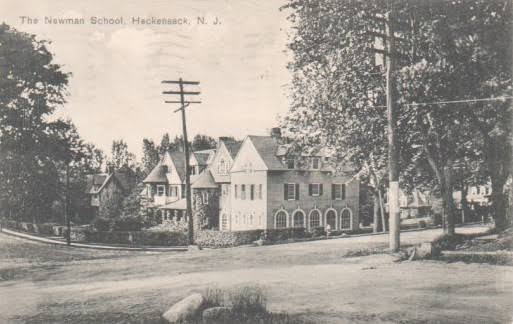
The Newman School for Boys was a little different to other Catholic prep schools of its time, in that it provided a liberal secular education. Many of the teachers were lay-people and not robed, could marry and go home at night. The position that Kant occupied at the school, just as it was at the Catholic Seminary in Fitzgerald’s hometown of Saint Paul, was a complex one, serving more to illustrate the reliance of the German Idealists on the possibility at least of an absolute truth or God. The Saint Paul Seminary, officially founded in 1894 through the vision of Archbishop John Ireland and an endowment from railroad tycoon (and Gatsby’s celebrated role model) James J. Hill, took the view that whilst Kant’s metaphysical agnosticism was incompatible with Catholic dogma, his scepticism about the competence of either science or reason to prove or disprove God, made it a plausible hypothesis. There was something they had in common: one required a leap of faith, the other a leap of reason. For the vast majority of Catholics on the continent, however, Kant was the undesirable sceptic whose Protestant Lutheranism precluded him from appreciating or acknowledging an ‘absolute truth’ or the pillars of absolute faith in Rome. Hecker, on the other hand, was more appreciative of his labours, recognising in Kant’s ultimate critique of reason a game-changing concession: “philosophy was not able to give man satisfactory solutions to the great questions that agitate reason.” [6]
Hecker and his friends were changing the rules of engagement with divine matters in America, and the Church of Rome came under pressure to adapt to the impact that the Enlightenment and Romanticism had had on members of its flock in the major towns and cities. The printing revolution and global migration had at least partially torn open the veil. And whilst the highfalutin theories of Kant, Rousseau, Voltaire, Locke, Smith and Spinoza may have been lost on the vast majority of the lower classes, their ideas were being filtered and recycled in the most dazzling of ways through the globally popular verses of Shelley, Byron and Baudelaire and the inspiring epic stories of Victor Hugo and Leo Tolstoy. As people moved around the globe en masse with ever increasing speed and frequency, the religions of the world collided and competed for dominance. New truths were emerging, new questions were being asked. The ‘new world’ they were encountering may have looked the same, but it wasn’t the same. The liberal terms of an open market were now shifting to spiritual matters. Reality — or our experience of it at least —was under threat. More worryingly for Rome, it was being democratised.
Earlier references to Kant
Scott might have breezed over Hecker’s influence on his Catholic prep-school, but he would make several references to the speculative and romantic idealism of Kant in his novels, the first in This Side of Paradise, when he parenthesises Kant’s name in a line from a poem that the book’s protagonist, Amory Blaine, writes for the Princeton journal, The Nassau Literary Review. The second time he mentions Kant is in The Beautiful and Damned when Maury Noble alludes to the philosopher’s habit of looking up at the steeple of Löbenicht Church in his hometown of Königsberg in an attempt to focus his thoughts. Maury is dismissing the efforts of a friend to “pierce the darkness of political idealism with some wild despairing urge toward the truth”. Scott’s character dismisses his efforts as futile, telling him that it is like sitting every day in some rigid chair, “infinitely removed from life”, staring at the tip of a steeple through the trees, “trying to separate the knowable from the unknowable.” [7] It’s an image that Fitzgerald revisits in The Great Gatsby when the book’s narrator, Nick Carraway, finds himself staring at Gatsby’s house from beneath a tree in his garden, “like Kant at his church steeple”. [8]
Considered through the lens of Kant’s legacy in German Idealism, Fitzgerald’s three references to Kant’s steeple coalesce into a single metaphor: the passive contemplation of unachievable romantic ideals—the pursuit of the impossible. The steeple and Gatsby’s house represent the sum total of human aspiration: the Christians with their churches, and Jay Gatsby and his mock-Gothic mansion. It’s like that other line by Kant: “Two things fill the mind with ever new and increasing admiration and awe, the more often and steadily we reflect upon them: the starry heavens above me and the moral law within me.” [9] There is awe and there is wonder. But on the flip side, there is a huge amount of scope for disappointment and humiliation.
For Fitzgerald, the steeple and the house would have embodied a folly of sorts — the steeple, because it reached ambitiously and despairingly toward heaven, and Gatsby’s house because it reached-out, in no less ambitious and despairing a fashion, for the hand and heart of Daisy. Thomas Hardy’s similarly tragic overreacher, Jude Fawley was another of Kant’s disciples. In his 1895 novel Jude the Obscure, Hardy’s ill-fated working class scholar is seen staring longingly at the ‘dreaming spires’ of Oxford. In the end, the hero proves just as vulnerable to a brutal and indifferent noumenal world — the cold, hard world of physical reality. One by one, his ideals and ambitions are torn to shreds. A combination of pure chance, religious superstition and his generous devotion to the affections of a restless, unpredictable woman conspire against him and he dies a quiet and anonymous death, the energy having long since drained from his body. Both men idealise the women they love and the ransom they pay is their lives.
The Meaning of Kant’s Steeple
The story about Kant’s Steeple first told by Kant’s assistant, Ehregott Wasianski, in his 1804 biography, described how there came a time when a neighbour’s trees had become so large that Kant was no longer able to see his steeple. As a result, Kant becomes unsettled and finds that he is unable to focus his thoughts. In fairness, the story of the steeple and its temporary obscuration by the trees has all the hallmarks of a tantalising metaphor, but so far it’s baffled even the most formidable Fitzgerald scholars. The only exception to this is Professor Horst Kruse who devotes an entire chapter to its significance in his 2014 book, F. Scott Fitzgerald at Work. And Kruse’s interest is well justified. John Grier Hibben, the President of Princeton University and a respected authority on Kant and the philosophy of the Enlightenment, is likely to have repeated the steeple metaphor every time he wished to remind his students that it was “absolutely necessary that one should convince oneself of the existence of God”, but not so essential that one should be able to prove it. [10] A Presbyterian minister, Hibben, like many Christian thinkers of the late 19th century, selectively adapted Kantian philosophy to protect Christian faith from scientific scepticism and empirical attacks. In later years, Fitzgerald would show his frustration with Kantian philosophy when he openly challenged Kant’s contention that “two contradictory ideas cannot exist together in thought” when he wrote that “the test of a first rate intelligence is the ability to hold two opposed ideas in the mind at the same time, and still retain the ability to function.”
As Kruse notes, Fitzgerald earned excellent grades in his Princeton philosophy courses, and his interest in Kant was likely revived by the bicentenary of the philosopher’s birth in April 1924 while he was writing The Great Gatsby. [11] Crucially, the April 30 edition of The New Republic—published just days before Fitzgerald set sail for Europe to finish the novel—featured a three-page essay on Kant by John Dewey, printed directly after Edmund Wilson’s imaginary dialogue between Fitzgerald and Van Wyck Brooks. [12]
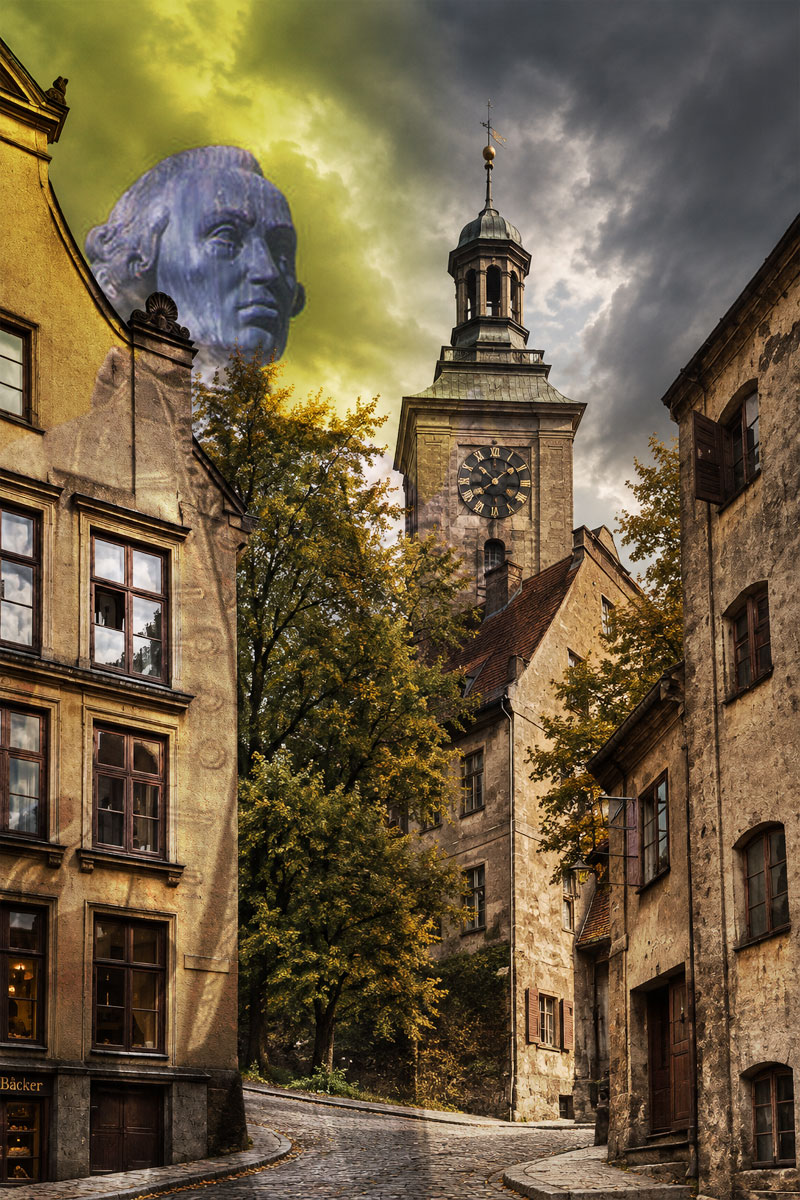
In the end, Kruse decides that because Kant’s habit of staring at the steeple exhibits all the classic symptoms of metaphysical reflection, then Nick Carraway is likewise engaged in a more profound experience. For this to work we have to accept that this is not just some throwaway line in the novel. Nick is not just looking at Gatsby’s house as he waits for the lovers to finish inside the cottage, instead he is contemplating the very nature of reality, the realm beyond what we can physically touch or measure. Catholic historians like Bob Scribner have sometimes described this process as a ‘sacramental’ way of seeing. The religious observer will look upon the divine image in a lingering, contemplative way, hoping that some eternal truth will make itself manifest in phenomena. Scribner writes that it “combined in a single action Luther’s idea of ‘looking through’ the physical image and the mystics’ notion of ascending from the sensual to the divine.” The “sacramental gaze”, as Scribner called it, represented an intense and emotional “passion to see”, that went beyond traditional Augustinian notions of “mystical seeing” to something that was closer in spirit to the epistemology of Kant, in which religion is brought back to the realm of experience. For the sacramental observer, things that were present in the Eucharist were not symbolic or metaphorical but real and substantial. They restored a ‘real’ divine presence (Kant’s ‘ens realissimum’). [13]
Fantastic Conceits
Central to Kant’s philosophy is the premise that human cognition actively constructs reality rather than merely absorbing it. As Johannes Artz notes in his analysis of Kant and Newman, “The noumena themselves are given to us in a shape which corresponds to our subjective structure.” In the Critique of Pure Reason, Kant posits that raw sensory input is filtered through an innate architecture—a perceptual apparatus shaped by pre-existing concepts of space and time. Our biology acts as an unavoidable apparatus: external stimuli enter through the senses and are immediately synthesised by the ego, transforming the unconditioned world into a structured, phenomenal experience without diminishing its reality.
The most grotesque and fantastic conceits haunted him in his bed at night. A universe of ineffable gaudiness spun itself out in his brain … Each night he added to the pattern of his fancies until drowsiness closed down upon some vivid scene with an oblivious embrace. For a while these reveries provided an outlet for his imagination; they were a satisfactory hint of the unreality of reality, a promise that the rock of the world was founded securely on a fairy’s wing — The Great Gatsby
Fitzgerald translates this philosophical mechanism into narrative reality through Jay Gatsby, whose “fantastic conceits” do not remain mere daydreams. Instead, through the sheer force of his vision, Gatsby projects these romantic ideals into concrete substance, elevating them from fragile illusions into tangible phenomena. When Nick and Jay cross the Queensboro Bridge toward the glittering skyline of Manhattan, Fitzgerald renders space and time strikingly fluid. Entering New York, Nick realises that the boundaries of possibility have collapsed: “Anything can happen now… Even Gatsby could happen, without any particular wonder.” [14]
Ultimately, Fitzgerald demonstrates in The Great Gatsby that reality is not an objective backdrop, but a dynamic projection of human desire—showing that when the mind’s lens is powerful enough, it does not merely interpret the world, it brings it into existence.
Related article
The Pink-Suited Polytropoi – The Philosophy of Nietzsche and The Great Gatsby
[1] ‘The Late Father Hecker’, Father Hewitt, The Catholic World, January 1889, vol. 49, p. 243
[2] The Great Gatsby, F. Scott Fitzgerald, Charles Scribner’s Sons, 1925, p.106
[3] Le Père Hecker: Fondateur des ‘Paulistes’ Américains, 1819-1888, Walter Elliott, Preface by Abbe Félix Klein, translated by Countess de Raviliax, Victor Lecoffre, 1898, Paris, p. XXXIV
[4] Self-Reliance’, Essays, Ralph Waldo Emerson, First Series, James Munroe & Company, 1847, p.39
[5] Pope Leo XIII officially condemned the theological tendencies known as “Americanism” in his January 22, 1899 apostolic letter, Testem benevolentiae nostrae, which was addressed to James Cardinal Gibbons, the Archbishop of Baltimore
[6] Aspirations of Nature, Rev. I. T. Hecker, The Catholic Book Exchange, 1904, p. 61
[7] The Beautiful and Damned, F. Scott Fitzgerald, Penguin, 2004, p. 211
[8] The Great Gatsby, p. 85
[9] Critique of Pure Reason, Immanuel Kant.
[10] The Philosophy of the Enlightenment, John Grier Hibben, Longman’s Green, 1910, p. 218
[11] ‘A View from Kant’s Window’, F. Scott Fitzgerald at Work, Horst H. Kruse, The University of Alabama Press, 2014, p.98.
[12] ‘Imaginary Conversations’, Edmund Wilson; ‘Kant After Two Hundred Years’, John Dewey, The New Republic, April 30, 1924.
[13] Popular Piety and Modes of Visual Perception in Late-Medieval and Reformation Germany, Bob Scribner,
The Journal of Religious History, Vol. 15, No. 4, December 1989, pp.459-461
[14] The Great Gatsby, p.83