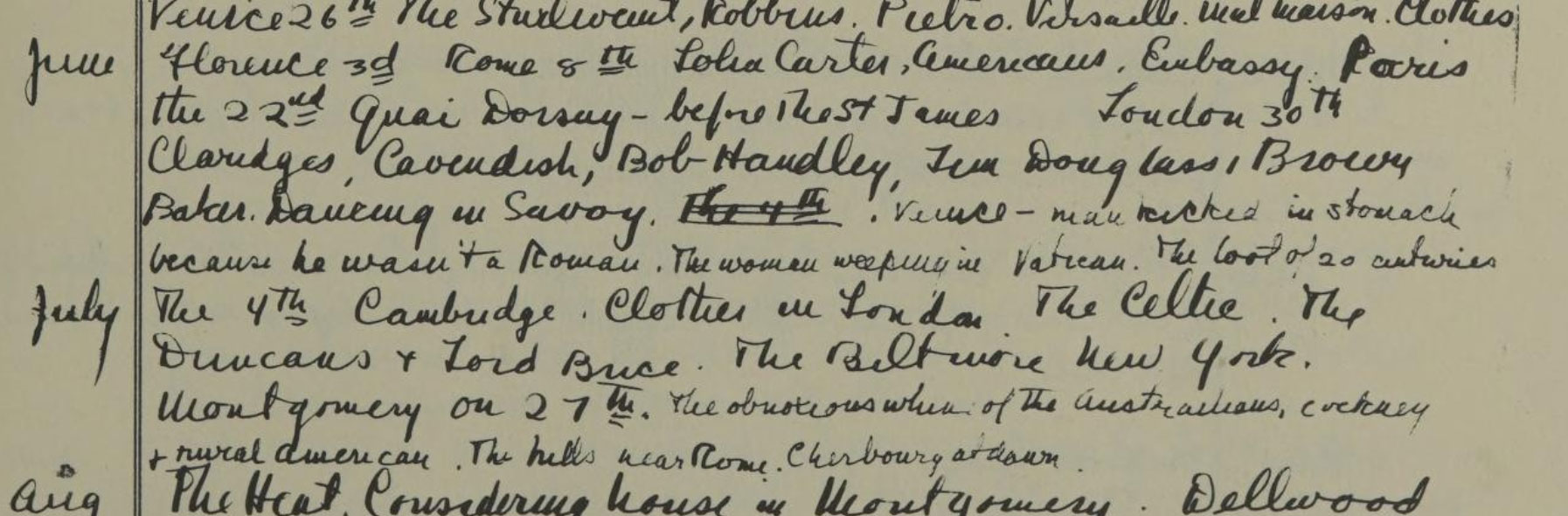
“There was London, and Wopping with Shane Leslie and strawberries as big as tomatoes at Lady Randolph Churchills. There was St. Johns Ervine’s wooden leg and Bob Handley in the gloom of the Cecil.” [1]
Bob’s name appeared among several names and places mentioned in entries in F. Scott Fitzgerald’s ledger covering his trip to Europe in the summer of 1921, and in a letter he received from Zelda in the autumn of 1930. The fact that Bob’s name appeared in diaries and correspondence on two very separate occasions suggests the encounter had been a memorable one. But why? Who was he?
At time of writing there are no other details to go on than the man’s name. However, after trawling through the records of all those people travelling to and from London on business at this time, and focusing only on those likely to have had the money to stay at a luxury hotel like the Cecil, the most likely candidate is Robert Bernard Handley (b.1875) a sub-director at the Banca Commerciale Italiana in London and privileged ‘correspondent’ for the Italian Treasury. [2] In early July 1921, the bank and its managing director, Giuseppe Toeplitz, had made a special journey from Rome to celebrate the opening of its London office at a banquet held at the Cecil. As director of its London office, it is almost certain that Handley would have attended the celebrations. [3] This means that Handley’s stay at the Hotel Cecil could well have coincided with Scott and Zelda’s second visit to the hotel in the first week of July. Although born in Rome, the 55 year old Anglo-American had found himself shuttling between Rome, Naples, Milan, Paris and London on a regular basis for over twenty years. By 1921, the bank had reached a position where it had almost complete control of Italian industry. His counterpart in New York was John Stewart Durland who had served as fiscal agent to the US War Department in Cuba during and after the First World War. [4] The passport application made out by Handley at the American Embassy in May 1920 shows him preparing for travel in Britain, France and Italy.
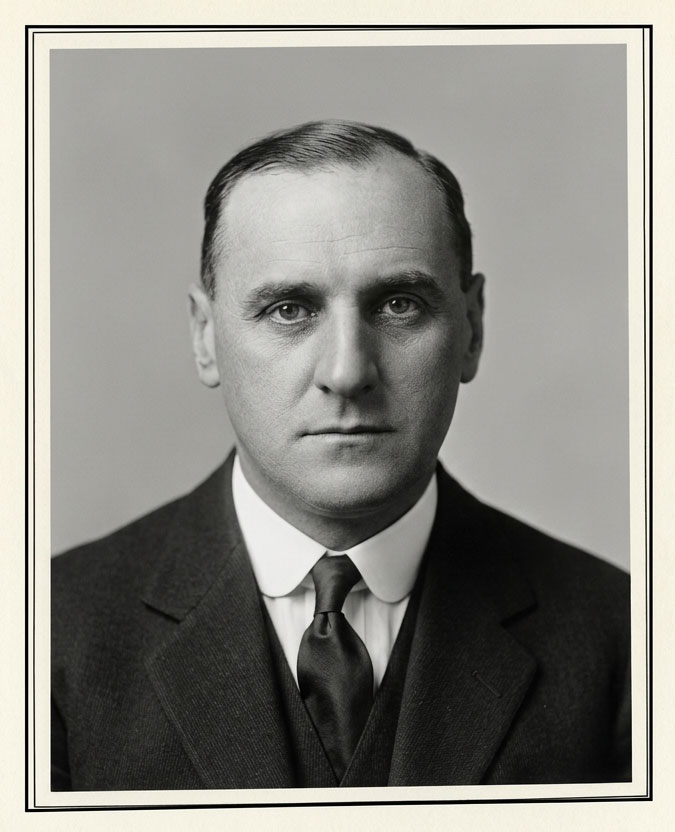
Robert’s father, Francis Montague Handley, had been born in New York to a British father who had served in the Royal Hussars. In the early 1870s, Francis, a successful banker and respected sculptor, had made his way to Rome where he became head of the Anglo American Bank at 79 Piazza di Spagna, a butterfly-shaped square known for its first-class restaurants and Spanish architecture. Scott would wander up this same street open mouthed during the couple’s pilgrimage to the final dwelling place of his hero, John Keats. The Keats-Shelley Memorial Museum at 26 Piazza di Spagna was less than 200 feet away from Handley’s bank. Built as part of the famous ‘Spanish Steps’ project, the elegant three-storey building had been lovingly restored as a ‘Memorial House’ by American poet and US Ambassador to Italy, Robert Underwood Johnson, a good friend of the Handleys and sometime editor for Scott’s publisher, Charles Scribner’s Sons. According to a self-penned interview that Scott produced for Cosmopolis in Rome, Scott and Zelda would take an apartment at the Hotel des Princes, located on the very same street as the bank when he returned to Rome in December 1924 to make his final revisions to Gatsby. [5] It’s not entirely clear why the author came back to Rome to complete the novel. On his first trip in 1921, Scott had been less than impressed with the square, telling Thomas Alexander Boyd back in his hometown of Saint Paul that it was “a close, dismal hole which had looked out on a cluttered, squalid street through which diseased children ran.” [6]
Like Scott’s friend, Shane Leslie, Bob’s father, Francis Handley had been made Chamberlain to Pope Leo XIII and the family had spent the full duration of their stay in Rome living in the grounds of the Vatican. Francis would also be the first American to be made a Commander of the Order of St. Gregory. His role as Chamberlain to the Pope would continue under Pius X, a high-status position in Rome that would bring him into contact with the Catholic nobility of France, Italy, Switzerland and Great Britain, among them the Duke of Beaufort and the Commander of the Pope’s Swiss Guard, Frederick Meyer von Schauensee, a Swiss baron. [7]
On Robert’s passport application in 1920, the name that Robert provides as part of his bona fides is retired banker, Robert D. Toland of Spruce Street, Philadelphia. Toland’s sister, Matilda Toland, had married Baron Schauensee and the two families remained close for many years, their son, Max de Schauensee, an opera singer and music critic, becoming a respected figure with Otto H. Kahn and the Metropolitan Opera Company. [8] That same passport application reveals that Bob was “known to the US Embassy.” Robert had two brothers who remained prominent figures in US and Italian relations. William W. Handley would serve as US Consul General in Naples from 1904 to 1914 and his younger brother, the Bristol-born editor and advertising executive, John Montague Handley of Chicago, who would become co-founder of the Italy America Society. In 1924, John would receive the Chevalier of the Crown of Italy from Leopoldo Zunini, Consul General of Chicago for Mussolini’s government. According to historian William Brunstein, Giuseppe Toeplitz, Bob Handley’s boss at the Banca Commerciale Italiana, had been among Mussolini’s first financial backers. The press of England would later say that Toeplitz was to Fascism what Herr Tyssen was to Hitlerism. The Chevalier award that John received was for the many years of service that he and the group had provided in fostering relations between the two countries — and for the cooperation he had shown its ‘directorate’ in Chicago, the Sicilian Mafia. The press of the time reports that the brothers had lived in Italy for 18 years and were believed to be “on intimate terms with members of the Italian nobility, government officials and literary men.” [9] The Society’s honorary president during this period was US Ambassador to Italy (and fellow Scribner’s author), Robert Underwood Johnson, a passionate devotee of the poets Shelley and Keats who would be relieved of his post in Rome just days after Scott had arrived back in London in July.
Whilst it is impossible to know for certain if Scott and Zelda’s Hotel Cecil ‘playmate’ Bob Handley is the same Robert B. Handley of the Banca Commerciale Italiana, he certainly makes sense in terms of the context. Scott and Zelda had just returned from Rome where they had socialised with staff from the American and British Embassies. The fact that Scott’s friend Shane Leslie, who had arranged his trip to London, had a diplomatic status at the Vatican not unlike that of Robert’s father Francis some twenty years earlier, is also very compelling. [10] John F. Carter Jr., the Embassy advisor who Scott had bumped into in Rome would almost certainly have been aware of the Handley family and their status in US-Italian relations, even if there is no evidence that he knew them intimately. It’s also interesting to note a number of other supporting details. Robert’s nephew, John Montague Handley Jr was a resident of Neuilly in Paris in the mid-to-late 1920s, where Scott and Zelda regularly met with Hemingway, and where Zelda was hospitalised for a time. [11] Their shared interest and activity in the local arts scene means it is possible they had come into contact, although it is by no means certain they did. A news item in the Paris edition of the New York Herald in June 1927 reports on an “informal tea” the Handleys had given at their home on Avenue Victor Hugo, a favourite gourmet haunt for Hemingway and Fitzgerald. [12] Around the corner from the Handleys at 44 Avenue Victor Hugo was the home of Louise Bryant, a friend of Scott and Zelda’s who had earned a scandalous reputation as a feminist and Soviet sympathiser. Also among the Handley’s wider circle of friends was author Katharine Brush [13] whose novel Red Headed Woman would be adapted by Scott in an unused screenplay for MGM. It is also curious to note that Zelda was offered a place with the San Carlo Opera Ballet Company of Naples — a city that Robert would visit regularly on business.
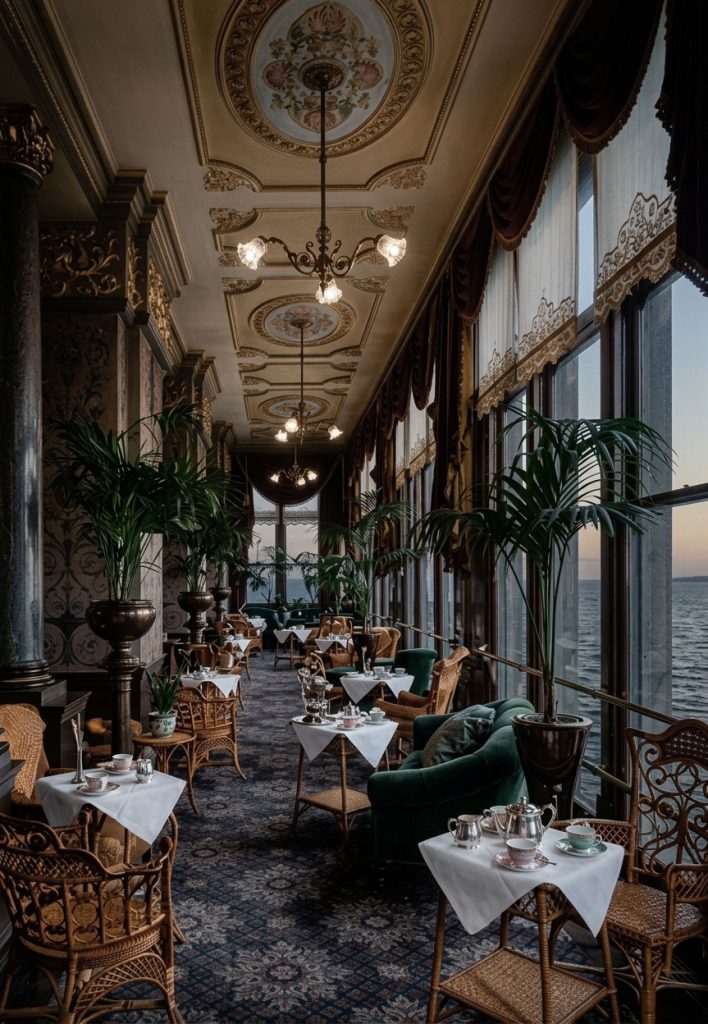
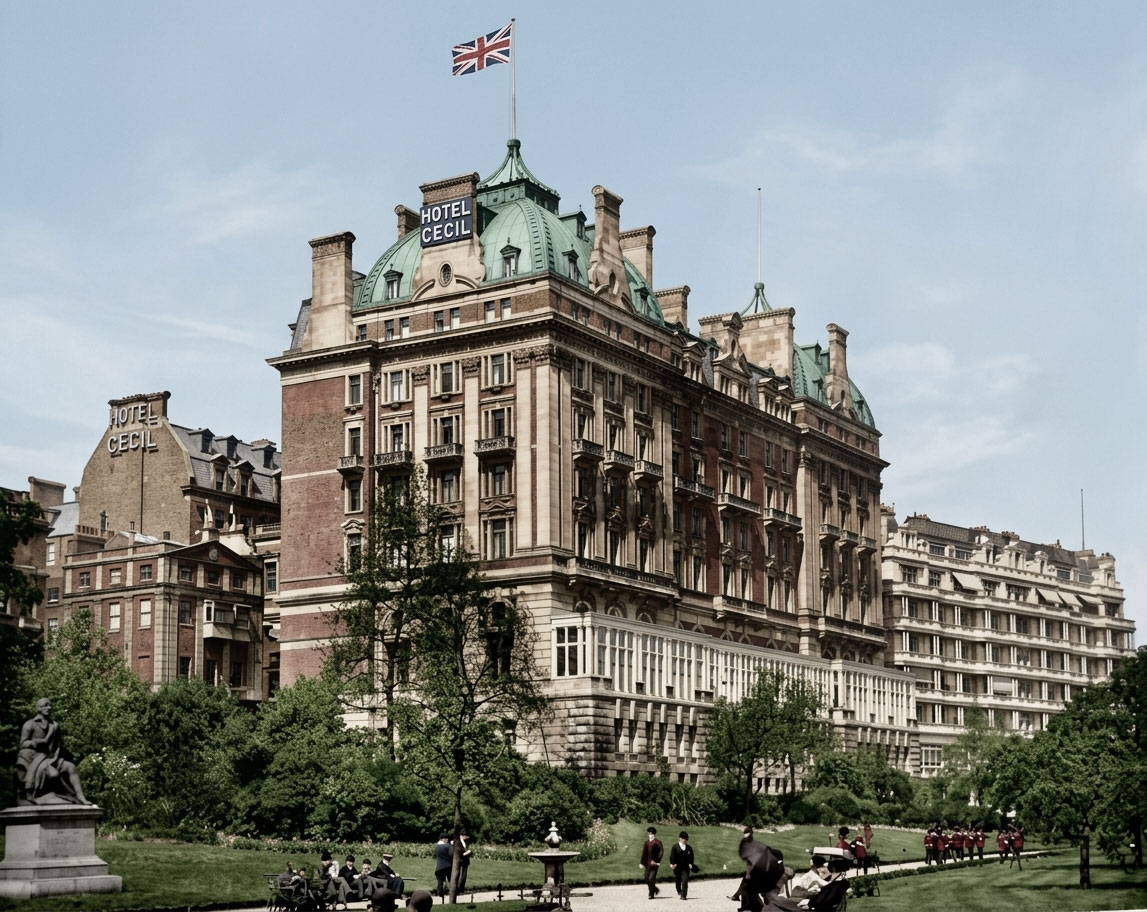
Scott and Zelda Fitzgerald had arrived at the hotel in the second week of May 1921, and returned (or so its believed) in the first week of July after their ‘Grand Tour’ of Europe. From 1917 to 1920, the ten-story landmark hotel had served as the headquarters of Lord Rothermere’s newly formed Air Ministry, but since then had been refurbished. The cost of first class accommodation here was likely to be anywhere from £15 to £20 a night (about £500 today). The reopening of the Hotel Cecil on New Year’s Eve, 1920, had been supported by a lavish advertising campaign in the British and American press. Reports would tell of the incredible transformation that had just been performed. A year of reconditioning work had waved goodbye to the bare floors, ugly desks and temporary partitions that characterised it under the government. Every nook and cranny had been totally remodelled and redecorated. The grill room, with its views across the river, and the grounds had been totally revamped in the style of Louis XIV, and each of the 800 rooms had dedicated central heating systems that guests could control at their pleasure. If the hype was to be believed, the “Rendezvous of the world” was going to quickly regain its status as the “finest hotel in the Kingdom”.
[1] Dear Scott, Late summer/early fall 1930, Correspondence of F. Scott Fitzgerald, F. Scott Fitzgerald, Random House, 1980, p.246
[2] Robert Bernard Handley (b. Rome 5 Nov 1875. d. 3 May 1955 Naples. Handley’s company was set-up in 1895. The Naples branch was controlled by Polish-Italian banker, Jósef Leopold Toeplitz. During the war Toeplitz and the bank were scrutinized by the pro-war newspapers in the US for their links to Germany. The bank‘s major shareholders were the Deutsche Bank, Dresdner Bank, Bank fuer Handel und Industrie, and Bleichröder, Oppenheim and Berliner Gesellschaft. Between 1923 and 1925 Toeplitz supported the economic policies of Alberto De Stefani, first minister of Finance and then of the Treasury in the Mussolini government. He and the bank were regarded as the financial agents of the Fascismo.
[3]The Bankers’, Insurance Managers’, and Agents’ Magazine Volume 112, July-Dec 1921, p.186
[4] Bankers Magazine, 1917-08: Vol.95 No.2, August, 1917, pp.234-325. John Stewart Durland, b.1876. helped organise the National Bank of Cuba and the Bank of Havana in 1906.
[5] ‘Un Giovane Autore Americano’, Conversations with F. Scott Fitzgerald, 2004, p.72. John Keats died of TB at the house in February 1821. Scott, who had arrived in Rome several weeks after the centenary of Keats’ death romanticised about having TB himself. The 1924 apartment was at the Hotel de Palaces.
[6] ‘Scott Fitzgerald Here on Vacation Rests by Outlining New Novels’, St Paul Daily News, August 29, 1921, p.E6
[7] ‘He Resumes His Work: Francis Montague Handley’, Wauwatosa News, May 10, 1902, p.3
[8] Robert’s friend, Robert D. Toland would commit suicide in September 1921 (shot himself through the head). See: Philadelphia Inquirer, Sept 251921, p.1
[9]John M. Handley (b.1869), Family of Francis and Adelaide Handley, Census, England, 1871, Tottenham Place, Clifton, Gloucestershire; US 14th Census, 1920, Chicago; John M. Handley, Editor & Publisher, September 27, 1924, Vol.57, No.18, p.25.
[10] Robert B. Handley’s bank had just set-up new offices in Rome, the US and London. Handley would have been a prominent Anglo-American in the consular circles in Rome. Perhaps Scott and Handley had travelled back to England together.
[11] ‘News of Americans in Europe’, The New York Herald, Paris Edition, February 17, 1932, p.4
[12] ‘News of Americans in Europe’, New York Herald, Paris Edition, June 29, 1927, p.4
[13] ‘News of Americans in Europe’, New York Herald, Paris Edition, April 30, 1931, p.6