Little more than a year after the Russian Free Library’s Alexei Teplov found himself dodging spies in Hastings, the seaside resort and its neighbour Bexhill on Sea, would feature in a more sinister tale of counter-espionage, when the daughter of the former Director of the Department of Police (Fontanka) in St Petersburg and Kishinev, Aleksey A. Lopukhin and Princess Marie Ourussoff, found herself at the centre of a rather perplexing kidnap plot.
Barbara Lopukhin had arrived in Bexhill with her 12 year old sister and English governess, Miss Margaret Russell, in the last week of July 1907. The party had responded to an advertisement placed in a newspaper at the very start of their holiday in England. Once in Bexhill they were guests of lodging house proprietor Mrs Frances J. Hyde at 11 Elmstead Road. Coming directly from Homburg in Germany, the party had planned to stay just three or four weeks, but their stay had been so comfortable that they had remained in the town for some three months. During the day the girls would amuse themselves at the beach or play tennis and in the evenings they would attend a variety of fairly bland and inoffensive social functions. Over the course of the twelve weeks she was said to have grown passionately fond of England and rather depressed at the thought of returning to Russia. During the fifth week she had written to her mother and asked for an extension to her holiday, and a further seven weeks were duly granted. Cholera had made an unwelcome return to Russia, and her mother was said to be somewhat privately relieved.
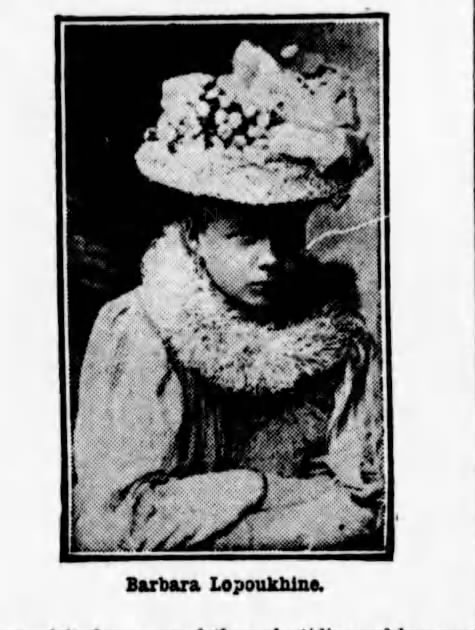
It seems that after lodging in Bexhill for some three months, Lopukhin’s 18 year-old daughter Barbara and her governess Miss Margaret Russell had arranged a night out at the Aldwych Theatre in London. It was intended to be a glitzy treat after the relative languor of the sleepy East Sussex resort; a reward for the fairly mind-numbing number of hours the girl had poured into studying Shakespeare, learning the English language and tolerating the low-key activities put on by the governess. [1]
Over in Saint Petersburg at this time, the American labour activist, William English Walling and his wife had been arrested and taken into custody by the secret police for assisting members of the Finnish Progressive Party. The American Embassy sprang immediately into action, trying to learn of the charges against them and arranging their release. It was being alleged that the couple had been financing the revolutionaries, but there were other things being considered that were not divulged at this time. There have been subsequent reports that Britain’s foremost Russian expert, Harold Williams, then freelancing for The Manchester Guardian and Daily News, was also detained. Like Walling he was said to have been accused of supporting anti-Tsarist revolutionaries. [2]The much-sought treaty with Russia had been signed just several weeks before and America was taking a passive, if not entirely supportive stance of the agreement. The focus of British interests was shifting, changing the very delicate balance of power in Europe and the Pacific. Inevitably the arrest of Walling caused an outrage in the US and a diplomatic storm erupted.
After checking in at their boarding house on October 18th in Woburn Place, Miss Lopukhin, her sister and Miss Russell made their way to the theatre where they were to attend a performance of Seymour Hicks’s new musical comedy, The Gay Gordons. At 11.00pm on the night of Thursday 24th, the performance ended and during the hustle and bustle of leaving the party, the group became separated. Thinking it possible that Miss Lopukhin had begun to make her own way back to their lodgings, the governess returned to Woburn Place, but becoming increasingly concerned at the failure of the girl to return home decided to contact the Police. That weekend, a letter was posted from the North Western district bearing the girl’s name and signature. The letter, composed in French, read, “When you receive this letter I shall be dead. I was seized and kidnapped outside the theatre. I do not know by whom or why. I am now in a cellar suffering and wounded. I am giving my brooch to a little girl, so that she may post this letter onto you. I am going to poison myself or I shall go mad. I shall be dead soon.” [3]
Inquiries made by Scotland Yard detectives showed that the letter had been written on the very notepaper that the girl was known to be carrying at the time she vanished, a detail that was later verified by her governess, Miss Russell. Her father Alexei Lopukhin, communicating from St Petersburg, proposed blackmail as a possible motive. Sir Melville Macnaghten of CID took immediate charge of the case and within an hour had set up a search of the entire London district. In addition, a reward was offered. The governess had her own suspicions, thinking the disappearance of the girl “not unconnected with certain political sentiments against her father … who must have made many enemies during the time he held important positions in Russia” (Daily Mail, Oct. 29, 1907).
Russian Prime Minister Pyotr Stolypin telegrammed similar concerns to the British Foreign office: “The kidnapping is undoubtedly the work of Russian revolutionaries and is their vengeance for her father’s conduct under M. Plehve‘s reactionary regime. His strong measures to crush the revolutionary movement were particularly brutal in the days preceding the famous “Red Sunday” in January 1905.”
After five days, a description of the girl was released to the public with a £10 reward for information leading to her return: “Barbara Lopoukhine, age eighteen; height 5ft. 7in.; complexion fair; hair brown, eyes grey; well-developed hips and bust; dress navy blue kilted cloth skirt, navy blue silk blouse, with small white stripe, black fur dogskin coat, below hips (fastened close up at throat with four large whitish-grey buttons), wide- brimmed brown straw hat (trimmed brown silk and two straight brown quills), white kid gloves, black stockings, black shoes (patent tips). Wearing a white silk elastic woven surgical anklet on right ankle. May be wearing amethyst or garnet brooch, oblong shape, 14in. long, and cross to match, set in plain gold, on gold chain of Russian make. Any person giving information leading to the discovery of the whereabouts of this young lady will receive the above reward. Information to be given to the Commissioner of Police, New Scotland Yard, S.W., or to any police-station.” [4]
Who was Aleksey Lopukhin and why was he targeted?
To even begin to understand why revolutionaries may have targeted Lopukhin’s daughter, you have to go back a few years to the Kishinev Pogrom of 1903, and Chief Lopukhin’s failure to head-off the drastic sequence of events that led to the Bloody Sunday Massacre of January 1905.
The notorious Kishinev Pogrom was when over 49 Bessarabian Jews were ruthlessly butchered and hundreds more injured during a particularly savage three days of violence. The whole issue was a minefield, diplomatically, politically and culturally. In his statement to the press after the kidnap of Lopukhin’s daughter, the Police Chief had been very careful to refer to a non-specific threat from the revolutionaries, avoiding all reference to the event by name. But what he was talking about was Kishinev, a shamelessly brutal episode that had drawn global condemnation — especially in Britain and America. Even now some four years later, the issue was dangerously packed and charged with all kinds of bitter acrimonies and dangerous rumours. The immediate response to the events had not been straightforward either. Dozens of unseen hands and rival machinations had been at work to turn what might have been a spontaneous explosion of ethnic violence into a calculated Tsarist conspiracy which might spark, if things played out as planned, a lethal Jewish backlash and their inevitable expulsion from Russia.
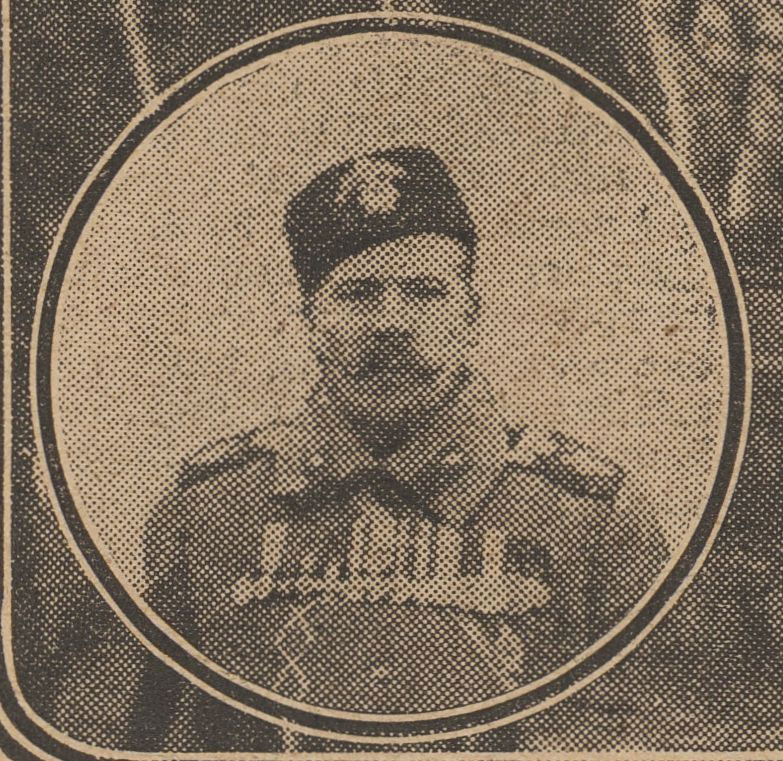
Watching as the flames of conspiracy and counter-conspiracy tore through the town and surrounding villages, was the unscrupulous spy-master, Pyotr Rachkovsky, soon to displace Lopukhin as Deputy Director of Police in St Petersburg. As Chief of the Okhrana’s Foreign Agentura, the shape-shifting former radical had found himself in charge of Russia’s Secret Service in Europe where his elaborate campaigns of provocation and entrapment were almost as legendary and unprincipled as his relentless anti-Semitism. Just several months earlier, Rachkovsky had played a pivotal role in stitching together the infamous, ‘Protocols of the Learned Elders of Zion’, an entirely fabricated text describing Jewish plans for global domination. He had produced the words, now he was building the necessary framework that would allow those words to flourish into a plausible reality. As bizarre as it was and as twisted as it was, the events taking place in Kishinev that year would be a key turning-point in time, with support for a Jewish Nation growing stronger by the day. And as a native of Dubasari, a neighbouring town of Kishinev, Rachkovsky’s interest in the region was perhaps more personal than most.
The post-mortem that took place in the immediate aftermath of Bloody Sunday in January 1905 had seen the Minister of the Interior, Pyotr Sviatopolk-Mirsky replaced by General Trepov and Trepov’s Secret Police bloodhound, Pyotr Rachkovsky come in to replace Lopukhin. On both occasions Lopukhin had little option but to issue statements to the press that would go some way toward explaining the failure of his Police to intervene and prevent the massacres:
The strained relations existing between the Russians and the Jews of Bassarabia were made worse by the fact of finding in an outlying village a murdered Christian boy. Officials denials of the ritual murder were not given credit by the peasants, who attributed other murders in the towns of Kiev and Kishinev likewise to the Jews … The Minister of the Interior has instructed a circular to governors all over Russia, authorising them to make immediate use of firearms in cases of anti-Jewish disturbances. [5]
The conclusion he had drawn was this: it was infighting among the Christians and the Jews that was the cause of the murderous riots. A Christian boy had been found dead, and rumours of a Jewish ritual murder had spread through the town in no time. The Governor of Bessarabia, General von Raaben had delayed in his actions and when he did act he made the decision to deploy the military and withdraw the Police.
The first significant punch had been delivered by The Times of London some four weeks earlier. On May 18th, the newspaper published reports of a private dispatch alleged to have been conveyed to Chief Lopukhin by the Minister of the Interior in Kishinev. The dispatch alleged to have been received by Chief Lopukhin had featured a clear instruction for Police NOT to intervene in the violent bloodletting unleashed on the Jews by Christians. Worse still, it was alleged that these “wide disturbances against the Jews of Bessarabia” had been planned some two weeks in advance. According to the report, the Minister of the Interior had been well aware that “wide disturbances” were being planned against the Jews in Kishinev at least two weeks in advance. It was said that his reluctance to intervene was based on his belief that the Jews had been exploiting the local populations and fomenting disorder. Whether or not this “disorder” had in any way been assisted by the appearance of Lev Goldman and his secret printing press at Lenin’s personal invitation the previous year isn’t made clear, but it seems reasonable to speculate that this and the rioting by Kiev and Moscow students that came as a result of detention in Kishinev, was the perfect grounds for someone in the Imperial Government unleashing their darkly elaborate plan. [6] Using a turn of phrase that was clearly designed to cause the utmost offence to the revolutionaries, the despatch explained that whilst it was the responsibility of any Minister of any “great autocracy” to exercise his power and will to maintain order, to refrain from doing so. The Christians, it requested, should face discipline but not punitive sentences or armed aggression. In short, it didn’t wish to see the Christians any more radicalised than they may have been already. [7]
The basic gist of the “secret despatch” was that the massacre could have been prevented and that the town’s Governor, General von Raaben and his Chief of Police Lopukhin had deliberately ignored the warnings. [8]
A Forgery
The dispatch was subsequently found to have been a forgery. [9] It was your classic divide-and-conquer strategy. Tensions in the district had been simmering for some ten years. Riots led by the town’s orthodox population against the Jews had already occurred during the Easter of 1890, but these had been promptly subdued by the town’s authorities. Further controversy occurred some five years later when General Gregorieff, the prefect of Kishinev, an ‘assimilated Jew’, was accused of selling military secrets to the Austro-Hungarian government. The mysterious 24,000 francs reported to have been arriving in his bank account each year was believed to have been deposited by ‘some foreign agency’. When officials searched his belongings they claimed to have found several sealed packages containing detailed plans of troop dispersal in an anticipated war with Austria. A report in The Times of London concluded by saying that five Kishinev civilians had been implicated in the affair and that upwards of 174 Jews had been expelled from the immediate area, including Kiev.
The events in Kishinev proved to be the first significant strike by Russia’s far-right against this increasingly volatile district. That Lenin had instructed Leon Goldman to set-up his Iskra press in Kishinev was clearly an indication that the region’s Jews were facing manipulation from all sides. A location had been identified, a stage was being built, a script was in production and all the various actors were now assembling. The energy that flowed here was being directed. It was little wonder that Prelooker and Rabinovitch’s contentious ‘New Israel’ sects, set-up in Kishinev and Kiev respectively, were being touted as Tsarist fronts to cleanse the region’s Jews. Not by fire just yet, but holy water. Even so, it was unlikely that this was the case, despite their motives being no less abstruse. This was a key location militarily, something that had been proved in its recent war with Turkey, but there area was being recalibrated, and not as the Tsar’s government saw it, in Russia’s favour.
By 1903 nearly half the population of Kishinev was Jewish. Forced out of Romania and across the border they simply had nowhere left to go. And as Romania had a belligerent status, one may be forced to review its motives, and channelling the Jewish Diaspora so that it would coalesce on the Southern borders of Russia could have been part of an opening strategy as it sought closer relations with Austria-Hungry.
As far as the Russian Government was concerned, the appearance of Lev Goldman and the wave of student violence that arrived in his wake made an already unstable region vulnerable to radical notions; a powder-keg ready to blow a gaping hole along Russia’s borders and key defences. Within four weeks of the massacre of Kishinev, Boris Chicherin, uncle of the Soviet revolutionary Georgy Chicherin had replaced General von Raaben as Governor of Bessarabia, and by August General de Plehve was holding talks with Zionist Leader Theodore Herzl and setting plans in motion for the region’s Jews to return to Palestine — a move that had all the potential to block the gaping radical hole in Russia’s southern defences. Plehve’s plan had been anything but veiled. In a letter to the Zionist Congress in Basle at the end of summer, Russia’s Minister of the Interior pledged that the Zionist movement would have the full backing of the Tsar and his government if it made good on its promise to set up the Jewish Nation outside of Russia. If it entertained any notion of locating a Jewish society inside Russia, de Plehve said the government of the Tsar would take the strongest measures against it. But if it planted them firmly with Palestine it would use every influence and authority it had “in facilitating the new Exodus”. The 6,000,000 Jews it had corralled into a small corner of its southern Empire had clearly become the kind of burden it no longer wished to carry. [10] As far as the Tsarist government was concerned the region was oxygenating the blood of the Socialist radicals. If the tick could no longer satisfy itself on the nutritional merits of its host’s blood, it would simply fall off and die.
Within days of the ‘secret despatch’ being published, a wave of riots erupted in London’s East End, carried out in the main by the boisterous and unmanageable members of the Bessarabian and Odessan gangs operating around the music halls and theatres of Whitechapel and their anti-Semitic rivals. Several thousand exiles had gathered at the Great Assembly Hall in Whitechapel under the auspices of the Russian Social Democratic Circle, the Veker group and ‘Waker Association’ members of the Bund. Joining the erstwhile British radicals Harry Quelch and Ben Tillett on stage that day was exiled Ukrainian, Felix Volkhovsky. The man chairing the meeting was Vladimir Burtsev’s old friend Joseph Frederick Green, the Oxford-educated and pugnaciously British ex-clergyman who had been nominated Honorary Secretary of the Society of Friends of Russian Freedom. In an effort to whip-up as much noisy, eye-ball popping energy as possible against the ‘Russian autocratic government’, the Anglo-Russian panel placed no small amount of weight upon the ‘secret Kishinev despatch’ published in full by The Times just weeks before, but now known to have been faked. [11] A letter of support from Labour leader Keir Hardie described how hard it was to understand how in the first years of the 20th Century such outrages could not only be tolerated but “sanctioned and permitted by a so-called Christian government”. [12] After some reflection a proposal of ‘armed-resistance’ was advocated by some of those chairing the meeting. [13]
The Assembly Hall meeting was followed by a larger event at Hyde Park. Again it was chaired by Volkhovsky and Green. From three platforms the 3,000-strong crowd was addressed in English, Yiddish, French and German. Prevented from speaking as a result of some ongoing heart problems, Nikolai Tchaikovsky read a note from Peter Kropotkin, conveying his thoughts that they should name and shame the real instigators behind the massacre and who were preparing a series of other such massacres in St Petersburg, Kiev and other cities. The likes of Plehve had added more and more to the oppressive laws first imposed by Tsars Alexander III and Nicholas II. The laws of the Pale (settlement) had been stringently enforced and the spheres of industrial and commercial activity in which Jews could prosper further reduced. Those who challenged the system were then treated with exceptional cruelty. [14]
The Bloody Sunday Massacre
Two years later, Lopukhin found himself at the centre of another controversy, when he and his department were accused of failing to prevent the brutal sequence of events that had led to thousands of workers and their families being fired upon by guards outside the Winter Palace at the conclusion of a demonstration led by Father Georgy Gapon, a charismatic priest with firm links to the Assembly of Russian Factory and Mill Workers. It was said that Lopukhin’s actions, or rather inactions, had been central to the tragedy, and that his sanction and support of the worker’s assemblies had created something of a blind spot. His social policing experiment was said to have been a disaster, which instead of steering workers clear of radicalisation had only served to speed it up. Russia’s Secret Police accused Lopukhin of administrative failure, police incompetence, and a complete breakdown in political oversight.
The relationship between Lopukhin’s Department of Police which had worked in tandem with the Ministry of the Interior and the Secret Police was often strained, the latter composed almost entirely of the most racist reactionary monarchists who opposed any form of retreat from anything but an unassailable Tsarist autocracy. On the one side were Russia’s ancient families like the Lopukhins who were generally sympathetic to the liberal movements, and on the other there were the Black Hundreds, ultra-nationalist monarchists who often expressed their ruthless devotion to the Tsar through coordinated attacks on Jews and Socialists. Lopukhin, like Stolypin, recognised that the fight against Revolutionary Socialism and anti-Tsarism would be best supported by a series of liberal reforms that would see peasants begin to enjoy the benefits and privileges of owning land. For the two liberal monarchists, belief in Tsarism could be maintained through modernization and earning respect. The tensions that had existed between Pytor Rachkovsky of the Secret Police and Alexsei Lopukhin finally spilled over during the winter of 1906 when the former Director of the Police spilled the beans on Rachkovsky’s clandestine system of provocation.
Responding to accusations of his own incompetence during the trial of sixty-five members of the Council of Workmen’s Delegates, Lopukhin had produced a report which was said to provide incontrovertible evidence that Rachkovsky — who had by this time replaced Lopukhin as the Director of the Police Department — had, in collusion with the Black Hundreds, embarked on a systematic campaign of belligerent aggression and encouragement. Among the more serious offences had been the printing of thousands of “incendiary proclamations” which Rachkovsky and the group then distributed through back door channels to governors and police chiefs in St Petersburg, Moscow, Orel and Vilna. What Lopukhin accused them of couldn’t have been any clearer: between them they had coordinated the previous year’s massacre of the Jews at Alexandrovsk and Ekaterinoslav. Lopukhin was claiming that Rachkovsky and the Black Hundreds were literally asking the army and Chiefs of Police to wage war on Jews, Poles and Armenians.[15] On hearing the evidence the Workmens’ counsel, M. Grusenberg duly subpoenaed Lopukhin as a witness, but even despite his investigation having the backing of the Russian Prime Minister, Count Witte, the court had refused. Lopukhin nevertheless communicated the contents of the report to the press, his conviction being that it was only through being made aware of these facts that the Duma would be allowed to exercise its existing influence and stop the systematic murder of Russian Jews. He had left the world in no doubt that Rachkovsky, the former head of the Secret Police had brutally imported its mechanisms into the Department of Police and the Ministry of the Interior. The massacres of the Jews at Alexandrovsk and Ekaterinoslav had been coordinated by Rachkovsky and General Trepov who had been brought in to restore order in the chaotic aftermath of Bloody Sunday. As far as Lopukhin was concerned, there were two distinct governments in Russia, one headed by Count Witte and the other headed by General Trepov. [16]
Burtsev, Azeff and Lopukhin
A few years after the Bloody Sunday disaster, Aleksey Lopukhin was dragged into another tabloid sensation, this time the notorious ‘Azeff Affair’. In what appears to have been a well orchestrated stitch-up featuring Lopukhin’s long-time police-rival, Pyotr Vachkovsky, and spy-catching revolutionary, Vladimir Burtsev, the former Chief of Secret Police was charged with colluding with the enemy. How much either Hasting regulars, Aleksei Teplov and Alexis Sheftel knew of the plot isn’t known but it is interesting that both men were active in Hastings during the period in which Lopukhin’s daughter was on vacation in neighbouring Bexhill-on-Sea. [17]
According to Burtsev, a conversation he had with Chief Lopukhin had confirmed that Socialist Revolutionary, Yevno Azef, was a Russian double-agent working simultaneously for the revolutionaries’ Combat Organization and Pyotr Rachkovsky of the Secret Police. Burtsev had approached him during a train journey near Cologne and it was during the course of a long and mutually beneficial conversation that Lopukhin had confirmed his worst suspicions. Lopukhin’s confession was subsequently published by Burtsev and brought to the attention of the Russian authorities. In February 1909 Lopukhin was duly charged with colluding with the enemy. Revealing that a top-level revolutionary like Azeff was working for the Secret Police had done untold damage to the State. According to reports appearing in the press, Lopukhin had abhorred the use of agent provocateurs, and despised the likes of Azeff all the more for the kind of salary he was drawing as a result of his dubious services.
Speaking to the press from his base in Nice on the France-Italian border, Burtsev tried his best to explain how someone like himself — who occupied a place near the top of Russia’s ‘most wanted’ list — had been brought into the confidence of such a senior former Police Chief who seemed to have the utmost respect for protocol. According to Burtsev, he had met Lopukhin on the train by chance and claimed that both men had been assisting, previous to that, in an area of historical research that was of interest to them both. Burtsev at this time was editor of The Byloye journal, and there had been an ongoing exchange of letters.
Sometime in late 1907, around the time that Lopukhin’s daughter had disappeared, Burtsev came into receipt of information that there was a Police agent operating within his group of revolutionaries. He didn’t divulge the name of the traitor, but by a process of elimination, Burtsev was able to ascertain that the man they were looking for was Yevno Azef, leader of the Socialist Revolutionary Party’s terrorist operations; the man who was believed to have coordinated the murders of Father Gapon, de Plehve and the Tsar’s uncle Grand Duke Sergei Alexandrovich. Seizing his opportunity on the train, Burtsev fished for answers and got them. Azeff was the man they were looking for. [18]
According to a Paris correspondent of The Times of London, the Socialist Revolutionary Party had a hard time swallowing Burtsev’s claims. It seemed too great a coincidence. If his story was correct then he had gleaned the information as a result of a chance encounter on a train in a part of the world that neither of the men was based in. The chances of this happening by chance seemed slim, and the chances of Lopukhin slipping it into a casual conversation during the journey seemed slimmer still. Within days, Burtsev himself became the subject of suspicion. A tribunal comprising senior members of the revolutionaries had been convened and Prince Kropotkin, Madame Vera Figner and Hermann Lopatine were among those deciding his fate. In the end, it was judged that the information that Burtsev had gleaned from Lopukhin, regardless of the actual circumstances, proved beyond all doubt that Azef was an agent provocateur. The Revolutionary Committee promptly withdrew their accusations and threw their weight behind Burtsev. It was estimated that Azef had either murdered or been instrumental in the imprisonment and exile of over 6,000 revolutionaries since being recruited in 1900 and had received in excess of £5,000 yearly from the Tsarist Police. The traitor’s penalty was death. [19]
Within days, a slightly different story began to emerge in the press. In this version of the story Burtsev had approached Kropotkin and the Revolutionary Committee with his doubts about Azef prior to meeting Lopukhin on the train. Unable to provide any proof they told Burtsev they would look into it, but warned him that if no evidence of any wrongdoing could be unearthed, Burtsev himself would face execution. Having risked everything to expose Azef, Burtsev says he was left with little option but to approach Lopukhin and implore him to confirm his suspicions, if only to save his own life. Lopukhin was said to have been reluctant at first, but overwhelmed with the evidence that Burtsev had put before him, had finally conceded that Azef had been their agent.
But there was a problem with this story. On the one hand, Burtsev wishes us to accept that the evidence he presented against Azef to Kropotkin and the Revolutionary Committee was so weak and circumstantial that it was rejected by the panel outright. However, when Burtsev approaches Lopukhin with that same evidence on the train in Cologne, the former Director of Police finds it ‘overwhelming’. It was never made clear why the Socialist Revolutionary Party deemed the evidence so insufficient, when Lopukhin, the former Police Chief — who would have had no real faith in Burtsev — had by contrast found it so very persuasive.
Despite support from his friend, Prince Aleksey Obolensky and his brother-in-law Prince Ouroussoff, Lopukhin was sentenced to five years in Siberia after being found guilty of high treason and assisting enemies of the State like Burtsev. [20] Maintaining his innocence, his daughter and her governess, Margaret Russell, demanded that they accompany him during his time in exile.
What Became of Miss Lopukhin?
At one o’clock on the afternoon of Wednesday, October 30, 1907, Barabara Lopukhin returned almost as mysteriously as she’d vanished. She adjusted her dress, knocked at the door and waited for the maid at Woburn Place to answer the door. Although few details were forthcoming, the press reported that she had appeared back at the boarding house in one piece, after being kept in isolation for the best part of a week by two men. After several days the men were alleged to have put her in a cab and dropped her off at Saint Paul’s Cathedral and she had made her way on foot from there. By the following morning it was like nothing had ever happened. [21]The saga ended just as news was coming through of the release of American Williams English Walling and his wife from custody in Saint Petersburg. [22] For the press it was something of an anti-climax, and the Police were left to explain the wisdom of spending several thousand pounds on the manhunt for the girl in London. No information was shared about the kidnappers with some speculating that revolutionaries had been behind it, and others, that it was Rachkovsky and the Black Hundred. Scotland Yard were asked not to pursue the matter and the girl left for France with her governess, Miss Russell, the saga coming to a very final, if unsensational close.
[1] ‘Kidnapped in London’, Daily Graphic, October 29, 1907, p.3; ‘A London Mystery’, Daily Telegraph, October 29, 1907, p.11
[2] ‘3 Americans in Web of Russia’s Secret Service’, Democrat and Chronicle’, October 21, 1907, p.1
[3] Daily Mail, Oct 29, 1907
[4] ‘Kidnapped in London’, Daily Graphic, October 29, 1907, p.3.
[5] ‘Origin of the Massacre’, The Washington Post, June 6, 1903, p.5
[6] Lenin was anxious to see Iskra develop from being a niche, underground publication to something that could ‘satiate the whole of Russia’. He had contacted Leon (Lev) Goldman in Kishinev suggesting that he might set-up a printing press in the area. In January 1902, Goldman’s adopted hometown of Kishinev was one of sixteen additional cities and provinces placed under “extraordinary police supervision” by an anxious and underprepared Imperial Government. See: Lenin Collected Works, Progress Publishers, 1974, Moscow, Volume 34, p. 93.
[7] ‘The Anti-Semitic Outrages at Kishineff’, The Times, May 18, 1903, p.5
[8] ‘Russia, Confidential Despatch’, The Times, May 18, 1903, p.9, p.10; ‘The Anti-Semitic Outrages at Kishineff’, Manchester Guardian, May 18, 1903, p.6
[9] The Times, May 27, 1903, p.11. Prominent historians, including Stanford professor Steven J. Zipperstein in his definitive book Pogrom: Kishinev and the Tilt of History, have concluded that the letter was all but certainly a forgery
[10] London Daily News, August 26, 1903, p.6
[11] ‘The Kishineff Massacre’, The Times, June 22, 1903, p.14.
[12] ‘The Kishineff Massacres’, Manchester Guardian, June 22, 1903, p.11.
[13] The Observer, June 21, 1903, p.7
[14] London Daily News, June 22, 1903, p.4
[15] ‘The Organisation of Pogroms’, The Times, December, 28. 1906, p. 8
[16] ‘The Organisation of Pogroms’, The Times, October 27, 1906, p.7
[17] There are few records of any Russians living in Hastings at this time, although Prelooker had set-up a branch of the Russian Reformation Society in the town.
[18] ‘Russian Police Plots: Azeff’s Dark Career’, London Evening Standard, February 6, 1909, p.4
[19] Westminster Gazette, February 4, 1909, p.7
[20] ‘The Great Russian Scandal’, Daily News, February 2, 1909, p.5
[21] ‘Return of the Missing Girl’ Daily Mirror, October 31, 1907, p.3
[22] ‘Out of Russian Prison’, The Independent (Missouri), October 30, 1907, p.2