Section D and Russian Intrigue
So far, we’ve learned that Captain Ernest Brown was not only questioned about the Nightingale Shore murder, he was also questioned about two other serious incidents: the murder of a police officer in Turkey, and spying on subs in Glasgow. In the first of these, the Nightingale Shore murder, Ernest revealed that at the time of the nurse’s murder he was branch secretary of The Comrades of the Great War in Glasgow, a British ex-servicemen’s organisation that had been co-founded by the ultra-conservative MP, Wilfrid Ashley, who would also serve as its President.
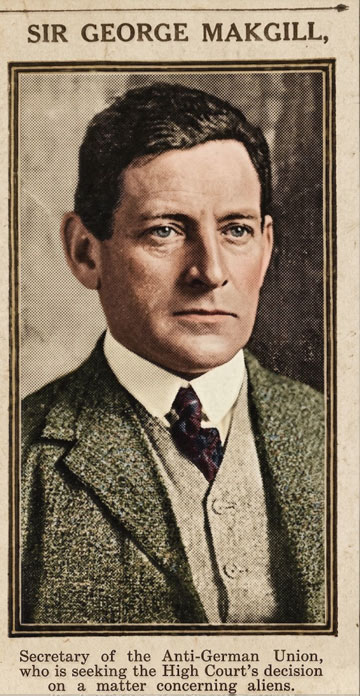
As a member of the Anti-Socialist Union and the People’s League Party, Ashley was also closely aligned with Sir George Makgill, a mysterious early intelligence figure who is believed to have founded Section D, a ‘secret unity’ of Mi6 with close ties to the higher echelons of the British Conservative Party and Ashley’s anti-Trade Union movement. Extraordinarily, some 14 years prior to the attack on Nurse Shore, Charles Crossley, a senior representative of the Citizen’s National League — a forerunner of Makgill and Ashley’s Anti Socialist Union — featured in the death of Serge Gapon on a beach at Hastings, the resort on the South East coast of England where Florence was heading on the day she was attacked.[1]
The body of the powerfully-built Russian, said to be the brother of ‘Bloody Sunday’ revolutionary, Father Georgy Gapon, was washed from a groyne at Hastings on Sunday 11th March 1906. [2] A few weeks later, the body of his brother — the man who had led Russia’s 1905 Revolution — was found hanged at a villa in Oserki, just outside St. Petersburg. The summer previously, Russian Revolutionary, Alexei Teplov, founder of the Free Russian Library in Whitechapel in London had told the London Daily News of farcical attempts by the Tsarist Secret Police, the Okhrana, to monitor his movement at Hastings Pier, just yards from the sea groyne where Gapon’s body had been discovered. Just two years later, the daughter of Tsarist Police Chief, Aleksei A. Lopukhin would find herself at the centre of a sensational kidnap plot after a trip to London from her lodgings in Bexhill-on-sea. [3]
The three-mile stretch of sand on the undulating coastline of East Sussex was certainly proving popular with Russian ‘Whites’ and ‘Reds’ alike. Within weeks of the girl going missing, the 24 year old print-setter, Alexei Sheftel vacated his lodgings at 7 Priory Road and headed for New York, where he lived out the rest of his life.
Charles Crossley, the visitor from London, had been seen talking to Sergei Gapon at the pier the previous evening. Gapon, clearly in a state of distress, had told him he was a captain in the Tsar’s Imperial Guard and on his way to visit the Russian Consul in Folkestone. An attempt to deport the man under the Aliens Act by magistrates in Eastbourne the week prior to his death had been unsuccessful, when the British Home Secretary, Herbert Gladstone, had declined to enforce the order. Crossley and his brother were the last men to see the Russian alive.
Two days later, Crossley featured in another report, this time announcing the formation of a National Anti-Socialist League at the Junior Carlton Club in London’s Pall Mall. The meeting was held under the presidency of Thomas Orde Hastings Lees, Honorary Secretary of ‘prepper’ association, The National Service League. [4] Among the League’s most active and influential supporters was George Makgill.
In the aftermath of the Russian Revolution, Section D, an offshoot of Makgill’s privately funded Industrial Intelligence Board (IBB) was tasked with flushing out the Soviet threat which was thought to have emerged in Working Men’s Unions in post-Revolutionary Britain. Despite its links to the upper ranks of civil society, Section D’s methods were described as brutal and extreme even by those who used its services (Churchill’s intelligence man, Desmond Morton, head of Section V at Mi6, among them). Makgill was assisted in the project by ‘Room 40’ Playfair Cipher specialist, Sir Reginald Hall, the former director of British Naval Intelligence. Hall, Ashley and Makgill would subsequently join forces with Théodore Aubert, the Swiss lawyer who would defend White Emigré, Maurice Conradi, charged with murdering Soviet ambassador, Vatslav Vorovsky — possibly on the orders of Alexander Guchkov — in Switzerland in 1923.[5]
The deeply mysterious Makgill is a chronically ubiquitous figure in tales of Jazz Age intrigue. As an ultra-conservative British baronet and right-wing propagandist, Makgill viewed the rise of the Bolsheviks as a profound threat to free enterprise, the British Empire, and western civilization. And his fears about communism weren’t confined to Russia. In the opinion of Makgill and his friends, the Labour Party would ‘Bolshevise Britain’. When Florence died, Britain’s relationship with Russia was teetering on a knife-edge. The Lloyd George government was hopelessly fractured—torn between those willing to make peace with Moscow for the sake of commerce, and those who saw any deal as a pact with the devil. That May, Soviet Foreign Minister Leonid Krassin landed in London to negotiate. But to understand the explosive climate he stepped into — and whether or not Brown was part of that climate — we need to rewind two years.
Trouble in Tiflis
After the October Revolution in Russia, Florence’s brother, Brigadier General Offley Shore, was assigned to the British Military Mission in in Tiflis (in modern day Georgia) where he served as British Attaché to the Tsar of Russia’s Imperial Forces. Shore would remain at his headquarters as part of the Imperial network of spies and embassy staff until he was replaced by Colonel Geoffrey Davis Pike in spring 1918. But his departure wasn’t a happy one.
Back at the British Foreign Office, ministers had been furious at Shore’s refusal to share intelligence with anyone other than the War Office. No one was more concerned than Senior British diplomat, Sir Charles Marling, the British Minister in Tehran, who pressed to have Shore removed. A renewed Turkish offensive had threatened allied efforts to safeguard the Baltic territories of Transcaucasia against advances by Lenin’s Bolsheviks, the hard-line revolutionaries looking to extend control of Southern Russia. Tiflis was fending off attacks from all sides: from the Turkish Army to the south of the city, and Lenin’s forces from the north.
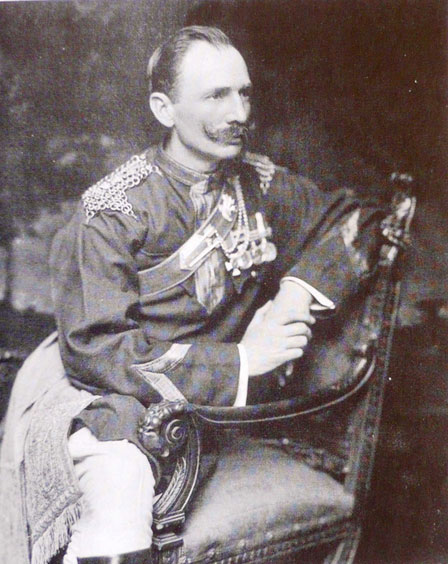
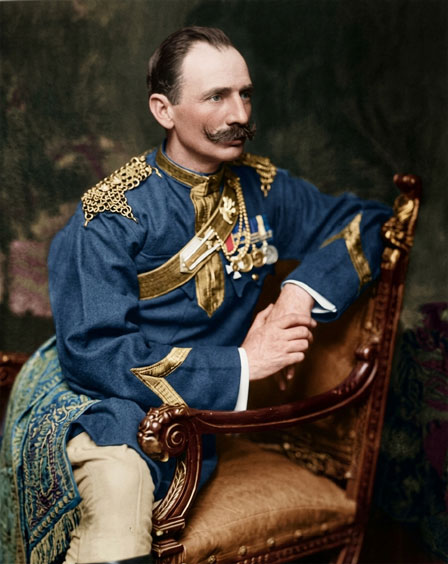
At this time, allied defences were being shored-up by a ragtag army of Armenian and Georgian nationalists who were demanding the immediate release of British-held funds controlled by Brigadier Shore to secure additional weaponry. The British Directorate of Military Intelligence had just signed-off on a plan devised by Oliver Locker Lampson to finance the Armenians using 20 million pounds sterling from funds held by Shore’s Mission at Tiflis. Despite being ordered to release them by Marling, Brigadier Shore, still head of the mission, stalled and refused to do so. In a telegram to the British Foreign Office dated December 21 1917, Marling, responsible for financing the local forces, complained that Shore was hesitating and urged the War Office to intervene. [6]
As a response, Captain Edward Noel, a respected and perhaps more cooperative member of the British Secret Service, was brought in. According to Timothy C. Winegard, professor of history at Colorado Mesa University, Noel’s job was to monitor communications and ensure that all intelligence and funds were shared immediately whenever necessity demanded it and whatever the cost politically.[7] Protecting British and American interests in the Baku oilfields became priority number one (read: Michael Tillotson’s 2018 Times article).
As the general situation in the Caucasus and Northern Persia continued to deteriorate, Marling and the Eastern Committee of the British Foreign Office [8] shifted the weight of their expectations on the energy and commitment of the Armenian and Georgian forces in defeating the advance of the Bolsheviks and the Ottoman Empire (the Turks). In a report dated October 11 1917, the Eastern Committee had remarked that British interests in the fate of the Armenians had passed from a “sentimental and humanitarian concern” to a “grave material concern”. The Ottoman plan to unite the all Turkic, Tatar, and Uralic peoples of the Caucasus was paying off, dramatically raising the stakes and urgency of the Armenian Question”.
In an attempt to appease the Turkic subjects, Russia’s new Prime Minister, Alexander Kerensky, responding urgently to events on the ground, renounced the plans of the former Tsar to annexe Constantinople and the Turkish Straits. Instead, he began putting plans in place to grant much greater equality and autonomy to the Muslims of the region. [9]
Kerensky’s plans were, of course, a major blow to the Eastern Committee at the British Foreign Office. It was felt that the only real weapons against the Turks had been the “racial vitality” of the Christian Armenians, whose loathing of the Turks had only been excited further by the scale and ferocity of the massacres they endured in 1915 and 1916. In the Committee’s estimation, the Armenians were the only ethnic group large and reactionary enough to repel the Ottoman and Bolshevik menace. [10]
Undeterred by Kerensky’s pledges, the British and the French forged ahead with plans to raise an all-Armenian guerrilla unit to raise the energy of Russia’s rapidly disintegrating forces and stave off the Turkish advance. Florence brother, General Offley Shore is said to have approached the High Commissioner of Armenia who explained Kerensky’s opposition to the idea, believing the number of Armenian fighters in the region was simply not sufficient to deal with the threat.[11] The 150, 000 or so Armenian troops fighting alongside the Allies were scattered throughout the Russian Empire, and since Kerensky had no plans to annexe Constantinople, he had no interests in concentrating their forces in this one area.
Shore’s hesitation in releasing the funds came at a staggering cost to Britain and Imperial Russia. The price paid by Armenia was greater still. Within weeks of Shore’s refusal to arm the Armenians through British held funds in Tiflis, a further 2,500 Armenians and 20,000 Azerbaijanis lay dead. The Bolsheviks had seized control of Baku. Within weeks General Shore had been replaced by Brig-General Lionel Dunsterville.
Marling was one of the Bolsheviks’ fiercest British opponents. The triumph enjoyed by the Revolutionaries in removing Nicholas II was encountering a counter-challenge by Tsarist loyalists who were now enjoying Britain’s full support. Marling’s plan was simple: remove Lenin and the Bolsheviks from power and restore the Russian monarchy under the leadership of his friend, the Grand Duke Dmitri Pavlovich. Pavlovich, who had been exiled by the Tsar over the murder of Romanov confidant, Grigori Rasputin in 1916, had struck-up a close personal bond with Marling, and both men would have regarded Brigadier Shore as something of an obstacle in their attempts to restore a Tsarist regime.
It was Marling’s belief that Shore and the War Cabinet’s refusal to recognise the urgency of arming the Armenians and the Georgians had considerably undermined the allied efforts and Churchill’s ‘secret war with Lenin’. Sadly, the man who replaced Nurse Shore’s brother Offley as the Head of the British Military Agency in Tiflis — Colonel Geoffrey Davis Pike — was murdered by Bolsheviks just eight months after his arrival. It is something of a tragic irony that he should have been born to a long serving military family at Lunsford Cross in Bexhill on Sea, where Nurse Shore was discovered beaten and unconscious in a third-class train carriage.
A Revenge Killing?
Just days before the murder of Nurse Florence Nightingale Shore in January 1920, General Kolchak, the White Russian leader that Britain and America had been supporting against Lenin’s government of Bolshevist revolutionaries, had been handed over to the Bolsheviks and ceremonially executed. In the immediate aftermath of Russia’s October Revolution, a full scale civil war had erupted between the ‘Whites’ — supporters of the Tsar — and the ‘Reds’ — supporters of Vladimir Lenin. For two years the Whites were supported by allied forces, but the complete withdrawal of British troops in October 1919 and American troops the following January, would leave Kolchak and his troops exposed. As a result, the General had been forced to surrender.
The exit route Britain had promised the beleaguered General had been removed too.
Kolchak’s hopes of escaping across the border to the British Mission had been scuppered and his capture and execution marked a complete U-turn in the coalition government’s relationship with the Soviet. Obliged by the terms of the peace treaty which came into effect on January 10th 1920, just two days before Nurse Shore was attacked on the train, Lloyd George was preparing to talk trade with Lenin and ditch all prevailing military efforts to remove his Soviet government. The Committee on Russian Affairs, the pro-Interventionist lobby that had been pushing Lloyd George to launch a full scale military offensive against the Soviets, and which had included influential members of British military intelligence in Petrograd, was left barking with fury, seeing it as nothing less than treachery.
The man that Makgill and the Committee on Russian Affairs appear to have been preparing as the Tsar’s replacement in Russia was none other than the Grand Duke Dmitri Pavlovich — friend and ally of Sir Charles Marling who had been none too quietly backing the fresh Romanov bid for the throne. When news arrived of Kolchak’s capture and execution, Pavlovich was in exile in London. As the sister of Offley Shore, and the cousin of Rafaele Farina, a senior Russian Intelligence Officer at Mi5, it is possible that the attack on Florence could have been a revenge attack by White Russian Tsarist loyalists for the appalling betrayal of Kolchak and Imperial Russia.
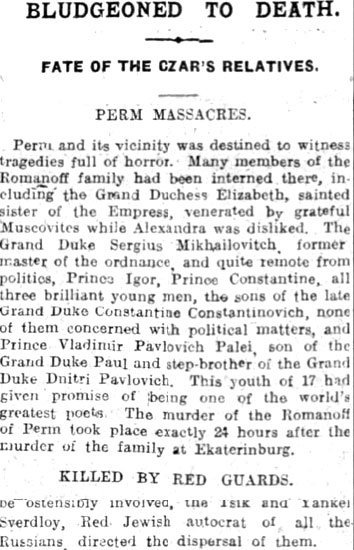
During these same months, Grand Duke Dmitri Pavlovich had just been receiving word of the violent death of his stepbrother and other members of the Tsar’s extended family. The details were grim. Bolshevik guards had taken rifle butts to the heads of Prince Vladimir Paley Pavlovich, the Grand Duchess Elizabeth Feodorovna and four other members of the once mighty Romanov family and left them for dead inside a mine-shaft.
The injuries sustained during the attack were brutal and merciless. Reports of the incident suggest the injuries suffered by the royal victims were not unlike those sustained by Florence in the attack on the train. Reporting the attack on Nurse Nightingale Shore on January 22 1920, the Illustrated Police News painted a chilling scene. Florence had been found “disfigured, unconscious and soaked in blood from a gaping wound in the head”. “Outrage rather than robbery” was considered to be the motive. [12]
Home Office pathologist Dr. Bernard Spilsbury recorded that Nurse Shore had received three separate blows to the head ‘possibly by a revolver butt’. One wound had passed completely through her scalp, a second revealed bone exposed beneath the wound, and a third showed a large fracture to the skull. Her injuries were every bit as horrific, and every bit as ferocious as those inflicted on Prince Vladimir and his family. If the three blows had been dealt to subdue the victim during the commotion of a robbery, the level of violence was clearly disproportionate to the threat that someone of Florence’s age and small stature would have presented.[13]
The White Russian exiles in London and Paris were the first to feel the full bloody weight of being sold out by the allies; visas were obstructed, relief efforts undermined and the trappings of diplomatic privileges were to be stripped from them overnight. The Bolsheviks may have taken their considerable wealth and properties but it was the crippling mechanisms of British bureaucracy that had robbed them of hope — the only real resource the movement needed at this time.
Winston Churchill, who had invested so much of his time, skill and reputation supporting the ‘Whites’ expelled a mighty sigh of resignation. He was powerless. Britain still had in excess of 2,000 troops in Russia, many of them prisoners. In Churchill’s view, ‘all the harm and misery in Russia’ had arisen out of the wickedness and tyranny of the Bolsheviks. The policy he had always advocated was the ‘overthrow and destruction of that criminal regime’. [14] Despite the War Secretary’s protests, Prime Minister Lloyd George and the Cabinet had made their decision. The following February, Churchill was removed from the War Office, and Walter Long was removed from the Admiralty. The Conservative-Liberal Alliance that had got Britain through the war was about to be well and truly shattered.
Just how credible is Brown’s story?
Was Ernest C. Brown the regular man of mystery he makes out to be in the interview with the Washington Evening Star? Well, despite the fact that several episodes that Brown mentions are a little too difficult to verify at time of writing, the story he tells of his time with the Inter-Allied Commission in Turkey and being arrested for the murder of a Turkish Officer in Galata in November 1921 certainly chimes with real life events — and it is also directly linked to other real or imagined Soviet plots. The relative obscurity of the event and the fact it was published in a reputable title, also lessens the probability of outright invention even if the timeline he provides in his interview with Hartswick is somewhat vague.
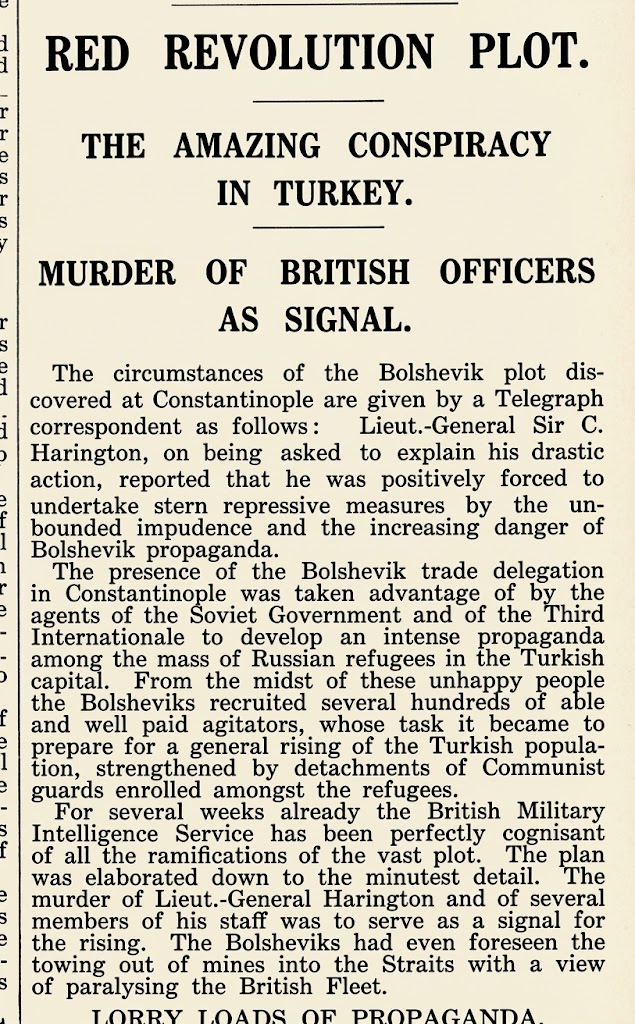
Brown’s third and final arrest in Galata in January 1922 appears to have coincided with something called the ‘Harington Plot’, a tense diplomatic crisis that took place in Turkey between July and September 1921. The story centred on a Soviet-backed plot to assassinate General Charles Harington, the British Commander-in-Chief and Chairman of the Inter-Allied Commission. Galata at this time was dominated by refugees escaping the Bolshevik advance in Southern Russia.
According to a report by the Sheffield Daily Telegraph in November 1921, the ‘best blood of Russia’ — the White Russians — had taken over the businesses and ‘dispossessed innumerable Turks and Greeks’. Russian was the predominant language and all the best restaurants and all of the shops seemed to be Russian. A Russian Generalissimo, the Grand Duke Nicholas Nikolaevich, now without arms, means or power, had even anchored his yacht there.[15]
Brown claims to have arrived with the Inter-Allied Commission at a time when Thrace — then occupying a bottleneck region between Turkey and Bulgaria — was the subject of alleged massacres. According to eyewitnesses, the Turks had invaded the disputed area, massacred Greeks in the villages before looting from houses and committing all manner of appalling horrors.
In March 1921, The Daily Herald of London was duly reporting that Turkey had refused to accept the terms proposed at the London conference and was demanding the return of Thrace.[16] The role of The Inter-Allied Commission was to try and unravel the tangle and restore peace. As a civilian staff photographer it was Brown’s job to provide visual evidence of the atrocities. Curiously, the murder of the Turkish officer for which Ernest C. Brown was subsequently arrested took place on November 11th — the day of the Armistice Day Ball at the British Embassy — the day that it was being reported that Turkish Nationalists in Adrianople were planning fresh raids on Thrace.
“Now then Mr Brown — who are you and what are you? Suppose we take a step over to Police Headquarters and talk it over.”
— The Strange Case of Capt. Brown, Thrice Accused of Capital Crimes, Washington Evening Star, 1926
One man who may have had a significant impact on the Commission’s arrival in the region was billionaire arms-dealer, Basil Zaharoff who had strong family links to Thrace and whose stakes in armaments manufacturer, Metro-Vickers had given him considerable leverage over Britain’s military capabilities and the reach and effectiveness of its secret service. Curiously enough, Zaharoff was also one of the many curious passengers over the years to have boarded the Orient Express, whose real-life snowdrift stay in Thrace in December 1929 inspired Agatha Christie’s legendary novel.
Brown’s arrest in January 1922 also just happened to coincide with the publication of a series of photos presenting the ‘Tragic Plight of Russian Refugees’ in the Turkish capital.[17] The photographs were published in London’s The Graphic newspaper and appear to have been commissioned by Ariadna Tyrkova-Williams [18] and Michael I. Rostovtzeff’s White Russian Refugee Relief Association, at that time operating from Fleet Street in England.[19]
After his stint as photographer with the Inter-Allied Commission, Brown had stayed and found a studio in Grand Rue de Perá, a street choked with refugees who now ambled aimless and shamefaced over its winding, desultory dust plains. According to reports, some 110,000 Russians had arrived in the city after General Wrangel’s defeat against Lenin’s strengthening forces in the Crimea. The White Russian Army had evacuated and landed here. The publication of these pictures would have been seen as a provocative move from the Brits, and Brown confesses in his interview that his earlier shots of Thrace ‘had not pleased the Turkish High Command’.[20]
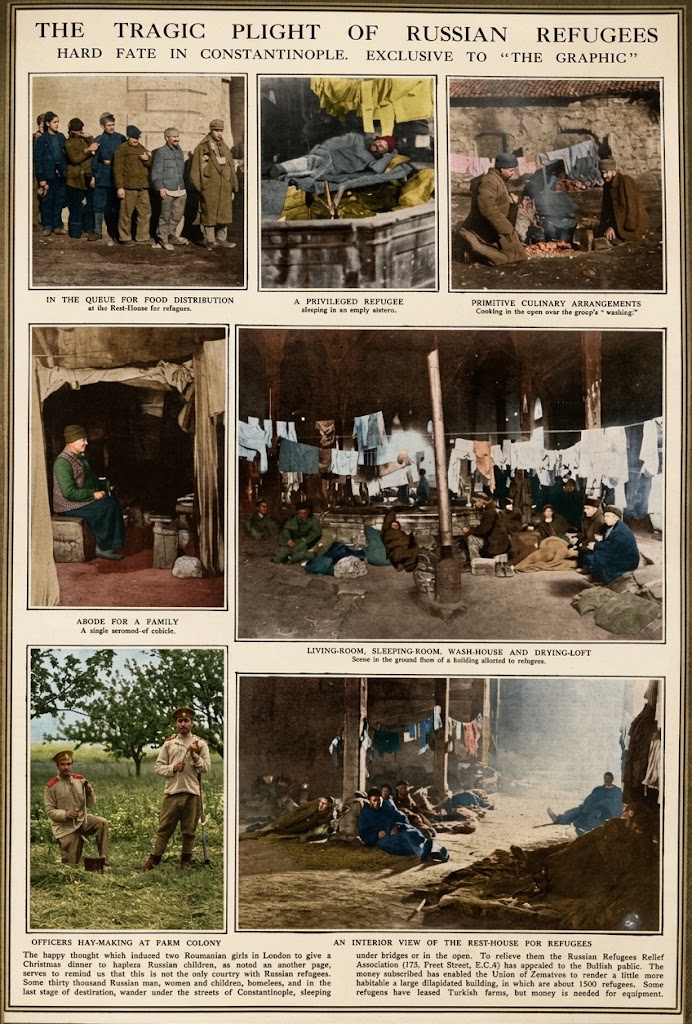
Brown was duly hauled before General Refet Pasha (Refet Bele) at his HQ in Istanbul — chief architect of the Greek Genocide, and by October that year, the newly appointed Governor of Thrace.[21]
The plot against Harington, which proved to be unfounded, had been ‘unearthed’ by British Intelligence, or, as I think is far more likely, the men working for Sir George Makgill’s famously unmanageable and unaccountable, Industrial Intelligence Board.
According to legend, the so-called ‘Harington plot’ had centred around a scheme to spark a mutiny among Muslim troops serving as part of the British Imperial forces and then blame it on Lenin’s Bolsheviks. [22] The desired outcome was that Britain would withdraw support for the Turkish Revolutionaries and revoke the Anglo-Soviet Trade Agreement, signed, much to the anger of Churchill and the Committee on Russian Affairs, by the Lloyd George government in March 1921. Curiously, among those leading questions about the plot in the British House of Commons was Comrades of the Great War founder, Colonel Wilfrid Ashley, a close ally of George Makgill.[23]
Reports in the press at the time hint at various reprisals and agent provocateurs and it’s certainly the case that a good number of arrests were made by Turkish police. Was Ernest C. Brown one of those arrested?
In an extraordinary move, Refet Pasha — the man who had Brown arrested for the murder of a Turkish officer — accused Liberal statesman, Damat Ferid Pasha, Andrew Ryan of the British Embassy and Sait Molla of the Friends of England Society, of devising the plot to derail ongoing trade negotiations between Britain, Turkey and Russia. Brown could certainly have been helping things along, especially if he’d been in the employ of Makgill and the Industrial Intelligence Board. [24]
The final irony is that it was the Reading Room at the British Library that proved so central to Ernest Brown’s alibi. The room’s status in all manner of spy capers is legendary and his story regarding his alibi is confused to say the least.
In the Washington Daily Star article of 1926, Brown tells F. Gregory Hartswick that he was cleared of any involvement in the Shore Nightingale murder as a result of a time stamp on a Reading Room permit stub. However, in an interview published by the London Sunday Post on January 18th 1920, Brown claims he had been released solely on the word of a Reading Room attendant, who had some vague recollection of Brown visiting the room that week. In this report Capt. Ernest C. Brown states unequivocally that the stub he had retained from his reading room session had NOT been dated. [25] In all fairness, it’s a significant revision that provides a more credible alibi.
Sadly, Brown was released from custody on the very day that Shore succumbed to her injuries. Any chance of a positive ID from the victim was gone. Florence had died without regaining consciousness.
[1] Hastings and St Leonards Observer 17 March 1906, p.10
[2] Father Gapon led a peaceful worker’s demonstration to the Tsar’s Winter Palace on January 9th 1905. As the crowd approached, the palace guards opened fire, resulting in several hundred injuries and fatalities. Father Gapon subsequently escaped to Britain before being executed by Socialist Revolutionaries on the Russian-Finnish border in March 1906.
[3] Daily Mail, Oct. 29, 1907/Missing Russian Girl, Bexhill-on-Sea Observer, 02 November 1907, p.3
[4] Pall Mall Gazette, 15 March 1906, p.9
[5] Theodore Aubert and the Entente Internationale Anticommuniste: An Unofficial anti-Marxist International, Twentieth Century Communism (Vol. 6), Michel Caillat, 2014
[6] Telegram from General Offley Shore to Foreign Office, Dec8 1917 (conveyed to Marling) and Marling Telegram to Foreign Office, 21 December 1917, TNA F.O. 371/3018, F.O 371/3019, 241203/229217/17, 13 December 1917, TNA F.O 233320/235977/237859/224839/17
[7] The First World Oil War, Timothy C. Winegard, p. 159-160. See also TNA CAB/24/144, Eastern Report No. 46, 13 Dec 1917, p.5/TNA CAB/23/4, War Cabinet No. 294, 7 Dec 1917, p.4, TNA CAB/23/4 War Cabinet No. 298, 14 Dec 1917, p. 3-4. TNA CAB/23/4 War Cabinet No. 303, 20, Dec 1917, pp. 3-4.
[8] The Eastern Committee featured Lord Curzon, General Smuts, Lord Hardinge, Robert Cecil, E.S Montagu, General Dunsterville and Sir Mark Sykes. see: Papers of the War Cabinet’s Eastern Committee, British Library: India Office Records and Private Papers.
[9] These were the sea passages around the Dardanelles and the Bosporus (at the opposite ends of the Sea of Marmara). The Constantinople Agreement was a deal negotiated by Britain, France and Imperial Russia in March 1915 which would see Constantinople and the Dardanelles handed to the Tsar’s Imperial Russia in the event of an allied victory. The plan was thrown into disarray when the Tsar was overthrown by Kerensky’s Provisional Government in February 1917 and ditched entirely by Lenin’s Bolsheviks.
[10] Political & Secret Files, India Office, London, files 10/623, P4/122, Eastern Report, no. XXXVII, Caucasus, October 11 1917 and FO371/3016/204952, Foreign Office to Spring-Rice, October 25 1917.
[11] TNA, FO371/3016/209437/204952, General Offley Shore to Department of Military Intelligence, October 28 1917
[12] Murdered Nurse, Illustrated Police News 22 January 1920, p.2
[13] No Light on Train Crime, Nightingale Shore Inquest, Bexhill-on-Sea Observer, 24 January 1920, p.3
[14] Churchill to the House of Commons, Manchester Evening News 19 November 1920, p.4
[15] Sheffield Daily Telegraph 03 November 1921, p.2
[16] Daily Herald 22 March 1921, p.3
[17] The Graphic 28 January 1922, p.9
[18] Ariadna Tyrkova Williams was the wife of anti-Bolshevik journalist Harold Williams. Both were leading members of Britain’s pro-Interventionist, White Russian pressure group, the Committee on Russian Affairs (see page 18 of this article).
[19] Russia’s Greatest Enemy?: Harold Williams and the Russian Revolutions, Charlotte Alston, Bloomsbury I.B. Tauris, 2007
[20] Canton Daily News Sunday, August 15, 1926, p.43
[21] Aberdeen Press and Journal 25 October 1922, p.6
[22] Turkish Plotters Seized, The Scotsman 22 September 1921, p.6
[23] Boris Johnson’s grandfather, Ali Kemal Bey was hung as result of the tensions and counter-plots that arose from the events in 1922. Ernest C. Brown was Branch Secretary in Glasgow of Long’s Comrades of the Great War.
[24] Ernest C. Brown gave his interview to the Washington Evening Star a short time before Makgill’s sudden death in October 1926. His death terminated the existence of his Industrial Intelligence Board overnight.
[25] Mr Brown’s Alibi, Sunday Post, 18 January 1920, p.2