Raphael Farina, the ambitious new head of Mi5’s G4 Russian Section is on the 4th Floor at 4 Queen’s Gate, South Kensington. Ever since the British Prime Minister David Lloyd George had agreed to hold trade talks with the Soviet his work has tripled in volume. There was a time when he had just a handful of Russian exiles to watch, now there were thousands streaming into the country, every one as unique and as exceptional as the last. The mass migration of loyal Tsarist subjects to Turkey and then to Europe to avoid the blood-letting under Lenin’s Bolsheviks has resulted in multiple complex operational, legal, and intelligence challenges.
Just who were the spies and who were the refugees?
Surveillance and tracking were stretched to the limit, and the murder of Farina’s cousin, Nurse Florence Nightingale Shore, in a mystery attack on a train between London and Hastings has made it difficult for him to focus. A high value White Russian, Count Paul Ignatieff, a former friend of the Tsar, has turned up in St Leonards on Sea — the very place that the nurse was heading.
Enquiries made with Hastings police have yielded little in the way of intelligence. The Count is in a nursing home and hoping to settle in the area, but if he has any other plans, they are a closely guarded secret. Farina is also running a parallel investigation. At the same time he is looking into the Count, he was making other enquiries about another Russian official, Alexander Kerensky in the Tonbridge area — the temporary home of Farina’s mother, the Baroness, who Nurse Nightingale Shore visited the day prior to being murdered.
A Russian Prime Minister in Kent
At the time of her death, Florence had just been demobilised, moving from the nurses’ hostel in Boulogne in October 1919, to the Hammersmith and Fulham Nursing Association based at Carnforth Lodge sometime in November 1919. It’s highly unlikely that Florence knew anything of her cousin’s Mi5 enquiries, much less the activities of mysterious émigrés like Kerensky, who just two years previously had been the most powerful man in Russia. Nevertheless, the once most powerful man in Russia could now be found crashing over at a friends’ house, just a few miles from Shore’s aunt. The threats and the dangers that Florence thought she had left abroad were emerging now as shadows much closer to home.
The Files KV 2/658 and 2/659 at the National Archives in London feature a letter written by Farina to Chief Constable Charles Prior asking for confirmation of Kerensky taking up residence at Rust Hall off Langton Road — the home of Near East expert and author, Simon Henry Leeder. Travelling from Constantinople sometime in the winter of 1919, Kerensky’s first known address in England had been Connaught House, 9 Montague Street, opposite the British Museum in Russell Square (KV2/659). After liaising with the Divisional Superintendent in Tonbridge, Chief Prior confirmed that Kerensky was still in residence at Rust Hall but was shuttling regularly between Tonbridge and London.
In many ways, Tonbridge was an unusual place to stay. Author Stephen Gary once described it as a small town set in quiet fields of “mustard and apples, hops and wheat” ensconced by instantly recognisable oast houses. The grinding motor of political machinations that could be heard whirring in the city was absorbed by its teeming avenues of neatly kept shrubs and hedgerows. This was no place to court excitement. But for Kerensky, still in-hiding, it was out of harm’s way and would have suited his typically agrarian Socialist sensibilities.
Kerensky, who had served as Prime Minister in Russia’s provisional government for little more than five months, was there with his close-friend and interpreter, Dr. Jakob Osip Gavronsky, who had represented the Kerensky government in London. The doctor’s Regent’s Park address — 7 Cambridge Terrace — would also provide Kerensky with a more convenient central London base. But who was Kerensky?
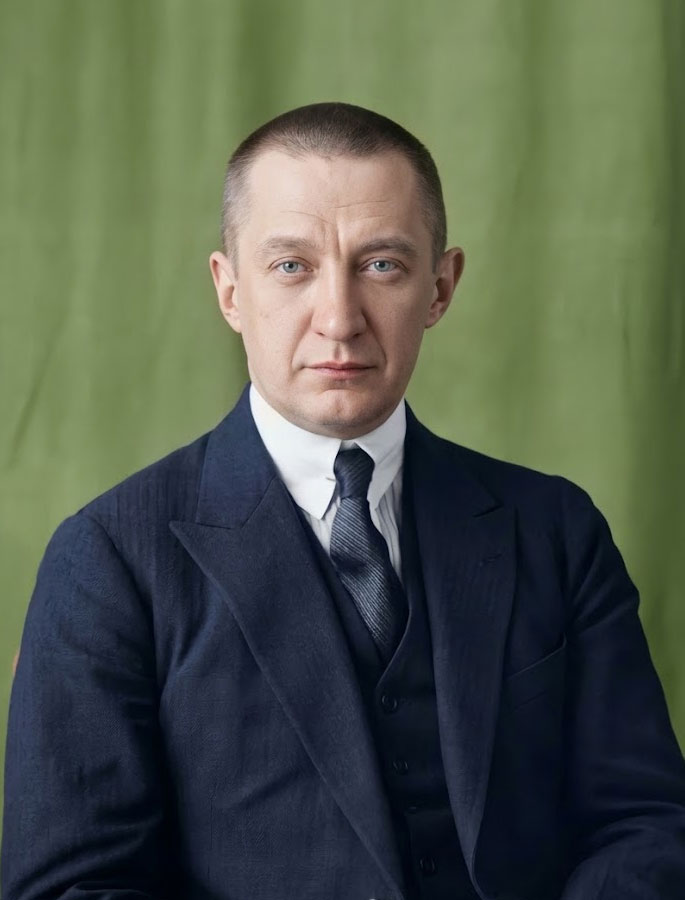
Like Guchkov, Kerensky had played a critical role in the formation of a government in the aftermath of Russia’s February Revolution before being forcefully supplanted by Lenin and the Bolsheviks in October 1917. Both men had been members of Russia’s State Duma. One was a wealthy industrialist with a progressive yet monarchist mindset and the other a revolutionary socialist unable to maintain his premiership in the face of mounting pressure to end the war with Germany. Whilst Kerensky was narrowly able to stave-off a coup d’état by his frustrated military commander, General Kornilov, he was no match for the Marxist hardliner Lenin, whose promise to end the war with Germany would win him the armed support of the people.
Kerensky fled first to Scotland, then to London and by January 9th 1920 was alleged to have been telling Central News in America that the British should ‘abandon Kolchak and Deniken and raise the blockade’. [1] It was his view that the ongoing meddling and sanctions meted out by the West was antagonising the Russian people; Allied Intervention wasn’t defeating Bolshevism, it was strengthening it. The British War Office had one agenda, the British Foreign Office had another. [2]
The reactions of Guchkov and Kerensky to Western intervention in the Russian Civil War after the Armistice of November 1918 couldn’t have been more different; Guchkov was all for it and Kerensky and his former Ambassador Dr. Govransky were vehemently against it. In an address to the House of Commons on June 30th 1919, Dr. Govransky described how Kolchak had ‘usurped’ the authority of Nikolai Avksentiev and the All-Russian Government who had united against the Bolsheviks.
Kerensky had his doubts about the British, but the British had even graver doubts about Kerensky. A letter from Rafaele Farina to Commander Ernest Boyce dated just two weeks after his cousin’s murder on the London to Hastings ‘Express’ was querying a possible hook-up between Kerensky and Ignatieff in St Leonards. In a letter addressed to Kerensky in Paris written on January 25 1920, the Paris-based Vladimir Zenzinov writes, “I have not yet thought out how to approach Ignatieff re: the necessary telegram to you (?).” [3]
According to an entry in Kerensky’s Mi5 case file dated November 1919, the opinion of Farina had already been expressed in no uncertain terms: “Has been recently in Berlin and is now reported to be in league with the Germans to the detriment of allied interests and to influence Russian public opinion against Admiral Kolchak’s government.” Within hours, a letter was dispatched to the Postmaster General from the British Home Office demanding the interception and inspection of ‘all postal packets and telegrams’ addressed to Kerensky in London and Tunbridge Wells. [4] Whilst many of their suspicions were likely to be unfounded, at least in part, hardcore anti-Socialists like Sir Walter Long, George Makgill and Wilfrid Ashley were given all the excuses they needed in pursuing a hard-line Tory agenda.
Whilst the International Press speculated about his whereabouts, Kerensky kept a low profile in England, quietly negotiating the release of his wife Olga and their two boys Oleg and Gleb. Unlike Kerensky, Olga and the children had failed to escape when the Bolsheviks took control of Moscow. Now they were being retained as leverage in negotiations with the West; guests of Lenin and the Cheka at the notorious Katorga labour camp. The head of Lenin’s new Secret Police, Felix Dzerzhinsky, was unambiguous about the matter: ‘As long as they are in our grasp,’ he wrote, ‘Kerensky cannot do much harm abroad’.
Sometime between September and October 1920, Mi5 intercepted a cipher table sent by the Soviet’s Minister of Foreign Affairs, Georgy Chicherin to the exiled Kerensky in London. The table was to be used by the Russians in decoding encrypted messages between the Soviet’ trade delegations in Europe and the Near East. It was a critical time politically and economically for all parties concerned, but publicly, at least, Kerensky and Chicherin sat on opposite sides of the fence. Despite being former allies, the Prime Minister had been Lenin’s fiercest critic outside the White Russians. However, a former member of the Tsar’s Secret Police, still in deep-cover in Moscow, was reporting that Kerensky was frequently alluded to at the Kremlin, and it was his belief that he was “now taking an active role in helping the Bolsheviks carry out their sinister designs.” [5]
In all fairness though, it seems entirely more likely that Kerensky was acting as mediator in Chicherin’s trade negotiations with the West, and that the release of his family and the British and French prisoners had become central to unlocking a successful outcome for all sides. Kerenesky’s family were eventually released by Soviets in October 1920, arriving in Newcastle on false passports, their heads shaved and wearing wigs. News of their dramatic ‘escape’ came within days of Britain publishing a draft Trade Agreement with Lenin’s Soviet. [6] The release of 62 British prisoners followed, but with little or no fanfare in the press.
The home where Kerensky was in-hiding — Rust Hall — had been co-financed and extended as a V.A.D Hospital during the war by Rachel Beer (née Sassoon), daughter-in-law of German-born banker, Julius Beer. Rachel’s nephew, Captain Sassoon Joseph Sassoon (1885-1922) had found himself working alongside Nurse Shore’s cousin Rafael Farina at Mi5’s G Branch. [7] As a recruitment choice it was either reckless or inspired; Sassoon’s maternal grandfather was Russian Philanthropist, Baron Horace Günzburg, former-treasurer to the Tsar and supporter of Kerensky’s Socialist Revolutionary Party.
Routinely described by the Press as the ‘Rothschild of Russia’, Günzburg had been in a circle of key British allies for years. In 1906, Günzburg in partnership with Arthur Balfour Haig, Basil de Timiriazeff (Russia’s Minister of Commerce) and Frederick William Baker (Chairman of the Venture Corporation ) had founded Russian Mining Corporation Ltd at 3 Princes Street in Mayfair. Its objective? To acquire and turn to account “mines and mining properties, rights, concessions and privileges within the Russian Empire.” [8]
Sassoon’s proximity to the Kerensky Government became even greater still when his uncle, the Baron Alexander Günzburg (brother of his mother, Louise), was made President of the Commission that had been duly dispatched to Europe and America by Kerensky in July and August 1917. By contrast, another member of the family, Sir Philip Sassoon had, by February 1920, become Private Secretary to the British Prime Minister, David Lloyd George — still regarded as little more than a traitor by Europe and America’s Diaspora of White Russians and their madding Tory conspirators. More bizarrely still, one of the friends that Nurse Shore was intending to visit in St Leonards on the day she was murdered was Miss Clara Kelbe, sister of George Gustave Kelbe, a senior figure at the Imperial Bank of Persia on whose board Sir Phillip Sassoon sat. In fact, it was the grandfather of Philip and Sassoon Joseph — the Persian Banking Grandee, David Sassoon — who had provided much of the collateral to set-up the Imperial Bank of Persia in the first place. He had also contributed significant amounts to founding Schröder & Co, where Kelbe’s father had been senior partner. [9]
Where Schröder & Co was concerned, the rumour mill was already grinding, the company having already come onto the radar of Section D founder, Sir George Makgill. His own view was that Schröder bank barons John Henry William von Schröder and Bruno von Schröder had been part of an elaborate German plot to undermine Britain’s military capabilities since the early 1900s. In his 1916 article for the British Empire Union, Britain in the Web of the Pro-German Spider, later published in the Daily Express, Makgill’s grievances are loud and clear: “Was ever a great empire so humiliated by its rulers? A Hungarian loan was floated by Baron von Schroder, who at the same time assured the Kaiser of his abiding devotion, and who a few months later, after war broke out, was naturalised by our British Cabinet.” [10]
Did Kerensky’s stay at Rust Hall have the backing and support of senior government and industry figures? Were David Lloyd George and the Foreign Office involved in complex multi-national deals flying quietly beneath the radar of Mi5? It’s possible. Lloyd’s once mighty coalition government was falling apart at the seams, with the once steady ballast provided by Churchill threatening to sink the ship completely as his weight lurched instinctively to the right. His view of Soviet expansionism, aggravated by his long-standing contempt for Socialism (“the philosophy of failure, the creed of ignorance, and the gospel of envy”, as he was want to repeat) very nearly resulted in his resignation, first in February 1920 and again in November when the draft of the Anglo-Russian Treaty was drawn-up by Parliament.
Egged on by General Gough, a failing economy and an increasingly unstable Europe, Lloyd George had been left with no option but to start talking trade with the devil, and nobody, certainly not Vernon Kell at Mi5 or Mansfield Cumming at Mi6, saw any long-term benefits to this arrangement. Lloyd George fended off the rebellion by saying that he had no intention of formally recognising Lenin’s government. The Liberal PM’s only desire was to end the famine that was currently crippling Central Europe and turning thousands of desperate Russians into blood-thirsty subversives and bringing it to the brink of Revolution — and nowhere more so than in Britain.[11] The food shortages that had started the Revolutions in Russia were spreading west. It seemed inevitable that it would bring with them the same thrashing waves of unrest.
If Kerensky and his people were working quietly with Lloyd George from the relative obscurity of Rust Hall on the finer points of a trade deal, we might never know. Captain Sassoon’s Mi5 service was cut tragically short, when at the age of just 36, Sassoon died at his home in Paddington. The date was February 7th 1922. It came just one day after Russia’s new intelligence agency, the GPU was formed. Meanwhile, the numbers making up the Tonbridge Circle just kept on swelling.
When Florence arrived at her aunt’s house in Tonbridge on Sunday January 11, news was breaking out in Berlin that the Tsar’s brother, the Grand Duke Michael Alexandrovich who had been tipped to replace him after the February Revolution in Russia, had escaped from a Bolshevik prison in Perm and had arrived safe and sound in Irkutsk. [12] By September he had moved to Siam. None of it was true, of course. The Grand Duke had never made it out of Perm, having already been ritually executed by a gang of renegade Bolsheviks. They had had arrived at his hotel with fabricated warrants to have him questioned, ferried him to another location and then shot him at point blank range in the head with home-made bullets.
Subsequent attempts at a cover-up were duly hatched by Bolshevik leaders, who saw no wisdom in further alienating the western allies before they’d even had a chance to talk trade, quite clearly seeing them as potent bargaining chips in future negotiations. Reports of the Duke’s safety had suited everyone, even the Whites. As long as there was a Romanov alive, so too were their hopes of restoring the monarchy and their ‘rightful’ place in Russia. A Home Office review of monthly developments that month had attributed the collapse of Kolchak’s forces to both his weaknesses as a leader and the “extreme reactionary tendencies of his supporters,” who for the most part consisted of “old regime officials, speculators, war profiteers and adventurers” whose only real objectives were “self-advancement and the re-establishment of a monarchist regime.” [13]
News of the Grand Duke’s escape would have energized a movement now suffering its greatest blow to date: Kolchak had been captured and was almost certainly facing execution. Like Anastasia in the years that followed, the Grand Duke Michael Alexandrovich was, at a symbolic level at least, being kept artificially alive. A correspondent had described the grave situation as “the phantom Army of a phantom government fleeing the phantom of another army.” [14] The news of the Grand Duke’s miraculous recovery couldn’t have come at a better time. If they could, they would have propped him up in his doubled breasted tunic and his Kiver Skako head-gear, and have him charge through the Urals on horseback, head flopping lifelessly to one side as he rode through the valley of death with all the flamboyant menace of the headless horseman. The truth was no good to anyone. The story itself would keep them alive.
In the first week of January, 50 year old Tonbridge resident, Colonel Frank Harris had overseen the organisation of the annual Rat Week. Poisons had been provided to deal with the escalating rat menace. Every house owner in the district was furnished with the necessary traps and “other destructive agents” and asked to make every special effort to drive them from the district. [15] For Farina and Mi5, the methods may have been different but the principle was much the same.
Oil Matters
Shortly after the death of Captain Sassoon in February 1922, Farina and Mi5 discovered that Russian agrarian economist and alleged rightist, Aleksandr Chayanov was communicating to Berlin from a nearby address in Tonbridge, his utopian ideals of the countryside being gently yet cleverly sculpted by Britain’s regular volley of rain showers and the vital organs of its streams and rivers pushing through its peasant soils. [16]
Chayanov had arrived in England with Alexander Mikhailovitch Ignatieff, Chief of the Trade Department, to negotiate the terms of the so-called ‘Urquhart Concession’ — a lucrative Anglo-Soviet deal that would help re-establish the vital mining concessions promised to Britain (and America) by the short-lived Kolchak government in Omsk. A terse and stubbornly unequivocal entry about Krassin’s mission made by an Intelligence asset in Russia reads simply: “It would be a mistake to allow Krassin’s mission to go to England … [they] talk reasonably about the developing of Russian resources and giving large concessions to British capitalists. They’re sweet reasonableness and their enthusiasm for their own special branch of technical work will convey quite the wrong impression to English capitalists.” [17]
Among those ‘English Capitalists’ hoping to regain at least some of those lost concessions was Sir Walter Long, the First Lord of the Admiralty, who had originally invested £500,000 of debenture stock in Anglo-Russian Trust Ltd. In January 1920, as discussions turned to establishing trade with the Soviet, Long had increased that stock by an additional £3,000. The wisdom of his investment was duly raised in the House of Commons by Britain’s very own home-grown Bolshevik, Cecil L’Estrange Malone: “The First Lord of the Admiralty is also the trustee for the British Admiralty, the trustee for the British Imperial Navy, and he is also trustee for imposing the blockade on Russia. Is it right that that gentleman should hold this dual position?” [18]
The irony in all this ran deep; it was Sir Walter Long, as First Lord of the Admiralty, who had imposed the very blockades on Russian ports that Kerensky was demanding to be raised. The squeeze he was placing on Russia was linked — and none too discreetly — to Long’s own private fortune.
And there was another thing. A little earlier in May 1918, Long had set up and chaired the Inter-Allied Petroleum Executive with the US, Britain, France, and Italy all enrolling as members. Sir Henri Deterding of Royal Dutch Shell ran the whole thing, but it was difficult not to notice that it was a Signor Farina who assisted the company’s Professor Bernardo Attolico and Signor Galli at the Italian Mission in London. [19] Was this Signor Rafael Farina? The former mining and minerals specialist — and cousin of Nurse Shore — subsequently recruited to Mi5?
The director of Mi6, Mansfield Cumming, had written in his diary as early as December 14th 1914 that Russia would be the most important country to Britain in the post-war future and that to influence plans and develop trading opportunities they “should sow seed & strike roots now”. [20] The man that Cumming had placed as the head of their Intelligence Operations in St Petersburg was Samuel Hoare, Conservative MP and long time associate of Sir Walter Long — Long and Hoare’s father having both served on the board of the Equitable Life Assurance Society.
Strangely, the Society’s American counterpart, the Equitable Life Assurance Society of the United States, had just won significant concessions to conduct business in Imperial Russia. As a result, Cumming’s man in New York, Sidney Reilly (Ace of Spies) hunkered down at the company HQ at 120 Broadway, knitting together the various threads that tied the Russio-Asiatic Bank to the recently restructured munitions wing of the Russian Supply Committee, both of which shared the premises. On closer inspection it seemed that Sir Walter Long was not the only man within the Admiralty and MOD who may have been profiting from his ‘dual position’ as chief of war and chief of industry.
Long’s Oil Executive was concluded in November 1918. It had been a resounding success. As its closing dinner Lord Curzon made his memorable boast: the ‘allies’ he told the diners, ‘had floated to victory on a wave of oil’.[21] Chayanov on the other hand had probably wished he’d stayed in Tonbridge as the future wouldn’t prove as kind. Despite his contribution to the Anglo-Soviet Trade Agreement he was arrested in 1930; part of an imaginary plot to overthrow the Soviet Government. Seven years later he was arrested again. 24 hours after that he’d been tried and shot.[22]
The race to recover millions in oil revenues lost as a result of the Bolshevik takeover in October 1917 was revived again in 1926 when news of an alleged Anglo-German plot broke in the press. The man at the centre of the scandal was none other than Oliver Locker-Lampson, the friend of Sergei Belosselsky Belozersky who lived on the same quiet residential street in Tonbridge as Nurse Nightingale Shore’s aunt, the Baroness Farina. It was yet another attempt to free Russia. The ‘program of liberation’ this time around was said to have been devised by former German military strategist, Max Hoffmann and ‘Oil Baron’, Sir Henry Deterding of Royal Dutch Shell.
Hoffmann, who had spent five years in Russia prior to the war, was certainly no friend of Kerensky, who had personally ordered the last Russian offensive against Germany in July 1917. The ‘Kerensky Offensive’ as it became known, proved to be counter-productive. Hoffman launched a successful counter-attack. The collapse of Russian resistance had weakened Kerensky’s leadership and the Bolsheviks emerged as victors. Within weeks, Hoffman had cultivated ties with White Russian forces and cooperated on a Royalist restoration in Russia.
Details of the plot had been revealed during a court case in Berlin. Two Georgian patriots in league with a group of German fascists had been charged with forging Soviet money. [23] During the course of the trial it was claimed that the British Foreign Office, and in particular Commander Oliver Locker-Lampson, had secretly conspired with Hoffman during the first half of 1926 to clear out the Bolsheviks from Tiflis (Georgia) and the Caucasus. The report submitted to the Court in Berlin described how England and Germany had joint economic interests in the liberation of the Caucasus, which would additionally block Soviet expansion into Turkey, Persia and India. Germany was to provide military and technical leadership. Britain, for its part, would assist by heaping diplomatic pressure on Poland and Romania to cooperate. The liberation of the Caucasus would, it was hoped, lead to the exploitation of the region’s mineral resources.
The claims being made in Germany were denied by all parties. Whilst Sir Henri Deterding accepted that Hoffman had approached him previously about such a scheme, he claimed that he had nothing at all to do with it. Interviewed by the Daily Mail shortly after the death of his wife, Oliver Locker Lampson said that although he was “always ready to take reasonable steps to help destroy Bolshevism in the world” he was ‘in no way associated with General Hoffman and his memorandum.’ [24] Hoffmann had died shortly after the plot had been hatched. His widow remained somewhat vague about her husband’s involvement, neither confirming nor denying any of it. If the allegations being made by Germans were true, it would prove to be just one in a succession of bold attempts that Lampson — the man of action — would stage over the years to ‘Clear Out the Reds’.[25]
By June 1919, dire predictions were being made about Britain and America’s fuel shortages. In a paper ‘The Oil Resources of the British Empire’ Professor John Cadman warned of the country’s increasing dependency on America for fuel. At this time Britain was producing only about 2.5% of the world’s oil. If Persia (present day Iran and Iraq) could be brought under British influence, as was discussed at the Sane Remo peace conference in April, that figure could have been increased to about 4.5%.[26] British reliance on American crude couldn’t be relied upon forever. In 1919, the U.S. Geological Survey had predicted that America’s oil fields would have been practically exhausted by the mid-1920s.
Since Winston Churchill had shifted Britain’s battleships to petroleum in 1912, the concern had moved from being a purely commercial and domestic concern to a defence concern. Under Alexander III & Nicholas II Baku in Southern Russia had overtaken the US as an oil power. By 1916 it had become known as Black City with 2,000 oil wells, and 200 refineries. However, just as we have seen in Libya since 2011, the Tsar’s failure to establish stability in the Baku region had meant oil prices had been in a constant state of flux. Bolshevik activity during the 1905 Revolution and tensions between the Azeris and Armenian of the region had resulted in declining production and rollercoaster oil prices. [27] The editor of Petroleum World described it as ‘the most awful blow that has fallen on the industry since oil has been pumped from the earth and expressed the fear that whole of the vast fields may be reduced to ashes’.
‘Boss of the Black Sea’, and future Soviet-leader Josef Stalin had played a fairly busy role in the banditry and terrorism that plagued the Baku oilfields during this period. Simon Sebag Montefiore’s 2008 biography, Young Stalin does an admirable job of showing how Stalin and the Bolsheviks were effectively holding the world to ransom. Rothschild’s oil executive Dr Felix Somary was left with little option but to contribute funds to the Bolshevik cause to ensure the smooth production and distribution of supplies from Baku’s refineries.[28] We have seen much the same collaboration between billionaire oil barons and the Islamic rebel militias assaulting Libya’s Oil Crescent today. Like Stalin, the Libyan rebel militias that have been carrying out assaults outside the control of the Government of National Accord had been operating a protection racket that was having profound economic impacts globally between the years 2016 to 2018. After installing himself as leader of the refinery storehouse workforce in Batumi, Stalin’s regular schedule of strikes and arson attacks meant he held the balance of power at a very early stage. As Batumi was the ‘gateway to Europe’ as far as Russia’s oil output was concerned, the Rothschilds would have very little option but to capitulate
Exactly the same threat was to resurface in April 1918 and by December that year Britain turned its military attention to Baku, whose escalating chaos threatened to carve new destructive routes into Persia. Prior to Lenin seizing power in 1917, about 20% of the world’s oil came from the districts around Baku, at this time a part of the Russian Empire. After temporary British seizure in 1918, in which General William Thomson was installed as governor it was reclaimed by the Bolsheviks.
The Americans had found this doubly frustrating. Shortly before the Bolshevik uprising had got underway in July 1917, reports had begun to emerge from Reuters that there was a “scheme to transfer” Russia’s vast mineral resources to America. It coincided with news of a further $100,000,000 loan to Russia from the United States Government. The Soviet power-grab in October 1917 saw the whole deal crumble and the debt cancelled. What made it worse is that the fortunes of Russia’s oil wealth were shifting in Germany’s favour.
Within months of Russia and Germany signing the Treaty of Brest-Litovsk, some were beginning to feel that Germany would be prepared to accept any peace deal provided she was free to exploit Russia’s “inexhaustible mineral resources.” [29] Journalist David Soskice claimed that Lenin had told the Soviet Executive Committee that Russia was pledged to pay a 6,000,000,000 rouble indemnity to Germany. To pay it, it would be necessary to hand over practically exclusive rights to exploit its minerals. An entry in the weekly Home office ‘scare bulletin’, the Report on Revolutionary Organisations in the United Kingdom, was beginning to express concerns that both the oil and coal crisis were issues likely to be seized upon by home grown militants.[30]
By January and March 1920, prompt action was being requested of the Lloyd George Government to deal with steeply rising car taxes and a debilitating petrol crisis.
A new Revolutionary cry was being feared: Peace, Land, Bread … and now Oil. [31]
[1] Birmingham Daily Gazette 10 January 1920, p.1
[2] Interview with Kerensky, The Guardian, 30 Jan 1920, p.9
[3] The British National Archives, KV 2/659, Count Paul Nikolaievitch Ignatieff
[4] The British National Archives, KV 2/658, Alexander Feodorovitch Kerenski
[5] The British National Archives, KV 2/659, Alexander Feodorovitch Kerenski
[6] Trade With Red Russia, The Times, October 5th, 1920
[7] The British National Archives, KV1/52, Vol. IV, M.i.5 H Branch Report, Organisation and Administration
[8] Westminster Gazette 01 December 1906 p.19
[9] The Gang Around George, Communist, 11 November 1920, p.5
[10] Britain in the Web of the Pro-German Spider, Daily Express, 9 November 1915.
[11] Churchill Adventurous Policy Cast Overboard, Premier Wants Peace with Russia, Daily News (London) 11 February 1920, Birmingham Daily Gazette 11 February 1920, p.4/Thomas Jones, Whitehall Diaries, Volume I, 1969, p.94
[12] The Bystander, Tuesday 14 January 1920, p.6
[13] A Monthly Review of Revolutionary Movements in Foreign Countries, Report No. 15, CAB 24/96/73, p.31
[14] A Monthly Review of Revolutionary Movements in Foreign Countries, Report No. 15, CAB 24/96/73, p.32
[15] Rat Week in Tonbridge, Kent & Sussex Courier 09 January 1920, p.2
[16] Aleksandr Chayanov and Russian Berlin, Frank Cass, ed. Frank Bourgholtzer, 1999, Letter 7, to Yashchenko Alexander Semenovich, p.65. His other address was in the neighbouring village of Hildenborough (in the Parish of Tonbridge) where he stayed in the council’s new Labourer’s Cottages (affordable housing).
[17] British National Archives, KV 2/573, Krassin’s Mission, 31 May 1920
[18] Malone, August 10 1920, House of Commons Hansard
[19] Final Report of the United States Fuel Administrator, 1917-1919, H.A. Garfield, George Edwin Howes, U.S. Government Printing Office, 1921, p.103
[20] The Secret History of MI6 , Keith Jeffrey, p.101
[21] How Petroleum Helped to Win the War, Kent Messenger & Gravesend Telegraph 07 December 1918, p.2
[22] Death Demanded for Five Prisoners, Daily Herald 09 March 1931, p.8
[23] New Anti-Soviet Charges: Forged Russian Notes, Daily Herald, 02 February 1929, p.10
[24] Anti Soviet Plot, Daily Mail, February 05 1930, p.13
[25] MP in Free Fight, London Daily News, 02 March 1928, p.8
[26] Oil Shortage Peril, The Times, June 5 1920, p.11
[27] Baku Oil Field Annihilated, The Telegraph September 9 1905, p.9, September 12 1920, p.10
[28] Boss of the Black Sea: Plutocrats, Protection Rackets and Piracy, Young Stalin, Simon Sebag Montefiore, pp.201-209
[29] The Resurrection of Russia, Edward Legge, The Graphic, August 31 1918, p.234
[30] Report on Revolutionary Organisations in the United Kingdom, Report No. 37, January 15 1920, CAB 24/96/58
[31] Motor-Taxes and Petrol Crisis, The Times, March 31 1920, p.14