Wrapping this up neatly is not a simple task. It’s January 1920, and fifty-five year old nurse Florence Nightingale Shore enters the carriage of a train on the London to Hastings line. Her friend Mabel who is seeing her off that day, sees a man in a brown suit enter the carriage just as the train is about to leave. He sits at the other end of the carriage. And that is the last time she sees Florence alive, because somewhere between London and Bexhill-on-Sea, Florence is violently assaulted. She dies of her injuries at a hospital in Hastings a short time later. A man by the name of Ernest C. Brown is brought in for questioning by Police but is released without charge.
Several years later Brown tells his story to the Canadian and American press and reveals that he had been questioned in two other investigations in three consecutive years — one of them for spying, and the other for the murder of a Turkish officer. Florence’s cousin, Rafael Farina is heading the Russian desk at Mi5, and is making enquiries into several high-profile Russians. Two of them had been requiring medical attention, and one of them resides at a nursing home in the very town that Florence was heading that day — St Leonards on Sea. Was Florence on her way to take up an appointment at the nursing home or was it all just a strange coincidence?
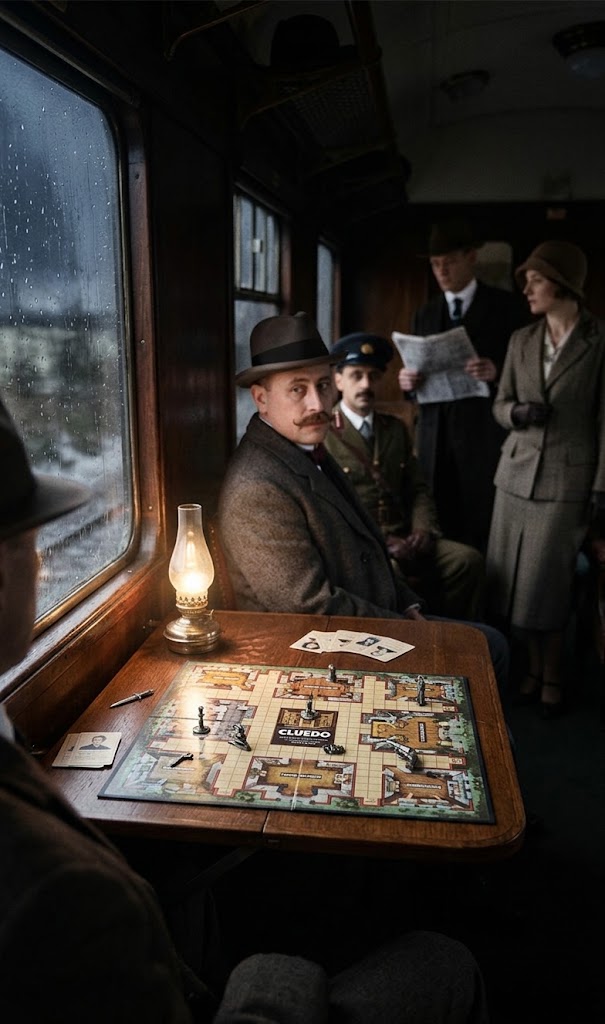
In many ways it may seem as if too many shady characters were now taking up position on the Cluedo game board. ‘Hows’, ‘wherefores’ and ‘with whats’ could be found tumbling from every corridor and secret passage of the tale. Let’s be clear about one thing though; it wasn’t some small pewter icon that had finished-off Nurse Nightingale Shore; it was something much more deadly.
Our strongest line of enquiry is probably Ernest C. Brown, “in and out of death’s shadow three times” if his story in the Washington Daily Star was anything to go by. But if the death of the nurse was in any way linked to her cousin’s work at Mi5 or her aunt’s activities in Tonbridge, where Florence had visited her the day prior to the attack, then what might anybody have gained by committing such an act?
Some explanations, though speculative, are not implausible
Killing Nurse Shore may well have been an attempt to manipulate her cousin Rafael Farina at either a practical or emotional level, jamming the young agent’s ability to process the intelligence that is arriving daily on his desk at 74 Queen’s Gate and compromising his judgement. Relations between Britain and the emerging Soviet state are at crisis point. The coalition government is torn between backing the upcoming trade agreement and going to all-out war with Lenin’s Bolsheviks. A civil war in Russia is not only tearing the country apart, it is standing in the way of rebuilding Europe and getting Britain’s economy back on track. Anti-Bolshevik exiles — from old Tsarist loyalists to overthrown government officials — are now swarming into Paris, Berlin, and London. But who are our friends and who are our enemies? Our understanding of Russian politics is weak and the individuals concerned remain deeply ambiguous. Farina has an impossible task on his hands, and his position is deeply vulnerable.
The intelligence that led to Mi5’s discovery of Count Paul Ignatieff in St Leonards on Sea had also been routed through a personal file on Guchkov. Was this a deliberate attempt to put the Count in the frame for the murder? Or were agents loyal to the exiled Prime Minister Kerensky sowing seeds of distrust that might further undermine Britain’s confidence in White Russia? The execution of another Red Cross and Queens worker, Edith Cavell in October 1915 had served as a potent propaganda drive against Germany to boost recruitment. Cavell and British Intelligence Officer, Dr Thomas Tollemache Jackson Bull had been accused of running a network of spies from a nurses’ training school in Belgium. Bull escaped with a six-month stretch of hard labour. Edith was shot at dawn.
John Buchan’s War Propaganda Bureau at Wellington House showed no shame in capitalising on the sheer scale of the horror expressed by the world’s public to ramp-up efforts against the Germans. From 1915 to 1918 it was the story that just kept giving. If it had been possible to pin the murder of Nurse Nightingale Shore on some fiendish Bolshevist plot against the establishment, a similar hue and cry might well have erupted against Lenin’s Soviet, which was enjoying increasing recognition in Europe. Had that been the logic employed by some sinister maverick forces operating in the shadows of the White Russian circles in England? It was fanciful but not impossible given the considerable stakes at the time.
A ‘scare bulletin’ from the British Home Office on February 9th 1920 would express concerns that a ‘more moderate view of the Bolsheviks in Russia’ was taking shape in Britain. Within “extremists circles” there was also a growing belief that a Soviet Britain was now within reach. [1] Extraordinary challenges demanded extraordinary solutions.
Just as Florence lay gasping for breath in Hastings, 24-year old clerk George Shanks was putting the finishing touches to his translation to The Protocols of the Elders of Sion, a notorious work of fiction, first published in Russia in 1905, that had been cynically revived as ‘fact’ as part of pro-Interventionist efforts to undermine support for the ‘Jewish’ Bolsheviks, channelling Britain’s vast reserves of ancient anti-Semitism into the path of a brand new threat. It was just a case of conflating the two in the imaginations of the public. Trying to convince the British Home Office of the dual threat was their new Director of Intelligence, Sir Basil Thomson, who buoyed up The Times of London review of Shanks’ Jewish Peril on May 8th with a warning that the “Jews of East End London” were fomenting rebellion over Britain’s brutal offensive being carried out by the White Russian anti-Bolshevik forces in Poland. [2] Thomson had quietly assured the government that a more aggressive policy against the “Jewish alien” would be a popular signal among the electorate. In the heading, ‘What the Working Man Thinks’ in his bulletin of May 6th, Thomson cheerfully reported that an agent who had conversed with “workers selected at random” had all had a “hearty dislike for the alien” and would like to see “powder and shot used freely among the Labour leaders and the Jews”. Another wished all Jews to be given “free passage to Palestine” where he had served.[3]
The beast of anti-Semitism had been let loose almost within hours of Lenin and the Bolsheviks wrestling power from Kerensky when the National War Aims Committee republished claims made in the Daily Chronicle in their Reality: Searchlight on Germany journal that practically all the Bolshevik leaders were Jewish — including Lenin. [4] It wasn’t even a half truth, but the British public were prepared to swallow it. The anti-Jewish riots in South Wales in 1911 were still playing out vividly in the minds of Home and Foreign Office rightists. It was an energy that could be harnessed, and there was probably no one more aware of this than the Home Secretary during that period, Winston Churchill, now desperately trying to fight a trade agreement with Lenin’s Russia.
Whether as the result of the natural vagaries of civil disorder or more cynical attempts to create a scapegoat, the tsunami of unrest among the country’s coal and dock workers had found itself being re-routed toward Jewish homes and businesses in a week-long orgy of looting and violence.[5] The man behind the National War Aims Committee and its fortnightly organ, Reality: Searchlight on Germany was Churchill’s cousin, Sir Freddie Guest — Chief Whip of the Liberal Democrats. Despite the efforts of prominent Jewish Britons like Lucien Woolf to argue down any link between Bolshevism and the Jewish religion, the tack was cynically pursued by senior members of the British government well into the early 1920s.
By February 1921, Lord Curzon and Sir Ronald Graham, the British Minister at The Hague and a leading advocate at the Foreign Office of a British commitment to Zionism, were still discussing the influence of Jews in the Soviet administration in cables in February 1921.[6] Curiously, The Bolshevik Peril, a ‘bombshell’ play written by the similarly-named ‘Ronald Grahame’ and resoundingly endorsed and licensed by Liberal MP and Royal Chamberlain, Lord Sandhurst, made its debut at a theatre in Tredegar, ground zero of the 1911 riots, in March 1919. [7]
During the war George Shanks, the young translator of The Protocols had served as a Sub-Lieutenant in Britain’s Royal Naval Air Service, attached on special service with the Imperial Russian Navy at RNAS Kingsnorth on the Hoo Peninsula in Kent. Resigning his commission in April 1919, he appears to have next worked as a clerk in Sir Freddie Guest’s Chief Whip’s Office at No.12 Downing Street, before securing an appointment with the Prime Minister’s Personal Secretary, Philip Sassoon, his Russian language skills quite probably being an asset in Lloyd George’s upcoming trade negotiations with Krassin and the Soviet. His proximity to the Committee on Russian Affairs and the howling, belligerent Churchill — who had given the ‘Jewish’ Bolsheviks his own verbal thrashing in his much-loathed ‘Zionism versus Bolshevism’ article just weeks before —also make it possible for Shanks to have been put there as a plant — either as a desperate shot at sabotage or as a means of keeping tabs on the regular flow of messages that were now currently shuttling daily between Krassin’s delegation and No.10 Downing Street. Nobody was thinking clearly, and all former political courtesies and good sense had been lost in the unforgiving fury of betrayal.[8]
The next man to have his name associated with The Protocols was Victor E. Marsden, the former Russian correspondent for the Morning Post who had been savagely imprisoned in the notorious Peter Paul Fortress in the immediate aftermath of the Bolshevik assault on the British Embassy in Petrograd in August 1918. The assault on the Embassy had culminated in the callous murder of Britain’s naval attaché, Captain Cromie, chief of British Intelligence in Russia for the British Naval Intelligence Division. According to reports, Russia’s Secret Police (the Cheka) had stormed the British Embassy, murdered and mutilated Cromie, then rounded-up and arrested dozens of British Subjects who were occupying the Military Mission at the time, Victor E. Marsden among them.
The gory details surrounding Cromie’s death were dutifully rolled out every time the Lloyd George government made any positive noises in support of trade with Russia. Marsden was to die suddenly in October 1920, the ill-treatment he’d suffered at the hands of the Bolsheviks having had a continued impact on his health. Any input he may have had into the third edition of The Protocols was likely to have been strictly honorary, but his inclusion on the book’s title pages packed a powerful message.
The strong, handsome features of British judgement were to be further disfigured with the discovery that the Bolsheviks now had men in Britain who had been coerced into distributing anti-British propaganda, some of them former British soldiers who were alleged to have been ‘turned’ at ‘propaganda schools’ in Russian prison camps during Churchill’s secret war with the Soviet.[9] As news of the inquest into Florence’s death was being reported, word was coming through of a serious charge being made by the authorities under the Defence of the Realm Act.
A few weeks earlier on January 16th, ex-Royal Navy man, John Frederick Hedley and his Russian-born wife Bella Sarah Hedley, had been charged with sedition in Rotherham. In its now customary sensational fashion, the Home Office weekly report on Revolutionary Organisations in the United Kingdom painted a very worrying picture of the couple’s activities. Fred is alleged to have told the 200-300 people who had gathered in South Yorkshire for a ’Red Guard’ meeting that during the war he and his fellow seamen had been instructed by the British Admiralty to sink several of their own submarines as part of an ongoing propaganda exercise. [10] According to a report in the Sheffield Daily Telegraph (placed below an update on the Nurse Shore ‘Train mystery’), Hedley had claimed that British and not German ‘chasers’ had been responsible for the losses during the raids on the East Coast of England.
On February 17th 1920, Hedley was duly tried under the Defence of the Realm Act at Rotherham Borough Police Court for making false statements and inciting mutiny and sentenced to six months hard labour. Several weeks later in March, news came screaming out from the headlines that another new Bolshevik plot had been ‘unmasked’ in the US. Documents were said to have been brought before a Senate Committee in the US that provided evidence of a Bolshevik plot to ignite a Revolution. A courier had been found with diamonds to the value of three million roubles with instructions to arm demobilized servicemen. British Police were being told to search for an emissary from Russia who was in Britain with plans from Lenin to launch a Great Strike in May.[11] Within weeks, Nurse Shore suspect and military deserter Percy Toplis was armed and on the run and being sought by Police as ‘most wanted’. It’s fair to say that as far as domestic threats were concerned, this was the most volatile year that Britain had faced in centuries. [12]
Whatever the exact motive, there was evidence to suggest — however circumstantial — that Nurse Florence Nightingale Shore may have been a casualty in an ever-spiralling war game played out by rival factions of an exiled Russian government. And more astonishingly still, the game had become localised, almost entirely, among the squirely old hedgerows and cottages of the Kent and Sussex countryside that Christie had so charmingly sketched-out in her detective novels.
Christie, curiously enough, had her own Man in a Brown Suit mystery to unravel. The book, published just a few years after the death of Nurse Nightingale Shore, follows the adventures of Anne Beddingfeld as she pursues suspected diamond thief, Sergius Paulovitch from England to Paris. The Count is a fake Russian agent run by ‘The Colonel’, a criminal mastermind and political mischief-maker. The Colonel’s assistant is Guy Pagett. The real life Guy Paget — an Army Major and Conservative MP — was a distant cousin of Lady Muriel Paget who in November 1920 took over the management of the Russian Relief and Reconstruction Fund on behalf of anti-Bolshevik, White Russian refugees living in Britain. The novel was published in 1924. It too featured an iconic London train station and a case of valuable diamonds, and it too had its own colourful menagerie of swarthy Russian counts and agent provocateurs lumbering through the quicksand of the British Secret Service.
But even Russian intrigue didn’t exclude robbery as a motive.
At the time that Nurse Nightingale Shore was attacked, it was being reported that crown jewels of fantastic value were being smuggled from Russia into Britain. Arriving as refugees in Turkey, many a proud White Russian had been obliged to trade his valuables for little more than a loaf of bread. The once wealthy Russian nobles were now enduring a ‘rice for rubies’ lifestyle, and inevitably some of the spoils were spilling from Ottoman bowl to the swag bag and across the Mediterranean into Europe. According to some reports, diamonds and emeralds which had been seized by the Soviet in the name of the State had been diverted to private looters. The famous Cullinan diamond, which had graced the sceptre of the Tsar was among them. A stash worth tens of thousands of pounds was even disposed of by Soviet Representatives Leonid Krassin and Lev Kamenev during their 1920 trade mission to London. Extraordinarily, the sale had the full backing of the UK Government, a move that could only have aggravated relations with its former White Émigré allies. Whether or not it’s conceivable that Nurse Nightingale Shore was in possession of such valuables — secretly couriering them from one place to another — at the time she was attacked, the stories and speculation dominating the headlines at this time were almost certainly the inspiration for Christie’s jewel heist crime caper, ‘The Man in the Brown Suit’. [13]
The Friends in St Leonards
According to the Leeds Mercury, the friend that Florence Nightingale Shore was due to visit in St Leonards on the day she was attacked on the train was another Queens Nurse, Miss Mary ‘Minnie’ Rotton. Miss Rotton lived with Clara Bessie Kelbe at Norlandrise, 6 Matthews Road in Silverhill — just a five minute walk from the care home of Count Paul Ignatieff at Woodmancote.[14] Kelbe was the daughter of Gustavus Werner Kelbe, a German-born partner in the same Schroder Banking Corporation we touched on in an earlier chapter in relation to the Sassoons of Iraq and Rusthall House. By contrast, Minnie had been born to Major General Guy Rotton and Tryphena Garrett of Canada in St Johns, Newfoundland in the mid-1800s.
The newspaper told of an ‘extraordinary incident in presentiment’ felt by Miss Rotton. It seems that Miss Rotton, the friend Nurse Shore was intending to visit, had been advised by an ‘acquaintance’ not to go to the train station to meet Florence that day. The acquaintance appears to have told Miss Rotton that they had a feeling that ‘something terrible’ had happened. Miss Rotton told her acquaintance that she must go as she had “promised to be there to meet her”. When she did arrive at the station, “she found an ambulance waiting, the train arriving a few minutes earlier than the scheduled time.” [15]
“On Sunday 11th, she went to Tonbridge for the day, and returned to Carnforth Lodge the same evening. On Monday 12th, in accordance with her arrangements, she went to Victoria Station to catch the 3.20 train to St Leonards Warrior Square Station.”
— Inquest Opened on Miss Shore, Shields Daily News 20 January 1920, p.3
As the ambulance Miss Rotton describes was at Hastings Station (not St Leonards on Sea) one really has to wonder why Minnie Rotton had not arranged to meet Florence at Warrior Square Station in St Leonards where the train had been scheduled to stop originally. What had prompted Miss Rotton to change plans and meet Florence at the station in Hastings when Florence was scheduled to arrive at St Leonards, the stop before?
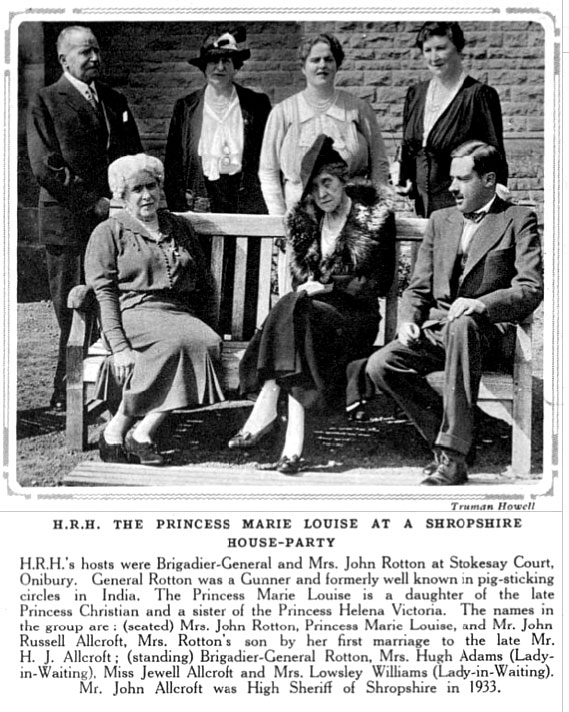
Mabel Rogers had told the inquest that on Monday 12th January, “in accordance with her arrangements, Florence had gone to Victoria Station to catch the 3.20 to St Leonards Warrior Square Station”. Her ticket was from Victoria to St Leonards on Sea. If Florence really had been on her way to visit Minnie and Miss Kelbe, this would have made far more sense as Warrior Square Station was little more than a 15 minute walk from Miss Rotton on Matthews Road. But in the statement Miss Rotton provides to the press, we can only surmise that she had arranged to meet Florence at Hastings and not St Leonards Station. Had the ‘extraordinary incident in presentiment’ experienced by Miss Rotton’s mysterious acquaintance extended to knowing that the train that Florence was travelling on — and the ambulance that was arranged to transport her — had been urgently re-routed to Hastings as result of Florence’s injuries? Minnie would have had no way of knowing that the train had been redirected, so how was it that she went to Hastings if Shore’s ticket had meant terminating her journey at Warrior Square, before it continued to Hastings?
“An extraordinary incident is the pre-sentiment felt by Miss Rotton, of St Matthew’s Road, St Leonards — the friend Nurse Shore intended to visit — an acquaintance advised her not to go to the station to meet Nurse Shore. “I feel that something terrible is happening”, she said … When she did arrive at the station she found an ambulance was waiting.”
— Something Terrible, Leeds Mercury 15 January 1920
In fairness, it’s more likely that the warning that Miss Rotton had received had not arisen from any prophetic vision but from friends close to Military Intelligence, Section 5. Gracing the board of the Bristol West Conservative Association that her father, General John Guy Rotton had been a member of, was Viscount Walter Long, the First Lord of the Admiralty.[16] Just 12 months previously, Long had been instrumental in establishing the Secret Service Committee, set-up rather specifically to deal with the new Soviet and Irish threats. The fact that Miss Rotton’s brother was himself a Brigadier General would have almost certainly have raised concerns, and triggered a flurry of feverish communications between the War Office, Military Intelligence and Police once Florence’s identity had been discovered.
Florence’s cousin, Rafaele Farina, had been drafted into one of Long’s newly reorganized Intelligence units, which included Mi5. The threat presented by Sinn Fein and the Russians had become urgent and intense. Long and Major Rotton, who had been born in Ireland, had been strong Ulster Unionists and supporters of Sir Michael Hicks-Beech, former Chief Secretary of Ireland and it is interesting to note that there had been several assassinations by Sinn Fein members, in January 1920. One of those killed was Assistant Chief Commissioner Redmond, who had been shot in front of the Sinn Fein HQ in Dublin. Given the momentous events in Russia and in Ireland, it is entirely possible that there had been prior warnings of threats to the lives of friends and family of prominent military figures. [17]
Surprising Revelations — Confessions in the restaurant car
“What do you want?” he said. “I have nothing more to tell you —nothing, do you hear …”
“Yes, you have something more to tell us,” said Poirot firmly.
“The Truth!”
— Murder on the Orient Express, Agatha Christie
Keeping track of all the various actors arriving and departing in this mystery can be a challenge, so crowding you all into the restaurant car and offering you a potted version of key events and characters may provide some clarity; Florence Nightingale Shore is brutally attacked and killed in the sealed compartment of a train travelling between London and Hastings. Her first cousin is Rafael Farina, Head of Russian Section at Mi5. In recent weeks he has been compiling files on several high-ranking Russian exiles in locations which can be related directly to Nurse Shore’s journeys in the 24-hours before her death. Russia remains divided. And Britain remains divided about Russia. The ‘Reds’ are in and the ‘Whites’ are out.
At the top of Farina’s list is former Prime Minister Kerensky, the Socialist Revolutionary who led Russia’s Provisional Government in the six month interval between the February and October Revolutions in Russia in 1917. For three years Kerensky has been in hiding. Now he is in Tonbridge with his friend and translator Dr. Gavronsky. This places him and his revolutionaries within 30 minutes or so of Florence and her aunt, the Baroness Farina on Hadlow Road. At this time, Mi5 are trying to determine if Kerensky is now working with the Germans to influence Russian public opinion against the White Russian movement.
Next we have Count Paul Ignatieff, President of the White Russian Red Cross. An extract from a file on Alexander Guchkov suggests that Ignatieff was in and around St Leonards at the time that Florence was planning to meet her friends there. The count’s brother, General Alexei Ignatieff was murdered by extremist factions within Kerensky’s Socialist Revolutionary Party some fifteen years before. Whilst not deemed an immediate threat, Mi5 are remaining cautious, withholding requested visas to anyone outside his immediate family.
Also in Tonbridge at this time, are two glamorous figures: the Baroness Farina (who Florence visited the night prior to the attack) and Lt. General Sergei Belosselsky Belozersky, the former Russian representative to Paris and Berlin who had served as adviser to General Yudenich during a two year war with Lenin’s Bolsheviks and who has retained very close ties to Mi6. A resourceful White Russian Prince, Belozersky’s commitment to removing the Bolshevik Government, would, like those of his friends, last until his death in the 1950s. He would also end up living just doors away from the Baroness on Hadlow Road in Tonbridge.
And then we have Florence’s murder, coinciding as it did, with the withdrawal of British support to Russia’s counter-revolutionary forces, the execution of its leader and the announcement of a trade agreement with their fiercest enemy, Bolshevik Russia. And as if this wasn’t perplexing enough, we’ve learned some other uncomfortable truths. The first is that the initial suspect in the murder investigation that followed the attack on Shore was former RAF Captain Ernest C. Brown, who had been arrested on suspicion of both espionage and murder, not once but ‘three times’. As Branch Secretary of the Comrades of the Great War in Glasgow, Brown would have come under the supervision of the Association’s founder Viscount Walter Long, whose close friend and ally, the lawyer Théodore Aubert, would go on to defend White Russian assassin, Maurice Conrad, charged with murdering the Soviet Ambassador to Switzerland in 1923 — a murder that some claim was financed by our old friend, Guchkov.
All of this really begged the question: had Florence Nightingale Shore been sucked into a spiral of revenge furiously escalating in the upper echelons of émigré society? Perhaps it was her proximity to her brother Offley, the stalling Brigadier General whose reluctance to release crucial military funds in December 1917 allowed the Bolsheviks to seize control of Southern Russia. Or perhaps it was Florence’s cousin, Rafael Farina, the Mi5 and Mi6 officer whose alleged complicity in the Zinoviev Letter had brought him into contact with the same mysterious shadow-world as the White Russian hostiles he had been investigating and whose personal files at Mi5 remained open for review.
Of course, it is terrifically unlikely that the Count, the Prince, Guchkov or Kerensky would have wielded the actual dagger, so to speak. Unlike Christie’s Orient Express mystery, there are likely to have been passengers beyond the purview of the coach in which the characters had assembled. Associates, detractors, loyalists, dis-loyalists — each of them capable of leaving an entirely new trail of clues, and all providing us with fresh, unspoiled tracks in the snow, leading to an ever sweeping blizzard of new questions.
Sadly, the answers to many of these questions are likely to remain unanswered.
Within 48 hours of the attack on Nurse Nightingale Shore, Ernest Haigh, Chief Inspector at Scotland Yard was deputed by the Home Office to take control of the case. The investigation was now being led not by Hastings Police but by CID at The Met. It was the second time that year that Chief Inspector Haigh would be asked by the British Home Office to intervene in a high-profile investigation — the first being the case against Harold Greenwood, the Solicitor from Llanelli in South Wales accused of poisoning his wife Mabel, the sister of Sir Thomas Vansittart Bowater, Conservative MP and five-time Mayor of London. Again, this was a sudden intervention and came several months after Greenwood’s arrest. [18]
“Did Miss Barnard tell you where she was going last night?”
Fraser replied to the question. He seemed to be speaking mechanically.
“She said she was going with a girlfriend to St Leonards.”
— The ABC Murders, Agatha Christie Train Mystery, 1936
Despite, or more likely as a result of being in some considerable debt, Haigh retired from the force in July 1920, just as the Shore investigation was being wound down. But it wasn’t to be the end of his adventures by any means. Within months of his retirement, the Chief Inspector found himself at the centre of a spat with Sir Edward Troup and the British Home Office. Serial Manchester fraudster, Frederick White was in the process of making a series of films chronicling the work of Scotland Yard and former Inspector Haigh had offered his services as screenwriter. [19] Whether by coincidence or design, the Home Office were in the process of producing their own film on Scotland Yard. The ‘official’ story of Scotland Yard, tentatively titled ‘Scotland Yard 21’ had been commissioned by Met Press Bureau.
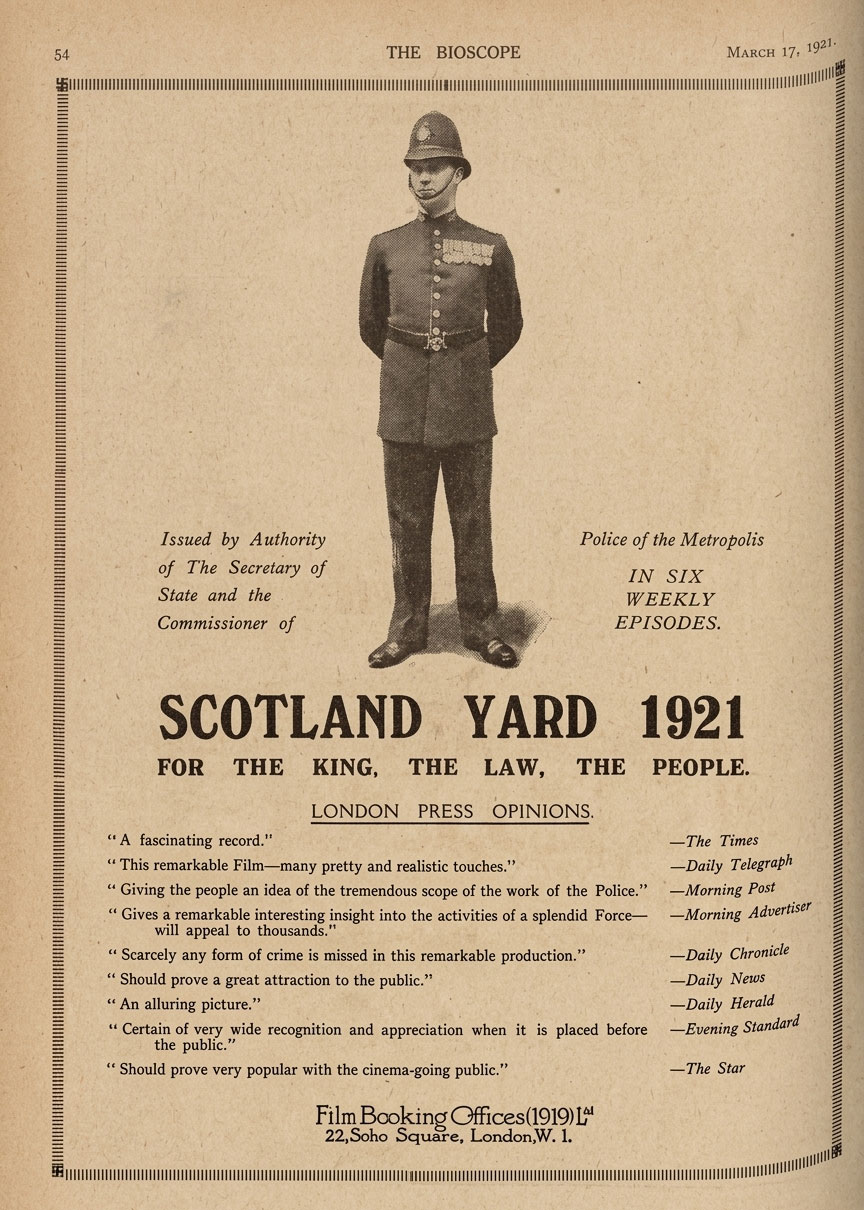
The bureau had been set-up by Troup and the Secret Service Committee in October 1919 as an attempt to wrestle back control of subversive propaganda in the wake of the Irish and Bolshevik threats. The Yard’s ‘Press Bureau’ was thus created to censor the flow of information between the Met and the film and press industries. The Topical Film Company were brought in as producers with former Military Intelligence man, Edmund Distin Maddick at the helm. Tropical’s new owner was Edward Hulton, the Manchester newspaper magnate whose Illustrated Sunday News had published Sir Winston Churchill’s anti-Communist battle-cry, ‘Zionism versus Bolshevism’ in February that year.

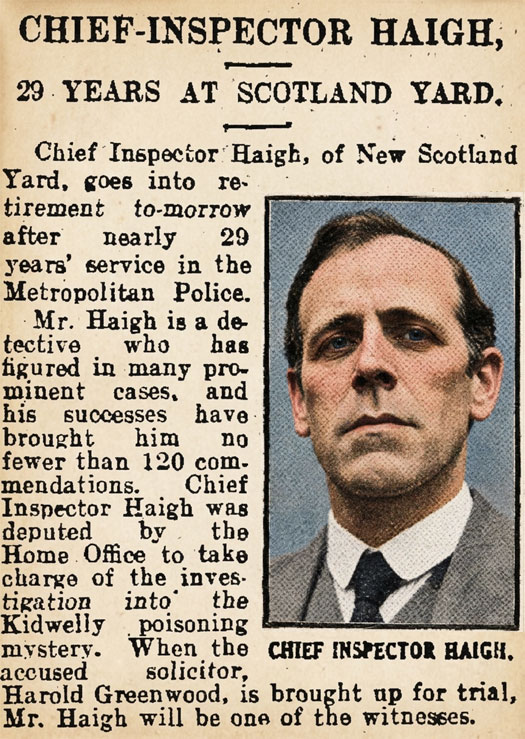
Attempts were made by the Home Office to have the White Brothers’ and ex-Chief Inspector Haigh’s ‘unofficial’ Yard movie removed from distribution, but their efforts did little more than give it another vital shot of publicity. Tropical’s Yard caper would eventually see Haigh writing and starring in a dozen or so titles that year. [20] In all fairness, there had been concern at Mi5 that the formal and anodyne film showing the daily procedural undertakings of Officers at Scotland Yard was unlikely to provide the sensational daring-do that was necessary to counter the subversive threat. It’s entirely possible that former Inspector Haigh had been tasked with providing the same thing ‘off the record’ and with none of the restrictions placed on the official film, overseen by Police Commissioner William Horwood.
Curiously, both Frederick White and Mrs Greenwood — the sister of Sir Thomas Bowater who Haigh had been investigating — were both from the Manchester area. White had been jailed there in 1914 for an attempt to defraud several prominent figures into investing into a bogus movie studio. Among them was William Herbert Cruddas, Secretary of the Conservative and Unionist Agents Association. Despite White’s 18-month sentence for fraud, ex-Chief Inspector Haigh worked with White for the duration of 1921.
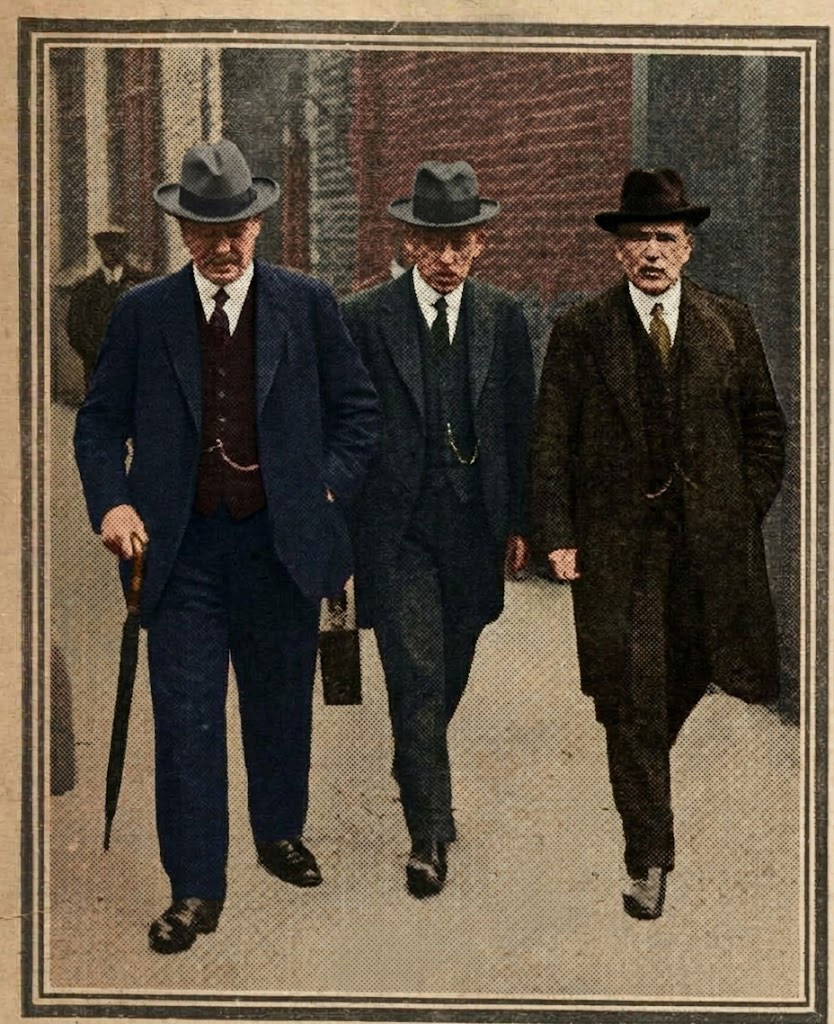
In 1927 ex-Chief Inspector Haigh’s movie mentor, the ex-convict Frederick White partnered Sir Park Goff in British and Foreign Films Ltd. [21] Goff enjoyed an illustrious career at the heart of the war time establishment, serving first as Kings Messenger to Russia and Baltic States and then as Assistant Secretary to First Lord of the Admiralty, Sir Walter Long (who had co-founded the Secret Service Committee in 1919). Curiously, Goff was the last formal British representative to see and speak to the Tsar alive and played a significant spying role in the capture and execution of several German agents during 1915. He also paid a critical trip to Russia at the height of the civil war to discuss terms with White Russian generals, Yudenich and Kolchak. The first film that Goff and White produced was ‘Volga Volga’ (1928), written by directed and produced by White Russian émigrés Viktor Tourjansky and Joseph N. Ermolieff. Like Ernest C Brown, Goff was from Glasgow but for many years had a residence at Marina Court in Bexhill-on-Sea — where Florence Nightingale Shore was found on the train. Another partner in the Goff and White film company was Colonel McInnes Shaw, Grand Master of Glasgow’s Orange Order which was notoriously aligned with ‘Peaky Blinders’ Razor gang leader Billy Fullerton — fascist thug for hire.[22]
Many of the secrets relating to Florence’s brother Offley and to the pair’s Secret Service cousin, Rafael Farina, were likely to have been too sensitive for public consumption and the threat of publication may well have put lives and careers at risk, irrespective of any possible relevance to the case. One thing is for sure, the Met Press Bureau — launched to counter Bolshevist propaganda just several weeks before — would have encountered its first real test. Information would have been managed, a crisis controlled, and the proposed cuts to Intelligence budgets being challenged by the likes of Sir Walter Long and Winston Churchill, may even have been narrowly averted. [23] The contents of the attaché case, or large red ‘despatch box’ that had been partially opened and rifled-through at Nurse Shore’s side was not explored at the Inquest, despite such boxes featuring commonly in government or ‘official’ matters.
There is another question we may feel compelled to ask. Had Florence’s visit to the Baroness Farina in Tonbridge the evening prior to the attack resulted in the conveyance of important documents? Had Florence been entrusted as a messenger by her Aunt or cousin and been followed from the house and then violently robbed of the papers?
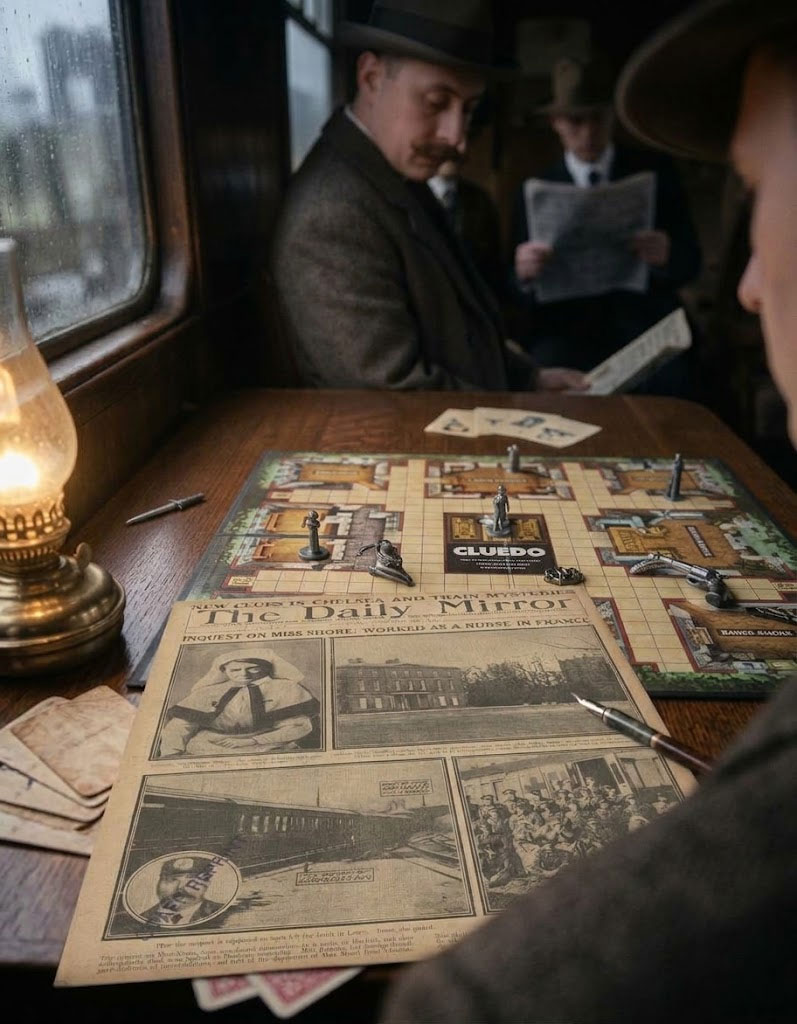
The arrival of the ‘man in the brown suit’ at the last possible moment before the train set-off for Hastings may be an indication of a premeditated attack preceded by close-observation on foot. But as Florence’s friend Mabel Rogers claimed she was still in the carriage with Florence when ‘the man in the brown suit’ is alleged to have jumped on board the train, you are left with the impression that this was not some predatory opportunist targeting a lone female traveller. Unless he had been tipped-off, the assailant would have had little way of knowing that Mabel would disembark — and the more people, the greater the risk. Perhaps he just seized an opportunity that presented itself, who knows?
As Agatha Christie once wrote, “there are questions that you don’t ask because you’re afraid of the answers to them”. Further pithy observations could be offered. Sometimes the best way of removing a breadcrumb trail is to remove the loaf entirely, and the politest way of refusing an answer, is to pretend you never heard the question in the first place. There are clearly many questions that Scotland Yard chose not to ask, and many loose-ends they chose not to pursue, and during the 100 or so years that have elapsed since the Nurse Nightingale Shore murder, those ends have almost certainly frayed to the point of failure. The scent has been lost and the file has been closed. Ernest Craufurd Brown and our mystery Russians remain the only glowing embers of a stubbornly cold case. [24]
[1] Report on Revolutionary Organisations in the United Kingdom. Report No. 37, February 5 1920, CAB 24/97/81
[2] Hands Off Russia Movement, Report on Revolutionary Organisations in the United Kingdom, Report No. 57, June 3 1920, CAB 24/106/102, p.3
[3] Report on Revolutionary Organisations in the United Kingdom. No 53, May 6 1920, CAB 24/105/39
[4] Reality: Searchlight on Germany, Issue 97, November 17th 1917, p.4. The report was a reworking of an article published Harold William’s Daily Chronicle on November 10th 1917 in which the real ‘Jewish’ names of several Bolshevik ministers were revealed
[5] For more see: The Tredegar Riots of 1911: Anti-Jewish Disturbances in South Wales, Colin Holmes, Welsh History Review, vol. 1, 1982, pp. 214–25
[6] The British National Archives, LG/F/203/2/8, Ronald Graham, The Hague, to Earl Curzon of Kedleston No.102, February 12 1921. Sir Ronald worked closely Vladimir Jabotinsky’s Zion Mule Corps when serving as Chief Staff Officer, G.O.C. Egypt. For more see: The Question of Palestine, 1914-1918; British-Jewish-Arab relations, Isaiah Friedman, pp.119-143. Graham was the British Ambassador in Italy during the rise of Italian Fascism under Mussolini in 1922.
[7] British Theatre and the Red Peril: the Portrayal of Communism, 1917-1945, Steve Nicholson, p.x, pp.31-33, The Bolshevik Peril, Wanted: Leading Man, Tredegar, South Wales, The Stage 13 March 1919, p.22, The Bolshevik Peril by Ronald Grahame, The Stage 20 March 1919, p.21. Thousands of plays were licensed by the Lord Chamberlain’s office every year.
[8] The claim that Shanks worked at Chief Whip’s Office under Churchill’s cousin Freddie Guest was made in the Plain English journal dated Jan 22 1921 (no.29, vol. II). For more see: https://www.monocledmutineer.co.uk/pdfs/George_Shanks_the_Protocols_of_the_Elders_of_Zion_Jewish_Peril.pdf
[9] Bolshevist Gold, Manchester Evening News 08 August 1919, p.5
[10] The British National Archives, CAB-24-97-24, Home Office Report on Revolutionary Organisations in the United Kingdom., January 29 1920
[11] Bolshevik Plot Unmasked, Pall Mall Gazette, 04 March 1920, p.3
[12] Serious Charge under D.O.R.A, Sheffield Daily Telegraph 05 February 1920, p.5
[13] Crown Jewels of Russia, Daily Herald 16 October 1919, p.1/Daily Mirror 31 August 1920, p.2
[14] England & Wales, Electoral Registers 1910-1932, St Peter, Sussex, P of B Hastings, England, 6 St. Matthew’s Road, Clara Bessie Kelbe, Mary Rotton, ref. SPR.Mic.P.335/BL.H.37. Kelbe died in November 1927 aged 69. Rotton died the following year aged 73.
[15] Something Terrible, Leeds Mercury 15 January 1920, p.9
[16] The Home Rule Scheme, Sir Michael Hicks Beach (Bristol West Conservative Association Dinner), Morning Post, April 30 1886, p.2. Miss Rotton’s brother, Brigadier General John Guy Rotton retired on May 18 1920.
[17] It was, incidentally, Lady Lucy Hicks-Beech, the wife the former Chief Secretary for Ireland, who in opposition to Florence Nightingale, had been a leading force in the formation of the Nurses Institute. Florence Shore Nightingale and Mary Rotton were among the very first Queens Nurses. The Institute was later patronized by Queen Alexandra of Schleswig-Holstein-Sonderburg-Glücksburg. The Rotton family remained on friendly terms with the Queen’s family. In the 1930s, Miss Rotton’s brother Brigadier John Guy Rotton played host to her sister, Princess Marie Louise of Schleswig-Holstein. The German Emperor Wilhelm II was her first cousin.
[18] Dundee Courier 09 June 1920, p.6
[19] The British Film Industry and the Metropolitan Police Press Bureau, 1919-1938 Cinema, Alex Rock, Television and History: New Approaches (ed. Laura Mee and Johnny Walker, CSP, 2014)
[20] The anxieties suffered by the Home Office over the release of the White Company’s film can be found in files MEPO 2/7442, PRO at the British National Archives.
[21] British and Foreign Films Ltd, The Bioscope 24 May 1928, p.11. The directors are listed as Sir Park Goff, KC, M.P (London), Sir Charles Henry Wilson L.L.D, J.P, M.P, Frederick White (Manchester, Proprietor of Frederick White Company).
[22] Orange Alba: The Civil Religion of Loyalism in the Southwestern Lowlands of Scotland since 1798, R. Michael Booker, PhD diss., University of Tennessee, 2010.
[23] Reports of the Secret Service Committee, January 27 1920, File KV 4/151
[24] A passenger list for the in May 1927 features an Ernest Crauford Brown, photographer, born 1892. He is being deported from Canada. News reports suggest that Brown was in Canada as early as 1923. He describes himself as a ‘freelancer’ with the Daily Herald of London. He even features talking at an event on Prohibition. He talks about his experiences of alcohol in Turkey. As in America he discusses his three arrests, including the Nurse Shore murder investigation.