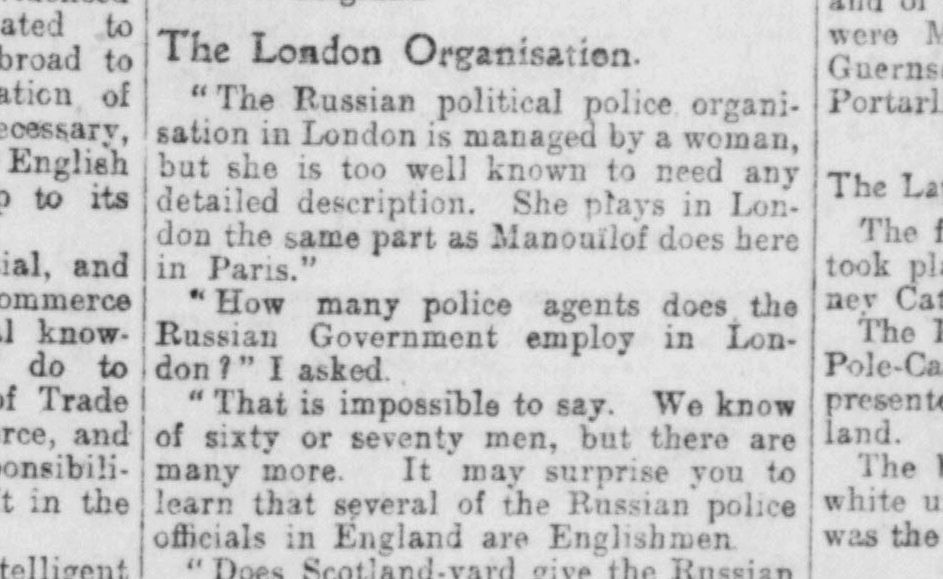
On January 27th 1905, the Daily News announced that a “special staff of Russian police spies” had arrived in London. [1] The following month, the New York Times and The Daily Express would publish a more detailed report based on an interview with Vladimir Burtsev’s colleague, Georgii Ivanovich Rabinovitch, claiming much the same thing, only reiterating the support that Tsarist Spies were receiving from Sir William Melville, newly appointed head of counterintelligence in the War Office’s ‘MO3’ — a precursor to Britain’s Secret Service Bureau. In an interview with the newspapers from his fifth-floor apartment in an old-world street at the back of the Panthéon in Paris, Rabinovitch told how the French and British police worked hand in hand with their Russian counterparts. The London organisation, however, was somewhat different in that its spies were controlled by a woman. How many spies they had in London was difficult to estimate. Rabinovitch claimed that they had positively identified some sixty or seventy men and women, several of them English, but it was likely that there were more. Unlike Paris, however, there was no formal arrangement with police in London, and the work they did on Socialists, anarchists and revolutionaries was carried out by a department that worked in the shadows. Every so often a train would arrive with a score of mysterious-looking, thickly bearded and shabbily-dressed individuals who would be met at the station by their handlers at the Russian Embassy on behalf of the secret police. [2]
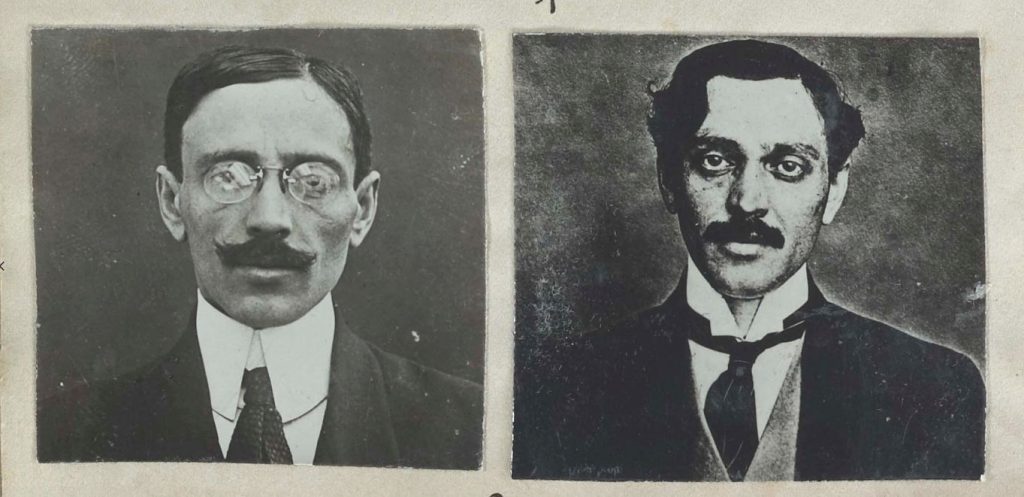
The ‘Hastings’ story emerged just weeks after the so-called ‘Bloody Sunday’ massacre, when soldiers of the Imperial Russian Guard opened fire on thousands of peaceful demonstrators outside the gates of the Winter Palace in Saint Petersburg. The leader of the demonstration, a priest called Georgy Gapon, had fled first to Switzerland, then to Paris and finally to London where he was given sanctuary by the émigré networkthat coalesced around Hammersmith under the watchful supervision of Lazar Goldenberg, David Soskice and The Society of Friends. The story arrived in the papers just as it was being announced that Major General Trepoff, the late Chief of Police in Moscow had been appointed Governor General of St Petersburg. [3] The man he replaced as governor was Ivan Fullon, whose unsatisfactory handling of the demonstration had also resulted in the removal of Aleksei Lopukhin as Director of Police in Saint Petersburg. Stepping into the role was the notorious spy-master, Pyotr Rachkovsky, a move that would send shockwaves through the émigré communities of Europe. Ever since taking a hard-line approach with student activists back in 1897, General Trepoff had gained an unfavourable reputation for placing large numbers of agent provocateurs in workers’ movements, or as The Times of London described it, pursuing a doctrine of ‘Similia similibus curantur’ — ‘let likes be cured by likes’. [4] The appointment of Trepoff and Rachkovsky to the roles would almost certainly have grabbed the attention of the revolutionary ‘Sherlock Holmes’, Vladimir Burtsev, who was suspicious of practically everything and everybody.
Burtsev’s friend, Alexsei Teplov, Secretary of the newly expanded Russian Free Library on Princelet Road in Whitechapel, responded to the news of Trepoff’s appointment by saying that it was his solemn conviction that the massacre of the striking workers on ‘Bloody Sunday’ had been deliberately prearranged. It was, he went on, all part of a careful scheme for crushing the desire for political and economic change. One of the spies, he said, had already been recognised as an agent provocateur. To Burtsev’s credit, most of the revolutionaries in his charge, including Teplov, had been trained in the skills of spy-spotting. To illustrate the point, Teplov boasted of the ease with which the circle of revolutionaries was outwitting the Tsarist spies. They were used to spies, he told reporters. The names, descriptions, addresses and doings of every one of them were known to the secret police and he laughed as he recalled some of his own experiences. “I never move around but am followed,” he said. “Even if I go away for a little fresh air, I put Russia to the expense of having me accompanied.” [5]
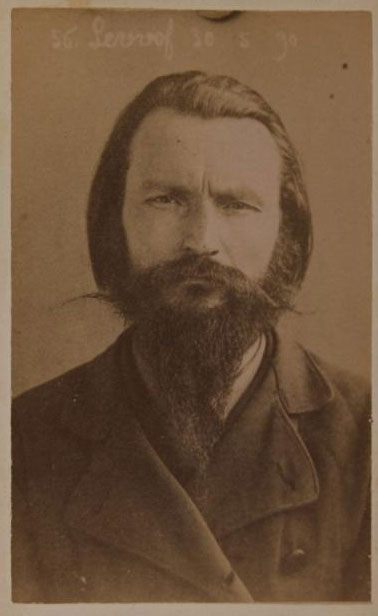
In a report titled, ‘Comedy in Hastings’, Teplov went on to describe how he had visited Hastings the previous summer and how the Tsarist police had followed him, ‘evidently’ because he had “something very deep at hand.” During his time in Hastings he had spared a few hours on the pier, just yards from the pier-side groyne where Serge Gapon’s body would be washed up in March the following year. [6] So mysterious had been his activities here that Teplov described how reinforcements had been sent for from London. Another night, after watching a concert at the White Rock bandstand opposite the pier, Teplov recalled slipping out from the crowd and losing himself in a ‘dark corner’ just for fun. Within minutes the Tsarist spies were running up and down the length of the pier ‘in the most excited fashion’. [7]
Twenty-four hours after the report was published, Teplov, David Soskice, Lazar Goldenberg, Warlaam Tcherkesoff and Nikolai Tchaikovsky would chair a meeting at Whitechapel’s Wonderland Theatre to discuss the threat and the challenges posed by Trepov’s ‘special staff’ of Police spies. The event had been arranged by the Society of Friends of Russian Freedom. Over 3000 people were alleged to have attended that night, including English Society President, Robert Spence, Balliol College’s George Meredith and Alfred George Gardiner — Philip Whitwell-Wilson’s editor at the Daily News. The committee duly announced that a new fund was being set up to collect and administer support for families of those killed or injured in the St Petersburg march with Spence, Gardiner and Meredith elected as treasurers. [8] Another meeting was pencilled in for the Sunday. [9] As each of the revolutionaries had appeared alongside mystery-man Sheftel on the 1901 ‘conscription’ petition, it’s possible that Alexis too was there. The man most likely leading the pack of spies was Edgar Farce, the tenacious French detective deployed in Britain by Rachkovsky at the Okhrana’s Paris office. It may be recalled that Farce had been hunkered down at Belbow Road in Hammersmith, just a few minutes walk from Sheftel on Sulgrave Road and Volkovsky and Goldenberg at the Society of Friends base on Augustus Road. Lenin and other members of the Russian Social Democratic Labour Party wouldn’t arrive in London for the hastily assembled Third Congress for another few months, but when he did, it was in the Percy Circus lodgings arranged by Sheftel’s co-signatoree, Nikolai Alekseev, Lenin’s London Lieutenant. This was gearing up to be quite a momentous year so the increase in spy activity was only to be expected.
What business Teplov had in Hastings that week was never explored, but given the resort’s significance in the publishing activities of Sheftel and Prelooker, it seems inevitable that Teplov was mixing no small amount of business with pleasure, perhaps even relaying messages beneath the convenient drone of the band.
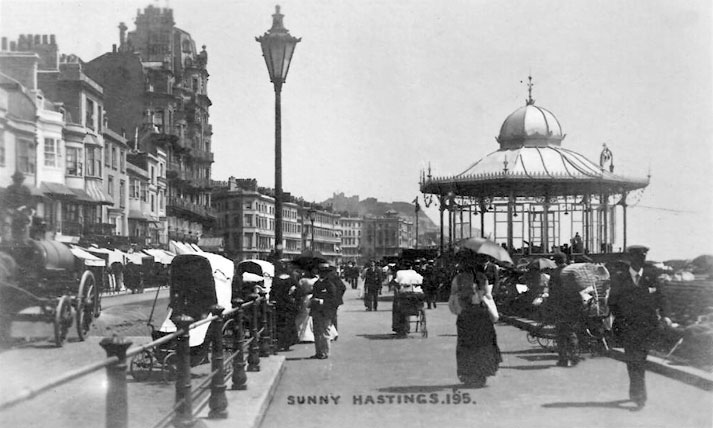
Whether Melville had some of his own men on the ground in Hastings isn’t known but it is interesting that the last man to see Serge Gapon alive in Hastings the following year was Charles Crossley, a senior representative of the Citizen’s National League, a patriotic union of grievous anti-Socialists. Crossley, a visitor from London, had been seen talking to Gapon at the pier the previous evening. The man told them he was a captain in the Tsar’s Imperial Guard and on his way to visit the Russian Consul in Folkestone. Crossley and his brother were believed to be the last men to speak to the troubled naval deserter (Hastings and St Leonards Observer 17 March 1906, p.10). Two days later, Crossley featured in another report in the press, this time announcing the formation of a National Anti-Socialist League at the Junior Carlton Club in London’s Pall Mall. The meeting was held under the presidency of Thomas Orde Hastings Lees, Honorary Secretary of ‘prepper’ association, The National Service League (Pall Mall Gazette, 15 March 1906, p.9).Among the League’s most active and influential members was Sir Walter Long who had for a long time been associated with Britain’s counter-espionage activities, both those that were publicly and privately funded.
Helene de Krebel
Just weeks after police discovered the body of Serge Gapon in a groyne on the beach in Hastings, the body of Helene de Krebel, aka Marie Derval, was found at The Liffen’s Hotel in Pimlico, just a short walk from the Russian Embassy at Chesham Place. In his 1933 memoirs, Special Branch detective Herbert Fitch describes Krebel as the mistress of Georgian anarchist, Warlaam Tcherkesoff (Varlam Cherkezishvili), a close friend of Sergey Stepniak and an associate of Prince Kropotkin and Rudolf Rocker. The middle-aged woman, thought to be the daughter of a high ranking Russian family, was found dead in her room on March 14th, 1906. It is alleged she had been hounded to her death by revolutionaries who’d suspected her of spying and had been pursuing her actively across America and Europe for some two years or more. [10] Was she the ‘woman spymaster’ that Rabinovitch had alluded to his interview with the press in Paris the previous year? Her proximity to the Russian Embassy certainly makes that a possibility, and it is curious to note that the body of Serge Gapon had been pulled from the sea at Hastings on the very day that Helene de Krebel had checked into the Liffen’s Hotel in Pimlico. [11]
The Murder League
Teplov’s flippant take on his trip to Hastings is tremendously reminiscent of Vladmir Burtsev, who according to John Quail’s Slow Burning Fuse, was running a ‘one man counter-espionage operation‘ against Russian spy-master, Pyotr Rachkovsky in Paris (for which he was extradited) and London (for which he was not). Curiously enough, at the time that the March 1901 ‘conscription’ petition featuring Hastings mystery-man, Aleksis Sheftel, was going to press, Burtsev was suddenly taken ill and making his way to Lake Geneva on the pretext of seeking a rest cure. [12] Drawing a link between Burtsev’s sudden trip to Switzerland and the publication of the petition on conscription is likely to rest on quite a long series of ‘what ifs’. In his 2017 book, The Struggle For A Free Russia, Robert Henderson reveals that rumours abounded among agents of the French Sürete that Burtsev had left London with a large stash of money from the Russian Free Press Fund and that upon his arrival in Lausanne he had made contact with a large base of Russian socialists. Equally concerning for the French Sürete, were his communications with émigré Varvara Dobreva in which he had asked for the address of a Russian student of chemistry called Safonov. Whether this is the same Yegor Sasonov who went on to murder Russian interior minister, Vyacheslav von Plehve, in the summer of 1904 cannot be determined as yet, although the London Evening Standard of August 26 does translate his name this way and refers to his father in Bad Soden — another political exile who was reported to be taking a ‘rest cure’. [13] As far as I can ascertain, Safonov was, like Sheftel, another Ukrainian student. In a report written by Boris Savinkov for the New York Times in July 1910, von Plehve’s assassin (now being referred to as ‘Yegor Sazonov’) describes how the plot had taken shape between Geneva and Berlin. [14] Irrespective of clearing-up the matter about Safonov’s name, Burtsev was certainly seeking a ‘rest cure’ in the right place at the right time, as Pyotr Karpovich was also here.
Pyotr Karpovich was the former student who murdered Nikolay Bogolepov, the rector of the Imperial University of Moscow, in response to the 1901 conscription issue. Like Safonov he had also been active in Geneva and Berlin immediately prior to the shooting. Four years later, The Washington Post was to write of a new development in the investigation into Bogolepov’s death: Karpovich had been inspired by a group of former Siberian exiles living on the shores of Lake Geneva (Lac Leman) where they had formed an executive committee dispensing kill orders. The leaders of this so-called ‘murder league’ were believed to be three Jewish exiles: Grigory Gershuni, Mikhail Gotz and Ilya Rubanovich, editors and typesetters at The Messenger. [15] Was Vladimir Burtsev’s sudden trip to Lake Geneva around this time part of some hasty debriefing mission? Or was he there to clean-up the trail?
[1] ‘Spies in London’, Daily News, January 27, 1905, p.6
[2] ‘Russian Spies in Europe’, Daily Express, February 16, 1905, p.5; ‘Russian Spies in Paris’, New York Times, February 16, 1905, p.8; ‘Russian Spies in Europe,
[3] ‘General Trepoff Now the Absolute Master’, Daily Express, January 30, 1905, p.1
[4] ‘General Trepoff’, The Times, January 26, 1905, p.4
[5] ‘Comedy in Hastings’, Daily News (London), January 27, 1905, p.6
[6] Serge Gapon was the brother of Bloody Sunday demonstration leader, Father Georgy Gapon, who sought by Tsarist police in London in the summer of 1905.
[7] ‘Comedy in Hastings’, Daily News (London), January 27, 1905, p.6
[8] ‘Mass Meeting in London’, Daily News, January 26, 1905, p.8.
[9] Aberdeen Press and Journal, January 28, 1905, p.5
[10] Russian Woman Comes to London to Dies’, Lloyd’s Weekly Newspaper, 15 October, 1911, p.3; Leeds Mercury 16 October 1911, p.3
[11] ‘Father Gapon’s Brother Drowned’, Derby Daily Telegraph 13 March 1906, p.3; ‘Hotel Mystery’, Dundee Evening Telegraph, March 21, 1906, p4 (newspaper reports Krebel’s body was discovered on Wednesday 13th March, 1906, a few days after checking in at the Liffen’s Hotel).
[12] Vladimir Burtsev and the Russian Revolutionary Emigration, Robert Henderson, PhD Thesis, Queen Mary, University of London, 2008, p.13
[13] London Evening Standard, August 26, 1904, p.5
[14] ‘An Assassin’s Story of Killing Russia’s Police Chief’, New York Times, July 10, 1910, p.5
[15] ‘Russian Police Find New Band of Revolutionists’, The Washington Post, Oct 9, 1904, p.3