It is January 1920, and Britain stands on a razor’s edge. While the government prepares to broker trade with Lenin’s Soviet regime, a bitter faction war is exploding behind the scenes: anti-communist hardliners and intelligence figures are frantically trying to crush the Bolsheviks. At the heart of this fractured shadow-conflict stands Florence Nightingale Shore’s brother, Brigadier General Offley Bohun Shore. Stationed in Tiflis, Shore’s stubborn refusal to release British-held funds to arm local anti-Bolshevik forces crippled the Allied proxy war, alienating top diplomats and sealing the defeat of White Russian allies.
Meanwhile, the net closes in on the prime suspect in Nurse Shore’s murder: Captain Ernest Craufurd Brown. A branch secretary of the ultra-conservative Comrades of the Great War, Brown cuts a profoundly murky figure. His bizarre resume includes an arrest for wartime spying on submarines in Glasgow, followed later by an arrest for the murder of a Turkish officer in Constantinople amid the high-stakes intrigue of post-war Turkey. Is he just a man caught up in the crossfire or a shadowy intelligence operative?
As strange as it may seem, there is another dimension to this spy story that is every bit as intriguing. Perhaps more so.
It transpires that Rafael Farina, the first cousin of Nurse Nightingale Shore, was a senior British Intelligence officer. [1] On Sunday 11th January, the night prior to the attack on the train, Florence had visited Rafael’s mother in Tonbridge, an idyllic Tudor market town some thirty miles south of London. The Baroness Farina was Florence’s aunt on her mother’s side. The reason for her visit, which lasted some several hours, is not recorded.
G4 Russian Section
At the time of Florence’s death, Farina was serving on the 4th Floor at 4 Queen’s Gate under Major George Joseph Ball as Head of Mi5’s G4 Russian Section. It was here that he dealt with a regular flow of political exiles, revolutionaries and slippery agent provocateurs. Farina’s next post was Head of Station for Mi6 in Latvia, whose membership of the Russian Empire had collapsed with the 1917 Revolution.
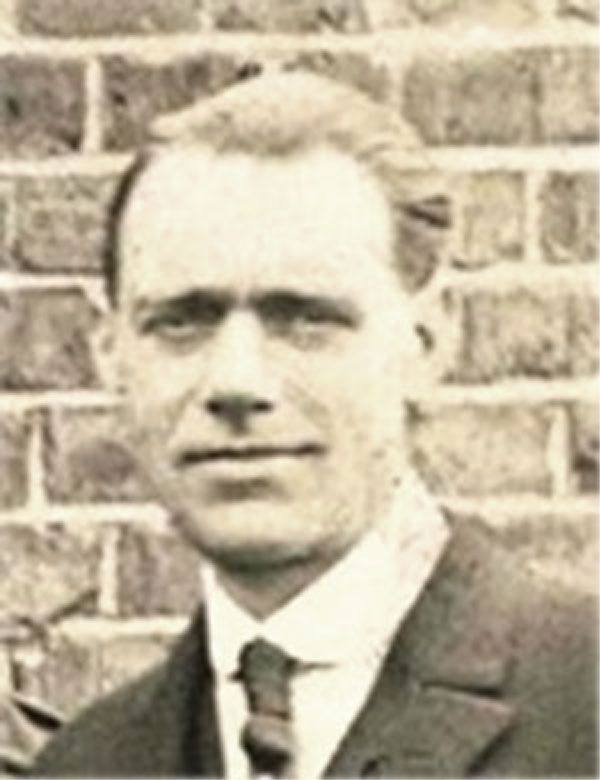
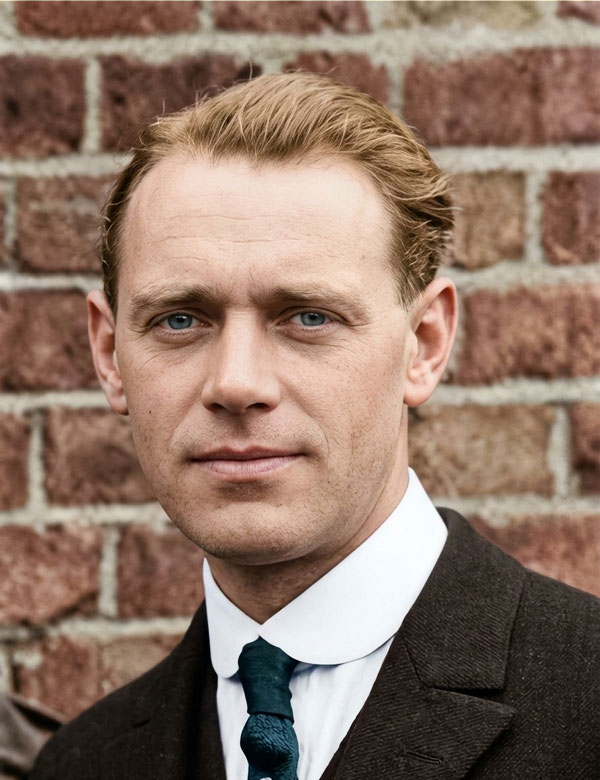
From February 1921 to March 1931, Farina fronted the Passport Control desk in Riga, by far the most prolific of the Baltic Stations operating under Mi6. Here he would be responsible for collecting special intelligence relating to Latvia and Lithuania. Mi6 — or SiS as it was known in those days — had been intimately allied with the passport control system for years. His first boss in Riga was Reginald ‘Rex’ Leeper, previously employed by the Foreign Office at the Political Intelligence Department now serving as First Secretary of Legation from Valdemara iela 7. [2] On Leeper’s departure to the News Department of the Foreign Office, Farina became attaché to Soviet-obsessive, Edward Hallett Carr. Between them, Carr and Farina ran many of the British agents and sources within the Bolshevik regime in Moscow. Farina left the Riga desk in March 1931 when he was succeeded by Harold Gibson, but his ten-year tenure there was not without incident.
In 1924, Farina had been responsible for bringing the explosive Zinoviev Letter to the attention of Mi5 and Special Branch. The so-called ‘Red Letter’, marked ‘very secret’, provided instructions to British Communists to mobilise its forces within Ramsay MacDonald’s Labour Government in support of the Anglo-Soviet treaty. The treaty, which had endured years of tough negotiations, was due to be ratified within weeks of the General Election scheduled that October.
The letter packed an additional punch; the success of any subsequent armed insurrection would require the cooperation of the armed-forces. Zinoviev’s message on this point was very clear: ‘agitation-propaganda’ was to be extended to the armed forces. When the green light for revolution was given, it would be “desirable to have cells in all the units of the troops, particularly among those quartered in the large centres of the country, and also among factories working on munitions and at military store depots.” [3]
The letter was signed on headed notepaper by Grigori Zinoviev, president of the Comintern, the Soviet International organisation.
On October 25, 1924, four days before the election, Lord Rothermere’s Daily Mail splashed the devastating headline across its front page: ‘Civil War Plot by Socialists’ Masters: Moscow Orders To Our Reds; Great Plot Disclosed.’ MacDonald and the Labour Party lost by a landslide to Stanley Baldwin and the Conservatives.
But the letter wasn’t real. The letter had been faked.
A subsequent investigation by the British Foreign Office discovered that the ‘order to our Reds’ letter had been a clever and audacious counterfeit produced by an Intelligence source in Riga. Worse still, it had been Nurse Shore’s cousin Rafael Farina who had ensured that the letter had entered the intelligence system and been received safely into the hands of Mi5 controllers in London. [4] Despite his apparent failure to ensure the integrity of human intelligence, Rafael remained at the Mi6 desk in Riga for a further seven years. How was this so?
Either the contents of the Zinoviev Letter were known to be perfectly true, or known to be perfectly false; that’s how so. Farina was just doing his job. If some members of Mi6 were involved in a dirty-tricks campaign to derail the Anglo-Soviet Trade Treaty as was alleged, then the most likely scenario is that Farina had been under specific instruction to deposit the intelligence into the hands of Mi5 by his Mi6 superiors, Hugh Sinclair and Desmond Morton with the knowledge and cooperation of his Riga boss, Reginald ‘Rex’ Leeper, whose propaganda work for the Political Intelligence Department of the British Foreign Office was legendary.
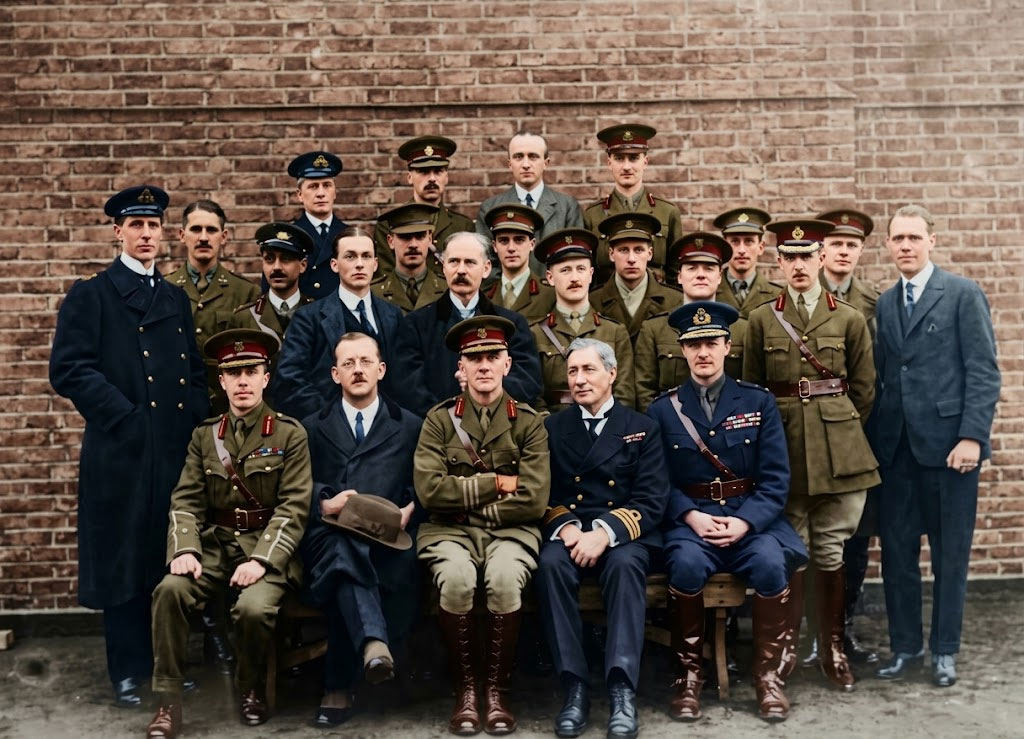
Adding weight to this possibility, it’s worth pointing out that Leeper took up his role as Chief of the British Legation alongside Farina on September 22nd, 1924. The incriminating letter that had been passed to Farina’s desk was dated September 15th 1920 [5], the week prior to Leeper’s arrival. A report and translation had been compiled by Farina in Riga on October 2nd and on October 9th a decoded telegram was received at SiS headquarters in London. It was duly handed on to Joseph Ball, W.B. Findlay (one of George Makgill’s men) and Churchill’s trusted aides, Desmond Morton and Hugh Sinclair. With Leeper at the helm, the letter (which might otherwise have been dismissed) was spared many of the usual rigorous protocols of Intelligence screening and analysis in Riga and was eventually leaked to a reporter of the Daily Mail. The most likely route was through Farina’s ex-Mi5 section chief, Sir Joseph Ball, who several years later would ditch his desk-job at Mi5 for a plum role in the Propaganda Department at Conservative Party Central Office. [6] Either way, it was all carried out within weeks of Leeper taking up the post in Riga.
Farina kept his job because he was simply following orders.
But what was Farina’s relationship to the Nightingale Shores? What were the familial connections? If you’ve read Rosemary Cook’s excellent book on the Nurse Nightingale Shore murder then you will have come across some of these names already.
The Farina and Hobkirk Families
Rafael Farina was the half-brother of Offley and Florence’s cousin, Brigadier Clarence John Hobkirk, another member of the family who pursued a long and distinguished military career, serving first with the Essex Regiment and then as Britain’s Military Attaché in Rome during the war. After sustaining an injury, Clarence was declared medically unfit and was retired from active service shortly after Florence’s death in 1920.
As you might recall from Cook’s book, it was Clarence who acted as executor in both Florence and Offley’s wills. On their deaths in 1920 and 1922, Florence and her brother had left large sums in securities to be paid to Clarence and his brother, the landscape artist and figure painter, Stuart William Tatton Hobkirk. Florence also left Stuart the pendant that Police had falsely assumed to be missing. [7] By 1924, Stuart was living at 16 Church Road, St Leonards — just a two-minute walk from Warrior Square Station, where Florence had been due to meet friends on the day she was attacked.
If Florence had bequeathed anything to their brother Rafael, it’s certainly not recorded.
Born in Switzerland in 1877, Rafael Lewis Julian Farina was the son of Italian exile, Baron Luigi Farina and Margaret Leishman — subsequently restyled the ‘Baroness Maretta Robina Farina Firras’ — sister of Nurse Nightingale Shore’s mother, Anna Marie Leishman of 18 Drummond Place in Edinburgh New Town. Luigi was her second husband. Margaret’s first husband, John Hobkirk, the father of her two boys Stuart and Clarence, had died shortly before her marriage to Luigi in Rome in 1878. Reports in the British Press suggest that Luigi Farina was one of an illustrious stream of visitors conveying his wishes to General Garibaldi at Stafford House during the Italian revolutionary’s one and only visit to England as the guest of the Duke of Devonshire. [8]
During this period, the fortunes of the Nightingale Shore family were taking a nosedive. The Shores had returned from a tour of Dresden and Holstein to news of a massive loss of shares in the family stake-holdings. By 1878, Florence’s father Offley had accrued debts of over £100,000 and was facing bankruptcy. [9] It wasn’t the first time and it wouldn’t be the last. In October 1879, it was announced that Colonial Trusts Corporation Ltd, which had controlled the family’s stakes in the Midland Railway Company of Canada and various collieries around the globe, was being wound down after a two year investigation.
Luigi Farina’s fortunes were no less serious. He had arrived in England in 1860, the year in which his father, Baron Rafael Farina had been expelled from Naples for taking part in the so-called ‘Count d’Aquila Conspiracy’. [10] According to the press of the period, it appears that Luigi’s father, the newly appointed Prefect of Police, had conspired with Prince Louis to depose the Spanish Bourbon King of Naples, Francis II in advance of General Garibaldi’s arrival.
The plot — which was as vague then as it is now — was to then scuttle the ship carrying Garibaldi — the great ‘liberator’ of the revolution — before he and his army could ever set foot in the capital and reunite the divided Italy. Within days of the alleged plot being exposed, the Prince and his fellow conspirators had fled to France and then to England, their land and properties confiscated.
As Churchill may have said: it was a riddle inside a mystery inside a coup d’etat — wrapped-up in a revolution.
Rafael Farina … Spycatcher
Cousin Rafael had begun his Secret Service career at the Ministry of Information, a post that had taken him as far away from his hands-on science career as he could get. Graduating with a 1st in ‘Assaying’ from Camborne Mining School in 1899, Farina had spent the first years of his adult working life as a mining engineer for Orsk Gold Mines before being recruited into a notorious investment scandal featuring Lord Derby, Lord Knollys and senior members of the Royal Household. [11] Formed in 1905, the Siberian Proprietary Mines had only weak concessions to mine gold, and within two short years its shares had collapsed. [12] Timely buying and selling, however, ensured that its senior shareholders profited handsomely from the scheme. The company would subsequently become another casualty of the Russian revolution.
Prior to this engagement, Farina had been in the employ of the Transbaikalian Gold Mines of the Altai Mountains in Siberia. [13] His reports for the Institute of Mining and Metallurgy described gold veins of varying quality. Some were ‘porous, friable and highly oxidised’, whilst others were of the ‘hard white quartz type.’ [14] Despite his freedom to travel, Farina wasn’t footloose and fancy-free. In 1903, he had married Isabel Anna Baird Smith, the granddaughter of Richard Baird Smith, the Chief Engineer of the East India Company and hero of the Siege of Delhi and the Indian Mutiny.
In 1914, Farina was on his way to the Caucasus, a mountainous yet mineral rich region extending over Russia, Georgia and Azerbaijan. [15] His Russian language skills had earned him the responsibility of managing much of the underground work of the Caucasus Copper Company in the Batumi region of Georgia, an area that was constantly under threat of Turkish invasion. He returned to England in 1915. A congenital issue with his leg saw him declined entry into active service and he was enrolled into the Department of Information, responsible for publicity and propaganda. [16] Eventually, Farina’s knowledge-base and language skills would bring him to the attention of Mi5 and it is here that his story begins in earnest.
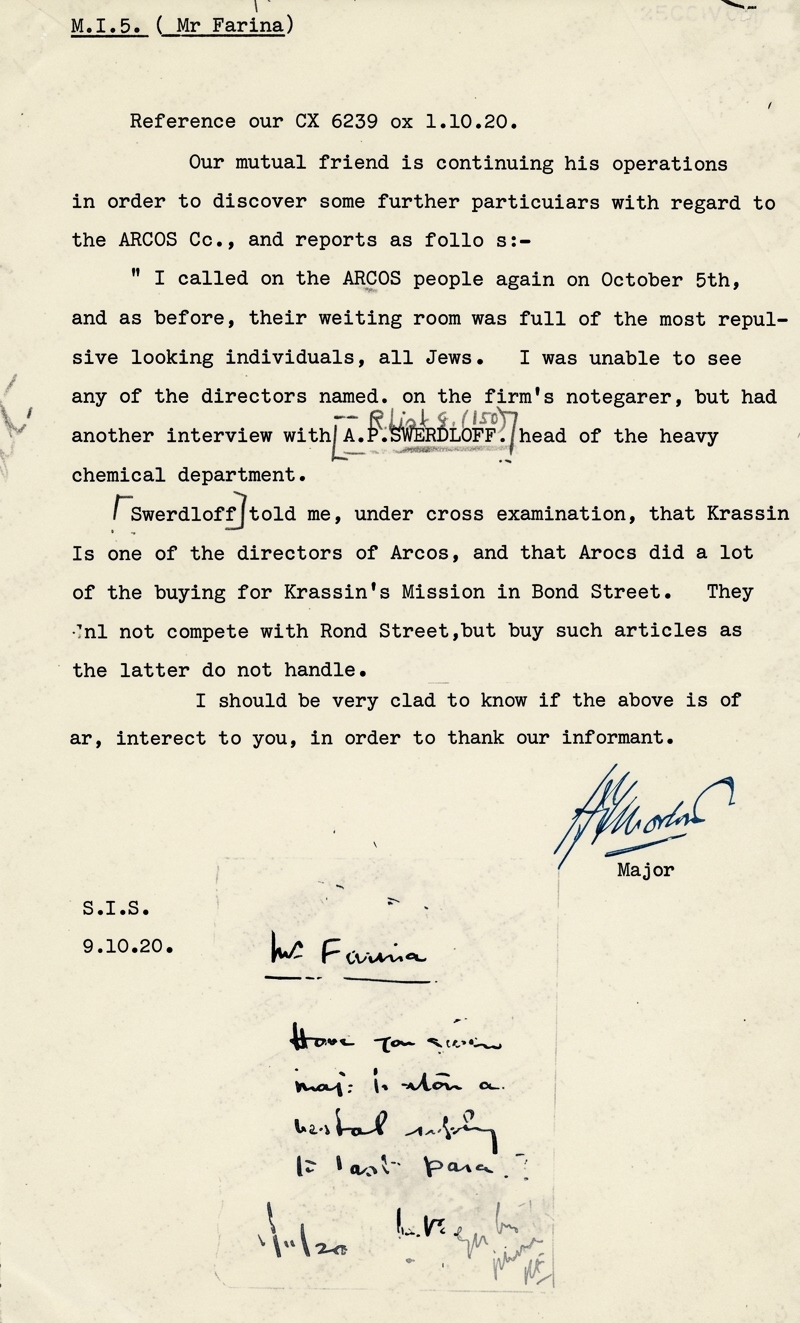
The type-written letter in the picture below sees Desmond Morton of Mi6 discussing the formation of Krassin’s All Russian Co-operative Society with Florence’s cousin in October 1920. [17]Other files indicate that Farina was working at the Russian Section of Mi5 as early as August 1918, when he was attached to G4 branch, a small but rapidly expanding team of four officers and four secretaries tasked with putting together a blacklist of Russian émigrés. [18] Farina wasn’t to know at this stage that several of these émigrés were living just yards from where his cousin Nurse Shore was heading on the day she was attacked.
Extraordinarily enough, another tight skulk of crepuscular Russian exiles were also in the vicinity of Farina’s mother back in Tonbridge, the aunt that Florence had visited on the afternoon and evening prior to the attack. Is it possible that Florence was followed from Baroness Farina’s house in Tonbridge back to London? And from London to St Leonards on Sea? Had Rafaele Farina’s prominent security role made Florence a vulnerable target and was he there on the afternoon of her visit?
Baroness Farina
Shortly after 12.30 on the afternoon of Sunday January 11th, 24-hours before the assault on the train, Florence had visited Rafael’s mother, the Baroness Farina at her home at 88 Hadlow Road in Tonbridge, some 30 miles south of London. The Baroness was her aunt on her mothers side and had been maintaining the not-altogether legitimate title of ‘Baroness’ ever since her marriage to Rafael’s curiously footloose father, Luigi.
Even though her friend Mabel Rogers claims that Florence knew of her trip to visit friends in St Leonards on Sea some days in advance, Florence didn’t continue to the resort after visiting Tonbridge. Instead, that same Sunday evening, Florence took the 7.30 train back to London, before setting off again on the Monday for St Leonards. It’s an unusual move in the circumstances, as Tonbridge was already more than half-way to St Leonards on Sea. The Hastings Line, operated by the LB & SC Railway Company, linked London and Hastings via Tonbridge, Lewes and Bexhill. I think many would agree that it would have saved time, energy and money for Florence to have travelled from Tonbridge to St Leonards on that same Sunday evening or to have stayed at her aunt’s house overnight and to have grabbed a head start the following day. What was so important that she first had to go back to London? And what was so important that she first had to visit the Baroness?
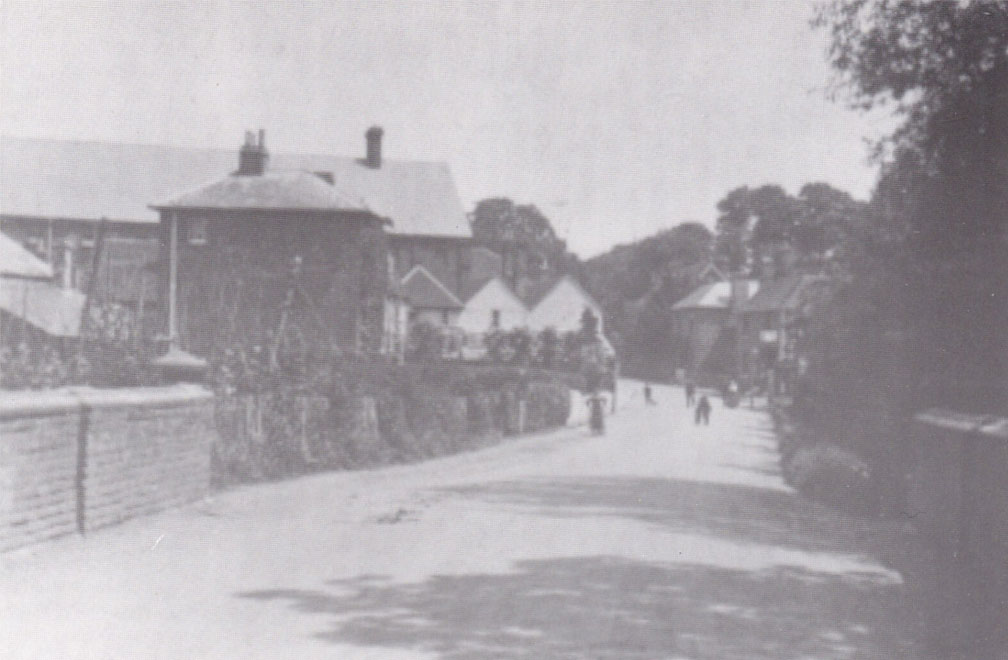
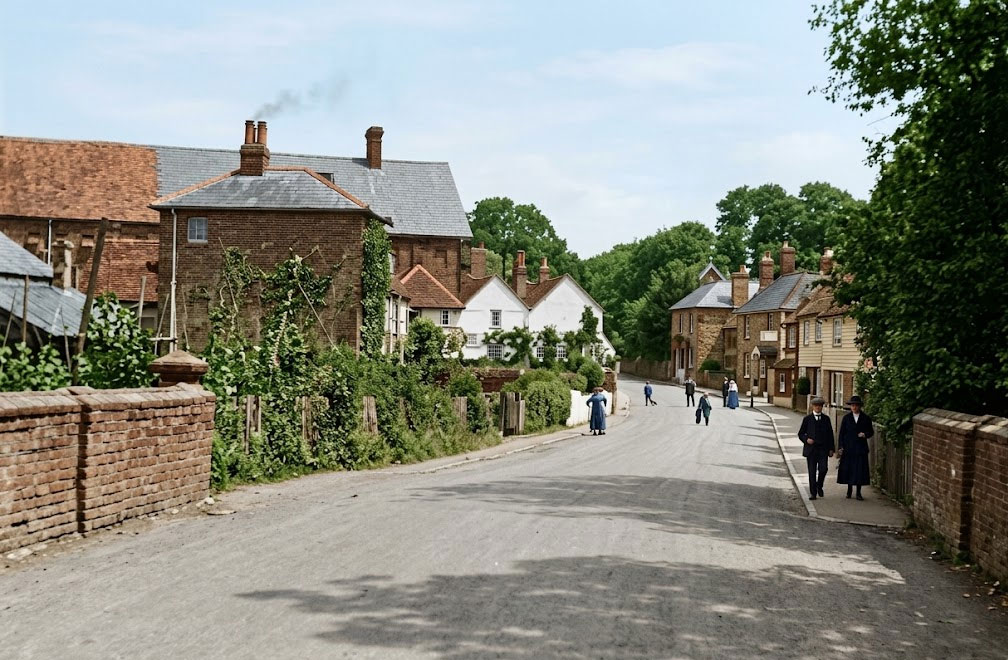
Florence must have been keen. That weekend, London had seen its worst storm of the winter so far. A severe gale had sprung up on the Saturday evening and continued into the small hours of Sunday morning. When Florence arrived at her aunts on the Sunday, many of the low lying roads around Tonbridge and Tunbridge Wells were under several inches of water as the banks on the River Medway gave way to the weight of the storm. Trees had been uprooted, chimneys toppled, and local cup-ties had been postponed.
The north of the country had been hit even worse, with a significant accumulation of snow seeing football fans being turned away at Sunderland, Darlington and Newcastle. On the Sunday, the road between Tonbridge and Maidstone was impassable. Even rail lines had been disrupted. The weather had been so bad in the south that the London Paris Air Service had had to be abandoned and in the nearby village of Penhurst, twenty fields were under water. The low lying plains of the Eden Valley were completely flooded too.[19]
By the Tuesday, Tonbridge Police were still trying to solve the mystery of the death of fifty-six year old George Eddings who had been found dead in a ditch on the main road between Marsh Green and Edenbridge. One theory they were pursuing is that he may have been knocked into the ditch by a passing motor car during the recent storms.[20] At a figurative level, the situation couldn’t have been any more apt. Despite the obvious challenges, however, Florence had been intent on visiting her aunt on the Sunday morning, dashing back to London on the Sunday evening, before steaming off again to St Leonards on the Monday.
St Leonards was not the desolate, groggy sand-scape you might have assumed it to be at this time of year. Even today, British seaside resorts in January tend to have all the miserable charm of a wet ashtray the morning after the night before; the fires of fun and mayhem have all ended and only the sopping mulch of its ashes remains. St Leonards was a little different. The buckets, spades and parasols may have been locked firmly away in the cupboard during the winter season but the enormous outdoor roller-skater rink would drag in scores of post New Year revellers from the capital and neighbouring districts. There was also a daily programme of music from the Julian Clifford Orchestra banging out from the Palace Pier. Below the jubilant rattle and hum of Beethoven’s Fifth racket, the wild waves of the English Channel would splash and roar a burly percussive rhythm against the cast-iron piles beneath.
The novelist and philosopher Aldous Huxley once remarked that during the winter months there was more dazzling music being performed on St Leonards’ pier than there was in the West End of London.[21] If Florence had been around on the Thursday she would have been treated to Clifford’s arrangement of Vasily Kalinnikov’s Symphony No.1. Trained at the Leipzig Conservatoire under Józef Śliwiński, Clifford had retained strong ties to both Polish and Russian composers and could boast the pianist Ignacy Paderewski and the ballerina Anna Pavlova among his friends.
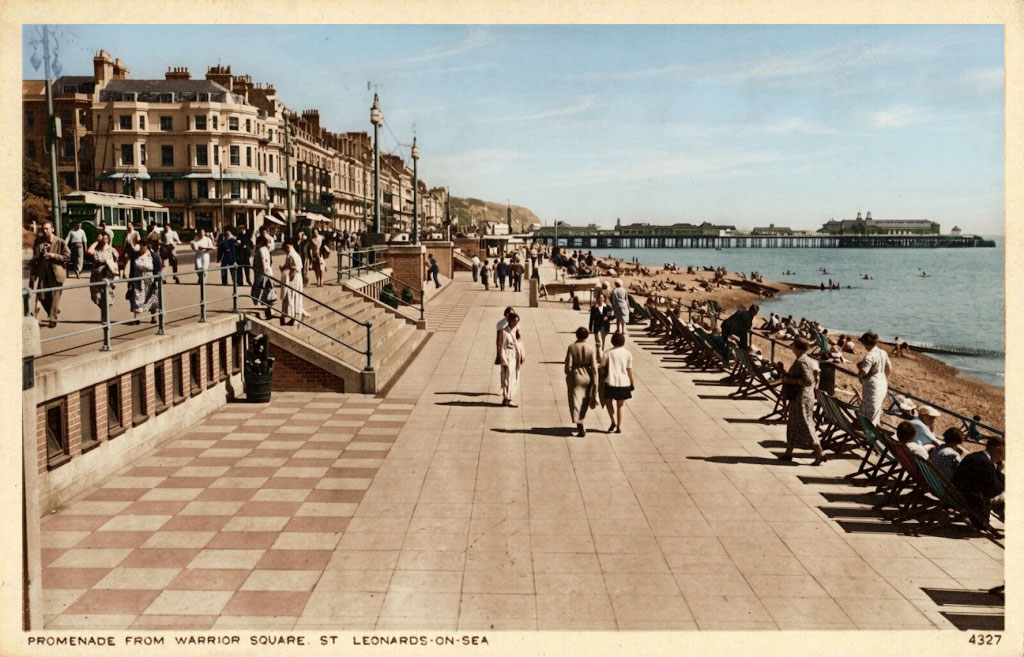
The previous Tuesday had also witnessed the annual extravaganza, the Masked and Fancy Dress Twelfth Ball. A bevy of groovy flappers in masquerade masks would come roaring through the town, sequins and beads rattling as they mingled with the powdered-up men and women in Georgian fancy dress, with the night concludingas alwayswith a rapturous, firework display. To outsiders, the spectacle would probably have looked like the visual or spiritual equivalent of a ritualistic letting blood in readiness for the epiphany that followed. An orgy of music and the sparks of clanking champagne glasses would send a rousing New Year message through the streets. Coastal resorts in winter were usually like a dull throbbing headache along the contours of Britain. In terms of the traditional excesses of New Year celebrations, St Leonards was the hair of the dog or the ‘plop plop fizz’ of an Alka-Seltzer. There was a charge here, a current of energy. There was life.
But it wasn’t all high-culture and high-jinx. Shortly before Florence was due to arrive, the resort had suffered one of its worst fires in years and doctors were warning of a rapidly escalating flu epidemic. The offices of the local Hastings & St Leonards Observer news room had their own tragedy to tell when it was learned that one of their former editors, Capt Robert E. Eversden of the RAF’s 47th Squadron, had been shot dead accidentally by a sentry whilst at an aerodrome in South Russia. [22] The one thing the resort certainly wasn’t in January was sleepy. It’s just a shame that Florence didn’t live long enough to enjoy it.
The coroner at the inquest into Florence’s death also quizzed Mabel on her own unexpected stop at Tonbridge. On the night of Monday January 12th, Mabel had been sitting in a theatre in Covent Garden when she learned of the attack. The production being performed, ironically enough, was Shakespeare’s blood-thirsty revenge tragedy, Hamlet with Sir John Martin-Harvey reprising his role as the grievous Prince and Frederick Ross as his father’s ghost. A tap on Mabel’s shoulder during the interval was followed by some shocking news; Florence had been attacked and lay in a coma. Mabel had made her way to the hospital in Hastings but in a statement she made at the inquest, she claims she was only able to get as far as Tonbridge Station.
Mabel — the 52 year old superintendent of the Carnforth Lodge Nursing Home in Hammersmith, London — had left on the 11.20 pm train from London and disembarked in Tonbridge at 12.00 am. She arrived at the hospital in Hastings some three hours later. The entire journey that Florence would take to Hastings would have lasted around two-hours twenty minutes in total, so arriving at the half way point in Tonbridge should have taken about one hour and ten minutes at the very most (at some point in the 1920s there was a 90-minute route between London and Hastings).
Did Mabel meet with Baroness Farina prior to ‘motoring’ to the hospital?
At the inquest it was not clear why Mabel could only get as far as Tonbridge before managing to ‘motor on’. Did Mabel have to wait more than an hour for a connection? The train from Victoria Station that Florence Shore had taken earlier in the day was a direct connection to Hastings. Surely the night-duty staff at the ticket office would have warned her. Did Mabel ‘motor on’ to Hastings accompanied by the Baroness in a car? And if so why, when the train would evidently have been the quicker option for both of them? Mabel’s statement at the inquest is a little short on detail.
‘I caught the 11.20 train but found I could only get as far as Tonbridge and motored on.’
You stayed there the night, I suppose?’
‘No, I motored on’
What time did you get (to Hastings)?
‘About 3 o’clock’
Mabel Rogers describing her journey to the hospital at the Inquest
According to the Daily Herald, Scotland Yard were also exploring the possibility that the assailant had jumped off the train at Lewes and boarded another train standing in the station bound for Tonbridge. [23] It’s a minor point but it’s worth mentioning.
The Tonbridge Circle
Within twelve months of Baroness Farina arriving at 88 Hadlow Road, the former Russian representative to Paris and Berlin, Lt. General Sergei Belosselsky Belozersky arrived with his American-born wife, Susan — daughter of American Civil War Hero, Charles A. Whittier — at 20 Hadlow Road, just 200 yards from the Baroness. [24]
Like so many Russian exiles seeking sanctuary on Britain’s shores, the Prince was fiercely critical of both the Bolshevik regime and the liberal and left-wing elites that showed too much in the way of tolerance. The first man in his crosshairs was General Hubert Gough, the outspoken former Chief of the British Mission in North West Russia: “General Gough is of the opinion that Soviet Russia has committed no unpardonable crime. Apparently he has forgotten, amongst other things, the murder of Captain Cromie at Petrograd, and the doing to death of several brother officers of his. If he had, all I can say is that we Russians have longer memories.” [25]
Gough had made the mistake of blaming the series of violent executions breaking out across the Russian states not on the Bolshevik government but on the ‘bandits’ who they were failing to control. The various Soviet enclaves set up in Lenin’s name were, Gough alleged, nothing of the sort. It wasn’t the government that were responsible; it was an absence of government. The people of Russia had decided who they didn’t want, even if they weren’t entirely sure who they did want. Our policy on Russia, Gough said brusquely, was based on “false principles”. Not only had we “no right to interfere with Russia, but when we did interfere, it was in a partisan manner.” Churchill had sought only to restore the Tsarist regime that the people hated. It was Gough’s belief that there should now be “free and full intercourse with Russia.”
A few months earlier in February 1920, Gough had made a plea to the British Prime Minister for peace to be made with Russia. In a letter signed by a dozen or so other military commanders, Gough asked that Western Powers try not to be influenced by the “fear of Revolutionary propaganda” and to help restore the economic stability that Europe now needed, and which rested on the resources the Soviet had. In their estimation, “the longer peace is delayed the more certain it becomes that the German influence will be re-established in Russia.” [26]
The publication of Gough’s ‘memorial’ in The Times on February 23rd was followed by an ‘anonymous’ letter on March 3rd — most likely from the pen of Prince Belosselsky Belozersky — rejecting Gough’s claim that the Soviet was the ‘will of the people’. Below his letter was a similar one by Aylmer Maude, the uncle of George Shanks, the man who had only that month unleashed his full 90-page translation of The Protocols of the Elders of Zion on the unsuspecting English public. Maude’s own contribution was a little more razor-sharp, describing Gough’s view on interference as an “efficacious plea to divert attention from the true issues”. [27]
Baroness Farina and Prince Belozersky were still on Hadlow Road in August 1921 when news of an imminent breakthrough in the Nurse Shore Nightingale mystery was published in the local newspaper. A ‘certain’ Chief Detective Inspector who specialised in murder cases had made a statement to a Sunday journal that ‘developments of a sensational character’ would shortly be announced. [28]
Sadly, no such announcement was ever made.
There’s little doubt that the Belozersky would have been under close observation by Farina and his team. This was a high-value Russian asset, and friendly or not, his activities locally and abroad would have been treated with the utmost urgency. According to letters and communications in the Churchill Archives, Churchill had been in regular contact with Belozersky during the closing stages of the Russian Civil War, where Sergey served as adviser to General Yudenich, commander of the Northwestern White Army.
The story of the couple’s arrival in Tonbridge and their work for the Russian Relief program was covered in the Sevenoaks Chronicle the following year. Some ten years later, Grand Duke Dmitri Pavlovich, the man Sir Charles Marling and Britain had been grooming as the Tsar’s replacement, would attend Susan’s funeral at Tonbridge Parish Church. [29] Just twenty years previously, the Canton Daily News had run a story of Dmitri’s ‘infatuation’ with Susan. The Tsar is alleged to have punished Dmitri by sending him on a six-month ‘sabbatical’ in Egypt.
In December 1929, another funeral took place, this time for the 28 year-old wife of Oliver Locker-Lampson, the former British military commander who had served as the Ministry of Information’s representative in Russia. It was Locker-Lampson who had devised the plot to arm the Armenians against the marauding Bolshevik advance. And it had been the hesitation of Nurse Shore’s brother Offley, that had prevented the plot’s success.
Oliver, who at one time had lived at Robertson Terrace in Hastings, was an old intelligence colleague of Reginald ‘Rex’ Leeper — Farina’s first boss in Riga. Leeper’s department had acted as liaison between the British Foreign Office and the Secret Intelligence Service in Russia during and shortly after the 1917 Revolution. Years later, it was alleged that Oliver’s Armoured Car Division had been complicit in a Guchkov-funded attempt to remove Prime Minister Kerensky from power by the leader’s military commander, General Kornilov.
Kornilov denied the accusations. His attempt to wrest control of government, he explained, was merely a desire to “strengthen the hands” of Kerensky’s Provisional Government in carrying out its administration and to restore the rule of law over a quickly fragmenting military. It was not, he insisted, an attempt to restore the Romanovs but a way of preventing the return of Vladimir Lenin and a catastrophic maximalist power grab. Despite his protests, several Romanov heirs were arrested — among them Grand Duke Dmitri Pavlovich.
Oliver Locker-Lampson’s experiences in the region in the immediate aftermath of the revolution made him a fierce anti-Bolshevik, and his mammoth twenty year stint as MP for Birmingham Handsworth is marked by a regular schedule of anti-Communist protests and praise for the fascist movements of Hitler and Mussolini. Consoling him at his wife’s memorial that day was his old friend, Sergei Belosselsky Belozersky of 20 Hadlow Road. Oliver’s wife had become a regular attendee of the Russian Church on Buckingham Palace Road, and an uplifting service in Russian and English had been organized by her husband. Captain Alexander Soldatenkov, former secretary of the Imperial Russian Embassy in London also attended. [30]
A few years later, Locker-Lampson gave evidence before Justice Avory in a libel action case brought by Princess Irina Alexandrovna against MGM pictures, who had portrayed her — inaccurately, or so it was claimed — as one of Rasputin’s lovers. Commander Locker-Lampson stunned the court with not one but two claims: the first that he had been involved in a plot to save the Tsar and his family, and the second, that he had been personally invited to murder Rasputin by the ultra-nationalist monarchist, Vladimir Purishkevich. [31]
In a deeply ironic twist, Oliver’s cousin Miles Lampson, former British Ambassador to Hong Kong and Egypt, would die at the very same East Sussex Hospital in Hastings as Florence Nightingale Shore.
In the next part of the story we turn to the cosy seaside resort that Florence was heading to that day — St Leonards on Sea — and to the arrival of a Russian exile who was being very closely monitored by her cousin at MI5, Rafael Farina.
[1] The British National Archives, KV1/52, Vol. IV, M.i.5 H Branch Report, Organisation and Administration
[2] Rex Leeper was also a member of George Buchanan’s pro-Interventionist lobby, the Committee on Russian Affairs which demanded full scale military engagement with Lenin’s Bolsheviks in support of White Russian liberals and monarchists.
[3] ‘Moscow Orders To Our Reds’, Daily Mail, Saturday, October. 25, 1924
[4] The Zinoviev Letter: The Conspiracy that Never Dies, Gill Bennett, OUP Oxford, 2018, p.46
[5] The Foreign Office List and Diplomatic and Consular Year Book for the United Kingdom, Harrison and Sons, 1949, p.281
[6] Gill Bennett quite rightly keeps her mind open regarding the source of the leak to the Mail as once it had been decoded in London it was being dutifully copied by various individuals and departments.
[7] The Nightingale Shore Murder, Rosemary Cook, p.186
[8] London Evening Standard 14 April 1864, p.3
[9] The Affairs of Harrington Offley Shore, Western Times 30 October 1879, p.3
[10] Resignation of Farina, Morning Advertiser, 11 January 1861, p.4
[11] Russia’s New Era, R.J. Barrett, The Financier and Bullionist Ltd, p.180
[12] Edward VII (Penguin Monarchs): The Cosmopolitan King, R. Davenport-Hines (2016) Penguin Books
[13] The Mining Magazine, August 1911, Vol.5, No.2, p.137
[14] Nature, Nature Publishing Group, February 22 1906, p.398
[15] Mining Magazine, Volume 11, 1914, p.355
[16] The Zinoviev Letter The Conspiracy that Never Dies, Gill Bennett, 2018, OUP/Mi6, Keith Jeffrey, Bloomsbury, 2010, p.188-191
[17] Leonid Krassin (1870-1926 ) was Soviet Russia’s Minister (Commissar) for Trade and Industry.
[18] The British National Archives, KV1/52, Vol. IV, M.i.5 H Branch Report, Organisation and Administration
[19] Evening Mail, January 14 1920, p.6
[20] Found Lying in a Ditch, Daily News, 14 January 1920
[21] Temporaries and Eternals: the Music Criticism of Aldous Huxley, 1922-23, Michael Allis Cambridge Scholars Publishing, 2013, p.215
[22] Hastings and St Leonards Observer 10 January 1920, Hastings and St Leonards Observer 17 January 1920, p.6,
[23] Daily Herald 16 January 1920, p.1
[24] Sevenoaks Chronicle and Kentish Advertiser, 28 July 1922, p.2/Good Night, Beloved Comrade: The Letters of Denton Welch to Eric Oliver, Denton Welch, 2017, University of Wisconsin Press, p.14/ https://tonbridgepeoleandancestry.blogspot.com/2021/03/1921-1951tonbridge-resident-prince.html
[25] The Gough Controversy, Globe 04 March 1920, p.5
[26] A Plea for Peace with the Bolshevists, The Times, Feb 23 1920, p.19
[27] Letters, A White Russian, Aylmer Maude, White Russia, The Times, March 4 1920, p.10
[28] Nurse Shore, Baroness Farina, Sevenoaks Chronicle, August 1921.
[29] Kent & Sussex Courier 14 December 1934, p.15
[30] Daily Mail, December 31, 1929
[31] Dundee Evening Telegraph, March 2, 1934