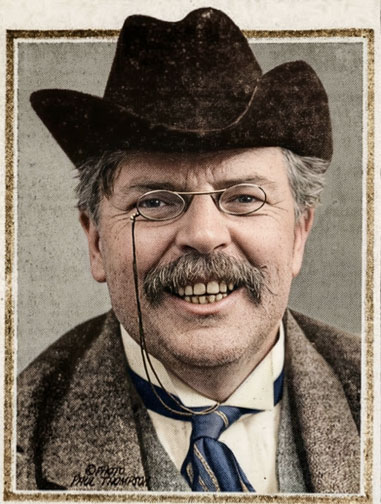
When Scott’s favourite British author, G. K. Chesterton addressed the press on the eve of his lecture tour of the States in January 1921, he had something he wanted to say about America. America wasn’t the great ‘Melting Pot’ it often presented itself as being. Equality may still have been the ideal in America, but it was no longer the reality. [27] The very things that America’s immigrants had arrived here looking for were gone already. All that remained of it now was a dream of the dream. On his return to England, Chesterton continued to assess this great melting pot of people and their supernational character. He was also determined to confront the threat this remarkable ‘unnation’ was facing from Eugenics — a ‘silent anarchy’ that was eating at society.
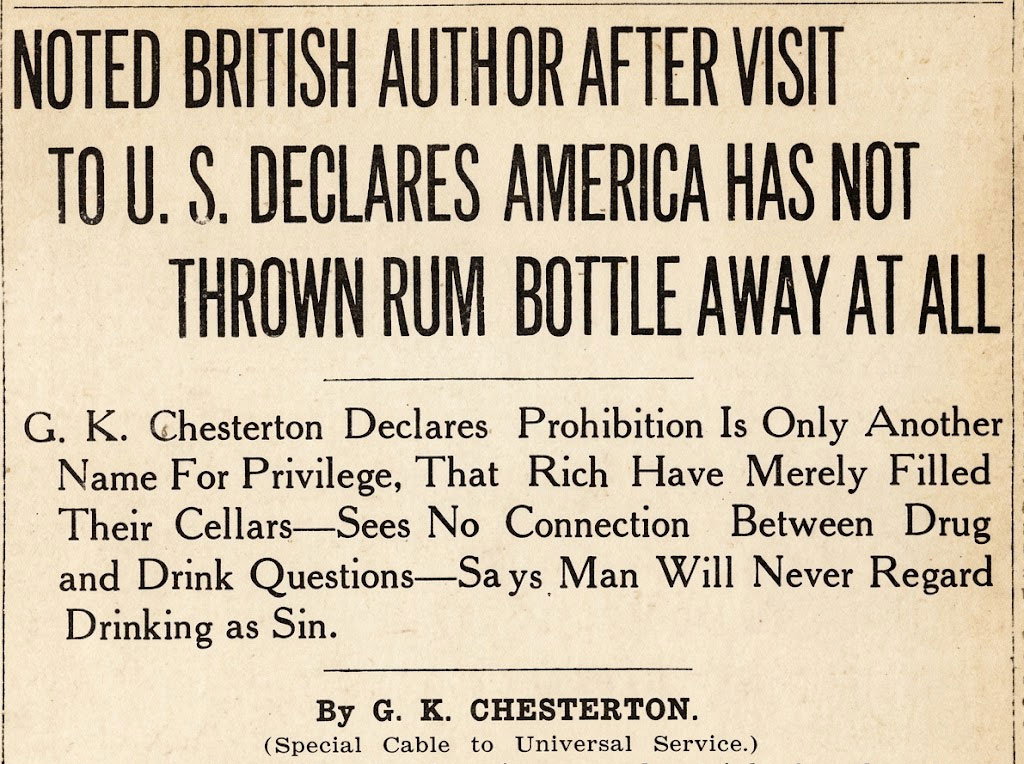
In 1922 he published his findings. Eugenics and Other Evils, written after but published before his account of his six-month American adventure, added no small amount of weight to the punches already thrown by his co-religionist, Father Thomas J. Gerrard in his book, The Church and Eugenics. This much was clear from the book’s title. Eugenics wasn’t something to be tolerated or cosied-up to — it was evil.
In his now customary fearless and felicitous (if not downright facetious) manner, Chesterton systematically set about crippling the entire scientific and ethical basis on which Eugenics stood. In the book’s preface, Chesterton passed comment on the love-affair the West had with the science and how it had coincided with the evolutionary fancies of Nietzsche gaining traction among artists and intellectuals. Writers like George Bernard Shaw had begun to embrace the idea that to breed a man like a cart house was the true way to attain that higher civilisation, noting that cart-horses were, afterall, very highly regarded for their contribution to the arts and sciences.
16-minute podcast discussion
According to Chesterton, the reason for Britain and America’s obsession with Eugenics was as simple and it was paradoxical: the scientifically perfected state envisaged by the Prussian military, and over which a truly war had been fought, was now being sought by both the English and Americans. The Allies had once hated Germany, now they wanted to be just like them. For a very short-time during that war, the West’s romance with Nietzsche had seemed to collapse.
Between 1914 and 1918, a crude equation had been chalked out on the national consciousness: Eugenics equalled Prussianism. It was for that reason alone that we abandoned the whole idea. Now, however, the two countries were proceeding on the basis that Prussia could be “a pattern for the whole world”. If the Allies didn’t start adopting the same powerful militarism as the Junker, there would be more to fear from Germany in the future. Publishing this book constituted, in Chesterton’s eyes at least, an act of counter-terrorism.
The next seventeen chapters systematically set-about first exposing and then destroying the numerous false aims and theories upon which this science was based. He was also not afraid to address the subject of prejudice against the Irish and the Catholics, whose disinheritance “fictions” and “dreams of lost dignity” were now being snapped-up almost as enthusiastically by the Eugenicists as their lands. [28]
The view of Eugenics taken by Chesterton’s friend, Shane Leslie, was a little more ambiguous. For a time at least, Leslie, like Mary Harriman Rumsey, appears to have been partly seduced by the idea that the study of ‘Positive Eugenics’ may well offer solutions to the consequences (and the causes) of poverty, crime and alcoholism. The phenomenon had for many years provided something of a prop to the social justice and penal reform movements — things that were close to Leslie’s heart. It was, in fact, Leslie who had shown Scott and Zelda Fitzgerald around the impoverished slums of Whitechapel during their brief week stay in London during the spring and summer of 1921. This “wild expedition to Limehouse” hadn’t been conceived to gloat, but to inform. [29]
Between 1912 and 1916 Leslie had shown the young Fitzgerald around the palatial mansions of Long Island. Limehouse had been Leslie’s attempt to show him how the other half lived. For a time at least, Eugenics had begun to flourish in the more generous soils of the social reform movement. Men like Arthur St John, a well-respected Christian Socialist and founder of the Penal Reform League, had written in very positive terms of the exciting new developments being made in the social sciences. The gist of what St John had produced had been based on an address made to the Eugenics Club in Haslemere, England on April 10, 1911. His paper was published in full in the July edition of The Eugenics Review and included an update on the work being carried out by Henry. H. Goddard at the Training School for Feebleminded Girls and Boys in Vineland, New Jersey.
St John, a former Captain in the British Army in India, but of Irish stock, had arrived in America in September 1910 as one of several delegates dispatched by Sir Evelyn Ruggles-Brise, President of the National Prison Board to the International Prison Congress in Washington DC. [30] Once in America, St John regaled the press with stories of his time at Westward Ho! and tales of how his schoolmate, Rudyard Kipling, a “queer little undersized lad” with a fondness for ‘long words’, had sometimes been forced to eat worms by some of the more bullish older boys. [31]
Despite making some assumptions about civilisation that might seem overly high-minded, condescending and arrogant to modern readers, the sense of urgency and sincerity is palpable throughout his report. As part of the social justice program, Eugenics had found its rightful, if not entirely comfortable or desirable place. Leslie’s review of the life of the man who sent St John to Washington —Borstal founder, Sir Evelyn Ruggles-Brise — in a 1939 issue of The Eugenics Review might also be viewed in this context.
Despite the view taken by Leslie on Positive Eugenics, some of his critics, have narrowed-in, perhaps a little unfairly, on a remark that the author had made in his 1939 memoirs, American Wonderland, in which he writes that by the time of the Restriction of Immigration hearings in 1924, America had been a little late in ensuring that “its future was eugenically safe”. However, these critics miss the point that Leslie was making. Leslie was pointing out, not unreasonably, that for many years America had deliberately thrown open the gates at Ellis Island to attract cheap, non-skilled labour. In the first years of industrialization America had wanted hands, not brains to enter the country. Now America had changed its mind and wanted to exclude all those less-skilled men and women perceived to be stealing jobs from the natives.
For our understanding of Gatsby, it’s an important if not uncontroversial point that Leslie is making. The fabulous wealth that America has built as a nation had been boosted enormously by the cheap, quality labour provided by its immigrants. In a system that perhaps had more in common with battery farming, immigrants were being stacked like animals to enrich its national stock. American supremacy, certainly where the wealth of the great nation was concerned, was based on a complex admixture of cheap labour, high-level corruption and organized crime. The dream that had brought all these millions of people to America was tainted by ‘bad blood’.
What Leslie said next was even more controversial — but not in the way that some critics believe. In what may seem at first a statement that is unduly sympathetic to Eugenics, Leslie writes: “The great alien question is: will the lowest common multiples of so many continental races develop into the highest common American? … The unknown element in eugenics and race-mixture may set the theories of Stoddard and Madison Grant at a discount.” It is a statement that has long been presented as evidence for Leslie’s support of Eugenics, but quite the opposite may be true. What Leslie appears to be saying is that as a result of the unpredictable nature of variables in the genetic make-up of offspring, the positive genetic outcomes of ‘race amalgamating’ were likely to reduce the value and credibility of Madison Grant’s and Lothrop Stoddard’s theories of race betterment.
The original scientific research undertaken by biologist, Gregor Mendel suggested that trait inheritance — the interplay between dominant and recessive traits — was something of a lottery. Departing from this logic for a moment, Leslie goes on to note that the failure to extend the gene pool within the French Canadian colonies had practically ensured that the French peasant of the 18th century hadn’t made any advance for centuries. Its people hadn’t progressed at all. By contrast over just three generations “the folk of the United States” had thrown up an entirely “new type” of race that had a smaller jaw and longer bones. This presented “the rare spectacle of a new race amalgamating.”
Leslie may have been casually tossing in pseudo-maths and pseudo-economics into the metaphors he was using, but the point he was making was a valid one: the ‘melting pot’ ideal had always played to the country’s advantage. [32]

Leslie was even more flippant about how Eugenicists were going about tackling the ‘problem’ of the African American. The way he saw it, if the blacks and the whites were allowed to mix freely and produce children, white blood would eventually extinguish the black. It wasn’t a particularly moral or Christian solution, he conceded, but at least it was ‘Eugenic’. Leslie had presented these views in the ‘Melting Pot’ chapter of his book in which he tried to imagine what the ‘perfect American’ would look like in the year 2000AD. He naturally drew the conclusion that by then, all the various races of America would have blended together successfully. “No one race can permanently hold America”, he writes. The great ‘Melting Pot of America’ would once again come gently to the boil and by the year 2000 a whole new race would inhabit the New World. It wasn’t just America’s future that was theirs for the taking either, but also its past.
Leslie also had plenty to say about the various contributions made to the American Revolution by Irish-American Catholics (“it was Irish memory that severed the American colonies from England”), the joyous spirituality brought to the church and Jazz music by African Americans (which made the singing of Cathedral Choirs seem “an insult” by comparison) and the donation made by the Jews who had been “lavish with their millions” in the advancement of engineering, economics and philanthropy. Increasing support for mixed-race marriages was already providing the solution. Leslie reasoned that the “slow penetration of the white blood” by the Irish, the Blacks and the Jews was the only “eugenic solution” that was ever likely to work. [33]
Sadly, it has to be said that the language that Leslie uses however, as flippant and dry-witted as it is, occasionally supports the stereotypes of the times. This is probably why this chapter has been misunderstood so often. Scott’s old literary mentor is making a serious point in the most insensitive of ways: if white men can ‘help themselves’ to black women, but make the converse (black men seducing white women) punishable by death, the race problem would solve itself.
It’s an appalling way to phrase it, but Leslie is turning the language and the logic that was common among bigots at this time, back on the bigots themselves. It’s a fine line indeed between irony and imitation.
Leslie would make similar observations in his 1934 autobiography, The Passing Chapter. Like Father Gerrard, Leslie had some sympathy with the more humanitarian concerns of Eugenics — the elimination of social ills like poverty and criminal behaviour — but he was positively dismissive about the application of its breeding programs to mankind. “To eliminate one half of the albinism in the human race,” he mused, “would take the whole Christian era”.
In all fairness, Eugenics could boast few genuinely scientific laws.
The only one that Leslie had any real respect for were the findings of Gregor Mendel on the ratio between weak and dominant stocks. But Leslie was also quick to remind us that Mendel had only ever experimented with “immoral mice and unblushing sweet peas who generate in quickest succession.” The application of all this to man was at best theoretical.
Eugenics, was not in Leslie’s opinion, completely understood by either its supporters or opponents. Leslie readily accepted that it wasn’t a new phenomenon either. Neither was ‘Dysgenics’. In his 1916 book, The End of a Chapter, Leslie observed that English society had, in all living memory, been an elitist closed-shop: “The Whigs of pedigree stood at the head of a great patrician stud”. Though Eugenics as a science was unknown until the turn of the century, “the social value of good breeding” had always been observed — and had always been overrated. Blood, whatever its merits, had always guaranteed high status and success, despite the fact that the “defects of aristocratic inbreeding” were obvious for anyone to see.
The old Conservative Catholics were not exempt from his criticism either.
It had taken John Henry Newman, the Protestant-turned-Catholic reformer who Scott’s prep school had been named after, to “freshen the veins” of the Catholic Church as a whole. The way Leslie saw it, the Old World had always benefited from an injection of new blood. Like the American brides who hooked up with the British blue-bloods, the fresh input staved-off decay. The war had left us wanting. Much had been depleted. “New metals and new moulds” had never been needed more than they were now. [34]
We may never know for sure if Father Fay’s decision to visit Scott at Princeton in February 1914 had been triggered by the series of lectures on Eugenics delivered by Dr Conklin, just as we may never know for certain if there was ever any discussion between Scott and Fay that had given the young author the confidence and motivation he required to complete his Love or Eugenics musical, but it’s interesting to note the titles of Lenten sermons that Fay had been hawking around Washington at this time. An advertisement in the Richmond Times Dispatch on February 28 1914 reveals the titles: Faith and Reason (March 1), The Church in Civilization (March 22), The Church and the Freedom of Thought (March 20), the Church of the Individual (April 5). [35]
The Lenten addresses would be made at the Sacred Heart Cathedral and were open to Catholics and non-Catholics alike. With titles like those it’s hard not to believe that some reference was being made to Eugenics, the most fashionable expression of civilization, freedom and the individual at that time. As Scott sat down to couple together the first of his satirical rhymes for the Triangle Club, it was announced that the State Federation of Catholic Societies of his home state Wisconsin was launching a campaign to ban the teaching of Sex Eugenics in schools. Love was winning for once, if only in Wisconsin. [36]
Turning back the clock to 1885
On the very day that Scott sat down to write his letter to his editor, Max Perkins, telling him of the “enormous power” building within him and how he was going to be approaching the Gatsby novel “from a whole new angle”, the Johnson-Reed Restriction of Immigration Act (H.R. 7995), was formally being put before Congress. The date was April 10, 1924. The Bill had been expected to reach its resolution in four calendar days but was passed on April 12, two days ahead of schedule. From this point on, a strict quota would be put in place on immigrants from Asia and Eastern and Southern Europe.
It is quite extraordinary when you think about it. Jay Gatsby, the man from absolutely nowhere whose rags to riches story would come to represent the birth and death of the American Dream, let out his first hungry cry for life on the very day that America’s 68th Congress agreed to kill the hopes of millions.
Just weeks before it was signed into law on May 24, the Bill’s co-sponsor, David Reed was celebrating his win in the New York Times. The “America of the Melting Pot”, Reed gloated, had finally come to an end. The flow of human traffic from Russia, Italy and the South East regions of Europe would now be reduced significantly and indefinitely. For the Tom Buchanans of America, it was a win on both a practical and ideological level. The new “ground legislation that Congress had passed,” said Reed, “would preserve the racial type at it existed here today”. The National Origins formula had finally slammed the door shut on large-scale immigration. The American that existed now would be the American of the future.
Reed explained that until now, the country had proceeded on the basis that it was the “refuge of the oppressed of all nations” and for centuries, decent White Americans had indulged this belief. Now that dream was over. Immigrants would no longer arrive in the country believing that they somehow miraculously “fused together into a distinctive American type”. The ‘Melting Pot Pageants’ at the schools of Henry Ford that had become the amusement parks of Americanisation for a brief spell during the war would be cooled to a more comfortable, non-binding temperature.
Reed was delighted to announce that America had turned back the clock to 1885— not only the year that the Statue of Liberty had sailed into Hudson Bay as a beacon of hope for the “tired, poor, huddled masses” of Europe, it was also the year in which Scott had intended to set his new novel: “Dear Max … When I send on this last bunch of stories I may start my novel? Its locale will be the middle west and New York of 1885 I think. It will have a catholic element.” [37] Beginning about 1885, Reed went on, “new types of people” had begun to arrive in America, far different to those peoples who had colonized it originally”. Large numbers of men and women started coming first from Italy and Greece and then from Poland, Turkey, the Balkans and Russia. Their arrival brought with it “a whole new problem of assimilation”. [38]
The subject of immigration would have been practically impossible for Scott to ignore at this time. In the house magazine of his publisher, Charles Scribner’s Sons, the issue had been furiously debated on a good dozen occasions, starting with Edward G. Conklin’s Some Biological Aspects of Immigration in March 1921 followed by The Westward Tide of Peoples by New York’s former Commissioner of Immigration, Frederic C. Howe in September 1922, an article that drew a firm but courteous challenge from K.C. McIntosh in February the following year. Debate about the issue, taken from all sides of the political spectrum, was also on heavy rotation in Fitzgerald’s favourite reads, the Saturday Evening Post and the North American Review. These included Restriction campaigner J. J. Davis’s Jail or Passport in December 1923 and H. H. Currans, Fewer or Better or None the following April.
Despite recognising that the Restriction of Immigration order was one of the most momentous decisions ever made by American Congress, the response of the Catholic Press was for the most part brief and flippant: ‘was the bootlegging of immigrants to be added to smuggling and bootlegging of liquor as a national activity?’, asked the Rochester Catholic Journal. [39] A much tougher line had been taken by the Irish Home rulers. In April 1924, the President of the Ancient Order of the Hibernians, Michael Donohoe, demanded that all members of the United States Senate and House of Representatives should reject the bogus findings in the special report for Congress compiled by Eugenicist, Henry H. Laughlin:
“The Laughlin report pretends to be an examination of 445 custodial public institutions, out of a total of 667 such institutions in the United States; and the so-called investigation has been so managed as to convey the impression of ‘scientific research.’”
Laughlin’s report had tabulated its results under such headings as the Insane, the Criminal, the Feebleminded and the Defective. The intent, Donohoe argued, had been to manoeuvre the Irish and the Jews into the most discreditable of these types. It had been manifestly a part of an anti-Irish and anti-Jewish campaign. Laughlin had been taking advantage of a wave of post-war intolerance, both racial and religious, that was completely “un-American”. Official service records would show, Donohoe contended, that “the boys of Irish blood” had fewer rejections for defects than any other ethnic type. The leader of the A.O.H ended his address to Congress by asking its “fair-minded members” to reject the report outright. [40]
Francis Scott Fitzgerald, one of those “boys of Irish blood”, had found himself being lumped in with the criminal and insane in the most criminal and insane of ways. It was June 1924 and the 27 year old American Dreamer was waking up to a new reality.
Taking Stock
In the most beautiful but most complicated of ways, the whole thing brings us right back to Isaac Hecker, whose revolutionary take on Catholicism had partially inspired the founding of Scott’s prep-school, The Newman School for Boys. “Can a man repeat the past with genius? … One true act opens the passage for ten more. Man is left to his own destiny; religion but sanctifies it. The only Catholicon for Man is in being true to God, humanity, himself.” Had Hecker lived another thirty years he might well have phrased it differently: “How can a man be a super hip Modernist icon, a Catholic, a Eugenicist and a true, American patriot all at the same time?” Fortunately for us, Hecker wouldn’t need to ask it, as Scott was asking it himself as he sat down to start work on Gatsby.
The America that people had returned to after the war was one of paradoxes: on the one hand it rowed furiously and enthusiastically toward the future and on the other it let itself drift lazily back to the past like some lumbering, unmoored dreadnought. The story of how America was evolving at this time was like the story of Modernism itself: a tale of adventure and belief in biological, intellectual and technological progress that was matched, somewhat unevenly, by a mindless devotion to its antiquarian and imperial origins.
Modernist leader, Benito Mussolini was a case in point: a passionate (if inconsistent) Futurist who recycled a symbol of Ancient Rome as the emblem of his party and who had a wistful predilection for renting ‘factual imitation’ castles in Greece. We cannot repeat the past, said Hecker, but we can help perfect it. On the death of respected judge and prison reformer, Sir John MacDonell in 1921, The Advocate of Peace wrote of him: “His modernity was shown by his vital interest in Eugenics.” And to all intents and purposes, this is how Eugenics was being viewed by the vast majority of social reformers and intellectuals during the first years of the Twentieth Century: it was the greatest expression of Modernity.
To understand the enormous magnetism the term Eugenics had and the inspiration that it provided, you had only to look at its etymology: in Greek, this harmless derivative of the words ‘eu’ and ‘genius’, means ‘good genes’, whilst in Roman Mythology, the word ‘genius’ represented the divine spark that was believed to be inherent in every man or woman alive. Genius was the creativity in man that not only maintained life but perfected it. Genius was man’s guardian angel, his ‘higher-self’. This is why Sir Francis Galton, the Godfather of Eugenics, had , had concentrated all his early efforts in tracing the discreet relationship between ‘heredity’ and ‘genius’.
Initially at least, Eugenics had been the science of first tapping and then mining the vast reservoir of human potential. Theodore Dreiser wrote his book, The Genius about it and his friend, Joseph G. Robin, had tried to adapt it into a play. Robin’s own sister, Dr Louise Robinovitch, had generated no small amount of sensation herself when she published her own study, The Genesis of Genius in the Journal of Mental Pathology in January 1906.
According to Dr Robinovitch, the greater number of geniuses in the world had been born to men and women of maturity — those of forty years and above — contradicting the then fashionable Eugenic notion that women should marry fast and marry young if their children were to inherit the best of the couple’s genetics. The doctor’s more level-headed study had shown quite the opposite to be true: “the high cellular potentiality of almost all great men are given life when their parents present the highest degree of cellular potentiality” — typically when the man was between 30-35 years of age and the woman between 25-30 years of age. [41]
In her remarkable 20-page essay, Louise sends a shot across the bow at social reformer and Eugenicist, Felix Adler. Adler had taken the seemingly orthodox view that the object of marriage was procreation “in order to keep the flame of human life burning”. Dr Robinovitch had responded by saying that these claims were “absolutely valueless”.
Adler had virtually kickstarted the entire ‘Love or Eugenics?’ debate in an address he had made at the at Steinway Hall in New York in 1905. Speaking before members of the Society for Ethical Culture, Adler cooly declared that happiness was not essential for a successful marriage, dismissing as “selfish egotists” practically anyone who thought that their own happiness was more important than “anything else in the universe”. These young men and women were wrong, Adler concluded. What should be striven for was not love but “better offspring.” [42] When the whole ‘race suicide’ debate was being revived in 1915, the New York World responded to Adler’s theories by repeating the basics of an address that Louise Robinovitch had made at the First International Congress of Psychiatry in Amsterdam in 1907.
ccording to the doctor, poor, dysfunctional families were apt to produce as many great men as those in the upper set. The evidence, Dr Rabinovitch had suggested, showed that the “commercialism underlying marriage in all countries” was more likely to have greatly increased the number of “mediocre children” in the world than reduced it. Dreiser’s friendship with Louise’s brother, Joseph G. Robin may well have rubbed off on the author because his own book, The Genius, written in 1913 would dismiss Adler’s theories with no less intensity than Robin’s sister, Louise Robinovitch. Dreiser’s novel follows the fortunes of Eugena Witla, an artist who is struggling to express his sexual and artistic energy within the tight, oppressive boundaries of a conventional, monogamous marriage. Dreiser was, appropriately enough, described by the Minneapolis Journal as a “literary Caliban” for the hero’s failure to curb his appetites in the novel. [43]
Dreiser would arouse even greater controversy with his deeply provocative essay, Right to Kill. The essay, published by the Socialist magazine, The New York Call in March 1918, had been written in response to the furore that been caused by the ‘Bollinger Baby’ affair. In November 1915, Dr Harry J. Haiselden of Chicago had performed involuntary euthanasia on a seven year old child with severe learning difficulties. The whole thing had divided the nation, with Dr Haiselden — the ‘Black Stork’ as he became known — attracting as much commendation as condemnation. [44] Dreiser, an anti-war pacifist, seized the opportunity to expose the hypocrisy and double standards of a Christian America that could offer its unconditional support for the killing of Germans but which rejected outright the mercy killing of children born with severe health defects or those experiencing mental or physical pain.
In his typically black, dry-witted style, Dreiser offers a scathing critique of the anti-choice Christian movement, framing his narrative, not unreasonably perhaps, around the issue of self-determination and the basic principles of human kindness. He was imitating the logic of the mob and turning it back against the mob in the hope of jamming the pro-war argument: “If a state can protect itself (the individual) against criminals, so called, or predatory or diseased forces of any sort, how about the defective child or grown person?”
For Dreiser, the war had been a disgraceful commercial racket. The writer suggested that the “bugaboo” of the pro-moralists — those who believed in “the existence of exact and spiritual laws of right and wrong” — should be shown the door immediately so that people could be freed of “invariable rules” set by arbitrary masters. It was Dreiser’s view that the various dogmas of religion were opposing the urgent demands of a “pagan reality” and the “progressive way”. The religionists didn’t deal in laws, but in “theories”, in “dreams” and “delusions”. [45]
Perhaps drawing on the suicide attempt made by his friend, J. G. Robin at the height of the Northern Bank scandal in 1911, Dreiser asked his readers if they had never heard of a businessman taking his life because he was ruined? Did they actually understand the sheer scale of the suffering that some people, often through no fault of their own, were experiencing in the world? The author was at a loss to understand how America could accept the complicated laws of death in the animal world or in war, but not in the interests of mercy. Dreiser viewed the typical American as someone trading in fairy tales: “Man dreams of what he would like to do and builds up paper defences”.
Nature, on the otherhand, knew instinctively what was required.
The author thought it was time to clear away the finely spun webs of sweet, religious notions and face the facts: man lived by killing and eating other animals. Life was Darwinian. It was “an eating game”.
The harshest lesson that Nick learns at the end of the Gatsby novel, is that self-preservation is the weak man’s strongest instinct. Tom and Daisy could have shouldered the death of Myrtle but instead they let Gatsby take the blame. No matter how thickly you may have compiled your ‘paper defences’, reality always killed you in the end. Circumstances would come along that would pick you up and throw you into “Moloch arms of society” and you were sacrificed as they saw fit. Life was no fairy tale and Dreiser knew that.
The difference between Tom Buchanan and Jay Gatsby in the end, was the difference between a man screaming Iggy Pop’s Lust for Life, at the top of his lungs and someone crooning the soppy, saccharine chorus of The Rubbette’s Sugar Baby Love. Jay’s survival in this world was doomed from the very start. He was the most fragile and careful of dreamers in the most brutal and careless of worlds. Gatsby’s death was to all intents and purposes, a mercy killing. [46]
A few weeks after Dreiser’s article had been published, a group of vigilantes found themselves being charged with murder after confessing to the lynching of ‘enemy alien’, Richard Prager, in front of a mob of over 200 men and women in Illinois. The men’s legal defence tried to argue that Prager was a German spy and the men had every right to kill him on suspicion under the current rules on the status of aliens and the terms defined by the Espionage Act of 1917. Prager had been working as a coal miner and was rumoured to have been unhappy about mine conditions. He was also believed to have made some mildly derisory comments about President Woodrow Wilson.
Claims that Prager had plans to bomb the mine were found to have been completely without foundation. When war with Germany had been declared, Prager had attempted to enlist with the US Navy but had been rejected as a result of a defect in one eye. Extraordinarily, each of the men on trial was acquitted of his murder. There had, apparently, been an unwritten law in the American Constitution that did not permit an “unpatriotic attitude”. [47] The New York Times rightly observed that this new “unwritten law” gave practically any group of men the sovereign right to kill or execute justice as they saw fit. [48]
For Theodore Dreiser, the message that Christian America was sending was a rather mixed and chilling one: a licensed doctor didn’t have the ‘right to kill’ a terminally patient, but any Tom, Jack or Walt had the inviolable ‘right to kill’ anyone they suspected of being disloyal or un-American.
If Dreiser expected America to extend the logic of ‘no right to kill’ to the war with Germany he was going to be disappointed. The general consensus among Americanist Catholics was summed up more than adequately by the Reverend Henry C. Hengell a member of the Newman apostolate in Wisconsin. Hengell would write that the anti-war movement was wrong in its assumption that it was “never right to kill”. The killing of Germans to make America and other nations “safe for democracy” was one such occasion when the sixth of the Ten Commandments could be interpreted a little more loosely: “Thou shalt not kill” meant that one should not kill unjustly or without legal authority.
When the State authorised destruction it was because God had willed it. War offered the only lasting security for peace. Propping up patriotism was the duty of every American and supporting that duty was God. The Christian was faced with two distinct options: the autocracy of unbelief or the democracy of belief. [49] Prager’s death, incidentally, had come less than twelve months after the lynching union official, Frank Little, whose story was immediately seized upon by Dreiser to sound his horn on social injustice. That same spring, Felix Adler had renewed his own commitment to the Euthanasia movement by publishing, The Three Shadows, a chapter in his book, An Ethical Philosophy of Life, that echoed many of the sentiments and arguments put forward by Theodore Dreiser. [50]
The Only Escape
There’s a moment at the end of Mary Shelley’s Frankenstein when the monster is speaking of the envy and indignation he had felt upon learning that Victor Frankenstein, the author of his existence and own unspeakable torments, had been daring to hope for happiness. The Doctor had done what anyone might do after creating life from non-living matter: he’d found a woman and fallen in love. Now he wanted to go old school and sire children the more conventional way. It was the ultimate story of patricide and sibling rivalry. Everybody knows of the Doctor’s engagement, including the monster. The monster had once dared to dream of happiness too. He describes being “soothed with dreams of virtue, of fame and of enjoyment”. Some might see it as a straight-lift from Caliban in The Tempest. But in this play, Shakespeare makes it abundantly clear that Caliban, a bestial slave, has little regard for romance.
Caliban’s appetite for his master’s daughter, Miranda is purely physical. Shelley’s monster, on the other hand, had hoped to meet people who would ignore the monstrousness of his outward form and love him for “the excellent qualities” that he was capable of sharing: “I was nourished with high thoughts of honour and devotion. But now crime has degraded me beneath the meanest animal.” The dishonour he had brought to his name by murdering Victor’s wife had now ruined any chance of happiness he had once had.
Like Gatsby, the monster sees that his life could have gone one of two ways: he could have applied his genius to the betterment of mankind and take it forward or he could amass an infeasibly large and criminal fortune and plough it all into idle dreams. He could be ‘great’ like James J. Hill or he could be rich, omnipotent and in a position to actually rig the American Dream like the gangster, Meyer Wolfshiem. It all came back round to what American lawyer, William N. Gemmill had had written about Genius and Eugenics back in 1915:
“Men are not measured by their height or the length of their belts but by the spirit which moves them to good or ill”.
The ‘fallen angel’ that Frankenstein’s monster had been at the beginning of the novel had become a ‘malignant devil’ by the end of it. The thoughts that had once been filled “with such sublime and transcendent visions” of beauty had been eroded gradually by desolation. He could turn his human genius to doing good things or doing bad things. Death, the monster confided, was his only consolation. No longer would he feel “the agonies that consumed him or be the prey of feelings unsatisfied” and dreams unrealised.
Like Gatsby he steps fatalistically upon his raft and is borne away on the waves into darkness. [51] Death is the monster’s only escape. And it’s probably for this very reason that Gatsby too must die. The Great Gatsby is not so much a book as a suicide note — the great impostor’s final lament. And he’s intending to go out on a high.
[27] What I Saw in America, G.K Chesterton, Dodd, Mead and Company, September 1922, pp. 33-47; ‘Chesterton Here Talks of Liberty’, New York Herald, January 11, 1921, p. 7
[28] Eugenics and other Evils, G.K. Chesterton, Cassell & Company Ltd, 1922, pp.144-145.
[29] Shane Leslie to F. Scott Fitzgerald, February 21, 1922, The F. Scott Fitzgerald Papers, Princeton University, C0187, Box 46, Folder 17
[30] ‘Here for Congress’, Washington Herald, September 16, 1910, p.4;
[31] ‘Kipling Made to Eat Worms’, Wellsville Daily Reporter (New York), October 3, 1910, p. 8. Dr Nicolas N. Lebedeff of the Prison Hospital in Moscow also attended the conference. In 1930 a Gabriel A. Lebedeff, (1894-1964) a former Lieutenant in Wrangel’s White Army who forced to flee Russia after the revolution, was recruited as lab assistant at Cold Spring Harbor.
[32] ‘I Study the Melting Pot’, (Chapter XVII): Memories of Four Tours in the United States of America (1911-1935), Shane Leslie, M. Joseph Ltd, 1936, pp. 205-223.
[33] ‘I Study the Melting Pot’, (Chapter XVII) American Wonderland: Memories of Four Tours in the United States of America (1911-1935), Shane Leslie, M. Joseph Ltd, 1936, pp. 205-223.
[34] The End of a Chapter, Shane Leslie, Charles Scribner’s Sons, p. 171
[35] Lenten Sermons, Richmond Times Dispatch, February 28, 1914, p.10
[36] ‘Oppose teaching of Sex Eugenics’, Racine Journal News, March 10, 1914, p. 7
[37] Letter to Maxwell Perkins, June 20, 1922, A Life in Letters, p.60.
[38] ‘America of the Melting Pot Comes to An End’, David Reed, New York Times, April 27, 1924, p. 23
[39] ‘Closing the Door’, Rochester Catholic Journal, April 25, 1924, p.11
[40] ‘A.O.H President asks Congress to Reject the Laughlin Findings’, The Catholic Telegraph, April 3 1924, p.7
[41] ‘The Genesis of Genius’, Dr Louise G. Robinovitch, The Journal of Mental Pathology, Vol. VII, No.5, 1905, pp.228-248
[42] ‘Happiness is Not Needed’, New York Tribune, December 19, 1905, p.6. Felix Adler had, like her brother’s nemesis August Belmont, donated substantially to Charles Davenport’s Eugenics Record Office at Cold Spring Harbour.
[43] Theodore Dreiser, Richard Lingeman, G.P. Putnam‘s Sons, p.120
[44] ‘Has a Physician the Right to Take Life?’, The Washington Post, November 18, 1917, p.1
[45] ‘The Right to Kill’, Theodore Dreiser, The Call Magazine, New York, March 16, 1918, from the book Theodore Dreiser, ed. D. Pizer, Wayne State University, 1977, pp.224-229
[46] ‘The Right to Kill’, Theodore Dreiser, The Call Magazine, New York, March 16, 1918, from the book Theodore Dreiser, ed. D. Pizer, Wayne State University, 1977, pp.224-229
[47] ‘Plead Patriotism as Defence for Prager Killing’, New York Tribune, May 17, 1918, p.1; June 1, 1918,
[48] ‘The Prager Case’, New York Times, June 3, 1918, p.10
[49] “They misapply moral principles for unpatriotic ends”, Our Sunday Visitor (Catholic newspaper, Illinois), August 11, 1918, p.1
[50] An Ethical Philosophy of Life, Felix Adler, D. Appleton and Company, 1918, pp. 154-161
[51] Frankenstein, Mary Shelley (1818), Penguin Books, 1985, pp.262-265