In Part I we looked at how Fitzgerald’s 1923 play, The Vegetable took a satirical look at the absurdities of The American Dream and what happens to people when they fail to live up to hyper-competitive capitalist and social-Darwinist ideals. The play centred around Jerry Frost, an uninspired 35-year-old railroad clerk who dreams of becoming President (or failing that, a postman). His mid-life crisis and bizarre dream sequences mock the rigid classification systems of human potential, intelligence, and worth which were popular among 1920s eugenicists.
In Part II I want to take a closer look at the impact of Fitzgerald’s Catholic youth on his cynicism about the pseudo-science, and how it evolved into the more elevated critique of human potential in The Great Gatsby.
The Perfect Man
Resistance among Catholics to the Eugenics movement was not a new phenomenon.
In 1904, the editor of The Catholic Telegraph ridiculed attempts by the Sociological Society of London to promote Eugenics on the basis that it was not possible or indeed ethical to have the propagation of the human race based around a model that was at that time more fashionable for the breeding of thoroughbred horses. A more comprehensive study had been prepared for the Dublin Review by Father Thomas John Gerrard in 1911. Gerrard’s report, The Catholic Church and Race Culture, laid out the moral and scholarly basis that was used to provide the backbone of the Catholic University of America’s response to the increasing mass appeal of Eugenics in 1914.
In an effort to restore some balance and give the counter-argument an equally persuasive ‘hook’, Gerrard re-centred the Eugenics debate within the equally attractive notion of American Liberty. The vast majority of Americans were still seduced by the idea of the ‘dream’. The mantra of a better, richer, fuller life and equality for everyone still resonated loudly as an ideal. Responding to this, Gerrard posited the idea that the Shavian program of Eugenics being touted by men like Conklin was not only anti-God, it was also anti-Liberty. If the objective of Eugenics was to improve the racial qualities of the individual, then it required the support of the Catholic Church.
16-minute podcast discussion
For inspiration and encouragement, Gerrard would draw inspiration from the softer side of Eugenics, spearheaded by the British physician and writer Dr Caleeb W. Saleeby who had been attempting to re-focus the aims of Eugenics within the broader agenda of social justice and maternalism. For men like Saleeby it was the psychic element in man, not the physical element that would best enable the individual to rise above the challenges presented by life. The psychical element in man drew not only on intelligence and science but also on love. [21]
Unlike men like Conklin, Saleeby insisted on the sanctity of all life and Motherhood. When life had been provided by God, it should be continued. Whatever the circumstances and whatever disabilities the child faced, the mother’s love for the child always triumphed physical health. It wasn’t the science of race culture that worried Gerrard per se, it was the fact that Nietzsche’s ‘Superman’ notion was appearing with worrying regularity within the framework of the more fashionable Eugenics narrative.
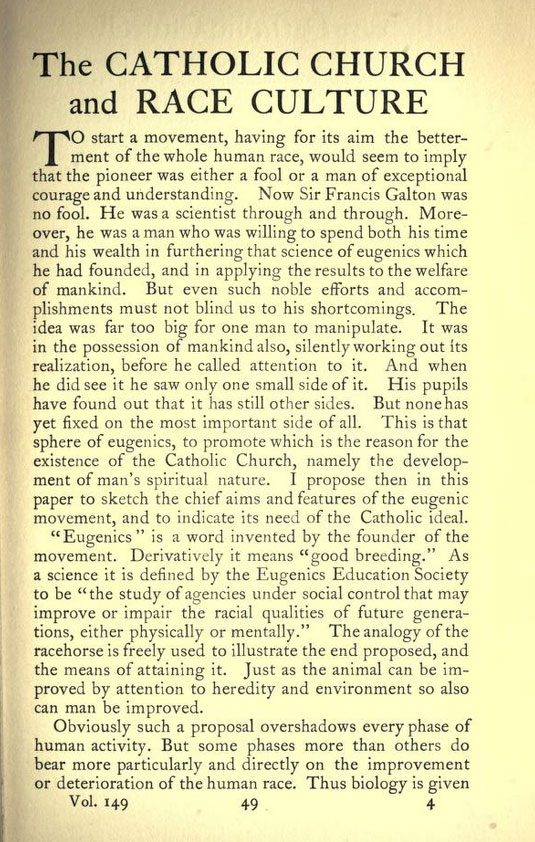
This would be something that would be addressed more aggressively by Scott’s mentor Sigourney Fay in his anti-Prussianist tract, The Genesis of the Super-Man in 1918. Gerrard believed (wrongly perhaps) that in Nietzsche’s perturbed mind, the Superman had meant something that was ‘other’ than man, “a lawless being considered to be lawless simply because it should be lawless”. Gerrard believed that Eugenicists like Maximilian A. Mügge were quickly buying into the whole weary Nietzschean franchise. Attempts were being made to combine Eugenics and Nietzsche’s Superman in a deliberate effort to spawn not just a Eugenic Science but a ‘Eugenic Religion’.
In his 1911 essay, Mügge had alerted readers to the fact that Galton and Nietzsche’s ideas had been published within months of each other in 1883 — first Galton with Human Faculty and then Nietzsche with Thus Spake Zarathrustra. They were products of their time, wrote Mügge. Both ideas aimed at a Platonic ideal, “whips wherewith to drive man towards a goal known only to himself”. From a cosmological point of view, continues Mügge, “destruction and star-dust are the ultimate end of man’s career”. [22] Just like Gatsby, man in the 20th century was climbing a ladder to “a secret place above the trees”. [23]
Mügge’s intention to sow the seeds of a Eugenic Religion had set the alarm bells ringing for Gerrard. If anyone should have earned a place at the forefront of designs of a Eugenic Religion it should be the Catholic Church. For the best part of a thousand years, the Church had been clearing a path for man’s rise from the Godless primordial swamp.
If Mügge was serious about a new era of Eugenics that would improve man’s spiritual nature every bit as much as his physical nature, then Gerrard believed that Mügge should start by adopting the existing principles and ideals of Catholic theology. Gerrard’s efforts were to all intents and purposes a rather desperate attempt to reground or re-centre Eugenics within the paradigm of ethics and orthodox religion.
In an effort to appeal to all those readers who had recently been turned on to Nietzsche, Gerrard made a point of stressing the points on which he and Nietzsche were in complete agreement: Catholic ethics was likewise in pursuit of producing the perfect man; “a man full grown, complete and entire; spirit soul, and body altogether without blame.” If Gerrard had one criticism to make of Sir Francis Galton, the distinguished godfather of Eugenics, it was that Galton’s scope was too narrow. Galton had failed to understand that there are “causes of causes”. It was the causes of alcoholism that were to blame for alcoholics, the causes of poverty that were to blame for people being poor, diseased and uneducated.
In this, he was totally on point with Saleeby.
Gerrard hoped that any Eugenic Religion would follow the example already set by the Catholic Church in promoting a “genius in morality”— a state of higher perfection. Gerrard points out that Nietzsche’s ‘Superman’ cannot be produced by purely anthropometric measurements, statistical observations and human experiments based purely on Mendel’s laws. Even in Nietzsche’s ideal there was the need of a sentimental, artistic flavour. Gerrard was happy to concede that it was this “unknown quality represented by the word Superman”, supported by strong moral codes and Christian ethics, that should be “at the centre of Eugenic religion”. “The perfect man”, Gerrard finishes, “both perfect both in his God-given nature and God-given supernature, needs the higher intellectual light of revelation.” [24]
Gerrard’s essay would be extended and re-published several times over the next five years, in many ways serving as the first and only firm word on Eugenics being offered by the Catholic Church until it published its official condemnation of the science — the Casti Connubii — in December 1930.
In the most extraordinary and unexpected of twists, Catholic Priest, Thomas J. Gerrard had found himself advancing views that were not terrifically unlike those of New York’s esoteric Theosophical Society: the aims of Christianity, Gerrard was saying, had a great deal in common with Eugenics and quasi-religious cults like those in California. The Gospels of the New Testament shared the views of the transcendentalists. Both systems of thought, Gerrard believed, sought to unleash man’s “inner light of revelation” — his inner spark.
The language that Gerrard had been using was clearly an appeal to the fashionably Nietzschean world of American spiritualist mavericks like Moses Harman, editor of the Light-Bearer journal, and celebrity Eugenicist, Harold Bolce at the short-lived Cosmopolitan Church in San Francisco. [25] Interestingly, Bolce’s musings on New Internationalism in 1907 revealed his support for that other prophet of human expansionism and self-realization, James J. Hill, the self-made millionaire that Gatsby’s father memorably compares with his son in the final pages of the novel:
“He had a big future ahead of him, you know … If he’d of lived, he’d of been a great man. A man like James J. Hill. He’d of helped build up the country.”
Bolce had been no less impressed by Hill:
“Mr. James J. Hill, has conquered more territory with a coupling pin than Caesar did with a sword. This new master of money and domain, realizing that business knows no boundaries —that the world, commercially and financially, is ready for unification —has merged European gold with American genius and Oriental opportunity.”
Hill returned the compliment in his 1912 book, Highways of Progress: America’s “dream of a conquest of world markets” was a bubble that was about to burst. One of the few men who had understood what it would take to control the “markets of the future”, Hill thundered, was Harold Bolce. [26]
In Gerrard’s own progressive gospel, Man was being presented as a ‘light-worker’. It’s easy to appreciate why the more Conservative prelates of Rome preferred to dodge the issue entirely: it was a can of worms. He might not have known it, but Gerrard was using the language of Supernatural Eugenics. A Eugenic Religion was on the rise. Scott may have been gripped by much the same impulse when he sat down to write The Great Gatsby.
Beautiful Little Fools
The novel, on its most superficial level at least, offers a bleak but realistic response to the author’s 1914 Princeton musical composition, Love or Eugenics? For Daisy Buchanan, the woman who cruelly dumps her mysterious low-brow boyfriend in favour of his physically and financially superior rival, the answer to the question couldn’t have been any clearer or more emphatic: “Thanks but no thanks Jay or whatever your name is, I’ll take Tom and Eugenics over love every time”. For all his imagination and ‘psychical’ gifts, Jay Gatsby is just no match for the fantastically wealthy polo player whose genes can be cultured not only for the greater good of Daisy, but for the entire Nordic race.
Having known many men like Tom Buchanan at Princeton, and having met many more when he was guided around the homes of Long Island’s aristocracy by his friend and counsellor, Shane Leslie, Scott is likely to have observed the reality of modern-day New York a little less romance than Gerrard and the Catholic Church. As honourable as Gerrard’s ideals were, there was a certain section of the city who were never going to marry for love. Those weren’t bells ringing out on your wedding day; for many they were the shrill cha-ching of the cash-register.
To the Old Money families of America that Tom and Daisy Buchanan belong to, marriage had always been about good breeding. In her 1952 autobiography, The Glitter and the Gold, Consuelo Vanderbilt, the socialite daughter of Alva Belmont and William Kissam Vanderbilt, would describe in excruciating detail how she had spent the morning of her wedding to the 9th Duke of Marlborough crying alone in her bedroom. And it was not an isolated episode by any means.
Read any decent book on the history of Eugenics and then re-read The Great Gatsby. If you do, you are likely to find that several minor episodes begin to make a good deal more sense: the stories about Daisy crying her eyes out on the evening before her marriage to Tom? Daisy’s hysterical recognition that the best thing for a girl to be in the ‘distinguished secret society’ that she and her husband belonged to was a ‘beautiful little fool’? It’s all there if you care to look.
Daisy Fay, just like so many other girls of her class in America at that time, had been collapsing under the burden of choosing a suitable Eugenic marriage over an undisciplined life of pleasure. Pleasure wasn’t just frivolous in 1920s America, it was dangerous too. Just a few short weeks before Scott transformed the freedom-loving ‘IT-girl’ into a worldwide sensation with his debut novel, This Side of Paradise, Dr Murray Leslie of London had declared war on all loose young women.
Standing before a captivated audience at the Institute of Hygiene in London, a stone-faced Dr Leslie explained how the “frivolous, scantily-clad, jazzing flapper, irresponsible and undisciplined” was perhaps the single gravest threat that the world was facing at that time. Leslie had done the math and found that there were over a million “excess females of marriageable age” in Britain alone. He had an announcement to make: the flapper’s irresistible philosophy of pleasure for pleasure’s sake was destroying society.
It was a grave situation indeed. The consequences of “sex disproportion” and low moral standards were slowly undermining the ethical foundations of humanity. The outlook was bleak; this trend, if it was allowed to continue, would have disastrous consequences on the birth-rate for years to come. [27] Young women were simply not getting married and producing babies quickly enough:
“The women most suited to marriage are not marrying,” barked Leslie. “Those who are the fittest, both physically and intellectually, go forth to earn their own living, while less provident women of the unskilled workers class marry and have large families.”
It was quite literally race suicide: the poor and the stupid were rising in numbers. The song said it all: “One thing’s sure and nothing’s surer, the rich get richer and the poor get—children … ain’t we got fun?” [28]
It may come as no surprise to learn that Dr Leslie had also been a speaker at the First International Congress on Eugenics in July 1912. It was at this gathering that Frederick L. Hoffman had made some no less sensational claims. According to his research, breeding rates among the Irish immigrants of New York was so prolific that America was fast becoming ‘a Catholic Nation’. [29]
When Scott writes of the nineteen year old Daisy Fay crying on the eve of her wedding to Tom Buchanan, he is responding to views like these. [30] And what are we to make of all those references to blond people and Tom’s powerful Aryan physique? Or the pathetic attempts by Gatsby to rise above his station? The novel works on so many levels, but probably none more successfully than as allegory on Love or Eugenics — something that would have resonated on a very personal level with Scott, who had suffered (perhaps more than most) along similar lines of rejection, first with his girlfriend, Ginevra King, and then, for a time at least, with his future wife Zelda and her family.
The story of Jay Gatsby is really the story of Scott and his own dysgenic circumstances: the great sportsman who wasn’t that great, the great scholar who no matter how hard he tried just couldn’t pass exams, the great lover who was almost always being passed-over for someone ‘better’, the struggling Irish-Catholic immigrant who had landed in Protestant Princeton on a shameful, freak inheritance. Compared to friends like Townsend Martin, the author’s wealthy and respectable room mate, he was the low-born mooncalf, Caliban.
Within weeks of arriving at Princeton The Tempest and Doctor Faustus had been among the most probable choices of plays slated for production that year. As a member of the English Dramatic Association, the relevance of the plays to Eugenics is unlikely to have been lost on the author. For someone like Scott, it wasn’t ‘bad luck’ that he put all his failures down to, but bad genes. Like his creation, Jay Gatsby, the one thing that would allow him to rise above his physical and social limitations was his brilliant imagination and his sheer determination to succeed.
Thus Spake the Blonde Northern Girls
The clues had all been there in Fitzgerald’s Absolution, the story of the lies that a young boy tells to his priest as he attends his weekly confession. Published as a short story by The American Mercury in June 1924, Scott had originally intended using the tale as an explanatory prologue to Gatsby. In this story, Rudolph Miller, a beautiful little blond boy with “eyes like blue stones” attempts to outwit God and overcome his sinful circumstances by re-imagining himself as ‘Blatchford Sarnemington’, a swaggering Prussian calvary officer waiting for the charge at Sedan. [31]
At his most spiritually vulnerable moment — the moment the boy is about to collapse before the priest and confess all — he becomes a dazzling Nietzschean ‘Superman’ leading a rebellion against God.
No matter how gross or shameful his past behaviour, the boy believes that he is now free to shake-off his humble surroundings and exist beyond the usual laws of nature and morality. Once secured safely in the armour of his arrogant alter-ego he can effectively sin no more. The boy had become like Nietzsche’s pneumatikoi. For one fleeting moment in time he is quite literally a free man, beyond good and evil.
As the boy runs from the church, the scene described by Scott is full of subtle Nietzschean imagery. The “girls with yellow hair” walk sensuously along the roads, calling “innocent, exciting things to the “tall young men from the farms” working on the grain. A “blue sirocco” wind trembles nervously over the wheat. The wind is no match, however, for “the blonde Northern girls” who are seducing the boys in the fields. For Nietzsche, the gentle breath of the sirocco — a light southern wind — personified the weak, lazy will of Christian mediocrity that was grossly inferior to the powerful winds of the north. God’s suffocating breath was blowing drowsily across the wheat fields of the young boy’s Midwestern hometown.
In the boy’s eyes at least, the townspeople retain a lazy servility to God. The light sirocco breeze saps their will to power. The author seems to be suggesting that any attempt to fulfil one’s potential in a weary, enervated town like this would be impossible. The girls act like sirens, luring the boys to their spiritual deaths. The compromises they had made with God and the suffocating conventions of romance had made the townspeople listless and cowardly. Nietzsche thought it better to live amid the ice and thunderous roaring winds of the north than the warm, fatalistic breezes of the tropical south. Mencken’s translation reads:
“This tolerance and largeur of the heart that “forgives” everything because it “understands” everything is a sirocco to us. Rather live amid the ice than among modern virtues and other such south-winds!”
These winds, Nietzsche believed, sapped the energy out of man and curbed the egotism of the strong. They were “a conspiracy of the chandala against the free functioning of their superiors and the free progress of mankind”. The majority of men “preferred delusion to the truth”. In Nietzsche’s estimation, it was the winds of the Sirocco that weakened Man’s will. The boys out in the fields were losing themselves to love. In Absolution, Scott’s wilful adolescent observes Christianity crushing the spirit out of man and turning all its townsfolk into ‘dismal fatalists’. It wasn’t that these people weren’t worthy of redemption, it was that they should never have been seeking it in the first place. [32]
The book that seems to have inspired Scott’s reference to a Sirocco wind was Nietzsche’s The Antichrist, republished as a Borzoi Pocket book in September 1923 by Alfred A. Knopf and translated from its original German by Scott’s friend, H. L. Mencken. [33] In the eventual version of Gatsby published in 1925, Scott’s hero fulfils the more spiritual ideal of Eugenics envisaged by Dr Caleeb W. Saleeby and to a lesser degree by the Catholic Eugenics dabbler, Thomas J. Gerrard. The Nietzschean ‘superman’ is there in spirit but he also has a softer, more psychical dimension. Gatsby’s teenage schedule of self-improvement bears witness to this.
The list of childhood ‘resolves’ that Gatsby’s father shows to Nick in the final pages of the novel include as much emphasis on moral and intellectual exercise as it does on muscle tone and sports (‘dumbbell exercise, baseballs, sports, read one improving book or magazine every day, be better to parents’). Unlike Tom Buchanan, Gatsby is a more well-rounded individual, his creative imagination and capacity for love making him spiritually, morally and psychically superior to Tom.
A Defence of Gatsby
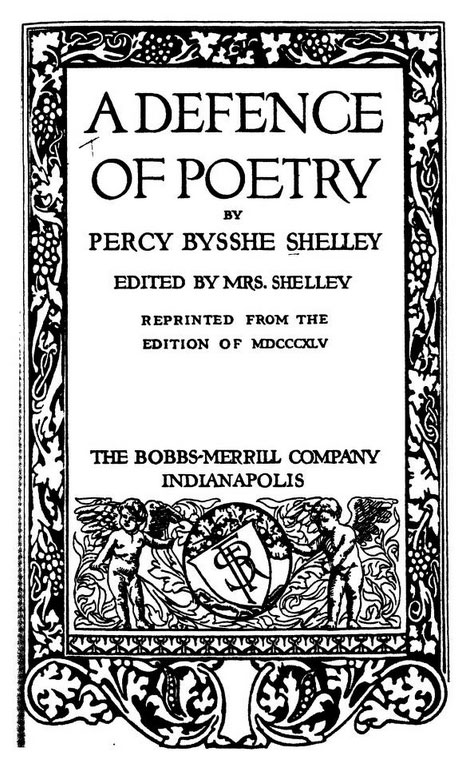
The basic gist of what Fitzgerald was saying about Eugenics can be found in Percy Bysshe Shelley’s essay, A Defence of Poetry. In this unfinished essay published posthumously by his wife, Mary, the legendary Romantic argues that it is the poets of the world, not the scientists and politicians, who are the true legislators and custodians of morality and civil society. For Shelley, poetry was “connate with the origin of man.” The insights and pleasures that were experienced by poets were not only more intense, and more excessive, they were also able to make “the partial apprehension of the invisible world.”
The stories of love, friendship, patriotism and sacrifice produced on such inspired epic scales by poets like Homer and Shakespeare, continued to stimulate and preserve the dreams and ideals of men. All these things led to the “moral improvement of man.”
Ethical science, Shelley promulgated, had only ever been capable of arranging the elements that poetry had already discovered (if not created). Without poets like these there would be no evolution. If stories like these were no longer told, the world would begin to run backward. The “devotion to an object,” whether it is Nick Carraway’s loyalty to Gatsby or Gatsby’s incorruptible love for Daisy, is what “lifted the veil from the hidden beauty of the world.” And because people still sought to imitate the inspiring actions of poetic heroes like Achilles, Hector and Ulysses, their own actions would continue to educate and civilise the world for centuries to come. Greatness could be carried forward. The stories produced by men like Shakespeare were the double helix of civilisation and all the wisdom and moral laws of the world were encoded therein:
“the sentiments of the auditors must have been refined and enlarged by a sympathy with such great and lovely impersonations, until from admiring they imitated, and from imitation they identified themselves with the objects of their admiration.”
— Shelley, A Defence of Poetry
One man who certainly has perfected the art of imitation is Jay Gatsby. Whether we are talking about the books in his gothic library, his ‘factual imitation’ house or his incongruous mock-English mannerisms we are presented with a man of “great and lovely impersonations.” His methods may be crude and his gaudy pink-suit might be a little lacking in sutlety, but in Shelley’s estimation, Gatsby’s vaguely absurd disguise communicates something greater.
“A poet is a nightingale, who sits in darkness and sings to cheer its own solitude with sweet sounds,” writes Shelley in reference to Ode to a Nightingale by John Keats. There are several references to Keats’ poem in the novel, the most conspicuous among them is when Daisy remarks that there is a nightingale singing on the lawn in her garden in Chapter One. Tom ignores her and continues talking, its profundity and romance completely lost on the brute.
If Shelley’s essay attempts to prove one thing, it is that poetry acts in a “divine manner,” it “awakens and enlarges the mind” through a spectroscopic process of similitude and “rendering.” The counterfeit worlds that poets like Homer and Shakespeare produce for their readers are more psychically or spiritually real than the unethical world around them. Scott presents Gatsby in the same way that Shelley presents the poet. He has that same “generous impulse to act what we imagine.” The world he creates is real because he thinks it is real. It is better than it is because he imagines it to be better than it is:
“All things exist as they are perceived: at least in relation to the percipient. The mind is its own place, and of itself can make a heaven of hell, a hell of heaven.”
— Shelley, A Defence of Poetry
The “epic or dramatic personage” being celebrated by Shelley in his essay (and by Scott Fitzgerald in Gatsby) wears the vestiges of ancient greatness like a “modern uniform.” Jay Gatsby, the man who has “a heightened sensitivity to the promises of life,” a “romantic readiness” and “gift for hope” has come to do battle with an ugly, immoral world. He is transforming base metals into gold. [34]
“His heart was in a constant, turbulent riot. The most grotesque and fantastic conceits haunted him in his bed at night. A universe of Ineffable gaudiness spun itself out in his brain … Each night he added to the pattern of his fancies until drowsiness closed down upon some vivid scene with an oblivious embrace. For a while these reveries provided an outlet for his imagination; they were a satisfactory hint of the unreality of reality, a promise that the rock of the world was founded securely on a fairy’s wing.”
— The Great Gatsby, p.95
On several levels at least, The Great Gatsby, appears to have been Scott’s attempt to recalibrate the rubric of Shelley’s essay to the challenges posed by the selfish excesses of 20th century modernity and eugenics. Poetry, like Long Island’s most eligible bachelor, ‘re-coloured’ the random world of matter in its own “Elysian light”. It took the pre-living substance of life and tethered it to a fairy’s wing.
Observing life wasn’t nearly enough. One had to engage with it empathically.
Scott, like Shelley, had recognised that it was only when the “pains and pleasures of his species” had become his own that man could truly become an instrument of moral good. Sacrifices of ego would have to be made, just like Gatsby makes the sacrifice of saving Daisy at the end of the novel. If one was to attain a higher level of consciousness, the usual instincts of survival had to be defeated. As Nick observes when Jay and Daisy eventually reunite, the remote, intense life that two lovers enjoy elevates them to a completely separate plane that boasts its own systems of logic. They are in that high “secret place above the trees” gulping down the “incomparable milk of wonder”.
Gatsby brings to Long Island a sense of chivalry and romance that many Americans had believed to have been buried in the madness of war and lost completely in the pessimism of the years that followed.
Nick continues to watch the couple, and as he does so, Gatsby’s resident troubadour, Klipspringer strikes up a song on the piano: “One thing’s sure and nothing’s surer — the rich get richer and the poor get … children.” The song, ‘Ain’t We Got Fun’, captured the zesty, selfish excesses of the period and the catchy dissonance of race suicide. It had also been an irreverent misquote of a phrase used by Shelley in A Defence of Poetry. [35] The writers of the tune were repeating an observation common among eugenicists (and the US Bureau of Census) at that time, that wealthier couples were remaining childless whilst the immigrants and blue-collar workers of America were thriving.
Race suicide had found its anthem.
Shelley had meant the whole thing very different. Shelley had observed that even in periods of intense social decay, the promoters of ‘Utility’ — a philosophy that endorsed practically any action that maximised the happiness and wellbeing of the majority — were keener to preserve the happiness of the rich than they were to alleviate the suffering of the poor: “The rich get richer and the poor get poorer” is what Shelley had written. To ram his point home, Shelley had quoted the so-called ‘Matthew effect’: “To him that hath, more be given, but from him that hath not, the little he hath will be taken away.” Eugenics, like Utilitarianism, was creating an even bigger gap between the haves and the have-nots.
A century after Shelley had written his essay, little appeared to have changed: “the vessel of the state is driven between the Scylla and Charybdis of anarchy and despotism”, wrote the poet. [36] You either had cruel oppressive power, or you had chaos. The only people capable of plotting a route right through it were lovers like Gatsby and Daisy, who for a few precious hours at least are totally oblivious to the cynicism of the song and the abject cruelty of the times that they live in.
Interesting, but too long a mouthful
As he undertook a complete revision of Gatsby in the late spring of 1924, Scott had written to his editor, Max Perkins, telling him of the immense creative power that was starting to build within him. Shelley had been “God” to him once, he gushed. He had just finished reading André Maurois’s biography of Shelley, Ariel and was full of renewed love for the man. In his handwritten manuscript for Gatsby, Scott had crossed out an entire passage referencing a popular Shelley legend:
“His eyes remained, like Shelley’s heart among the ashes, dimmed a little by many paintless years under the sun and rain.” [37]
The legend of Shelley’s ashes — the story of a partial triumph over death — was based on a story told by Byron that had appeared in Maurois’s biography. According to Byron, Shelley’s heart had survived the flames that had engulfed his body during his improvised cremation in Rome after his tragic death by drowning in July 1822. Byron, unable to pass up a great story when he saw one, might have seen it as fitting metaphorical testament to the poet’s exemption from the usual protocols of mortality and man’s participation in the “eternal” and the “infinite” that Shelley had put forward in his essay.
There can be little doubt at all that Scott was thinking of Eugenics when he sat down to write Gatsby. It is there in the imitating physical presence of white supremacist bully-boy, Tom Buchanan and the dedicated schedule of self-improvement embarked upon by Gatsby in his youth. At the time that Scott was writing the novel, the world of Eugenics was split between those who thought human progress was down to good breeding alone and those who thought it was down to a combination of lifestyle and environment — of opportunity matched by genius, love and ambition.
Scott was well aware of these two very separate schools of thoughts in Eugenics.
In 2003, historian Ann Margaret Daniel made a tantalising discovery. It was a copy of Samuel J. Holmes’ The Trend of the Race, signed and inscribed by Scott for his father-in-law, Judge Anthony Sayre. His inscription reads simply: “This is too long a mouthful but it’s most interesting to me.” The jovial message was a reference to the full spectacular title of Holme’s book: The Trend of the Race: A Study of Present Tendencies in the Biological Development of Mankind.
Samuel J. Holmes was among several lesser-known scientists who were placing far greater value on the influence of environment (nurture) upon heredity (nature) in Eugenics. [38] In the very first chapter of the book, Holmes opens discussion by referring to the theories of James Mark Baldwin, the son of a prominent abolitionist and a former professor at Princeton Theological Seminary. Baldwin, years ahead of his time, had challenged the world’s leading eugenicists to consider whether social conditions and practices played as profound a role in shaping our genes as biological inheritance.
Baldwin later relocated to France, where he served on the board of the American Library in Paris and edited its regular newsletter, Ex Libris. The American Literary review, like Scott, would go on to play a critical role in advancing the careers of Ernest Hemingway and other emerging American modernists and Harlem Renaissance writers. [39]
Scott’s purchase of the book has been taken by some as evidence of the author’s passionate support for Race Eugenics, but it is a view we might want to approach with caution. Firstly, Scott had purchased Holme’s book specifically for his father-in-law, Judge Sayre. In the earliest of his and Zelda’s courtship, Scott’s lack of wealth and status had been the source of a good deal of tension within the family, and like any caring husband anxious to please his in-laws, the author would occasionally do his utmost to prove he had been a worthy and suitable match.
Perhaps Mr Sayre had expressed an interest in Eugenics and Scott had simply bought it with the intention of pleasing the Judge?
Secondly, even the Catholic Paulist Fathers, who had played a significant role in founding and inspiring Scott’s Newman School for Boys, wrote favourably of the book, noting that the author had made a point of distinguishing between ‘physical’ and ‘social’ heredity, the idea that man’s biology was in no small part influenced by the world around him — his education and opportunities.
The tone and tack of Holme’s book was very different to those that had gone before it. Unlike The Passing of the Great Race and The Rising Tide of Colour it couldn’t really be described as political. The book had intended to take Eugenics in a more empathic or ‘caring’ direction, Holmes noting that as civilization became more and more advanced, the “evil effects of the various forms of social selection” were becoming ever more intense. The reviewer of the Catholic World thought it an “excellent summary” of the major issues in the broader field of racial development. [40]
Taken from this perspective, Scott’s gift to his father-in-law could quite conceivably have been an attempt to broaden or change the Judge’s views on the ‘nature versus nature’ question that continued to dominate Eugenic discussion. Don’t get the impression that the book was any less racially prejudiced than those by Stoddard and Grant — it wasn’t, especially where Mexicans were concerned — but if Scott’s intent had been to persuade his father-in-law that greatness could be achieved and was not just something you had at birth, then the book may have been part of Scott’s long-term agenda in persuading Judge Sayre that his regularly insolvent son-in-law might one day become a worthy match for his daughter.
[20] Eugenics: Fundamental Principles, Joh Webster Melody, The Catholic University Bulletin, Catholic University of America, Volume 20 1914, pp. 224-238. Melody served as Professor of Moral Theology at the Catholic University of Washington.
[21] The Catholic Church and Race Culture, Thomas J. Gerrard, The Dublin Review July 1911, Vol.149, No.298, p. 52. Saleeby’s father, Elijah George Saleeby was born in Syria. In 1877 he married Frances Maria Williams (born to a Quaker family from York). Elijah had previously been in charge of the Protestant Schools in Syria with his brother Solomon. The school, based in a remote village called Brummana, was known as The Darlington Station because it was backed by Quaker (Society of Friends) money from Darlington. Although born to a Greek Orthodox, Elijah converted to Protestantism.
[22] Eugenics and the Superman: A Racial Science and a Racial Religion, Maximilian A. Mügge, 1910 (publisher not known)
[23] The Great Gatsby, F. Scott Fitzgerald, Chapter Six, p.106. “Out of the comer of his eye Gatsby saw that the blocks of the sidewalks really formed a ladder and mounted to a secret place above the trees – he could climb to it, if he climbed alone.”
[24] The Catholic Church and Race Culture, Thomas J. Gerrard, The Dublin Review July 1911, Vol.149, No.298, p. 53, pp. 65-66
[25] Californian, Harold Bolce and his actress wife hit the headlines in 1913 with the world’s first Eugenic child, a girl called Eugenette.
[26] ‘Highways of Progress’, James J. Hill, Doubleday, Page & Company, 1912, p.38
[27] ‘Why Marriage Is Declining’, Sunday Pictorial, February 8, 1920, p.5
[28] The Great Gatsby, F. Scott Fitzgerald, p.92. The jaunty song that Scott quotes was a play on a phrase made famous by the poet, Percy Bysshe Shelley in his essay, A Defence of Poetry. Scott was reading Shelley at the time he was writing The Great Gatsby.
[29] ‘Catholics Grow in Numbers’, Saint Paul Catholic Bulletin, August 17, 1912, p.2.
[30] The Muhlbach Hotel that provides the setting for Tom and Daisy’s wedding was actually the Seelbach Hotel in Louisville, founded by Bavarian brothers, Otto and Louis Seelbach. Both names certainly has a very distinctive Prussian or ‘Nordic’ vibe. Prussian historical novelist, Louisa Muhlbach was briefly in the news columns of America during the war when her account of the White Lady of Bayreuth Old Castle featured in terror tales of the trenches.
[31] The Battle of Sedan was fought as part of the Franco-Prussian war in September 1870. The defeat of the French Catholic army by the Lutheran Prussian Army would play a critical part in the Capture of Rome and see the end of the Papal State.
[32] The Antichrist, F.W. Nietzsche, translated from the German with an introduction by H.L. Mencken, Alfred A. Knopf (1918), Borzoi Pocket Books, 1923, p.42; The Laws of Manu and Nietzsche’s “Attainable Perfection, Bradley Kaye, The Agonist, July 2022, Volume: 16, No:1, pp. 1 – 31. Nietzsche used the image of the Sirocco several times in his work, always derisively. Dr Bradley Kaye of Niagara University has explained to me that Nietzsche’s Sirocco metaphor is also “an allusion to political geography and Romantic Nationalist tendencies at that time”.
[33] The publisher’s half-brother, the film producer, Edwin Knopf became a good friend of Scott. The publisher would subsequently seek English rights to Scott’s 1934 book, Tender is the Night. Scott had in fact called Mencken ‘the Baltimore Anti-Christ’ in his review of his book Prejudices for The Bookman journal in March 1921.
[34] The Great Gatsby, p. 20. “then there was something gorgeous about him, some heightened sensitivity to the promises of life … it was an extraordinary gift for hope, a romantic readiness such as I have never found in any other person and which it is not likely I shall ever find again.”
[35] Ain’t We Got Fun (song by Whiting-Egan, 1921), The Great Gatsby, p.92. It’s the tune that Klipspringer plays as Gatsby shows Daisy around his house.
[36] A Defence of Poetry (1821), Percy Bysshe Shelley, ed. Mrs Shelley, The Bobs-Merrill Company, 1904
[37] The Great Gatsby – Autograph Manuscript, Fitzgerald, Princeton University, Manuscripts Division, Firestone Library, F. Scott Fitzgerald Papers (C0187), Box 4, p.74
[38] ‘Fitzgerald’s Princeton Through the Prince’, Ann Margaret Daniel, F. Scott Fitzgerald in the Twenty-First Century, University of Alabama Press, 2003, p. 17. Holmes developed this idea in his 1929 work, The Interplay Between Heredity and Environment.
[39] ‘Essentially an American Institution Planted on Foreign Soil’: The American Library in Paris, the Paris Herald, the Paris Tribune and Ex Libris, Nissa Cannon, Cultural History, Volume 10, Issue 2. Baldwin and the Library also played a supporting role in the careers of Sylvia Beach and Margaret Anderson.
[40] The Trend of Race (New Books) Catholic World, Volume 115, April – September 1922, pp. 407-408
[41] The Great Gatsby p.95
[42] The Great Gatsby p.67