An article written by rights activist, Henry Moskowitz, in February 1918, said that to understand Leon Trotsky’s infamous sudden visit to the Lower East Side of New York in January the previous year, you also had to understand the local landscape upon which his “powerful figure” was “silhouetted”. Its streets “were black with men, women and children”. Its thoroughfares packed with peddlers and their pushcarts. The colony supported five daily newspapers printed in Yiddish with a circulation of over 350,000. The Jewish life of the world was mirrored in its press. The International mind, Moskowitz continued, was popularised by its “agile-minded journalists”. The entire spectrum of radical and non-radical groups and individuals was represented on its streets. Orthodox synagogues and small congregations that were outwardly preserving the scrupulous traditions of its people were secretly affiliating themselves with radical societies that represented “every shade of socialistic thought”. The tone of its restless spiritual life energised the vigorous Jewish labour movement who concerned themselves not just with the freedom of the Jews in Palestine but across the whole of the world. They recognised the suffering and the costs but saw in the outcome of the war “a realisation of the dreams of their Internationalism — a federation of free peoples”. [1]
In the same article, Moskowitz recalled sharing the stage with Trotsky at an address at the Beethoven Hall. The date was February 2nd, 1917. In a self-deprecating aside the writer commented that as long as he dwelt upon the Internationalist concerns of the Jew, he received a warm response from the crowd. But when support of the war was urged, the response was not so enthusiastic. Trotsky, the “picture of the disinherited intellectual”, gaunt and shabbily dressed, sat beside him on the platform, but as soon as he rose to speak the crowd recognised him as one of their own and he seemed to grow bigger in stature. Trotsky’s manner, Moskowitz went on, was truly “magnetic” and his “sharp, metallic voice penetrated the hall without exertion”. He wasn’t like the conventional agitator. He was “calm, sincere and unromantic”. Trotsky had, according to Moskowitz, first arrived in Brooklyn in 1916 and not, as the rest of the world generally assumed, in January 1917. Previous contact with the city would certainly explain a few things, because within days of his arrival Trotsky was taking up key positions and precious column space in several of the city’s leading radical publications, including Novy Mir and the Forward — positions that many young Socialist radicals would ordinarily have to have waited some ten to fifteen years for. Of course, Moskowitz might have had his dates wrong, but it’s not inconceivable that he was quietly disclosing information that was hitherto not common knowledge. [2]
As anyone with a working knowledge of the 1917 Revolution might know, Trotsky is alleged to have arrived in New York on January 14th 1917, just a matter of weeks before the February Revolution in Russia which saw Tsar Nicholas II abdicate and Russia’s Provisional Government under Alexander Kerensky take power. Six months later Leon Trotsky would steal that power when Lenin’s Bolshevik Party overpowered Kerensky’s forces, seized control of the Winter Palace and established a Soviet Government. But it’s the rumours that preceded his return to Russia that have fuelled the conspiracy theories. Leon Trotsky is alleged to have left New York for Russia on March 27th with over $10,000 in funds. Who provided him with the cash has remained a mystery for 100 years. Curiously though, less than 72 hours after Trotsky had left for Russia, the Chicago Sentinel reported that Bernstein and Shapiro’s co-director at Der Tog, Meyer Aronson, had died and bequeathed in excess of $22,000 to local charities and schools as part of his commitment to the Brooklyn Federation of Jewish Charities. Had Trotsky managed to put one over on New York’s well meaning immigrant community? Well, that all depends on what they were expecting from his return to Russia that spring, but at the time that Trotsky departed at least, the prospect for Jews in Russia was looking really very positive indeed.
Printed above the news of Aronson’s death was a report on the annual banquet of Jacob Massel and Isaac Allen’s American Jewish Congress at the Auditorium Hotel. Both men will come into the story again a little later, but for now all we need to know is that at the end of the congress it was announced that Mrs Joseph Fels, whose husband had famously provided the funds necessary for Lenin, Trotsky and Stalin to return to Europe at the end of the 5th Congress in London in May 1907, had been elected as the American Jewish Committee’s first active President. The abdication of the Tsar was a time for celebration. Kerensky’s bloodless revolution and his subsequent granting of rights to Jews, the article boasted, had gone a long way toward settling ‘the Jewish problem’. In what is a far-reaching, poignant moment, J.G. Grossberg predicts that March 23rd 1917, the day on which Jews in Russia were granted political equality, would be celebrated annually for years to come. Bonfires would be lit, songs would be sung and thanks would be given. March 23rd would go down in history as the day of the birth of the Russian Republic and freedom for Russia’s Jews. The next man to offer his views was Dr A. J. Messing: “the same pot of democracy that has just overflowed in Russia is simmering in Germany, he declared before adding, “Kings are mere shadows that disappear with time, but the people are immortal”. [3] How were they to know that the joy would be so short-lived?
Six months after the speech was made, the Bolsheviks would stroll triumphantly into the Winter Palace, and in the space of just a month, the vast majority of Jews in Russia would be confronted with a whole new era and a whole new method of suffering as the civil war erupted and the dictates of International Communism became diametrically opposed to Zionism and parallel attempts to preserve the uniqueness of Jewish culture. Any paradise found was poised to be lost. Lenin and Trotsky may have upheld the basic freedoms granted to the Jews by Kerensky but there would be a series of new conditions. The Jews were no longer the outlawed people they had been under the Tsar, but they would be expected to suppress their unique religious and cultural identities in favour of serving the Soviet Nation. By 1927, Stalin had marginalised practically every senior Soviet figure of Jewish heritage and by 1940 the vast majority of those figures had been executed as part of the Purges led by Molotov in appeasement of the Nazis. And in Ukraine it began even earlier. The one-quarter of Jewish blood that Vladimir Lenin was believed to have flowing through his veins, had clearly not been enough to subdue his vision.
Despite whatever promises he’d been making, Trotsky’s romance with American Zionists — cultivated at least in part by his early membership of Kerensky’s Mensheviks and his dazzling peacenik Socialism — was about to bite the dust. Within weeks of the Bolshevik’s assault on the Winter Palace in November 1917, Joseph H. Schiff, leading fundraiser for the American Jewish Congress, cut off all ties with the revolutionaries. His various banks had made substantial loans to Kerensky’s Provisional Government and Lenin’s bolt from the blue takeover would mean losses that would be just as substantial. As Lenin seized control of the Kremlin his government cancelled all foreign debts, confiscated property and nationalized the banks. Schiff, like other stakeholders in the Kerensky Government, lost sight of his own substantial investment practically overnight. In February 1918, Lenin, Trotsky and the Soviet of People’s Commissars formally repudiated all bonds by the previous Tsarist government and all loans issued to Kerensky’s Provisional Government. The losses to Britain, America and France were colossal.
The talk of a Trotsky-Schiff pact — a long cherished fantasy (or hope) among Internet conspiracy theorists and fans of Antony C. Sutton — appears to have been based on Trotsky’s pre-October status among certain Socialist members of the American Jewish Congress. And though not the kind of man likely to have ingratiated himself with anyone, let alone those he couldn’t agree with, Trotsky’s fact-finding mission in New York had certainly won him no shortage of support among America’s Labour Zionists, who on learning of Kerensky’s victory and the abdication of the Tsar, were filled with renewed hope for a Jewish nation and an internationally recognised place in Palestine. In Trotsky’s eyes, Zionism had never been a solution to the ‘Jewish Question’. Worse still, its uniquely separatist vision presented the Soviet Comintern — and the Jewish Bund — with a stiff and immediate challenge to plans for global domination. Within weeks of Kerensky’s triumph, the series of meetings that had taken place between the Zionists and the Entente Alliance shortly before the ‘first’ revolution in February were snowballing into formal discussions. The most momentous event was yet to come. Just five days before the Bolsheviks seized control of the Winter Palace, the West’s support for a Zionist nation was officially acknowledged in a letter conveyed by the British Foreign Secretary Arthur Balfour to the group’s Anglo-Jewish leader, Lord Lionel Rothschild. [4] By December 1917 Britain and her allies had secured Palestine. Ottoman rule had ended, and a ‘New Jerusalem’ would steadily emerge from the ruins of Turkish dominance.
But the Jews of Russia were still faced with a problem. Kerensky had given them freedom. The incoming Bolsheviks, by contrast, would give them an ultimatum. And it was this rather brutal ultimatum that would provide Churchill and the Western allies with their best chance of defeating the Communist International. You could be a Jew and still be a Communist, but you couldn’t be a Communist Zionist. Any idea of a Jewish identity would need to be suppressed in favour of serving the Soviet Nation. It really was that simple. The contiguous nature of the events was perhaps best summed up in a double-headline that appeared in the Manchester Guardian on November 5th 1917: “Kerensky reported to be defeated outside Petrograd. Britain still advancing in Palestine”. The Zionists had suddenly become our best means of beating the Bolsheviks.
The pogroms that erupted in the Ukraine in January 1919 had been launched by a riotous mixture of anti-Semitic civilians and Bolshevik troops. Of course, it’s no coincidence that Ukraine had the largest concentration of Zionist groups, which were first pushed underground and then systematically eradicated by Trotsky and Lenin. The massacres in this region would continue until 1921, when most were corralled into Poland, along with a high percentage of Jews from other Soviet regions. By September 1919, it was being reported that Jewish casualties were estimated to be anywhere between 30,000 and 35,000 in the Ukraine alone. In one particularly notorious case at Trostyanets, all the Jewish inhabitants of the town, including children, were murdered. [5]
Just a few years later, an idle tabloid press, curiously ignorant of the fundamental differences that existed between Bolsheviks and Zionists, casually tossed out headlines regarding the plans of “Bolshevist Zionists” to erase British influence in Palestine by rejecting British currencies in favour of American dollars and Egyptian piastres. Even the ‘beggars of Nazareth’ were thought to have been in on the whole diabolical scheme. [6]
It’s clear there had been various links between Trotsky and the American Labour Zionists, but links in chains can be yanked apart under certain conditions, especially when you are confronted with someone as profoundly ambitious as Trotsky. The rolling, amorphous vapour we call clouds will form one shape and then another before rolling on. At the time that Father Gapon was marching his army of factory and mill workers on to Narva Gate in January in 1905, Trotsky was still in Geneva. His response to the opportunities in 1905 was much like it was in March 1917. Once the fire had been lit, he slipped back into Russia to capitalise on the flames. Stealing into the country via Kiev in February 1905, shortly ahead of the RSDLP meet in London, Trotsky immediately seized control of its underground printing operations. By June that year he was addressing meetings of the Workers Delegates and by October 1905 he was its Chairman, serving as a moderate Social Democrat. In 1903 he’d split with Lenin and was following the Mensheviks under Martov. By September 1917 he was back supporting Lenin. In short, the Trotsky who arrived in New York in January 1917 hadn’t yet made up his mind just where his political centre lay. The wind blows, the cloud follows and it’s never entirely predictable just which field the rain will fall on, or which of the soils will yield the richest crop. Trotsky might have argued that precipitation is best served with options.
The Links in the Chain
Just three years after the departure of Trotsky and the death of Meyer Aronson, founding publisher of New York’s Yiddish newspaper, Der Tog, the paper’s co-founder, Herman Bernstein, would provide on-the-ground coverage of the Russian Revolution for the New York Herald and Washington Post. Among its contributors was Chaim Zhitlovsky, founding member of the Union of Russian Socialist Revolutionaries Abroad (subsequently, the Russian Socialist Revolutionary Party)and a prominent Yiddish nationalist. It was from its tiny basement office that Trotsky famously told Herman Bernstein of the New York Times that the incoming Kerensky government “would probably be short lived, and step down in favor of men who would be more sure to carry forward the democratisation of Russia.” People were war weary. In a carefully prepared statement as plain as it was brief, Trotsky explained that Kerensky’s government didn’t represent the aims or the interests of the revolutionaries; their objective was to end the war, denying that it was German plot. [7] Given the plethora of more firmly rooted émigrés in New York at this time, many with far greater claims to both grievance and authority, it’s astonishing that The Times gave any column space at all to Mr Trotsky and one must assume that Bernstein’s intimacy with the Bolshevik in New York had played a part in the statement being published at all. In previous years, Trotsky had failed to register on the radar of the International press at all, his occasional statements and writings attracting only the attention of niche propaganda titles like The Call, Forward, Justice and Novy Mir. The only real exception to this was a flurry of excitable yet no less spurious promotions for the work he was undertaking in Germany. In January 1915 the Corvallis Gazette in Oregon ran a small box feature on Trotsky saying that we would soon see his name conspicuous in the affairs of Germany. The gist of news reports was that he had resigned from Russian affairs and was prospecting for Revolution in Germany with its “richer fields” and richer rewards. [8]
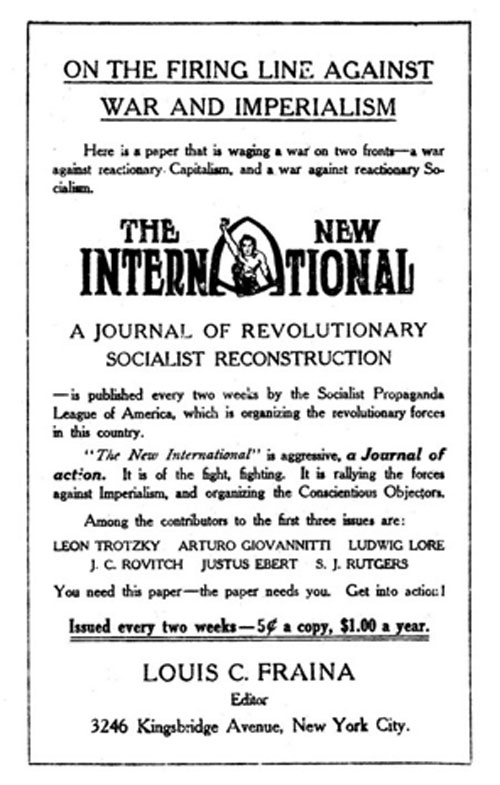
In a curious twist, the Bronx’s Louis C. Fraina, editor of The Class Struggle, and a man who perhaps did more than most to make Trotsky comfortable in New York lived just several hundred yards from Lenin’s 1905 host, Philip Whitwell Wilson. By 1917, Wilson had vacated his home at 16 Percy Circus to take up his position a New York correspondent of the London Daily News. According to his 1918 US draft card, he’d initially set-up base at 55 West 44th Street in Midtown Manhattan, but in just a short space of time he had bedded himself down at West 230 Street Spuyten Duyvil, the Bronx where he would remain quite happily until his death in the 1950s. Just 10 minutes walk east was the Italy-born Fraina and his 35 year old common-law wife, Jeanette D. Pearl, a chemist who had immigrated from Russia with her father Charles some thirty years earlier. The family’s first home at 2349 Pitkin Avenue in the Brownville district of Brooklyn put them within a five minute walk of Alexei Sheftel and Meyer Aronson on Sutter Avenue. Within weeks of his arrival, Trotsky was writing articles for Fraina’s new journal, The New International, the organ of the Socialist Propaganda League. An ad run in Fraina’s sister journal The Class Struggle described the fortnightly paper as an “aggressive journal of action … to fight fighting”. Other contributors to its first three editions included Ludwig Lore and Justus Ebert.
Trotsky was probably in town for two reasons: to act as barometer for public feeling and lay the foundations of a name and reputation that might resonate with American sympathizers at a later date. It wasn’t just a scouting mission but a public relations exercise; a confidence trick on the largest of scales.
Whatever Trotsky’s exact reason for being in America at that time, Bernstein’s co-directorship at Der Tog with Sheftel’s Brownsville associates, the Aronsons, put Lenin’s soon-to-be Lieutenant tantalisingly close to Alexis Sheftel, the 38 year-old typesetter from Hastings, during his three-month stay in New York. A short time later, Bernstein would quiz Vladimir Burtsev on the scope of German espionage in Russia in the final weeks of the Kerensky government. Burtsev had identified a George Frederick Spann, the brother of a member of the Kaiser’s cabinet who had been director of the Putilov munitions plant in Russia. A series of mysterious explosions at the factory had seen him arrested and jailed by the Tsar. Burtsev, the Revolutionary ‘Sherlock Holmes’, had met him in Siberia and was of the opinion that he was now back in St Petersburg directing German intrigue. [9]
The man who took over editorship of The Class Struggle as Fraina became more and more immersed in The New International and New York’s burgeoning agitprop scene, was Trotsky’s colleague at the Novy Mir, Gregory Weinstein. Exiled in Siberia, the former member of the Jewish Socialist Federation had escaped first to Paris in 1906, then to Switzerland before eventually settling in New York where his father Isador was a community Rabbi (US Census 1920). Like Fraina, Weinstein’s activities within the American Socialist Party enabled him to become a key player in the country’s Russian Socialist movement. He would also be active as a lecturer on the Hebrew Education Society circuit in Brooklyn. A few years later in 1919, Weinstein, shortly to be dubbed the ‘mastermind’ of the Communist Party in America, would find himself as chief of staff to Ludwig Martens, another close friend of Trotsky, whose various commercial activities in the US had seen him appointed America’s as yet unrecognised ‘Soviet Ambassador’ at the Russian Soviet Government Bureau.
Reception in Brooklyn
It’s entirely likely that the Lower East Side receptions held for Trotsky upon his arrival in January 1917 had been organized by a fairly eclectic range of admirers. Among the more plausible options would be Melech Epstein (Zionist Socialist Workers Party, Forverts journalist and a Brownsville resident), Louis B. Boudin, Louis C. Fraina or Aronson and Shapiro’s Der Tog partner at the New York Times and New York Herald, Herman Bernstein, whose home at 1381 Crotona Avenue in the Bronx, put him within several minutes’ walk of Trotsky and his family at his temporary base on Vyse Avenue. [10] Bernstein would leave for Russia in the last week of May 1917, some eight weeks after Trotsky. Although he would report predominantly from Petrograd, Odessa, Kiev, Moscow and Novogrod his passport application also covered supporting trips to Norway, Sweden, China and Japan. The letter that accompanied his application was from the news editor of the New York Herald said that he had “detailed service in Europe, particularly in Petrograd” but that his business would “probably necessitate his presence in England, France, Norway, Sweden and Japan”.
The exact nature of Bernstein’s trips to Russia and his earlier proximity to Trotsky is a complicated business. By July 1917, the Herald’s chief correspondent was reporting the Kerensky’s government belief that Lenin and his Bolsheviks were circulating large numbers of pamphlets and post-cards based on the wildest of rumours. These rumours, moreover, were said to be inciting acts of wanton violence against Russia’s Jews. In a broadly supportive comment, Bernstein pulled another quote from revolutionary spy-catcher Vladimir Burtsev who accused Lenin, Trotsky, Gorky and Zinoviev of systematically aiding Germany: “Thanks to Lenine, Zinovkieff, Trotsky and others during the terrible days of July 16 and 17, Wilhelm attained his purpose of marring the success of our war loan, bringing mourning into hundreds of Petrograd homes and paralyzing the life of the Russian capital, thus dealing a blow to the entire country and army. During these days Lenine and his associates damaged Russia more than a plague or the cholera.” [11] By December that year, Bernstein’s bylines were commanding coverage in most of America’s mainstream titles — and the shots being levelled at the Bolsheviks were getting progressively narrower and more extreme. ‘Bolshevik Leaders are German Agents!’ screamed the Boston Sunday Globe of December 2nd. The “gravediggers of the revolution” were digging a grave in which they would bury the achievements of Kerensky and the hope of its Jewish people (Boston Sunday Globe, 02 December 1917, p.2). Whatever favour Trotsky had found among Jewish leaders in New York earlier in spring that year, it was currently being withdrawn in the strongest terms possible. Things must have improved over time as Trotsky granted a number of exclusive interviews to his Bronx neighbour Bernstein during the years that followed the Soviet takeover.
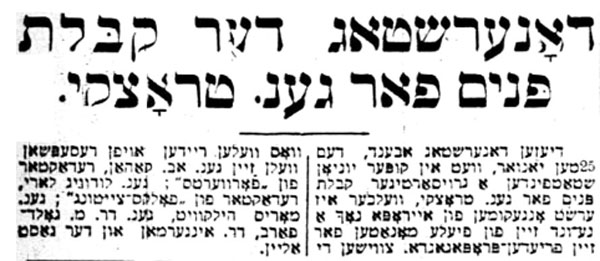
According to a report in Forverts on January 24, 1917, Trotsky’s reception in Brownsville had been billed as ‘an authentic Russian night’ complete with music, literary readings, samovars, and ‘authentic Russian tea’. [12] The reception took place a couple of evenings prior to the talk he would give in the Great Hall of the Cooper Union building alongside Max Goldfarb, another Forverts editor, and Socialist Party leader Morris Hillquit. The general impression is that the welcome meeting in Brownsville was a small and fairly orthodox affair, a traditional celebration carried out with the utmost respect for Jewish culture. The headline said it all: ‘Trotski haynt afn Bronzviler Bazar’. It was party time for Leon who would regale an intimate group of Brownsville residents with his revolutionary adventures in Europe against a culinary and musical backdrop of Lapsha, Blini, Chicken consommé, lashings of sweet and malty Caravan tea and a handpicked selection of tunes from a Mussorgsky opera threshed out on someone’s much treasured Balalaika. For someone who had spent the best part of thirty years conscientiously skimming-off his Yiddish excesses, the evening must have been an awkward and testy challenge that would have demanded no small amount of tact and patience on Trotsky’s behalf — especially when one of the locals, overcome with national pride and several cupfuls of fortified Russian tea would have picked up the Balalaika and made a passionately earnest stab at the appallingly forlorn Iz Za Ostrova Part II. The fact that it all took place 48 hours in advance of the much larger theatre event in Manhattan suggests a more personal guestlist; perhaps a low-key meet and greet before the inevitable slide into promotional and fund-raising chaos. The euphoria that would sweep through the city would come a little later in March with the announcement that the Tsar had abdicated, but there was a heightened sense of expectation, or a ‘buzz’ here all the same. Trotsky, or as his biographer Isaac Deutscher once called him, ‘the non-Jewish Jew’, had attained something of symbolic importance in this predominantly Yiddish district, and his arrival had taken on all the ceremony and pomp of a hero’s return. However delayed he’d been in getting back across to Russia from Geneva that year, he’d become a household name among Russia’s workers and even now some twelve years later, he was still reaching his largest audiences through Yiddish. Whether it was as a result of some earlier contact with New York as some speculate, or just the exceptional good luck of catching the wave at the right time, Brooklyn and Lower Manhattan were claiming Trotsky as their own. A caption beneath a cartoon of Trotsky in his Red Army uniform in the pro-Bolshevik newspaper, The Liberator, a few years later said it better than anyone: “The East Side Jew that Conquered Europe.” [13]
Among the Forverts staff were Trotsky’s early mentor and fellow Ukrainian, Leo Deutsch, known by some, as Lev Deich. Deich was a veteran campaigner and a figurehead of some note within Vera Zasulich and Mikhail Sheftel’s Black Partition movement of the late 1870s. After his dramatic escape from exile in Siberia, the 50 year Deutsch had made his way to join Trotsky and friends at Vera Zasulich’s Sidmouth Street commune in London. By August 1902 he was using his customary pseudonym Leo Allemoun and lodging at 26 Granville Square, placing him just a 20 minute walk from the much cherished Reading Room of the British Museum. Once in Britain, he regaled audiences throughout Britain with his experiences as a political prisoner in Siberia, ‘the Land of Exiles’. [14] Among his biggest fans were the Suffragettes who would incorporate his accounts of the prisoner hunger strikes into their own desperate battles with justice. By February 1911, Deich had relocated to New York where he embarked on a similar barnstorming lecture tour, dazzling audiences across the States with the stories of his daring escapes and remarkable adventures. The man spearheading his ‘launch’ in America was Herman Bernstein whose full page graphic article in the New York Times told of his 37 year of devoted service to a Revolutionary cause that spanned “an entire Empire”. [15] Deich’s closest associate in New York was another Ukrainian, Moissaye Joseph Olgin. A graduate of Kiev University and former member of the Jewish Bund, Olgin had emigrated from Germany to New York at the onset of war where he promptly became a regular contributor to Forverts. It’s not clear where either of them lived at the time of Trotsky Brooklyn reception, but the uniquely Yiddish environment of Brownsville would certainly have suited Olgin, who remained on good terms with one of the district’s most prominent revolutionary voices, Malech Epstein. His US army draft papers of 1918 however, have him residing 170th Street, the Bronx, just several hundred yards from Herman Bernstein at 1381 Crotona Avenue and a 20 minute stroll to Trotsky on Vyse Avenue.
[1] ‘Trotsky in Brooklyn’, Chicago Sentinel, February 15, 1918, p.7.
[2] ‘Trotsky in Brooklyn’, Chicago Sentinel, February 15, 1918, p.7.
[3] ‘American Jewish Congress’, Chicago Sentinel, March 30, 1917, p.8
[4] The Balfour Declaration, November 2, 1917
[5] The Scotsman, September 23, 1919, p.3
[6] Daily Mirror, April 7, 1925, p.3
[7] New York Times, March 16, 1917, p.4
[8] Corvallis Gazette, January 7, 1915, p.7
[9] New York Herald, October 5, 1917, p.16
[10] US Census 1910, Bronx Assembly District 34
[11] Washington Post, July 26, 1917, p.3
[12] ‘The Russian Revolution in New York, 1917–19’, Tony Michels, Journal of Contemporary History, Vol. 52, No. 4 (October 2017), pp. 959-979
[13] The Liberator III, 3, March 1920, pp.26-27
[14] London Daily News, November 27, 1903, p.5
[15] New York Times, February 12, 1911, p.6.