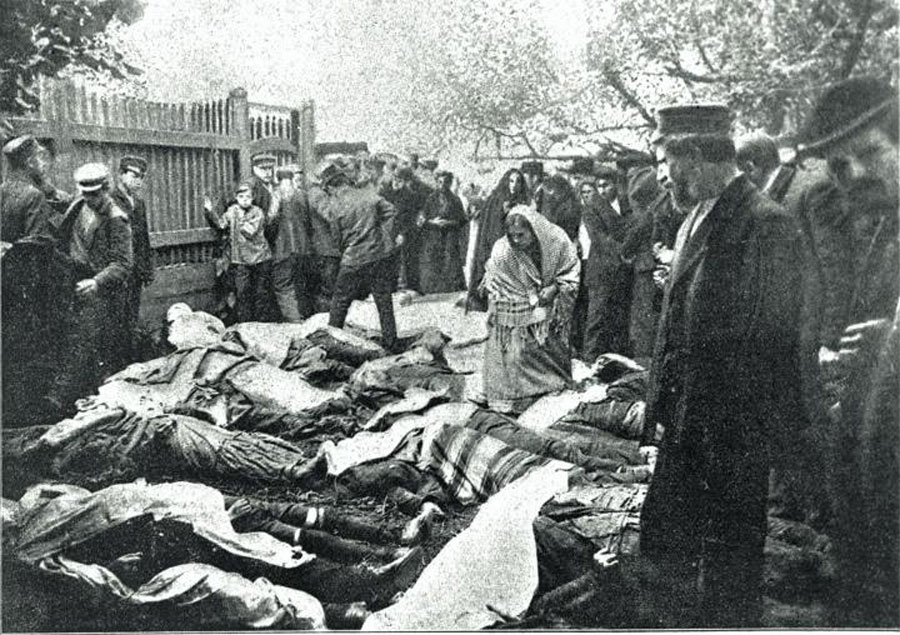
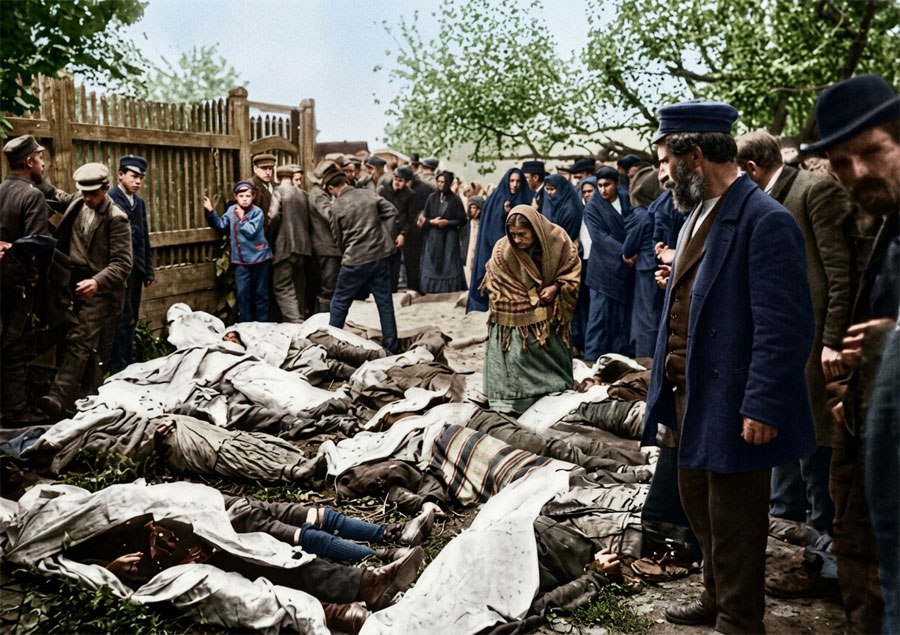
Passover in Western Europe would have started on April 9th and ended on April 17th. But again, it’s hard to draw any firm conclusions about the time and the date that Rutenberg chose to murder Gapon. It was a vaguely religious period for both Jews and Christians, and as we saw at Kishinev, it was very often a time of heightened tensions between the two groups. Little more than eight weeks after Gapon’s death, violence broke out between Jews and Christians in Bialystok. The Liberal Chief of Police of the town had been murdered, possibly by anti-Semitic members of the Black Hundred and a few days later a “Jewish Anarchist” was alleged to have hurled a bomb into a Catholic procession making its way through the town. Nearby a volley of shots were fired at a Russian Orthodox one. At both events a cry went up to ‘Kill the Jews!’ and that’s exactly what they did. By the end of the day’s aggressions 70 Jews lay dead and over 90 were seriously injured. [1]
The London Daily News did its best to play down the scale of the hostilities between the ethnic peasant Russians and the Jews, laying the blame squarely at the door of the murder of Chief Dierkacz, believed to have been murdered by the ‘Black Band’ for supporting the welfare of the Jews and a small number of hooligans who had been drafted in from outside. It wasn’t entirely true of course. The peasants’ anger at the inevitable gridlock placed on normal life as a result of the ‘Socialist strikes’ was directed at the Jews. As far as they were concerned, the Jews were split awkwardly and provocatively between those causing the disruption (the Jewish Socialists — the Bund) and those preventing a fair and practical resolution (the Jewish business owners and merchants).
The failure of the Left-wing and Liberal press to report truthfully on this matter was down to the narrative they were trying to preserve and the lives they were hoping to save. It was absolutely critical to the Socialist and Liberal campaigns being mounted around the world that it was the oppressive mechanisms of the Tsarist system and not the Russian people themselves that were to blame. Blaming the people would only divide them further, and the promise of a broad scale revolution would splinter and recede. Any harmony between the groups, however fragile, had to be maintained at all costs, with all eyes and assaults focused on a common enemy — the Court of the Tsar. The huge cultural divisions that existed between Jewish Peasant Christians and the mercantile ‘Jews’ were systematically ignored, polarising the narrative and handing the various solutions to the rival factions defending its two extremes. The various problems that were flourishing between the two religious and cultural groups were there alright. All it needed was a spark.
Discussions on the significance and meaning of the Bialystok pogrom, both in terms of how it was being perceived in Russia and how it was being treated in the global press saw the fragile coalition between the various Jewish action groups begin to fracture, leading to a dispute between the co-author of Gapon’s pamphlet calling for worker support for the Jews, S. An-sky and the young Zionist propagandist, Zeev Jabotinsky, a former Socialist Revolutionary and friend of Maxim Gorky and Pinchas Rutenberg who was becoming increasingly the most singular powerful voice in the Political Zionist movement.
Jabotinsky didn’t see things the way that An-sky saw them. He saw the failure to acknowledge the part played by peasants and workers in the violence against the Bialystok as an astonishing calumny and betrayal. Accepting that the workers may not have started the pogroms, they’d been abandoned by them nevertheless. Writing in his 1936 autobiography, The Story of My Life, Jabotinsky described the short-lived surge of joy flooding through his veins as he learned first of the declaration, and the pyroclastic anger that it sent hurtling towards the Jews as loyalist Tsarist peasants reacted. Returning to St Petersburg, he attended a meeting called by the Zionists at a hall in the city’s Solianyi Gorodok district.
The district, known locally as ‘Salt City’ stood on the banks of the Fontanka River, approximately in the region of where the Museum of Defence stands at 9 Solyanoy Pereulok today, about two or three hundred metres from the Okhrana’s original 16 Fontanka address and a 20 minute walk from Maxim Gorky’s apartment at 20/16 Znamenskaya Street (now Vosstania Street) — an apartment the author shared with Konstantin Pyatnitsky, the founder of the publishing house, Znanie where Gorky now served as editor and director. The meeting was attended by Jews and non-Jews alike and devoted exclusively to the whole issue of Jewish exclusion from the terms and conditions being demanded by the Worker’s movement. The Socialist Democrats and Socialist Revolutionaries had issued their statement rejecting the Tsar’s proposal but at no point had it mentioned the nationwide slaughter of Jews that had erupted in its wake.
When it was Jabotinsky’s turn to speak he took no time in making his point clear: people had tried to console them with the knowledge that there were no workers among those who embarked on the week-long vicious killing sprees — that the Russian proletariat stood for “equality and fraternity of all races.” For Jabotinsky though, the proletariat did something worse, “they forgot us.” That was the “real pogrom” he assured them. Menachem Ussishkin stood up and levelled a similar criticism: “the followers of Marx and Lassalle will forget about the sufferings of the people which produced these leaders just as easily as the followers of Jesus Christ and the Apostle Paul have forgotten their origin.” A similar tack was taken at the home of lawyer, Mikhail Isaakovich Sheftel a few weeks later to no less overwhelming support. The ‘Goyim’ at the meeting — the non-Jews — bowed their heads as he said it. Out of shame or respect, we don’t know. [2]
By February 1906, Jabotinsky’s conditional support for the Duma, based around a pragmatic appreciation of the short-term gains for the Jews, which would provide a route toward national autonomy, had been terminated and withdrawn. The path was becoming clear: to achieve his goals it would be necessary to separate all Jews from non-Jews and wreck the dominance of the Worker’s Movement. The scale and scope of the violence unleashed on the Jewish populations of Odessa and Bialystok as a result of the publication of the October Manifesto, had highlighted the anti-Jewish attitudes within the Russian proletariat, shattering his existing hope that they had no enemies on the left. It was to mark a turning point in Jabotinsky’s efforts to separate the Jewish people from the various regional, religious and cultural mechanisms that prevented their “beautiful unity.” If anything useful was to come from any of it, it would be necessary to exploit the pogroms on behalf of Zionism. [3]
The significance of Rutenberg’s revision of the date of Gapon’s death— even if he was involved in it or not — may now have been lost to time. A quick and ultimately disappointing browse of the Internet tells me that the Paris Commune had also been formally established on March 28th 1871, but so far not even the combined wisdom of Google, Syrie and Alexa have been able to solve the riddle.
Had Rutenberg really met Azef in Seversk? Had Rachkovsky really spoken to Gapon in the first few months of 1906 when attentions were already being focused on preventing the Duma? My own gut feelings are at this point, are that Rutenberg was drafting-in names that by the summer of 1909 had become so mired in controversy and dubious intrigue, that anyone in Russia, Europe or America would have been prepared to believe just about anything said about them. The deeply anti-Semitic and lupine Rachkovsky who had organised the publication of the pamphlet encouraging attacks on Jews at the height of the Revolution, had been discredited by former Chief Lopukhin as early as June 1906, when his dismissal from the Special Section of the Police had been requested by Witte as a result of being implicated in the fomentation of Jewish Pogroms, and later by Stolypin, in the murder of von Plehve. [4] Yevno Azef had been revealed as a double agent working for Rachkovsky, and Ivan Manasevich-Manuilov had found himself dismissed as Witte’s private secretary in September 1906 after it was found that he’d been involved in a series of serious embezzlement scandals. Practically every political faction in Russia — liberal, revolutionary or otherwise — would have accepted their involvement without question. They were easy targets, and easy scapegoats.
By the time that Rutenberg made his allegations neither Rachkovsky or Azeff were around long enough to challenge them with any real energy. By January 1909, Azeff had fled to Berlin and by 1910 Rachkovsky was dead. The only man really left to fill the gaps was Manuilov, who remained surprisingly quiet throughout.
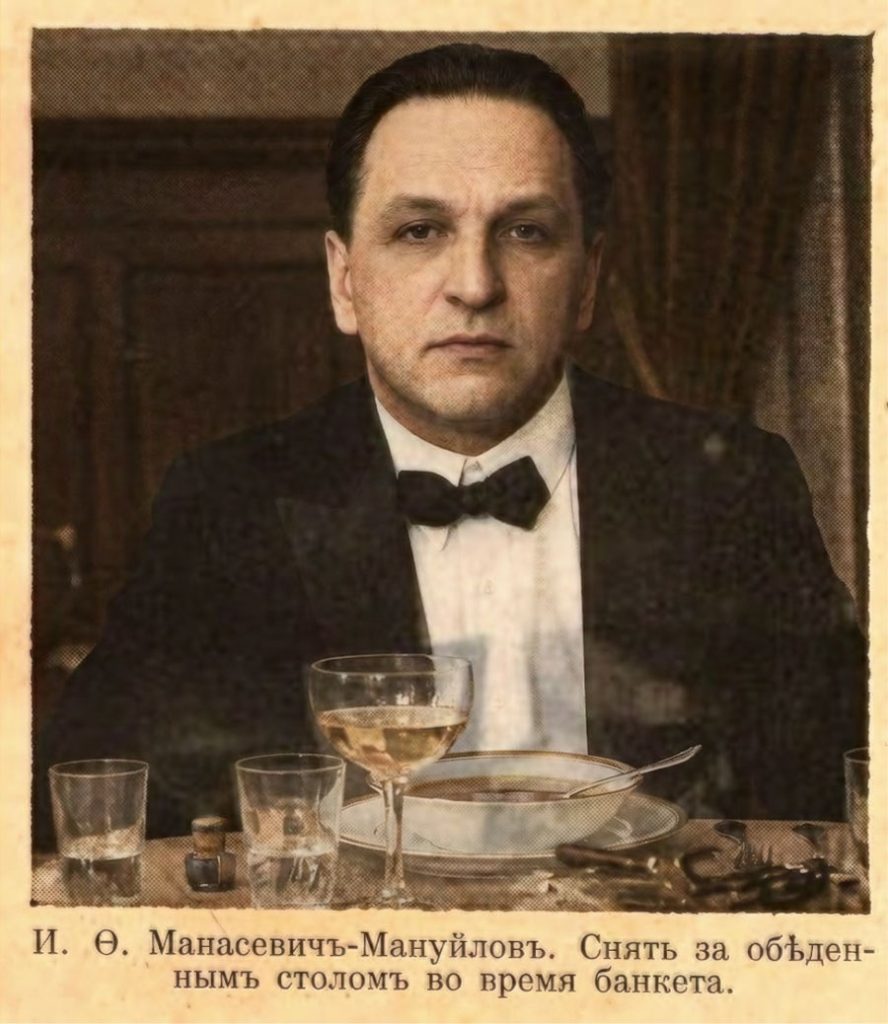
By January 1910, however, just months after Rutenberg named him in his explosive article, Manuilov’s home in St Petersburg was being raided by the Tsar’s ‘Preventative Police’. Papers and correspondence, including letters from Former Chief Lopukhin and Pyotr Rachovsky as well as documents relating to the Gapon case were seized. The reason for the raid was unknown but it was surmised by the press that it was based on the suspicion that Manuilov had been communicating with the Revolutionary Sherlock Holmes, Vladimir Burtsev — whose Byloe journal had just published the three-part kiss and tell by Rutenberg. [5]
The group’s suspicions were later confirmed by Chief Lopukhin’s wife and his daughter’s governess, Miss Russell. There had been no conversation on the train between Burtsev and Lopukhin as Burtsev had claimed. The leak about Azef and his exposure as a double agent had come from Manuilov himself, a man the current chief of the Secret Police had been seeking to expel over his articles in the Novoe Vremya. A similar story would appear in The Times. [6]
If their story was true, it took Rutenberg’s story to a whole new level: the unlikely situation of Rutenberg and Burtsev colluding with the notoriously unpredictable Okhrana agent, Ivan Fedorovich Manasevich-Manuilov was looking more and more plausible. Although it was his espionage activities in Rome that would prove to be among the more relevant of his adventures — at least where Gorky and Rutenberg were concerned — it is curious to note that it was Burtsev’s Byloe that produced the first credible thing that even came close to an official biography of the man in 1917, when Burtsev’s co-editor Shchegolev published ‘The Adventures of I. F. Manasevich-Manuilov’. When cornered by Bolsheviks on the Russian-Finnish border, it was Burtsev who persuaded Manuilov to leave as soon as possible to save his life. The place where he’d been cornered, ironically enough, was the seaside town of Ozerki, the very town where Gapon had been murdered. [7]
Although Ivan Manasevich-Manuilov had found himself at the centre of Rutenberg’s sensational claims about Gapon, the former Secretary to Count Witte hadn’t come forward to either confirm or deny the allegation. By 1910 he was the only man left standing. With the flight of Azef and the passing of Rachkovsky, the ‘golden age’ of the Okhrana had come to an abrupt and ignominious close.
Was Gapon Anti-Semitic?
Strangely enough, the question is not as extraordinary as it sounds. That Gapon had co-authored The Letter to the Russian Peasants and Workers in the summer of 1905, in which he and the author S. Ansky had made a clear and impassioned plea for ethnic Russians to get behind the Jewish cause, is not in doubt. What may be in doubt are the depth and sincerity of the priest’s concerns and the strength to which they extended after the publication of the Tsar’s Constitutional Manifesto on October 17th 1905. However, the problems really start with Gapon’s autobiography.
When enrolling as a student priest at the Lower Ecclesiastical School in Poltava, Gapon’s prodigious oratory talents and radical curiosity had come quickly to the attention of his instructor Ivan Tregubov. The impact of Tregubov on Gapon’s life would be tremendous. Speaking to The Daily Telegraph from Paris in the immediate aftermath of Bloody Sunday in January 1905, Tregubov provided a spirited defence of his old pupil. He had known the heroic priest for several years when he had been master at the Ecclesiastical College in Potlava.
The next thing he said was quite revealing: “Father Gapon was never an agent provocateur … he used his influence with Plehve and his official position as a prison chaplain to work sincerely and ardently, like the sincere and ardent man that he is, for the liberation of the working classes.” The statement came in response to the claims by certain members of the Russian Social Democrats in Paris and London that Gapon was acting as an agent of the Tsar and the Secret Police, seriously jeopardising the story later told by Rutenberg. Rutenberg had claimed that it was his shock upon learning that Gapon may have been in the pay of the Okhrana’s Pyotr Rachkovsky and his men that fuelled the savage assault that left him dead. However, The Daily Telegraph’s interview with Tregubov, his old tutor, clearly suggests that long before Gapon led his march to the Winter Palace, there had already been serious doubts about the exact nature of his agenda.
As mentioned previously, many of these doubts stemmed from Gapon’s previous arrangement with Police Chief Sergei Zubatov, in which it was agreed that he would represent a legalised Worker’s Assembly based on a clear and formal edict not to open its doors to members of the Socialist parties or Jews. Despite his natural radical instincts and prior experience with his father’s Zemstvo Councils, Gapon had agreed to the arrangement, bringing him into contact with the various representatives of government and local authorities, Empresses and Prefects, Ministers and Metropolitans that formed the bureaucratic framework around the Tsar.
None of his work was secret. In his pursuit of some basic rights for workers, like an eight hour day, it was generally accepted that Gapon’s objectives were sincere and he was relaxing his natural Socialist instincts in the hope of making some civil gains. The fact that he had the support of his old tutor, Tregubov was a sound indication of his authenticity. As a close associate of Tolstoy and Vladimir Chertkov, Tregubov had played a vital role in the plight of the Dukhabour, a colourful group of dissident Christians who had angered the Russian Orthodox Church and had found themselves subjected to many of the same gruelling restrictions on worship and movement as Russia’s Jews.
With the support of Christian Anarchists in America and Britain, including J. C. Kenworthy of the Brotherhood Church and the Arthur St John of the Penal Reform League Tregubov was able to raise the cash and secure the cooperation of the Minister of Internal Affair, Pyotr Durnovo to have them relocated to Canada. Tregubov had in fact spent the first four years of the 1900s at Tuckton House near Bournemouth, the home of Vladimir Chertkov, Tolstoy’s literary agent and the chief promulgator of Christian Anarchism as defined by Tolstoy in the UK. This is interesting in several respects as Gapon’s brother who had drowned at Hastings in March 1906 had first been arrested at neighbouring Eastbourne. Is it possible that he too had sought shelter at Tuckton House?
According to Tregubov, the young Gapon had been a boy of extraordinary intelligence, a voracious reader and passionate Tolstoist. The description was completely at odds with Lenin and Rutenberg’s subsequent depiction of Gapon as rather lacking in intelligence and with little or no interest in reading. Because of the forbidden nature of the literature that Tregubov was passing to Gapon, a small and secret nucleus of radicals was formed and Gapon had grown to be one of his most “fervent disciples.” Tregubov’s own take on the Bloody Sunday demonstration was that Gapon “was merely carrying out Tolstoism.” The priest’s Socratic method of question and answer when addressing the workmen was another example of Tolstoism. Tregubov went on to explain how the catechism of the Stundist Sect was constructed along much the same lines. The working classes of St Petersburg were full of Pashkovists and Stundists, in which virtually all religious dogma had been discarded (much like the Methodist and Unitarian movements in Britain). In place of robes and ritual and the rigorous abracadabra of verse and liturgy were more practical human challenges and concerns.
A month before the workers’ strike, Gapon had shown Tregubov a draft of his petition. It was clear that he was advocating a pacifist general strike on Tolstoist grounds as a means of liberating the workers from three of their biggest challenges: the Russian Orthodox Church, the State and Capitalism. Tregubov, who had shared his concerns with Felix Volkovsky about the creeping hand of terrorism among Tolstoy’s legion of supporters, had composed a similar petition, but with one notable difference in that it did not include precise demands for specific political rights. [8]
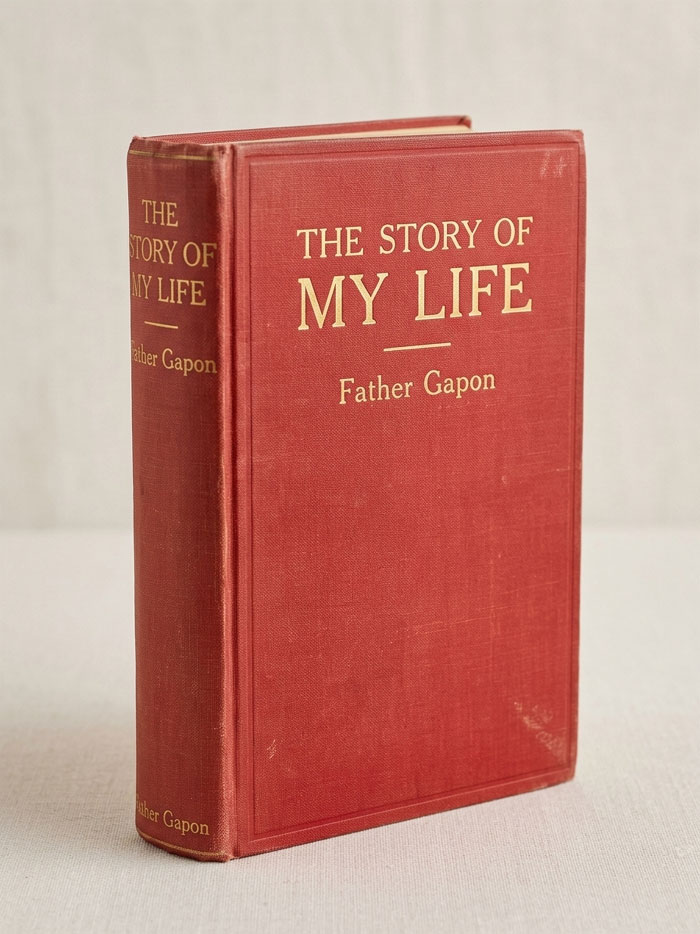
The Left-Wing historian, Walter Sablinsky, makes the claim that Gapon’s entry to the St Petersburg Theological Academy was based in-part on the intervention of Konstantin Pobedonostsev, procurator of the Holy Synod. Citing Father Gapon’s The Story of My Life, Sablinsky writes that the Bishop Illarion of Potlava had made a personal appeal on behalf of Gapon to have him enrolled at the elite academy even though a combination of ill-health and poor conduct had left him unable to complete his entrance exam. As a result he had no certificate. In its absence a “very strong recommendation” was said to have been put to Pobedonostsev. [9] The same story had appeared and in the very first part of the four-part ‘sneak preview’ that had been published in The Strand between July and August that year. I might be reasonable to infer from this, that Pobedonostsev had played a minor but critical role in Gapon’s career as a priest. But was there ever any truth in the statement, and was it his ghost-writers, David Soskice and G. H. Perris, who had fabricated the claim or was it Gapon himself?
The likelihood of the notorious bureaucrat and reactionary Pobedonostsev making such generous concessions based on Gapon’s radical and unorthodox conduct seems unlikely to say the least, especially in the absence of a formal certificate from the Lower Ecclesiastical School in Poltava. As the London Daily News was to report at the time of his death, Pobedonostsev lived by “clear, definite and deliberate creed”. [10] There were no grey areas. Pobedonostsev was an unapologetic defender of despotism and bureaucracy and proceeded in everything with the utmost caution, conscious that if he veered from the rule of law he would be infringing some rule or formality. We were being asked to believe that the man who stood for “absolute Orthodox Uniformity” would have consented to the enrolment of a student at his elite academy that had a long and abiding history of heterodoxy and someone who had even judged his own “unruly spirit” to be totally “unfit” for the priesthood. [11]
Why should it matter? Well the very suggestion that Pobedonostsev had played a part in Gapon’s priesthood would have been enough to destroy the priest’s credibility among the Socialists in an instant. As far as the revolutionaries were concerned it was Pobedonostsev who launched the pogroms in Odessa and Kiev in the 1880s and advised on the appalling ‘May Laws’ — the rules and regulations that effectively immobilised and damned the Jews.
The man who had masterminded Alexander III’s ‘Manifesto on Unshakable Autocracy’ as a knee-jerk response to his father’s assassination was fiercely anti-Semitic and judged by many to be the link in the chain between the Russian Orthodox Church, the Secret Police and the ultra-nationalist and monarchist bully-boys, the Black Hundred. His Manifesto had put the Church in the immediate firing line of the Revolutionaries: “in the midst of our great grief, the voice of God orders us courageously to undertake, in deference to divine intention, the task of ruling, with faith in the strength and rightness of autocratic power. We are summoned to reaffirm that power and preserve it for the benefit of the people from any encroachment.” [12]
The man’s reputation went before him and its inclusion in Gapon’s book is nothing short of baffling, as The Queen newspaper was to comment in December 1906: “In the Orthodox Church the authorities are not fond of people who think for themselves; but for the friendship of Bishop Illiario, ‘Georgey’ might never have realised his ambition. But when he was turned out of the college in Potlava, by a fine stroke of unconscious humour, the bishop sent him with a letter of introduction to the Educational Committee of the Holy Synod through the great reactionary and autocrat of the bureaucratic Russia, M. Pobedonostsev. Through his influence father Gapon was able to pursue his training … One can imagine Pobedonostsev speaking with a certain amount of grim humour when the name of Gapon is mentioned in its latest connection.” [13]
Within 24 hours of news breaking about Father Gapon’s ‘bloody’ march on the Winter Palace, the newspapers were reporting that Pobedonostsev had been taken ill. [14] Shortly after the release of Maxim Gorky some five weeks later, the head of the Orthodox Church was at the centre of another story. Responding to the recent breakdown in law and order, Tsar Nicholas III had published an ‘unshakeable’ sequel to the Manifesto of 1881, providing an unqualified reassertion of the absolutism of the Tsar’s autocracy.
Despite his alleged illness, rumours abounded that it was ‘the best hated man in Russia’ Pobedonostsev who was behind it. To make matters worse, it had been signed by the Tsar without consulting his ministers, cleaving open an already substantial rift with Witte, at this time Chairman of the Council of Ministers. It was clear from just the first few lines of the Manifesto that Pobedonostsev was showing no signs of changing tack and loosening his reign of tyranny:
“We humbly bear the trials sent us by Providence, and derive strength and consolation from our firm trust in the grace which God has always shown to the Russian Power and from the immemorial devotion which we know our loyal people entertain for the Throne. With the help and prayers of the Holy Orthodox Church, under the banner of the autocratic might of the Tsar, Russia has already frequently passed through great wars and disturbances, always issuing from her troubles and difficulties with fresh and unbending strength.”
— ‘Manifesto, Absolutism maintained’, London Daily News 04 March 1905, p.7
There are several ways you could look at the decision to include the anecdote in Gapon’s memoirs: Gapon was telling the truth to appeal to ethnic Russians and supporters of the Tsar; Gapon was telling the truth in an attempt to humiliate Pobedonostsev and hasten his departure from the Holy Synod, Gapon was telling a lie in an attempt to humiliate Pobedonostsev and hasten his departure from the Holy Synod; Gapon — or his ghost-writers Soskice and Perris — were secretly seeking to destroy the symbol of the warrior priest in the eyes of the revolutionaries. Such was the outrageousness of the claim that it certainly wasn’t there by chance. Either way it was a suicide mission, a handful of dynamite that was ready to blow.
There was another, infinitely more fiendish and altogether more fantastical explanation: someone somewhere had persuaded the priest that such a scandalous declaration would hurt and humiliate Pobedonostsev when it was really meant to devastate Gapon’s heroic image as part of a more elaborate and long-term game plan. Perhaps it was intended to do both. That would have been the smarter move by far.
From a Semitic point of view, there are no particular alarm bells in the first few chapters of Gapon’s memoirs. The author — or his ghost-writers Soskice and Perris at the very least — describe the restless journey of a man caught between his love of Christ and one of the more depraved manifestations of the repressive state apparatus: the falsity and hypocrisy of the Orthodox Church. Recalling an incident at the Ecclesiastical Seminary, Gapon describes how he was denounced by a local clergyman for demoralising the school and sowing the seeds of heresy. Tregubov had introduced him to Tolstoy and for the first time he had seen clearly where the “essence of religion” lay, not in its “outward forms”, rituals and ceremonies, but in its “inner spirit” and love for ones neighbour. [15] When he finally accepts that his fondness for “clandestine literature” and Unitarian principles does not coincide with the teachings of the Orthodox Church, a girl he has become romantically attached to intervenes: the one thing that he should be true to, she observes, is not the Orthodox Church but to Christ himself who had been the model of sacrifice for all humanity. The symbols and rituals of the Church were just that: symbols and rituals only.
The narrative up until this point would only have served to endear him with the Revolutionary dissenters and Christian Socialists who hedged the anarchist movement and who had very often collaborated with their Jewish counterparts. Whether any of it was true or not is another matter, as it remains just as conceivable that in a not unreasonable attempt to win the respect and support of the world’s Liberal and Socialist groups Father Gapon and his team of writers crafted a more rebellious and adventurous account of the route he takes through the church. Perhaps the young and capable Gapon had sat his entry exams like everyone else, grumbling privately about the hypocrisy of the Church’s Orthodoxies and not really standing out as anything other than a talented and conscientious student. As his former tutor Ivan Tregubov told the Daily Telegraph, he had been a boy of “extraordinary intelligence” who undertook his studies “zealously” and was “always at the top of his class”. [16]
Nevertheless, his story so far wasn’t without controversy. Even the accounts of his meetings with Zubatov are offered with disarming and casual frankness and the utmost transparency. It is obvious to anyone who reads his book that working alongside Zubatov and the Political Police had been a necessary sacrifice in his pursuit of better conditions and terms for the Workers. It bothered him, it concerned him and he was more than a little conscious that he was forfeiting his natural Socialist principles.
Some clarity on the fairly impossible situation that Gapon had found himself in would be provided a few years later when Father Grigori Petrov, a member of the State Duma and a Constitutional Democrat would be arrested, charged and imprisoned for taking part in political propaganda “without first seeking the consent” of the Ecclesiastical Authorities and the Orthodox Church. [17] In the absence of a Revolution, progress was only to be made within the clear and rigid codices provided by the apparatus of the state.
For those who had found themselves in the extremely unlikely position of making progress, there were various etiquettes to observe. Any attempt to operate outside these strict protocols would jam the system but it would never crash. Pobedonostsev had seen to that. The cogs and belts would keep on whirring, and the machine would spit you out. Gapon’s old tutor Ivan Tregubov, had discovered this already, having been booted out of Russia in the early 1900s. Arriving in England with Chertkov he co-founded the Free Age Press at Tuckton in Eastbourne. It was only after the October Revolution of 1917 that he would return, making some attempt to cooperate with the Bolsheviks and the Commissariat of Agriculture under Lenin at the Seventh All-Russian Congress of Soviets in December 1919. [18]
Gapon’s scholarly foundation in Tolstoyism, and his personal familiarity with Tolstoy’s disciples Chertkov and Tregubov opens up a can of worms in some respects. As a 2014 article by Benjamin Ivry makes clear, there have been concerns among modern scholars that his 1870s novel “Anna Karenina” raises questions about the novelist’s “complex and contradictory attitudes toward Jews.” [19] There’s no real need to go into the specifics, but suffice to say that it comes down to new translations of old material and that within the big heart and the extensive concerns of the author, he was never once willing to portray a significant Jewish character in his fiction. In his writings, his pacifist Christianity found him distinctly at odds with cruel and vindictive rules of the Mosaic (Jewish) Laws which he claims Jesus Christ had rejected. [20]
However, the closer you look at the author’s work and review his often contradictory sentiments the more it becomes clear that if the ‘quasi-Christianity’ of the Russian Orthodox Church was to slug it out with their Jewish cousins in a no-rules boxing fight, Tolstoy would be politically driven to cheer the Jews. If there was one thing he disliked more than the Jews it was the Holy Synod, and it was only at times of the most wanton brutality against them, that he could marshal the effort to condemn their Tsarist tyrants, and use their unique, relentless suffering to win global support for his own rather ambiguous revolutionary aims. This was never more evident than in August 1906, when a series of ‘private letters’ between the novelist and the late philosopher and rights campaigner, Vladimir Solovyov were leaked to the monarchist reactionary newspaper the Moskovskie Novosti:
“I deplore the persecutions to which the Jews are being subjected and regard them not only as unjust and cruel, but as senseless. The subject however does not occupy me to the exclusion of all others, or even above all others. There are matters which stir me more deeply, and therefore I could not write anything upon it that would greatly affect people.
I think that the ethical teaching of the Jews and their actual daily practice are incomparably higher than the teaching and practice of our quasi-Christian society, which accepts from the body of the Christian doctrine only the theories of repentance and expiation … and because of this moral superiority of the Jews we see envy, hatred and oppression”
— The American Israelite, August 10 1905, p.4.
If nothing else, it was a frank exchange of views. The letter’s psychology, however, was deeply schizophrenic. As supportive as it was, Tolstoy went on to explain how in spite of the injustices he had been witnessing, he disliked with equal intensity the prejudices that were inherent in the separatist and nationalistic ‘Jewish Mission’ (the Zionist movement). On the one hand, the letter published in the Novosti showed Tolstoy in a reasonable and positive light in which he shows sympathy with the plight of Jewish Russians, but on the other it shows him as taking a dangerously ambiguous and neutral stance during a crucial juncture in Jewish, and more specifically Zionist, affairs.
Further stories of Tolstoy’s anti-Semitism would later emerge. One of them featured Royal Photographer and Zionist fund-raiser, Constantin Shapiro who the novelist is alleged to have had escorted off his premises. Just a few days before the Tolstoy letter was leaked, Father Gapon, the most gifted student of Tolstoy’s acolyte, Tregubov, had published his Letter to the Russian Peasants and Workers imploring them to get behind the Jewish cause and take more aggressive stance in the war on anti-Semitism.
Whoever had leaked the letter had seen a rather advantageous fault-line in the already fragile relationship between the Tolstoyists and the Jews. The Committee of ministers who had been tasked with reviewing and translating the Tsar’s vague ideas on constitutional reform into concrete proposals had declined to recommend any specific measures that addressed the rights of the Jews. If there was one thing that angered Jewish activists like Jabotinsky and Maxim Gorky more than anti-Semitism, it was indifference to anti-Semitism — the cold hard shell of human apathy that starved the roots of change and light and oxygen to the little green shoots of progress.
The news of Tolstoy’s letter was revealed in The Hebrew Standard a few months later on October 6th. In the very next column was an interview with Maxim Gorky, the respected novelist who had assisted Gapon and Rutenberg in their escape in the aftermath of the Bloody Sunday demonstration. Speaking from his temporary on home in Finland he discussed the failure of the world to learn from the lessons of Kishinev. Kishinev may have horrified the world but they had endured “scores of Kishinevs during the last six months” — Bialystok among them. As far as Russia’s war with Japan was concerned, the peace deal being negotiated “had only strengthened the Government’s hand” and sapped the energy of the Revolution. [21] As Benjamin Ivry’s Forward article points out, just six months after the Tolstoy leak in January 1906, the author had revised his position again, writing in his diary: “Jewish faith is most irreligious … It is a proud faith in that Jews consider only themselves as the chosen people of God..” What impact this may have had on the psychology of Gapon’s assassins is something we need to address.
Gapon’s account of how he had been forced to shelve his idea of creating Labour unions like those in Britain is described in detail in his memoirs. After learning of Zubatov’s plans to legalise non-political workers unions partly subsidized by Police and State he had written and submitted reports to General Kleygells — Prefect of St Petersburg — and Metropolitan Antonius of the Orthodox Church, warning against his plans. But the more that Gapon resisted attempts by Zubatov to rope him into the legalised unions, the more determined Zubatov became.
Gapon’s various efforts on penal reform had greatly impressed von Plehve and he was clearly out to convert him and disengage him as a threat. But the internal structure and functioning of the Assembly was likely to create divisions. Unlike the Moscow groups, Gapon and Zubatov’s Saint Petersburg Assembly would need to adhere to strict criteria and conditions if was to retain the relative autonomy and self-administration sought by the priest. And it was something that would almost certainly upset the Jewish Socialists: formal members of the Worker’s Assembly were to be factory workers of either sex but strictly of Christian faith. [22]
If Gapon withdrew his support from Zubatov’s schemes and pursued a wholly independent line he knew he would encounter a series of insuperable obstacles from the Police. Superficially at least he would be willing to toe the line and suppress his more radical ambitions until the time was ripe. But what he divulges next may prove critical to understanding the various political and emotional triggers that concluded in his execution.
Zubatov had arranged a series of strategy sessions on neutral territory, with one at the house of a friend. Gapon had consented and met several individuals who had already been enrolled into his schemes. The first of these was Manye Vilbushevich (Shochat) and Dr Henrik Shaevich, two supporters of the early Zionist movement who had agreed to front the Independent Jewish Worker’s Party. Like several of his labour projects, Zubatov saw the party as a means of disengaging the Semitic masses from the Socialist Revolutionary movement by dangling the carrot of legalised trade unionism before them. Filling them with dreams of a mass repatriation with Israel and the Holy Land had always been the favoured outcome of the Okhrana and Konstantin Pobedonostsev, procurator of the Holy Synod. Zubatov’s first real bid in managing Zionism came in August and September 1902, when he granted permission to Shapiro and his friends to host the first (and only) Zionist conferences held in Tsarist Russia.
The first of these congresses took place in Bialystok on August 19th and featured delegates from the towns of Grodno. The second was held in Minsk on September 4th when over 500 delegates crammed into the theatre of the Hotel Paris “beautifully ornamented with Zionist symbols and flags.” Minsk, in modern-day Belarus, was a thickly populated district of the Jewish ‘Pale’, a former Bundist stronghold for Manye Vilbushevich and her team of propagandists, but now very much under Zubatov’s spell, believing that the Jewish movement would come to reject a revolution and take a purely economic direction. [23] The missing link in the evolution from Jewish Labour activism was, they believed, Zionism.
The choice of location was critical to their plans. Using the promise of practical living gains over and above the fool’s gold of Socialist idealism, Zubatov and his Zionists were now seeking to poach as many workers away from their bitterest rivals, the Bund. Zionism would give the workers not only the spiritual nourishment they needed, it would put food in their mouths and a few extra roubles in their pockets. [24] Among those chairing the events in Minsk was Dr Shapiro and the Odessa Committee. [25]
Prior attempts at assimilating the Jewish immigrants had generally been doomed to failure, partly on account of their love and fidelity to their culture and race, and partly as a result of rejection by ethnic Russians, intimidated by their trading acumen, suspicious of their intelligence and resentful of their wealth. According to Gapon’s sensational autobiography, The Story of My Life, one of the men supporting activities of Vilbushevich-Shochat and Dr Shaevich in Zubatov’s ‘Legal Beagles’ was ‘Dr Shapiro’ aka. Dr. Yosef Berkovich Sapir, one of the leading and most respected figures in the Zionist movement and a member of the Ḥovevei Zion in Odessa since his youth. [26]
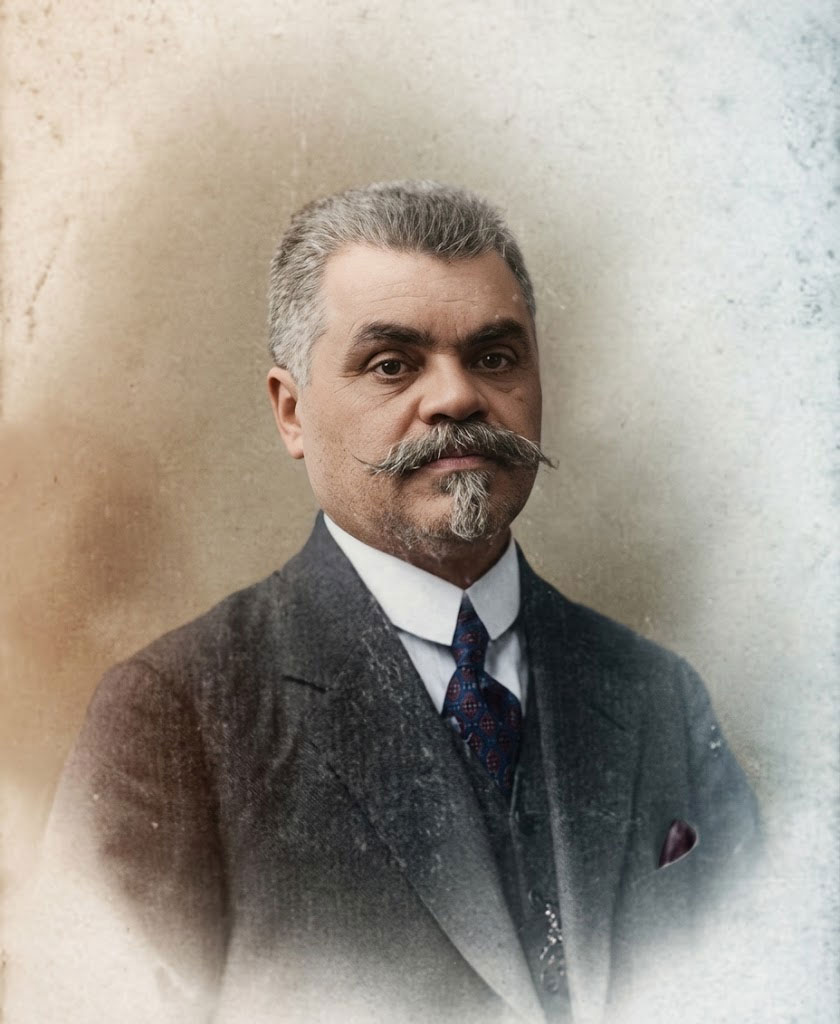
Whilst Gapon was quick to point out that in spite of their connection with agents of the Secret Police, all three individuals were likely to have harboured “real revolutionary sympathies” and may have had “ulterior purposes” in joining Zubatov. Weak defences aside, this was truly explosive stuff. One of the men with them at the meet was former Revolutionary turned undercover agent Mikhail Ivanovich Gurovich, a “tall dark gentleman” who had been recruited into the Secret Services by Zubatov and Plehve, his authentic revolutionary background, including several years of exile in Siberia, making him a strong and attractive magnet to men like Burtsev, who he had befriended around the time of the Paris Bomb Plot.
By 1899, the man who the fiercely anti-Semitic head of the Russian Imperial Navy, General Spiridovich once referred to as “the chinovnik Mikhail Ivanovich Gurovich of the Jews” had been installed as editor of the legalised Marxist newspaper Nachalo, a short-lived periodical, which would as time moved on, have presented an especially keen threat to Lenin’s battleship journal, Iskra. Writing to Gavriil D. Leiteisen in October 1902, Lenin said he urged “all honest Russian citizens strictly to boycott Gurovich and to treat him consistently as a traitor and spy.” [27] After his exposure by Lenin and his tribunal he was a firmly established pariah. With his secret ‘legalised’ work and activities well and truly wrecked, he was taken on in a more formal Police capacity and by 1905 was acting as private secretary to the Assistant Governor in the Caucasus, advising on special policing and political matters.
By the time that Gapon writes of Gurovich in his book, the full treachery of the man was known, especially to Vladimir Burtsev and the Socialist Revolutionary and Democratic coterie back in London. The pair had corresponded regularly over the years and there were few more aware of the depth and audacity of his deceit. The odds of Gapon’s ghost-writer David Soskice not being cognisant of the gravity of his appearance at the meeting with Vilbushevich-Shochat, Shaevich and Shapiro are practically nil. And this is quite concerning. To have revealed these much respected figures of the proto-Zionist movement as Police informers and agents of the State could so easily have brought about their immediate execution and a gradual erosion of support for the Zionist movement in general. Either it was reckless and irresponsible or it was politics of the cruellest kind. By slipping these names into his book, Gapon and his ghost-writers were committing personal and political vandalism on a remarkable and dangerous scale.
The chapter leaves little to the imagination: “Zubatov apparently gave material help to all these persons, and I summarised his policy in the ancient formula, Divida et impera. He was evidently attempting to organize the Jewish workmen under the flag of Zionism, and trying to detach them from the Revolutionary Party”. [28] The message that Gapon was none too subtly conveying was that the Okhrana was bankrolling the Zionists as agents of the State. In his determination to prove his worth among the Socialist Democrats and Revolutionaries, he was sacrificing a group who he would have had little understanding of, and even less in common with.
To make matters worse, the authors of the book had made every effort to blank-out or obscure anything that might reveal the identities of any Socialist Democrat or Revolutionary who may have assisted his escape — like Rutenberg and Gorky — or any protected source who may have aided his subsequent revolutionary efforts. In situations like these the names would be concealed by a totally misleading initial followed by a tantalising, trailing understrike (‘___’). The contrast in Gapon’s approach when it came to protecting leading Zionists was staggering.
That all three Jews had been active and willing envoys in Zubatov’s hive of legalized clubs and unions was unlikely to have been enough to incur the wrath of their legion of faithful followers. The greater offence was that they were being aligned with their “great friend and co-worker” Gurovich, whose treachery had extended to ratting on many of his former comrades and entrapping them into acts that would result in their arrest and inevitable exile. The revelation about their complicity would almost certainly have put their lives and reputations in jeopardy, especially from their former comrades in the Socialist Democratic Party and the Jewish Bund who increasingly viewed the Zionists and the exit-route they provided as a debilitating influence on their effectiveness and their numbers. The greater risk, however, was likely to have come from the Okhrana.
Writing of Manye Vilbushevich and Dr Shaevich, Gapon had confessed how in spite of their relationship with the Russian Secret Police he suspected they had “real revolutionary sympathies” and “ulterior purposes” in joining Zubatov. In other words they were betraying their handlers and working as triple-agents: they had been loyal to the Revolutionary cause and were working within the framework of the legalised party whilst pursuing their own revolutionary agenda. To put it more simply, they were Trojan spies. If you were to follow the logic of what Gapon was saying, then the corollary of this was that Dr Shapiro was on the level. His own cooperation with Zubatov and the Secret Police was a more straightforward affair: he backed their aims and supported their projects. It’s hard to know which would have had the gravest impact: revealing Vilbushevich and Shaevich as ‘triple agents’ or Shapiro as a willing stooge.
[1] ‘Over Six Hundred Victims’, London Daily News, June 19, 1906, p.7
[2] The Story of My Life, Jabotinsky, pp. 93-95
[3] Vladimir Jabotinsky’s Russian Years 1900-1925, Brian J. Horowitz, Indiana University Press, 2020, p.59
[4] Courts, Lawyers and Trials Under the Last Three Tsars, Samuel Kucherov, Frederick A. Praeger, 1953, p.282
[5] Evening Mail, January 31, 1910, p.3
[6] The Times (London), 31 January, 1910, p.5
[7] The Adventures of I.F. Manasevich-Manuilov, P. Pavlov aka. Shchegolev, Byloe, 1917, No. 5-6
[8] ‘Father Gapon: Interview with His Tutor’, Daily Telegraph, January 31, 1905, p.10
[9] The Road To Bloody Sunday, Walter Sablinsky, Princeton University Press, 1976
[10]‘ Pobiedonostseff’s Creed’, London Daily News, March 25, 1907, p.6
[11] The Story of My Life, Gapon, p.18
[12] Manifesto on Unshakable Autocracy’, April 29th 1881
[13] The Queen, December 16, 1905
[14] New York Times, January 24, 1905, p.2
[15] Story of My Life, Gapon, p.18
[16] ‘Father Gapon: Interview with His Tutor’, Daily Telegraph, January 31, 1905, p.10
[17] London Daily News, March 11, 1907
[18] The Modern Encyclopaedia of Russian and Soviet History, Vol. 39, Academic International Press, p.118
[19] Foward, Benjamin Ivry, November 6 2014
[20] What I Believe, Leo Tolstoy, trans. Aylmer Maude, OUP, 1921 (1884), pp. 160-180
[21] The Hebrew Standard, October 6, 1905, p.11
[22] Petersburg’s First Mass Labor Organization, Gerald D. Surh, The Russian Review, July, 1981, Vol. 40, No. 3 (Jul., 1981), pp. 241-262
[23] Sergei Zubatov and Revolutionary Marxism, Jeremiah Schneiderman, Cornell University Press. 1976, p.232
[24] Sergei Zubatov and Revolutionary Marxism, Jeremiah Schneiderman, Cornell University Press. 1976, pp. 252-254
[25] Philadelphia Jewish Exponent, September 19, 1902, p.6
[26] The Story of My Life, Gapon, pp. 93-94
[27] Lenin Collected Works, Progress Publishers, 1977, Volume 43, pages 91b-93a
[28] The Story of My Life, Gapon, p.94