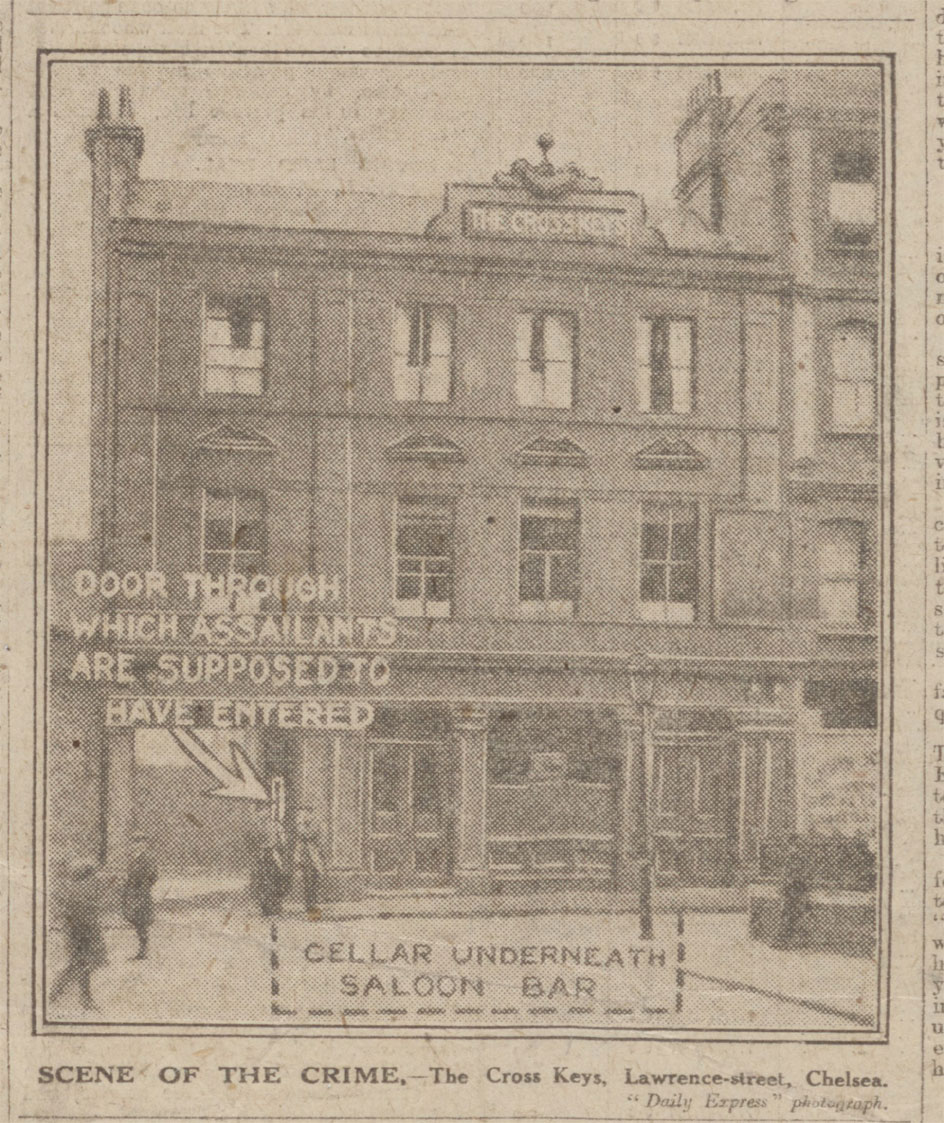
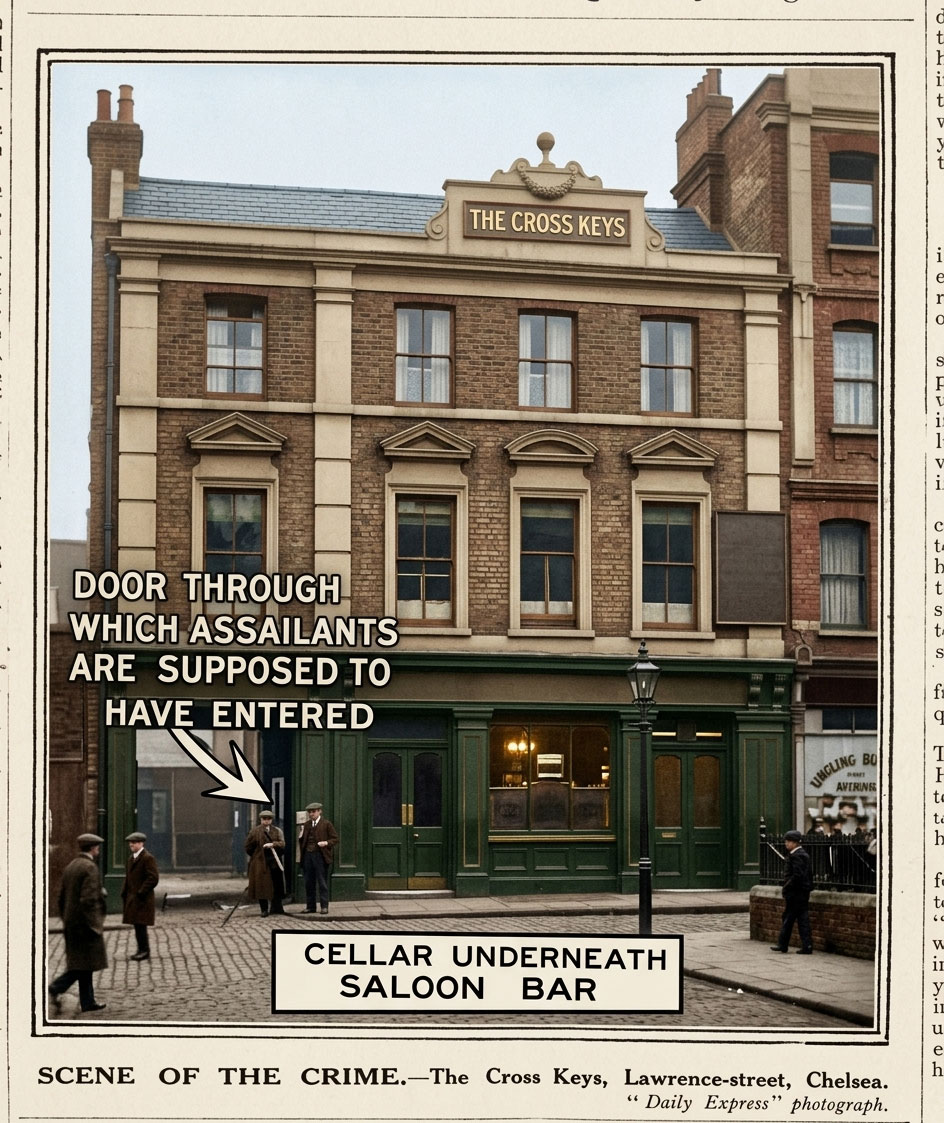
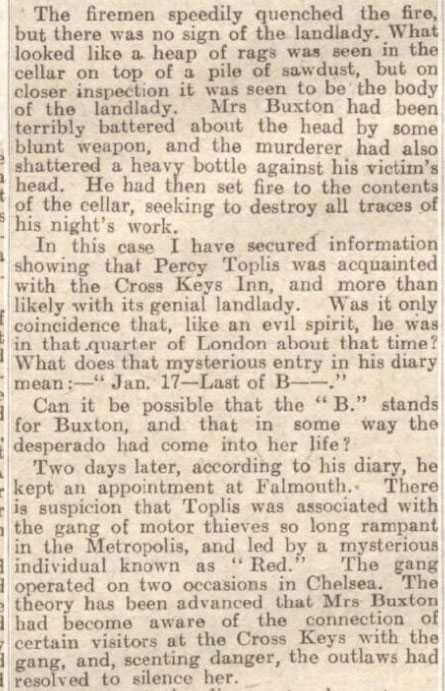
In the end it turns out that detective Woodhall may have had every reason to be suspicious about Private Percy Toplis. In January 1920 Toplis had been a suspect in the murder of Mrs Frances Buxton, capable and affluent landlady of the Cross Keys tavern in London. According to a report published by the Daily Post in June, Buxton had been ‘terribly battered about the head by some blunt weapon’ in the cellar of the property. The perpetrator had then set the contents of the cellar on fire. The body of Frances was found partially burned after smoke was found issuing from the building. There were no signs of a break-in leading Police to ascertain that the lady knew her attacker. The reporter tells the reader that he ‘secured information’ that Percy Toplis was acquainted with the Cross Keys Inn and ‘more than likely with the genial landlady’.
Another of the suspects was Charles Rennie MacKintosh, the famous Scottish architect. Mackintosh admitted to an affair with the attractive hostess and was a regular at the tavern — a popular haunt for the louche bohemian radicals, anarchists and writers less-than affectionately known as the ‘Chelsea Set’. According to her estranged husband in Bexhill-on-Sea, Frances was a bit of a radical herself. An enthusiastic suffrage supporter and Socialist, Mr Buxton describes his wife as an intelligent and ‘strong-minded’ woman with a string of successful bars and hotels to her credit. What part Toplis played in her life is uncertain but reports at the time suggest he was one of her many companions and was in receipt of gifts and ‘remuneration’. On January 17th 1920, the day of the murder, a sinister entry in Toplis’s diary reads simply, “Last of B …” The last of Buxton?
Mackintosh, however, had already come under the scrutiny of the Police. During his and his wife’s self-imposed exile in the coastal village of Walberswick in 1915, Mackintosh was suspected of being a German Spy. A bundle of letters he had written in German were found by Police and it was feared he had used his lantern to signal messages out to sea. The letters at the centre of the probe were addressed to Hermann Muthesius, a German diplomat and author who had been promoting the British Art and Craft movement to audiences back home.
Several years prior to the war Muthesius had served as cultural attaché at the German Embassy at 9 Carlton House Terrace, but between 1912 and 1914 things took a more radical turn when he joined the propaganda committee of pressure group on social reform with Karl Liebknecht of the Spartacus League, a Marxist revolutionary movement organised in Germany during the first years of the war. One prominent member of the League was Rosa Luxemburg, a naturalised German citizen who had been brought to the attention of Special Branch when she was among the 300 or so delegates attending the Fifth Congress of the Russian Social Democrats in Whitechapel, in the East End of London in 1907. Lenin, Trotsky and Stalin also attended (see: A Political Family: The Kuczynskis, Fascism, Espionage and The Cold War, John Green, 2017).
Whilst modern historians seem keen to laugh it off as wartime paranoia, it is clear that Mackintosh and his India-bound friends Sir Patrick Geddes and Annie Besant were appearing on the radar for their various subversive alliances — not least with the Irish Republicans. Their friendship with Suffrage leaders Ada Neild Chew and Rebecca West was damaging enough, but ‘Toshie’s’ increasing intimacy with French anarchists like Paul Reclus and early Scottish Nationalists like James Pittendreigh MacGillivray and Hugh MacDiarmid must have only deepened concern at Whitehall; their Scottish Nation anthology of poems combining dangerous intellectualism with a lyrical Jacobite twist.
MacDiarmid (real name Christopher Murray Grieve) had, like Toplis, served during the war in the Royal Army Medical Corps. Did they ever encounter one another? Who knows. One thing is certain however; both men had enlisted at the same time, both had completed training in England at the same time and both had served in Salonika. As Sergeant-Caterer of the Officer’s Mess perhaps MacDiarmid had come across Percy in full theatrical costume; monocle firmly in eye and Officer’s ‘swaggering cane’ gripped at his side. Whatever the truth of their engagement it’s interesting to note that both men had contracted malaria in Salonika and both were invalided out — possibly within weeks of each other. Curiously, both convalesced in Scotland, Toplis handling light munitions work in Grena Green and MacDiarmid returning to Montrose.
Like Toplis, MacDiarmid had been an exceptionally bright pupil whose education had been cut short by a temporary spell of crime. Not that it hampered his learning any. Immediately prior to the war MacDiarmid had landed a job as a newspaper reporter at the Monmouthshire Labour News in Wales, set up as mouthpiece for the South Wales Miners’ Federation (or ‘The Fed’ as it was known) and controlled by Keir Hardie — former member of the Scottish Land Restoration League and foundation stone of the British Labour Party.
The strikes and riots MacDiarmid covered during this early phase of his career he would later describe as ‘war reporting’. From his arrival in Ebbw Vale in 1911 until the very first whispers of war he wrote of the resistances of the coal miners. ‘It’s like living on top of a volcano here,’ he wrote home. The Tonypandy Riots of 1910 and 1911 had spilled right across the Rhondda Valley, and Winston Churchill, as Home Secretary, had sent in Calvary troops and mounted Police from the Met in a characteristically heavy-handed attempt to restore order.
The riots were ostensibly the culmination of a bitter industrial dispute between the workers and mine owners, but in regions like Tredegar the skirmishes and assaults took on a cynical and unpredictable anti-Semitic edge. The windows of Jewish shops and homes were smashed and 20 Jewish businesses looted. Soon there were similar disturbances taking place in nearby towns like Ebbw Vale and Caerphilly.
Another resident of Ebbw Vale at the time of the ‘Great Labour Unrest’ was Jesse Short, the only British man ever executed as a result of the Etaples Mutiny. Short had been born in nearby Bedwellty and spent the first years of the 1900s in Nantyglo and Mountain Ash, home of Emrys Hughes, a noted pacifist during the war and firm associate of Labour Leader, Keir Hardie. A coal miner by profession, Short had attempted army life several times in his 27 years alive, enlisting first with the Welsh Regiment in 1905, then with the 3rd Wiltshire Regiment in 1907, the Durham Light Infantry in 1914, before his eventual and ill-fated call-up in 1915 for the 26th Battalion Northumberland Fusiliers.
Invariably, Short’s periods of service lasted little more than weeks. He was a regular deserter even in peacetime and his stint with the Wiltshire Regiment ended abruptly on charges of theft. In 1909 Short was arrested again, this time for the robbery of 37 watches, 2 lockets and 1 bracelet from the shop of John Edward Watson in Hereford. He was sentenced to 15 months hard labour.
A Chapel and a Rest at Blaina
Whilst there is no evidence he and MacDiarmid ever met, it’s curious that Short should appear at the same postcode during such a momentous time. Interestingly, Toplis headed directly to Monmouthshire before his breakneck escape to Scotland. The area had become something of a haven for deserters and there are 25 recorded cases of men working under false names on the sprawling forestry estate surrounding the Brecon Beacons (BBC, The Conscientious Objectors of South Wales in WWI). That Toplis landed a job on a forestry plantation in Scotland immediately after his trip to Wales, suggests a well established network may have greased his journey north. According to the Dundee Courier of May 7th, a cap with the rogue’s name in it was found in Pontypool, just 11 miles from Ebbw Vale.
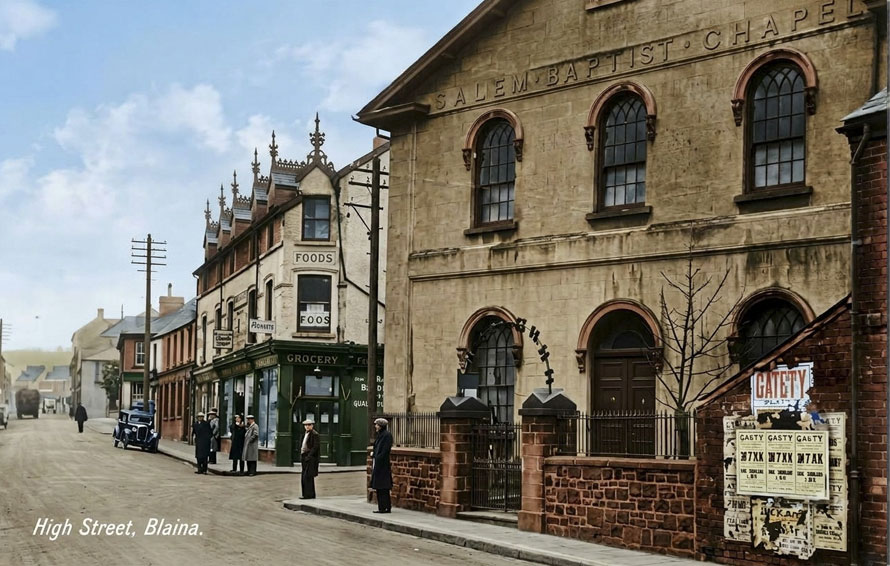
A week later there was another sighting. According to this report Toplis had been spotted in the mountainous, colliery village of Blaina, backing away from the police net put in place around Newport and Cardiff. A prayer meeting had been in progress at the Salem Baptist Chapel when a stranger wearing muffler wandered in. One member of the congregation describes Toplis sitting at the back of the church, wedged between two deacons. His head is bowed and his cap, wiped respectfully from his head as he entered the church, is twirled nervously between two fingers. He subsequently tells the worshippers that he has walked from London and is destitute. It would be an innocuous enough account if it wasn’t for two significant details. The Salem Baptist Chapel on High Street served the diocese of Blaina and Nantyglo. This put Toplis within just one mile of the village in which Mutineer Short had resided. Short was also a Baptist, so it’s not inconceivable that he and his family had sat among those same pews in the chapel.
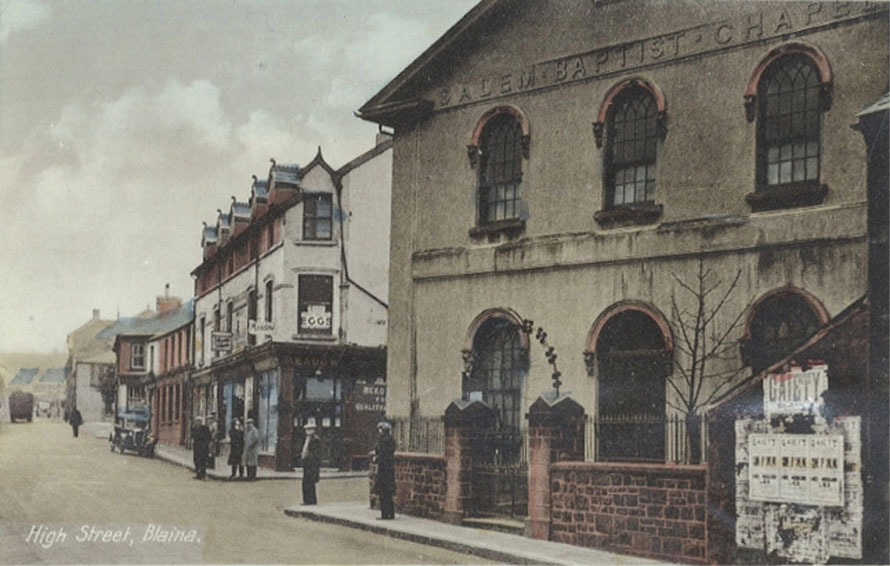
Just five years after Percy’s visit and only months after the Great Strike, the Blaina Cymric Miners Choir, composed entirely of unemployed miners, was to tour the Soviet Union where they staged a total of 60 concerts for mining and factory workers. Blaina and Nantyglo had endured some of the highest unemployment in the region and tensions in the community had been simmering for years. The depression here was as acute as it was prolonged. In response to the worsening conditions local leaders of the Communist Party of Great Britain had set up shop in the town, maintaining a stop-gap HQ on an old bus secured on large stone pillars. In the early 1930s with poverty now crippling the town, members of the Party, backed by the Bolshevik United Front and the National Unemployed Workers Movement took decisive action.
The ‘Blaina Riots’, as they were known at the time, were the culmination of 20 desperate years of devastating means testing and benefit cuts. The people had decided enough was enough and a series of demonstrations was organised. One of the rallying points was that same Salem Baptist Chapel in Blaina in which Toplis had taken refuge. It was here that the demonstrators gathered. Unemployed miner and Communist Party member, Brinley Jenkins stood inside the chapel addressing the crowds, his stirring Welsh oratory energising the mood and cranking up the volume no end. A total of 18 men were charged, 11 of them sentenced including Jenkins. All men were later released on the orders of the Home Secretary.
Curiously enough, a deacon at the Chapel at the time of Percy’s visit was also called Jenkins. William Jenkins managed the local post office. Other deacons at the chapel like Caleb Lewis had been colliery workers. Was it possible that the two men called Jenkins were related? Toplis had spent a week in the area, with credible sightings at Pontnewynydd and Cwmffrwdoer all appearing in the national press.
“When I was in The Kremlin in 1932 I was shown a map on which were marked potential revolutionary areas of the world. There were two red pins stuck in the British Isles – one in Clydeside and the other in the Rhondda Valley. But we in Monmouthshire always believed that the Eastern Valley was far more revolutionary than the Rhondda.” — Eddie Jones, Communist Party Councillor, Pontypool
In view of the resistance shown at the time of the Great Unrest, the region was more than capable of sheltering and supporting a scallywag anti-hero like Percy Toplis who would have had little or no conscience in exploiting their charity or ideals. And there was another thing; files recently released by the Freedom of Information Act reveal that between the years of 1931 and 1945, Hugh MacDiarmid, the area’s Scottish correspondent, had been placed on an Mi5 watchlist. The files describe him as a fanatic “only too ready to give his allegiance to any extremist cause.” (Security Reference /G/37b/63, National Archives). What exactly was he doing in Ebbw Vale at the time of the unrest? How had he procured his job at the paper?
Immediately after being demobilised in 1919, MacDiarmid spent several months in the anarchist-artist haven of Marseilles before returning to Scotland and co-founding the National Party of Scotland. During his time in Ebbw Vale he became a good friend of Keir Hardie. Welsh trade unionist, Vernon Hartshorn and Socialist politician, Victor Grayson were also known associates. Little more than 16 weeks after Toplis was gunned down in Penrith, Victor Grayson disappeared. No trace of him has been found since.
Legend has it that Victor Grayson — suspected of spying for the Irish Republicans and the Soviets — was planning to dish the dirt on David Lloyd George, at this time British Prime Minister. At a public assembly event in Liverpool Grayson had claimed he had evidence that Lloyd George was selling peerages and was using Mi6 informer and theatre magnet, Maundy Gregory as bagman. Gregory was no stranger to blackmail himself, his Ambassadors Club in Soho used regularly to harvest gossip and supply leverage on prominent celebrities and politicians.
Victor Grayson
By a bizarre stroke of luck, Grayson had marched into the Etaples Camp on the very day the Mutiny kicked-off. On a visit to Christchurch, New Zealand in November 1916 Grayson had enlisted in the 1st Battalion Canterbury Regiment – an Expeditionary Force who had first seen combat in Egypt in December 1914, before landing in Gallipoli the following year. Grayson arrived in France on September the 5th and on Sunday 9th of September they arrived at camp in Etaples. This was the day that attitudes at the camp had begun to seriously deteriorate. New Zealand Gunner A. J. Healy and several of his comrades had muscled their way through Police blockades set up to prevent privates entering Le Touquet. Healy was duly arrested and a mob had gathered at the bridge. Grayson had been on active service for little more than four days when he found himself at the eye of the storm.
Shortly after order had begun to be restored on September 16th, Grayson, like so many of the soldiers involved, rejoined his battalion and was posted immediately to the front. On October 12th he was wounded in action and by March he was back in London. Grayson had been on active service for little more than 31 days and only a fraction of those in the field. To the best of my knowledge, not one of his biographers have explored his time in Etaples at the time of the famous riots.
In an article for war journal, Stand To!, Julian Putkowski — historical adviser on the BBC series, The Monocled Mutineer, confessed that Percy’s Socialist pal, Charles Strange, had been part-based on Grayson. Interestingly, Strange commits suicide in the series finale.

Idle Fantasy
As I stood amongst the shadows of the bothy looking out at the excitable daylight beyond the window, an idle fantasy was taking shape. Toplis was no stranger to Soho, but was he also no stranger to Grayson? According to the more lurid stories appearing in the press ‘post-mortem’ of his death, Percy had been an anarchist and leader of a ‘Free Love Club’ operating in the émigré communities of East London. Had Percy’s involvement in another sordid racket placed him in possession of damning material on high profile politicians that were going to be of unique value to Grayson? Had letters, papers and photographs fallen into hands that could somehow damage the reputation of senior government ministers? Did the ‘small parcel wrapped in brown paper’ about which Toplis had ‘displayed no small amount of concern’ contain a political bombshell? According to the hotel keeper in Inverness, Toplis claimed to have left the parcel at a nearby public house. Had this been part of an organised ‘dead drop’? Was he telegrammed this location?
Coming back to Hugh MacDiarmid though, anything was possible and his proximity to Mi6 man Compton MacKenzie and the Highland Land League made his loyalties and commitments all the more problematic. In 1917 shortly after his recruitment into MI6, MacKenzie had become director of the Aegean Intelligence Service. Here they had recruited agents and personnel from forces stationed in Salonika. The creation of the AIS just happened to coincide with Toplis and MacDiarmid’s withdrawal from active service. And they had terminated that active service quite abruptly (and simultaneously) in Salonika of all places.
Did orders from a higher chain of command account for Toplis’s ‘daring escape’ from the detention compound in Camiers some 12 months later?
In his later autobiographical works, MacDiarmid confessed that the multilingual atmosphere of Salonika (housed as they were so closely with Serbian, French and Russian troops) had played a crucial formative role in his personal development as a Radical. Had it had much the same impact on Percy?
Whatever the truth of the matter, MacDiarmid’s continued involvement in Scottish Nationalist propaganda, clandestine militarist projects and the literary Scottish Renaissance ensured his broad appeal to both radical and romantic alike and he remains a beguiling conundrum to this day.
________________________